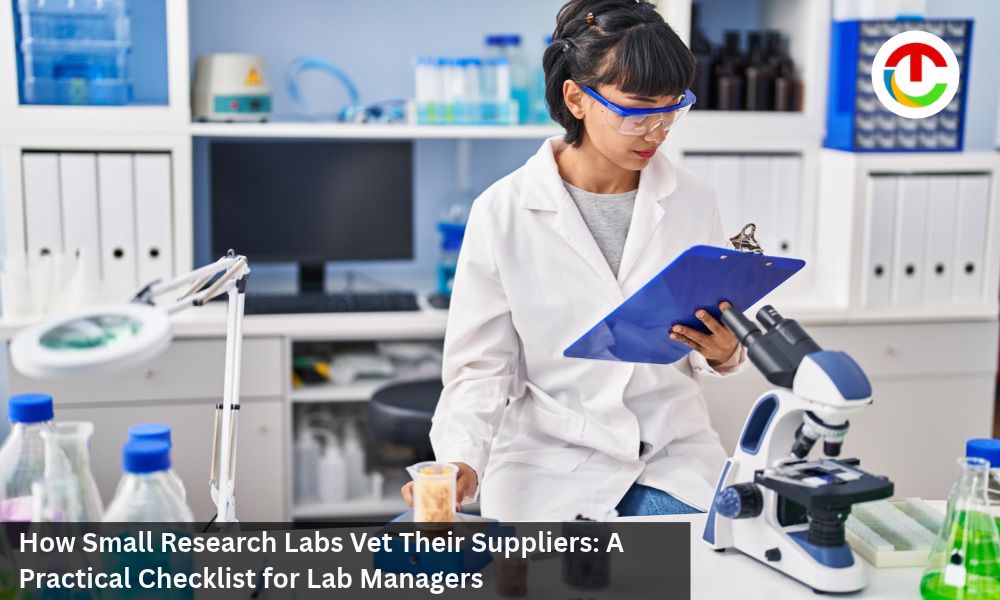
For a small research lab, the supply chain is rarely anyone’s full-time job. The lab manager who orders pipette tips on Monday is also running assays on Tuesday and writing a grant report on Friday. Yet a single bad lot of a basic consumable can quietly ruin weeks of work. A Supplier vetting contaminated diluent or a mislabelled reagent will not announce itself; it shows up later as data that will not reproduce.
Large organisations handle this with formal supplier qualification programmes, audit teams and approved-vendor lists. Smaller labs need something lighter that still catches the problems that matter. This article sets out a practical approach that a lab manager can run in an afternoon and repeat once a year.
Why supplier vetting is a business decision, not just a technical one?
It is tempting to treat consumables as a commodity and buy on price. The true cost of a cheap lot, though, includes the researcher hours spent on failed runs, the samples that cannot be replaced and the delay to every result that depends on them. For a lab billing clients or reporting to funders, a reproducibility problem is also a reputational problem.
Seen this way, supplier vetting is risk management. The question is not “who is cheapest?” but “who can show me, lot after lot, that what arrives matches what was promised?”
Step 1: Ask for documentation before you ask for a price
The fastest filter is paperwork. A serious supplier of laboratory materials should be able to provide, without hesitation:
- A Certificate of Analysis (COA) for each lot, not a generic product sheet. The COA should carry a lot or batch number that matches the label on the item you receive.
- The test methods and limits behind each result, so you can tell whether “pass” means a tight specification or a loose one.
- Storage and shelf-life information, including how the product should be kept once opened.
- A clear statement of intended use. Many products are sold strictly for laboratory research use, and a supplier that is precise about this is usually precise about other things too.
If a supplier cannot produce a lot-specific COA, or sends one that does not match the lot on the label, that is usually the end of the conversation.
Step 2: Read the COA properly
Having a COA is not the same as having a good one. When you review it, check four things:
- Lot traceability. Does the batch number appear on the certificate, the label and, ideally, the shipping paperwork?
- Relevant tests. For a sterile liquid, for example, you would expect results for sterility or microbial limits, endotoxin, pH and the concentration of any preservative. A certificate that lists only appearance and volume tells you very little.
- Specifications next to results. A result without its acceptance limit cannot be judged.
- Who did the testing. In-house testing is common and acceptable, but results confirmed by an independent laboratory carry more weight, especially for critical materials.
Keep each COA on file against the lot you used. If a result is ever questioned months later, that record is what lets you rule the material in or out.
Step 3: Check consistency over time
One good certificate proves very little. What you want is a supplier whose documentation looks the same from one lot to the next: the same tests, the same limits and results that sit comfortably inside them. Ask for COAs from two or three recent lots and compare them side by side. Large swings between lots, or tests that appear on one certificate and vanish from the next, are warning signs.
Step 4: Look at logistics as closely as at quality
A perfect product that arrives late, warm or damaged is not a perfect product. For small labs with little storage space, logistics often decide whether a supplier is workable at all. Consider:
- Where the supplier ships from. Shipping from within your own region usually means shorter transit times, fewer customs delays and fewer surprise import charges. A supplier with stock in several regions can be a sensible choice for labs that collaborate across borders.
- Packaging. Are glass vials protected? Is the outer packaging labelled clearly enough that it is handled correctly?
- Lead times and stock levels. Can the supplier tell you honestly whether an item is in stock, and how long delivery takes?
Step 5: Test the human side
Before committing, send a technical question by email and see what comes back. Does someone answer the question you actually asked? Do they send the document you requested, or a sales brochure? How a supplier handles a small question is a good guide to how it will handle a complaint about a faulty lot.
Step 6: Start small and record everything
Once a Supplier vetting passes the checks above, place a modest first order rather than switching everything at once. Record the lot numbers received, check them against the COAs and run the material in a non-critical application first. If it behaves as expected, widen its use. If it does not, you have limited the damage and you have the paperwork to raise the issue.
An example from the reagent shelf: bacteriostatic water
Even the simplest-looking materials benefit from this process. Take bacteriostatic water, a sterile water containing 0.9% benzyl alcohol as a preservative that is used in many labs to reconstitute and dilute research compounds. It looks like the most basic item on the shelf, yet a weak lot can introduce contamination or variability into every experiment that uses it.
Applying the checklist means asking a supplier such as Herbilabs Labware for a lot-specific COA, confirming that it covers sterility or microbial limits, endotoxin, pH and benzyl alcohol content, and comparing certificates across several lots. It also means checking practical points: whether the vials are sealed and labelled with the lot number, and whether the supplier ships from inside your region. Herbilabs, for instance, publishes a COA for every lot and ships from the EU, the UK and the US, which makes it easier for labs in different countries to work from the same documented material.
The point is not the brand. It is the habit of asking the same questions of every supplier, for every material, however ordinary it looks.
A one-page checklist to keep
- Lot-specific COA available before purchase
- Batch number on COA matches the label
- Relevant tests listed with acceptance limits
- Independent testing for critical materials
- Consistent documentation across recent lots
- Clear storage, shelf-life and intended-use statements
- Shipping region, packaging and lead times acceptable
- Technical questions answered clearly and quickly
- First order small, lot numbers recorded, material trialled before wider use
Conclusion
Supplier vetting does not need an audit department. A small lab that asks for the right documents, reads them carefully, checks consistency over time and pays attention to logistics will avoid most of the problems that bad consumables cause. The afternoon it takes is far cheaper than the weeks lost to a single bad lot, and the records it creates protect the credibility of every result the lab produces.
Also Read :- 7 Delta 8 Gummies From The Hemp Doctor: Strengths & Terms Made Simple