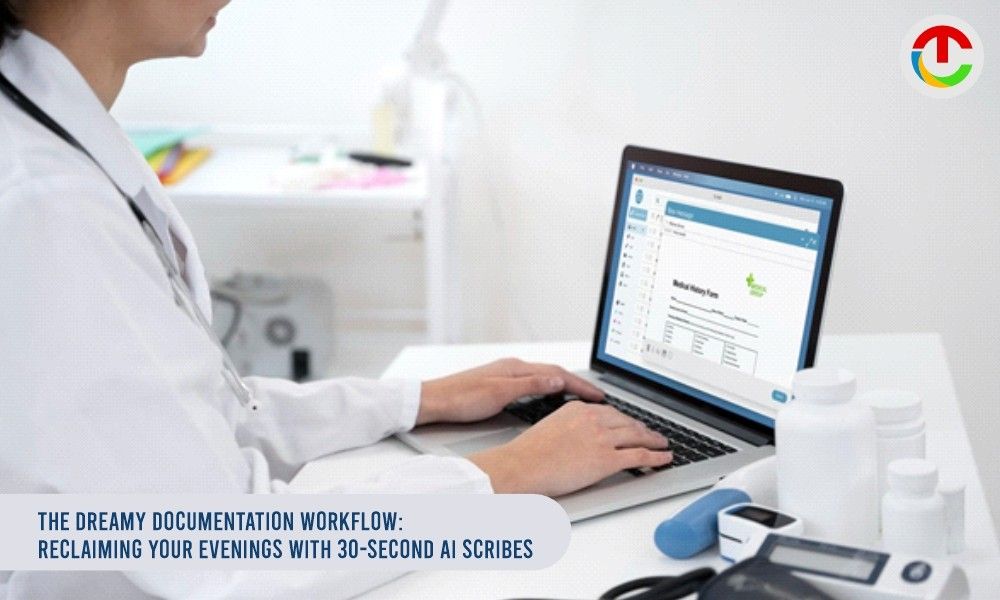
Today’s healthcare system needs to strike a proper balance between providing quality care to patients and maintaining complete, compliant patient records. Over the years, the amount and complexity of documentation that clinicians need to complete have increased dramatically, making it one of the most time-consuming tasks they perform when providing care.
The increasing burden of ongoing administrative tasks can extend beyond regular work hours, leading clinicians to complete documentation after hours and resulting in greater fatigue and reduced overall efficiency. Old-fashioned ways of completing clinical documentation, which rely on clinicians entering data into a manual system and then re-entering it after the visit, do not align well with the chaotic pace of modern healthcare environments.
Five Ways AI Scribes Transform Documentation Workflows
- Accelerating Documentation with AI Solutions for Healthcare

AI solutions for healthcare are transforming the time it takes to finish documentation. AI-based scribes listen to the clinician and patient as they talk and generate a structured note that captures important clinical information in real time using natural language processing and/or machine learning techniques within 30 seconds. The AI scribes quickly create documentation, allowing the clinician to provide patient care without interruption from waiting for manual documentation.
With immediate documentation, the clinician completes the clinically relevant documentation shortly after meeting with the patient, eliminating the need for after-hours documentation. Additionally, because the documentation was created during the patient encounter, it will be accurate rather than reconstructed from memory later. The efficiency created by AI scribes for clinicians in high-volume clinical settings enables clinicians to continuously provide patient care without the buildup of incomplete documentation tasks.
- Reducing Cognitive Load and Administrative Fatigue
Clinicians must give continuous attention to manual documentation, so they have to shift their focus away from patients and devote some of it to data entry. The two responsibilities add cognitive load to the clinician while they are working. As a result, over time, the cognitive strain increases mental fatigue.
AI scribes help eliminate the need for manual documentation by automating it. By having note-taking done in the background, clinicians can give their full attention to their patients throughout the appointment, making it a much more enjoyable experience to communicate with and spend time with the patient.
Also, reducing cognitive strain on clinicians enables better decision-making while providing care. Since clinicians’ mental resources are not being used for administrative activities, they have more available mental resources for analyzing information, recognizing patterns, and being able to make informed decisions.
- Enhancing Accuracy and Standardization of Records
Reliable documentation requires consistency and accuracy; inconsistencies (due to differences in how clinicians take notes), missing information, or incomplete entries can hinder clinical care and create difficulties for smooth administrative processes. AI scribes resolve these problems by using standardized frameworks to document patient information.
The use of structured formats ensures that all critical aspects of a patient’s record, including their medical history, presenting symptoms, diagnoses, and treatment plan, will be recorded consistently across all patients. The result is decreased variability within each patient’s clinical record, leading to a more consistently accurate set of records.
In addition to providing clinicians with reliable documents when providing care, accurate documentation provides the foundation for complying with governmental regulations and facilitating efficient revenue cycle operations.
- Integrating Seamlessly into Real-Time Workflows
AI scribes offer one of their major benefits: the ability to be integrated directly into current workflows in real time. Because traditional documentation processes occur after patient encounters, they typically cause interruptions and delays in documentation. With AI-powered systems, however, documentation is generated as the interaction between the patient and provider takes place, creating a perfect match between clinical activity and documentation.
Integration of AI scribes within existing clinical workflows eliminates the need to account for separate sessions devoted to documentation. This also allows immediate sharing of information with members of the healthcare team, enabling prompt collaboration and decision-making.
- Supporting Work-Life Balance and Long-Term Sustainability
The cumulative benefits of AI-driven documents extend beyond efficiency and accuracy; the impact on work-life balance is substantial. By reducing the time required to document, these systems decrease the time clinicians spend working after hours by allowing them to complete care administration within their normal working hours.
Thus, improved well-being occurs because healthcare providers have more time to rest and recharge and to participate in personal activities due to reduced burnout. Higher job satisfaction and improved overall performance result from reduced burnout.
In addition to benefits for clinicians, sustainable workflows increase retention and productivity from an organizational perspective. When administrative burdens are well managed, healthcare organizations can operate more efficiently while fostering a kind and professional work culture for their employees.
End Point
AI-enabled scribes are revolutionizing document creation by transforming it into a smooth, efficient, and sustainable process. They speed up note-taking, reduce the time spent, and improve accuracy as they easily integrate with your existing workflows with real-time information. As health care continues to change, the intelligent use of automation enables a workflow system that promotes efficiency and healthy working conditions so that documentation assists in providing care rather than detracting from it.