Most companies don’t have a customer experience problem – they have a decision-making problem. Customer experience simply exposes it.
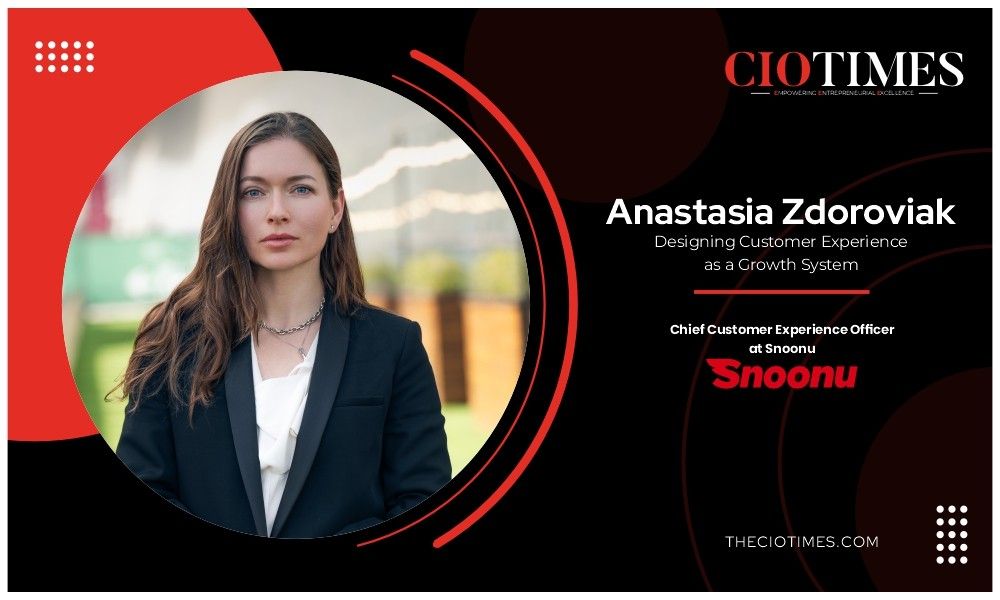
Anastasia Zdoroviak, Chief Customer Experience Officer at Snoonu, operates at the intersection of product, operations, and economics, where customer experience is not treated as a support function, but as a system that directly shapes growth, retention, and long-term enterprise value.
Her path into CX did not begin in customer support, but in finance, audit, and consulting – disciplines that trained her to think in systems, incentives, and second-order effects. That foundation continues to define her approach today.
As she puts it: “Sustainable growth doesn’t come from choosing between customer obsession and business discipline – it comes from designing them together.”
From Cost Center to Growth Engine
For many organisations, CX still sits on the periphery – measured in satisfaction scores, but disconnected from the core drivers of the business.
Anastasia challenges that model. At Snoonu, customer experience is embedded into how decisions are made, how product roadmaps are prioritised, how incentives are structured, and how unit economics are evaluated.
The question is not whether something improves CX. The question is: which customer behavior does it change – and what is the downstream impact on lifetime value, cost to serve, and trust over time?
This shift reframes CX from a reactive function into a lever for shaping business outcomes.
Designing for Behavior, Not Satisfaction
In complex marketplace environments, customer experience begins long before a user contacts support – and often fails long before that point.
“CX is the decision layer between product, operations, and policy,” Anastasia explains.
When any of these elements are misaligned, support teams are left to absorb the consequences. But resolving individual tickets is not the goal. The goal is to identify and eliminate the structural causes of friction.
While many organisations focus on individual customer feedback, Anastasia emphasizes the importance of pattern recognition over isolated anecdotes.
Individual stories matter – but only insofar as they reveal something systemic.
The real leverage lies in identifying recurring friction, measuring its impact, and addressing it at the source: whether in product design, operational gaps, or outdated policies.
At scale, attempting to fix issues manually is not just inefficient – it is unsustainable.
The Limits of Automation
As AI becomes increasingly central to customer operations, many organisations face a familiar temptation: to automate aggressively in the name of efficiency.
Anastasia draws a clear line.
“The moment automation is used to avoid responsibility rather than reduce effort, trust erodes.”
Her approach is grounded in a simple framework: frequency, risk, and emotional load.
High-frequency, low-risk interactions should be automated. But low-frequency, high-impact moments – especially those involving financial loss or trust – must remain human-led.
When applied correctly, automation does not replace human teams; it elevates them, freeing capacity to focus on the moments that matter most.
Leadership Without Borders
Having worked across multiple markets, Anastasia has seen firsthand how customer expectations vary across cultures but the principles of effective leadership do not.
What changes is how trust is built, how failure is perceived, and how transparency is communicated.
This has shaped her preference for adaptable frameworks over rigid, one-size-fits-all solutions.
It has also reinforced a consistent observation: many fast-growing companies confuse speed with progress, scaling volume before stabilising fundamentals.
Sustainable growth, in her view, requires clarity in decision ownership, escalation logic, and performance metrics – not just velocity.
Building Outcome-Driven Teams
At the leadership level, Anastasia prioritises three capabilities: clarity, judgment, and resilience.
But more importantly, she focuses on building teams that operate on outcomes, not tasks.
The strongest teams, she notes, are not the ones that move fastest – but the ones that understand why the work matters, and how it connects to the broader system.
This shift is particularly critical in customer experience, where the temptation to optimise for speed can come at the expense of long-term value.
CX as Trust Architecture
Looking ahead, Anastasia sees customer experience becoming less of a standalone function and more of a shared discipline embedded across the organisation.
As AI accelerates visibility into operational gaps, companies will no longer be able to treat CX as a surface-level metric.
Instead, it becomes a question of governance: how decisions are made, how trade-offs are handled, and how trust is preserved as the company scales.
The organisations that succeed will not be the ones that “invest in CX” as a function – but the ones that use it to shape how the business thinks, operates, and grows.