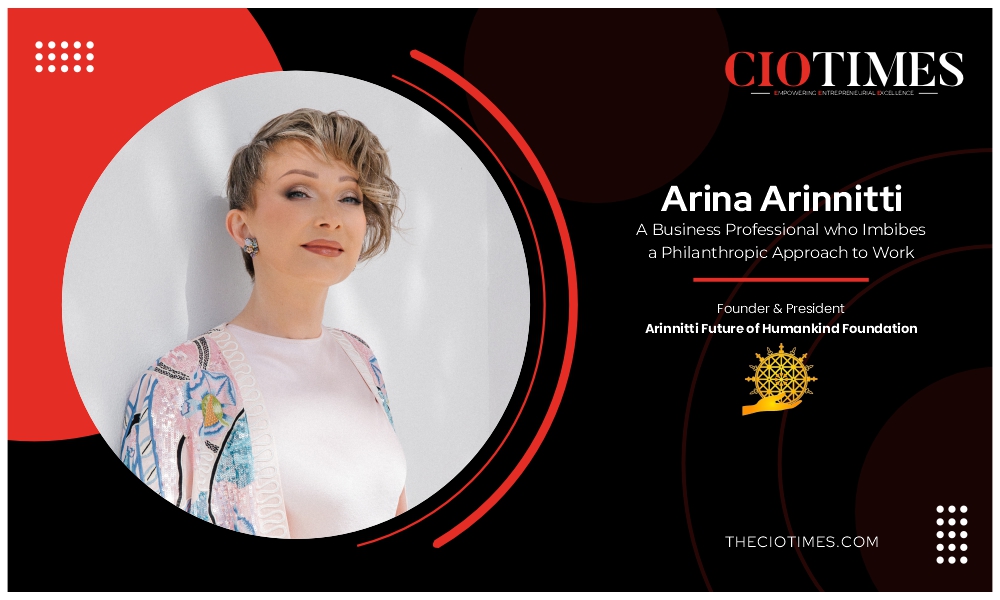
The combination of philanthropy and women in business is an exceptional amalgamation. It not only weaves profits in a business, but also molds businesses into a hub of doing social good activities. Empathy and lived experiences are the guides in these businesses; they are known for inclusive workplaces, and professionals who are close to their core values. In this context, Arina Arinnitti, Founder & President of the Arinnitti Future of Humankind Foundation, is a name we cannot afford to forget. Her leadership style blends compassion, nurturing, and a focus on possibilities. She addresses her work as “Tangible Models of Paradise on Earth”. This does not merely have a philosophical outlook to it; this has a lived approach to it.
This concept isn’t some airy, academic daydream for her. It’s a hands-on invitation to build a world we can actually touch, breathe, and inhabit. She moves Paradise out of the clouds and plants it firmly in the soil of our structures, our economies, and our shared stories. In her vision, architecture isn’t just about steel and stone; it’s about creating living spaces that pulse in harmony with the natural world, gently holding us in a state of balance and beauty.
Socially, she imagines a community that feels less like a crowd and more like a heartbeat, where belonging is a given, and everyone plays a role in sculpting their own environment. She reimagines the economy as a regenerative force, a system where wealth acts as a gardener, watering the seeds of creativity and curiosity rather than building higher walls. Culturally, she sees a life steeped in meaning, where the magic of art and the grounding weight of ritual aren’t saved for special occasions but are woven into the very fabric of the everyday, quietly lifting our spirits and expanding what we believe is possible.
Living Visions
Arina views the bridge between a grand dream and a physical reality as a living, breathing journey rather than a rigid set of instructions. For her, bringing an ideal to life is like weaving a delicate tapestry, blending deep philosophy with the simple, messy reality of human nature. She knows that a concept doesn’t truly exist until it becomes a place where someone can linger, breathe, and feel at home.
By looking at the world through a lens of interconnected layers, she maps out how our money, our hearts, and our habitats lean on one another, careful to ensure that every small shift honors the whole. She avoids the trap of rushing toward the massive, choosing instead to nurture small, intimate prototype places like Castillo del Sol and Arinnitti Ark, where ideas can find their footing and grow at their own pace. These aren’t just construction sites; they are soulful conversations between a vision and the earth.
At the end of the day, she believes the how is just as important as the what. When a team works with a shared pulse and genuine trust, the buildings they create naturally radiate that same sense of harmony. Strategy is never a cold machine; it is a quiet extension of our own awareness, slowly taking shape as the spaces, rituals, and communities where we finally feel we belong.
Weaving Domains Together
Predominantly, the three domains, namely, business, philanthropy, and art, are treated as individual domains that have distinct goals. Businesses seek profits, philanthropy imparts social needs, and art runs behind the meaning of life. Arina envisions this as a bifurcation. According to her, when building conscious ecosystems, these domains are utmost important to be inculcated as they’re attached expressions for a single purpose: creating value for humanity. Enterprise gives resources and structure, philanthropy opens doors for compassion and social impact, and art evolves imagination, identity, and cultural resonance.
When on the same page, these domains elevate one another, which makes life truly worth living. In the practical world, this should mean designing businesses that generate regenerative capital, foundations that deploy resources strategically to cultivate human potential, and artistic initiatives that embed vision and narrative into the cultural fabric.
She adds, “By dissolving artificial boundaries, the system becomes self-reinforcing, demonstrating that profit, purpose, and beauty can coexist as mutually supportive forces rather than conflicting incentives.”
Gardens of Belonging
When Arina reflects on the soul of Castillo del Sol and Arinnitti Ark, she doesn’t talk about blueprints or management; she speaks of them as if they have their own heartbeat. To her, these aren’t static projects to be policed, but wild, intentional gardens that need tending places where the walls and the whims of the people find a way to dance together, and the future is something hummed into existence by everyone involved. Governance, in her eyes, isn’t a gavel or a rulebook; it’s a quiet promise made long before the first stone is set. It’s a spirit that grows from the soil of shared values and a deep, marrow-deep trust, where neighbors stop being residents and start feeling like the protective guardians of a sacred flame.
In these spaces, the way things are run feels less like a lecture and more like a long, warm dinner conversation. She creates systems where responsibility is a shared gift, and people show up because they’re genuinely tethered to a deeper meaning. Instead of ironclad frameworks that might snap under pressure, she relies on guiding principles sturdy enough to give the community a spine, but supple enough to let it lean into the wind as it grows. Sustainability, for her, is a deeply human pledge that goes far beyond the environment. It’s about the emotional and economic weather of the community. She knows a place only truly survives when the hearts within it feel a spark, when curiosity is the local currency, and when the system can finally breathe on its own without being tethered to an outside life-support machine.
When it comes to the idea of scaling up, she isn’t interested in a copy and paste world. She sees growth as the magic of scattering seeds into different types of earth. Each community sprouts in its own surprising way, colored by the local culture, the specific tilt of the sun, and the unique quirks of its people all while carrying the same internal compass. In this light, expansion isn’t a repetitive factory line; it’s an organic, unfolding tapestry of distinct sister-communities that belong to each other without looking like clones of one another.
Arina states, “To me, these ecosystems are not built to be controlled or copied—they are grown, shaped by people, place, and purpose, each one unfolding in its own way.”
Inner Vision Terrain
In terms of future-oriented leadership, she envisions it as a vibrant operating system. It is not an upgrade of the old system. Conventional leadership was a world of hierarchy, control, and predictability. It trained leaders to manage structures, optimize performance, and maintain stability.
Today, instability is frequent. We are surrounded by consistent transformation, she says. In such times, perceiving management as enough or controlling is a fallacy. A future leader can be said who can steer complex situations seamlessly today. Fragmented outlook has become secondary; one needs to envision in systems. To help in foreseeing how the economy, technology, human psychology, ecology, and culture are all deeply interconnected.
Simultaneously, not paying enough heed to the inner dimension is considered a failure of traditional leadership. Older consciousness needs to be unlearned to craft newer roadmaps, as a leader is considered to have a new field of opportunities lately.
A person’s awareness level decides the amount of reality he/she is capable of creating around him/her. It also includes emotional stability, clarity, and integrity. These aren’t exactly soft skills. These are infrastructure. The future leadership is about meaning, as people follow truth these days, not titles.
She adds, “A real leader does not give instructions. A real leader creates a direction in which people recognize themselves.”
Conclusively, she says, leadership is moving from domination to creation. A true future leader is a person who fosters environments, who doesn’t micromanage people. He fosters spaces where people grow, and intellect, creativity, and purpose, and practices voluntarily.
She says, “The real measure of leadership is no longer how much you extract from the system — but what kind of world continues to exist because of you. Or, more simply: The leader of the new era does not adapt to reality. They design it.”
Measuring Vitality
When Arina explores how she captures the soul of impact the kind that escapes the narrow confines of a spreadsheet she speaks of strategy as a living awakening. To her, while revenue and efficiency are helpful pulse checks, they are merely the echoes of movement, not the heart of the story. She treats her work as a thoughtful intervention into human systems, believing the real magic isn’t found in what changed on paper, but in how the people inside that change feel when they wake up in the morning.
At the first level, she looks for a shift in the individual spirit. She watches for that pivotal moment when a leader stops running on the fumes of pressure and starts moving from a place of deep, quiet alignment. You don’t just see this transformation in a memo; you feel it in the room. The frantic noise of the workday settles into a steady, purposeful rhythm, and leadership stops being a reaction and starts becoming a grounded presence.
As that ripple moves outward, she senses the changing weather of the organization. A transformed team doesn’t just hit its numbers; it begins to breathe differently. She looks for the rise of a psychological sanctuary where it’s finally safe to think out loud, safe to disagree, and safe to create from the heart. She measures success by whether collaboration feels like a natural, flowing river rather than a forced march. She often asks the quiet, heavy questions: Do people feel like they are the lifeblood of a shared dream, or just cogs being ground down by a machine? For her, a high-performing system that leaves its people hollow isn’t success it’s a tragedy.
Ultimately, Arina tracks how these changes soak into the culture, redefining what it even means to win. Impact becomes visible when a business stops seeing profit as the finish line and starts seeing it as the soil for growing meaning. This kind of evolution is beautifully contagious, spreading from one team to the next until the entire ecosystem begins to lead with a more conscious heart. Strategy isn’t a mechanical tool for performance; it is a catalyst for evolution, measured by how much more alive a person feels in the life they are building.
She says, “Numbers can show growth, but real impact is when people feel more alive, more connected, and more fulfilled in the life they are building.”
Kinship of Resonance
When Arina explores the Sun Tribe, she isn’t talking about a dry LinkedIn network or a club with a membership fee; she’s describing a living, breathing pulse of people who just get each other. To her, this isn’t about following a leader or a handbook. It’s about a shared frequency. People aren’t checking boxes or fulfilling obligations here; they are showing up because their souls are hungry to build something that actually matters. It’s the difference between being forced to sit at a table and being drawn to a feast you helped prepare.
Psychologically, she taps into that ancient, marrow-deep human need to belong but with a modern twist. While our ancestors huddled together to keep the wolves away, Arina sees this tribe huddling together to set their creativity on fire. It’s a community of people who are obsessed with outgrowing their old selves while pouring that new energy back into the collective pot. Because everyone is moving toward the same North Star of conscious growth, they don’t need a boss or a rigid hierarchy to keep them in line; their shared dreams act as a natural compass.
Philosophically, she functions on the belief that none of us is an island. When one person in the tribe wakes up, or levels up, the whole group feels that shift. She looks at rituals, collaborative art, and shared stories as the secret sauce of the community, not just pretty decorations, but the actual tools that build trust and fire up the imagination. Ultimately, she sees the Sun Tribe as a beautiful experiment in human potential, proving that we are at our strongest not when we’re told to fall in line, but when we’re inspired to fall in love with a shared vision.
She shares, “Communities are most cohesive not when they enforce conformity, but when they nurture resonance, shared vision, and co-creative action.”
Spirit Shifting
When Arina looks at the bridge between the quiet work of the soul and the loud reality of global systems, she sees two notes in the same chord. To her, separating personal growth from systemic change is impossible; they’re in a constant, breathing conversation. She’s seen too many people gather beautiful inner insights that just sit in their heads, and just as many organizations try to rebrand or restructure without shifting the hearts of the people inside. In her experience, if the spirit of a place stays stagnant, even the most polished new system will eventually lose its luster and crumble.
She describes internal evolution as the seed, the invisible starting point that determines how we see, what we intend, and how we choose to move. The external world, our buildings, our laws, and our daily culture are simply that seed finally breaking through the soil. In her work, she doesn’t treat personal development and system design as different departments. Instead, she invites leaders to sharpen their own awareness while they simultaneously build the structures around them. This ensures the outside actually matches the inside, making the transformation as practical as it is profound.
Ultimately, Arina knows that when inner clarity and outer structures finally click together, something happens that lasts. The change stops being a fragile, individual effort and turns into a durable, self-sustaining energy that ripples across entire landscapes. For her, this alignment is the secret to a vision moving beyond one person’s dream to become a living reality that nourishes everyone it touches. It is the art of making sure the systems we build are honest reflections of the people we are becoming.
She asserts, “Inner growth without external expression remains private insight, but changes to external systems without inner development are superficial and unsustainable.”
Shaping Outlooks
Arina is an ardent believer in art, mythology, and aesthetics. Not only a means of adornment or entertainment, but they are the bedrock of perception, behavior, and collective imagination. Human societies have been guided by story and symbol before being exposed to policies or commerce. Symbols communicate complex ideas instantly and embed them in the subconscious, influencing action and decision-making without the need for rational persuasion. Mythology provides a shared framework of meaning, allowing individuals to situate themselves within a larger narrative of purpose and identity.
In sectors like architecture, landscape, and ritual, aesthetic design is a point that has its attention towards how people move, think, and feel within a space.
She shares, “Beauty is not decoration; it is a psychological infrastructure. It fosters cooperation, inspires aspiration, and stabilizes social cohesion. In my projects, every element — from spatial layout to visual language to storytelling — is intentionally crafted to align with the values we aim to cultivate.”
Focused Vision
During times of resistance in institutional and psychological aspects, Arina treats it as inevitable. New paradigms take these forms. Institutional resistance comes from rooted structures, processes, and incentives that have evolved to maintain the status quo. Whereas the resistance in psychology comes from fear, attachment, or habit, which is a common reaction to uncertainty. Steering through these requires patience, strategic insight, and demonstration.
She shares, “I approach resistance by creating evidence through experience rather than argument. Demonstrating viable alternatives — whether a prototype community, an organizational model, or a cultural experiment — allows people to witness what is possible, which often transforms skepticism into curiosity.”
She acknowledges resistance isn’t opposition; it is a measure of engagement of the tension between old paradigms and emerging possibilities.
Living Blueprints
When Arina looks at the next decade, she doesn’t see her Paradise models as static floor plans or gated retreats; she sees them as a living, breathing web of human laboratories. She’s preparing for a future where the old machinery of our cities and economies begins to rattle, viewing that friction as a golden opportunity to prove we can live by a much more inspired script. To her, these aren’t just plots of land; they are ecosystems where human heart, smart tech, and the wild pulse of nature finally stop clashing and start dancing. She envisions these spaces as a bold, working dare to the world, a way to show we can actually design our way into a more soulful existence.
She imagines these models acting like vibrant nodes in a global nervous system, using our connectivity to bridge distances and swap everything from hard resources to a shared sense of wonder. For her, these aren’t lonely bubbles; they are the first stitches in a global fabric woven from cooperation and ethical backbone. On the financial side, she’s on a mission to prove that wealth can be a source of life, a way to compost energy back into the earth rather than just strip-mining it. Socially, she sees these communities as an antidote to the modern ache of isolation, cultivating the kind of deep-rooted belonging that makes people feel truly whole.
Ultimately, she believes the real shift isn’t about the wood and stone of the buildings, it’s about a total software update for the human spirit. She sees these environments as the physical evidence of what happens when our minds, our social structures, and the planet’s needs finally click into place. By treating beauty, art, and storytelling as essential infrastructure rather than just pretty extras, she’s proving that a flourishing life is a tangible, reachable reality. Her dream is to make these spaces so undeniably alive that they spark a global movement toward a world that finally feels like it was built for us to thrive in.
Arina adds, “The evolution of these Paradise models is less about physical structures and more about a shift in civilization’s operating system—a tangible manifestation of what becomes possible when human consciousness, social design, and ecological intelligence align.”
After a heavy discussion session with Arina, we asked her some light mood questions, which she was kind enough to answer. The fireside chat was as follows:
- What book are you reading currently?
I’m currently reading The Prince by Niccolò Machiavelli. It’s a book that brings a very sharp clarity about human nature and the true mechanics of power. Not in an idealistic sense — but in a real, unfiltered way.
- One word that best describes your personality:
Visionary — I don’t just see what is, I see what wants to exist next… and I build the bridge to get there.
- What’s the most important lesson you’ve learned? (Personal or professional)
The most important lesson I’ve learned is this: power comes from alignment. Intention, thinking, and action must work together. Intention sets direction. Thinking creates clarity. Action makes it real. When they’re aligned, results are inevitable.
- What’s the best professional advice you’ve received?
The best professional advice I’ve received is this: don’t expect alignment in teams or systems if there is no alignment in your own thinking. Clarity at the leadership level determines clarity of execution. If your priorities, assumptions, and decisions are not internally consistent, that inconsistency will scale across the organization.
- What is your favorite quote?
One of the quotes of Peter Drucker that resonates deeply with me is: “The best way to predict the future is to create it.”
To me, the future is not something that happens to us. It is shaped by the quality of our decisions, the clarity of our thinking, and the courage to act. At a certain level, you stop reacting to reality — and start designing it.