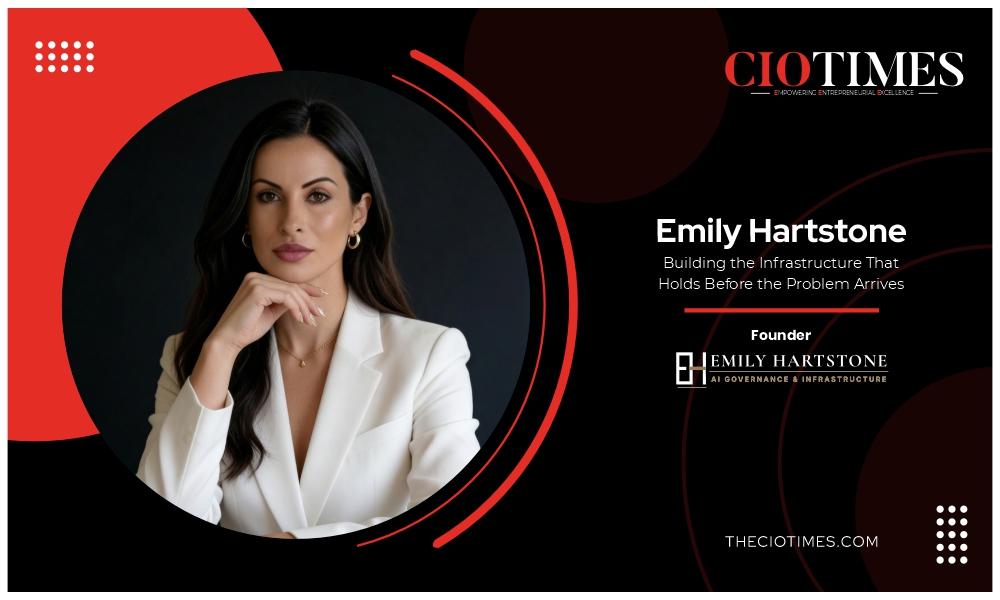
A new kind of leadership is emerging around intelligent systems. It is less concerned with what AI can say and more focused on what it is allowed to do. Emily Hartstone, founder of Hartstone Institute and the architect behind Runtime Authority Control, sits at the center of that shift. Her work lives where policy, runtime oversight, and autonomous systems converge, specifically at the moment when machines stop generating and start acting. The infrastructure she built keeps human intent in the loop at the one point that matters most: before execution.
Human-First Infrastructure
Emily Hartstone’s focus is the runtime authorization gap. It is the space between what a policy says an automated system can do and what it actually does the moment it executes. Through Hartstone Institute, she has built a coordinated four-layer architecture for governing machine-initiated action across enterprise environments. TORIXA™ diagnoses an organization’s exposure to ungoverned machine activity. Runtime Authority Control, LLC (RAC) ™ operates as the runtime control plane, deciding whether an action is authorized to execute. RIMAGINC™ is the governed execution environment where AI actually runs under enforcement. CORTHEM™ provides continuous governance verification, the decision-linked evidence that proves machine action remained within policy across time.
TORIXA identifies the risk. RIMAGINC runs the system. RAC controls what happens. CORTHEM proves it held. Taken together, the four layers form a closed-loop architecture that most organizations currently assemble from unrelated tools, if they assemble it at all.
Alongside the RAC Ecosystem, she leads From the Hart Management LLC (FTHM), the incorporated parent and active operating company behind her client work, and founded Soul Systems Studio to build structured digital foundations for founders. Under FTHM, she also leads EmPOWERthePATIENTS™, her advocacy initiative for people navigating chronic and rare illnesses. Years of operator experience sharpened a single instinct: technology has to actually serve the humans using it, and the infrastructure has to prove it.
Recognizing the Pattern
The realization that enterprise oversight had fallen behind what automated systems were already doing came as a slow burn, not a lightning bolt. Attention was focused on the outputs, ensuring the answer was accurate, fair, and on-brand. A different problem was forming underneath.
The moment crystallized in 2022, inside her own operations. Systems were not just responding. They were executing: triggering workflows, moving records, touching live data. There was no guardrail defining what they were permitted to do. The old assumption that a human would always be in the loop to click “approve” had quietly disappeared from the process.
“The market was governing the model. But no one was governing the action.”
That was the moment Runtime Authority Control went from insight to necessity. When software acts autonomously without a clear permission layer, the risk is not hypothetical. It is a failure unfolding in real time.
Hidden Actions
Public attention still gravitates toward what AI says, not what it does. A hallucinated sentence is obvious. Someone flags it, the mistake is traceable, and accountability is simple. But when a system quietly executes a decision deep in a company’s operational plumbing, the damage does not surface immediately. It shows up later, and rarely in a way that points back to the system that caused it.
The guardrails, in her view, were built for the wrong layer. Rules addressed what was visible: the words, the logic, the tone. The harder question was not in the conversation. Who authorized the action, and how can that authorization be verified? If you cannot name a problem, it does not get treated as a real risk until something fails hard enough to force the issue. That is now changing. As autonomous systems move from labs into production, what these systems are actually allowed to do is no longer a question that enterprises can defer.
Pressure-Testing Ideas
Hartstone Institute exists to stress-test ideas before they reach the market. Too many half-formed concepts ship. They are technically live but missing the structural core that would let them hold under load. The Institute is where she slows things down and finds what is true.
Every idea begins as a written thesis: the gap in the market, why existing solutions fall short, and what a real answer would have to look like. That thesis then gets pressure-tested from every angle. If it fractures under scrutiny, it stays on the page. Every venture that has graduated from the Institute, including TORIXA, RAC, RIMAGINC, and CORTHEM, cleared that bar before it was built.
“If the foundation doesn’t hold, nothing else should move forward.”
Filling the Gaps
Each layer of the RAC Ecosystem began the same way. A missing piece stopped being a theoretical debate and started creating real drag. Once the failure could be mapped, its downstream impact traced, and no tool in the market could close it, the work moved from concept to build.
RAC is the clearest example. Emily Hartstone watched organizations experiment with autonomous systems and identified the exact point where the authorization gap opened. CORTHEM followed a parallel insight on the evidence side. Most organizations could log activity, but none could continuously prove governance held across time. RIMAGINC answered a different question entirely: what does it look like when AI actually runs under real enforcement, not in theory? TORIXA closed the loop at the front end, giving leaders a structured way to diagnose their own exposure before they needed to fix it. Good infrastructure does not announce itself. It shows up, carries the weight, and solves the problem at the source.
“When the absence becomes the failure, the idea is ready to be built.”
Removing the Blindfold
Organizations frequently stumble when automated systems start moving money or modifying records. She traces it to a few common habits. The first is how trust gets transferred between environments. A tool performs well in a controlled test, and that confidence follows it straight into production. The risk profile changes completely, yet the original comfort rarely gets re-examined.
The second is how accountability blurs. When a person decides, there is a clear chain. When a machine acts and something breaks, the trail goes cold. The third is the distance between having a policy and actually enforcing it. Policies written for human-paced review cannot keep up with machine speed. Without active enforcement at the moment of action, policy functions as guidance, not protection.
Active Enforcement
Companies too often treat documentation as a substitute for oversight. That is the moment compliance gets confused with control. Teams build policies, fill in the frameworks, pass the audits, and stop. From the outside, everything appears covered. But the high-stakes moment, when a system executes an action, goes unchecked.
Documentation describes a plan, not a result. Policies specify how things should happen. They cannot verify how things actually happened. That disconnect looks minor until an auditor asks for evidence and gets a policy statement. Many organizations have stayed in that middle ground because the real consequences have not landed yet. That window is closing.
“Compliance may look complete on paper, but without enforcement, it doesn’t prove anything.”
Ownership Beyond Tools
Accountability for automated behavior too often gets treated as a technical issue. It’s an I.T. problem, or the vendor’s. That logic collapses the moment an automated action affects the rest of the company. Accountability belongs with the outcome, not with whoever owns the software. If a system initiates a financial transaction, the responsibility cannot stay locked on the technical side. It has to reach the people affected by the result. Control layers are not just digital fences. They are a direct reflection of how an organization manages its commitments.
“Accountability has to follow the consequence, not just the tool.”
Roots of Resolve
The high-stakes environments Emily Hartstone has worked in have shaped how she sees. She carries a healthy skepticism of anything that only looks good on the surface. Emily Hartstone’s early career managing high-end brand and event work taught her how easily a polished exterior can hide a shaky foundation. Paralegal training sharpened the instinct. She learned to read what was actually written, not what people assumed was there, and noticed a recurring pattern: the space between what someone intends and what actually gets executed is where the real risk lives.
The standards she holds infrastructure to are not academic. The RAC Ecosystem was built during a period when Hartstone was also navigating leukemia. Every system in her life was being pressure-tested at once: medical, operational, personal. The architecture held. That is not an incidental biographical detail. It is the reason her conviction about what “holds under load” carries the weight it does. She has lived on both sides of the question, as the person building the infrastructure, and as the person whose survival depended on other infrastructure holding. Emily Hartstone’s advocacy through EmPOWERthePATIENTS carries the same through-line. The human cost when essential systems fail the people they are meant to protect is not theoretical to her. It is the premise.
Beyond Surfaces
The common thread across industries is the same. Companies fixate on the visible layer, whether brand, product, or outcome, while the operational plumbing underneath gets ignored. Everything looks calm on top, but stability is often an illusion. It is only when pressure arrives that cracks in how decisions are made, and systems are wired start to show. The people closest to the work usually see the gaps first, and their warnings often take too long to reach the top.
That instinct for early detection feels core to who she is. Emily Hartstone often thinks of her father, Joel Martin Hartstone, who had a gift for sensing shifts before they became obvious. She shares that drive to see what is missing. For her, noticing the gap is not the point. The work is having the conviction to actually build what should be there.
“Seeing the pattern early only matters if you’re willing to build what’s missing.”
Building Credibility
The Hart Management keeps her close to the operational ground. Where the Institute generates ideas, FTHM is where those ideas meet real conditions: active client work, real execution, live operating constraints. Rigor in an abstract environment can drift from reality if nothing corrects for it. FTHM is that correction.
RAC is the clearest illustration. The primary insight came from working inside her own business. She lived the authorization gap at the execution level and found no existing tool could close it cleanly. When she speaks in enterprise settings about the operational gaps RAC addresses, she is not speaking from theory. Emily Hartstone is speaking as an operator who faced the problem and built the response. That distinction changes the conversation from a vendor making a case to a peer describing what she encountered and what she built to solve it.
Infrastructure for Intent
Soul Systems Studio is the clearest expression of her philosophy on structure. A system is never neutral. It either supports you or it works against you. When the framework is broken, more effort only accelerates burnout. When the design is right, it creates steady momentum that makes growth feel sustainable.
Emily Hartstone built Soul Systems Studio for a specific group: creative, ambitious founders who are deep in the work but lack the operational spine to sustain it. The templates and systems there are not surface-level solutions. They are intentional foundations designed to hold the weight of a growing business. The motivation is personal. Emily Hartstone has lived through the stretches where the absence of real infrastructure turned every step into friction, and she built the studio to close that gap for the people building what comes next.
“When the system is right, it supports you in ways effort alone never can.”
Where it become real?
RIMAGINC is where the architecture stops being a diagram and starts being operational. It is the governed execution environment inside the RAC Ecosystem, a live surface where AI agents generate, decide, and act, with every action intercepted by RAC and recorded for CORTHEM. Not a dashboard. Not a monitoring layer. A real execution environment that turns the architecture from conceptually correct into operationally undeniable.
If RAC is the control plane and CORTHEM is the evidence layer, RIMAGINC is where the whole system is put to work under real conditions. Policy, enforcement, and verification stop being words and start being load-bearing. That is the difference between explaining a governance system and showing one working.
Proactive Presence
In an AI-driven environment, Emily Hartstone’s standard is simple. Support has to be there before anything breaks. For years, “support” meant explaining after the fact why something went wrong. That model does not hold when machines are moving money or modifying records in real time. By the time you are explaining, the damage is already done.
The shift is toward something more continuous. An Emily Hartstone system presents in the moment, verifying each action against policy and context before it executes, leaving a clear trail of why each decision was made. The answers arrive before the questions get asked. Real support is a steady presence that helps things go right the first time, with safety and logic woven directly into the work as it unfolds.
“A system truly has your back when it’s there before anything goes wrong.”
Also Read:- CIO Times Magazine For More information