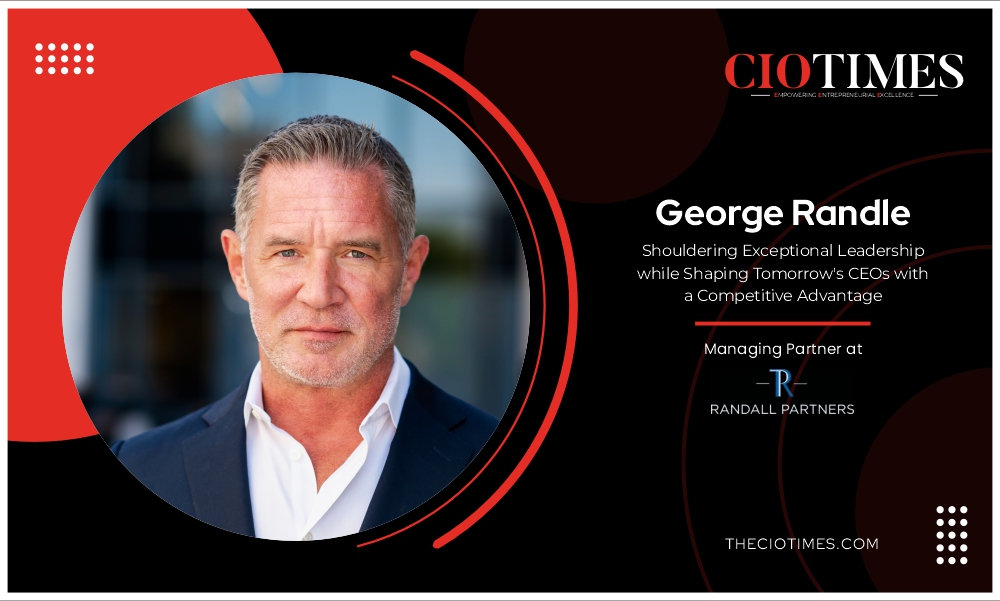
Transformational leadership is about guiding a team toward results. It is also about inspiring people to believe in a shared purpose. Great leaders create an environment where individuals feel valued, trusted, and empowered to contribute their best ideas. They embrace change, encourage innovation, and invest in the growth of those around them. A similar leader is George Randle, Managing Partner at Randall Partners, LLC. His day-to-day performance extends beyond day-to-day performance, shaping a culture of collaboration, accountability, and continuous learning. When people are motivated by purpose rather than pressure, they achieve more and adapt with confidence. That is what makes transformational leadership a lasting driver of organizational success.
Talent Leadership
He helps CEOs, boards, and investors unlock organizational performance by aligning leadership excellence with world-class executive assessment and search. As co-author of the best-selling The Talent War: How Special Operations and Great Organizations Win on Talent, George combines military precision, behavioral science, and corporate leadership experience to help leaders make confident, enduring talent decisions that drive performance, resilience, and growth.
A former U.S. Army officer and global HR executive, he has guided or influenced more than 80,000 hires across 60 countries. These statistics include thousands of senior leaders too. Today, he helps organizations elevate hiring, succession planning, and leadership assessment.
An Advanced Hogan Leadership Assessment Certified expert, he conducts pre- and post-close leadership evaluations for private equity firms and corporate clients, delivering ‘human due diligence’ that identifies mission-critical talent, assesses leadership effectiveness, and exposes gaps threatening enterprise value.
Through retained executive search, leadership assessments, and C-suite coaching, George enables organizations to de-risk hiring decisions, build resilient leadership benches, and accelerate organizational performance.
Talent Excellence
Randall Partners is a pioneer retained executive search and leadership advisory firm trusted by private equity investors, boards, and executive teams to build transformative leadership. Known for its rigorous, insight-led approach, the firm specializes in identifying and assessing exceptional C-suite talent while advising organizations on succession, leadership effectiveness, and long-term organizational performance.
By combining deep executive search expertise with sophisticated leadership assessment, the organization enables clients to make high-stakes talent decisions with confidence, strengthening leadership capability, accelerating enterprise value, and positioning organizations for sustained success in a constantly shifting business arena.
Leading Forward
His career has exposed him to military leadership, executive search, and organizational strategy. This diverse and distinct career has molded his approach to a fundamental truth: every problem is a leadership problem. Nearly every organizational challenge ultimately stems from a leadership decision: what was prioritized, what was overlooked, who was selected, which behaviors were rewarded, or which difficult conversations never occurred.
Technology and markets have evolved. The pace and complexity of business have changed dramatically. Yet people continue to expect the same essentials from their leaders. They want answers to questions like:
- Is there a clear direction?
- Will difficult decisions be made when required?
- And does the leader genuinely care about the people being asked to follow?
George Randle primarily learned this in the military. Rank grants authority, but it never guarantees trust. Trust needs to be earned. He witnessed the same principle while leading global talent organizations and now advising CEOs, boards, and investors. Leadership is not a title, a resume, or a compelling presentation. It is the behavior people consistently observe, especially when circumstances become challenging. The tools have changed, but the responsibility remains the same.
He shares, “The tools have changed. The responsibility has not. Create clarity, make decisions, take ownership, and put the mission and the team ahead of yourself. Check your ego at the door.”
Create clarity, make decisions, take ownership, put the mission and the team before yourself, and leave ego at the door.
The Talent Strategy
Organizations often proclaim that people are their greatest asset. Yet the leadership decisions remain among the least disciplined business investments. George believes the gap exists because while the statement is easy to make, building a rigorous leadership selection process is far more challenging. As he noted in The Talent War, people are an organization’s only true competitive advantage.
He adds, “Part of the problem is that most executives believe they are naturally good judges of people. But being successful in finance, operations, technology, or strategy does not automatically make someone an expert in selecting leaders.”
While companies subject major capital investments to rigorous due diligence, leadership hires are often based on resumes, a few unstructured interviews, and subjective impressions. Many executives overestimate their ability to assess talent, assuming success in finance, operations, or strategy automatically translates into expertise in identifying exceptional leaders.
Urgency further compounds the problem. Organizations under pressure to fill critical roles often prioritize speed over precision. It results in hiring to solve an immediate challenge rather than against a clearly defined vision of success. He compares this to grocery shopping while hungry. Everything looks appealing, but not everything is the right choice. As he explains in The Defining Hire, leadership selection is far more than an HR function. It is a strategic business investment that shapes an organization’s culture, execution, trust, and long-term success. Treating it with the same discipline as any other high-value investment, he argues, is essential for building enduring competitive advantage. The book is set to launch on 29th Sept for executives and senior leaders hiring. It will be a great insight for those who are on the verge of hiring senior-level executives.
Human Due Diligence
George Randle does not regard leadership quality as a substitute for financial metrics. He sees it as the catalyst that ultimately shapes them. While financial indicators capture historical performance, leadership serves as the leading indicator of future enterprise value. It is leaders who define strategy, allocate capital, build high-performing teams, cultivate organizational culture, and determine how decisively a business adapts when assumptions no longer hold.
Drawing on his work with boards, CEOs, and private equity firms, he identifies a persistent blind spot in many investment decisions. Although firms conduct rigorous due diligence on markets, operations, customers, and financial performance, they often devote comparatively less attention to evaluating whether the leadership team possesses the capability to execute the investment thesis.
George Randle shares, “The right leader can unlock value that is already trapped inside the organization. The wrong leader can destroy value much faster than most models predict.”
This is where human due diligence becomes a strategic imperative. It extends beyond credentials to assess whether leaders can scale the enterprise, navigate uncertainty, manage succession risk, and sustain long-term value creation under pressure. George believes exceptional leaders unlock unrealized potential, while ineffective leadership can erode enterprise value far faster than financial models anticipate. Financial metrics reveal what an investor is acquiring; leadership determines what that investment ultimately becomes.
Beyond Credentials
The conventional hiring processes are adept at documenting what a leader has achieved but are far less effective. They lack this effectiveness in terms of revealing how the results were delivered. Whether they can be replicated in a different environment. A resume cannot demonstrate how a leader responds under pressure, exercises influence, builds trust across functions, or navigates a failing strategy.
He argues that the greatest blind spot lies in behavioral derailers. Defensiveness under pressure, conflict avoidance, excessive control, or an unwillingness to invite challenge often distinguish exceptional executives from costly leadership failures.
George Randle states, “A résumé cannot tell you what happens when the leader is challenged. It cannot tell you how they use power, whether they create trust across functions, or how they behave when the strategy is failing.”
These are qualities conventional hiring methods rarely uncover.
To address this gap, he advocates behavioral assessment as an evidence-based complement to executive selection. He uses Hogan assessments to better understand a leader’s strengths, motivations, values, and likely behaviors under stress. However, he emphasizes that assessments should never make the decision. Indeed, they should strengthen it. Their greatest value lies in being combined with structured interviews, rigorous referencing, business scenarios, and a clearly defined picture of success. He believes the objective is to determine whether an individual’s capabilities, character, motivations, and risks align with the organization’s mission and the demands of the moment.
Human Judgment
Artificial intelligence is a powerful enhancer of human judgment. Its greatest value lies in bringing greater rigour, consistency, and evidence to executive selection by synthesising information, identifying patterns, and strengthening decision-making. Yet, insight alone should never be mistaken for judgment.
In George Randle’s view, algorithms can only evaluate the information placed before them; they cannot interpret organisational nuance, board dynamics, leadership credibility, or distinguish between executives who created enduring value and those who simply benefited from favourable market conditions. Nor does automation eliminate bias it merely embeds and scales the assumptions underpinning the data.
He shares, “AI can also create a false sense of certainty. A sophisticated score is only as good as the data, assumptions, and criteria behind it. Bias does not disappear simply because it has been automated.”
The boundary is unequivocal. It should challenge assumptions, surface evidence, expose blind spots, and strengthen the quality of decision-making but it should never assume responsibility for the final call. Leaders must still define success, interpret context, assess character, and accept accountability for the outcome.
While he is a strong advocate for initiating AI into executive selection, he maintains that technology should remain an instrument of discernment, never its replacement. When deciding who will shape the future of an enterprise, judgment remains an inherently human responsibility.
The Character Imperative
Exceptional leadership is shaped by experience, environment, and character. In this, character especially determines how leaders respond to other traits. Experience cultivates pattern recognition, while environment introduces pressure, opportunity, and constraint. Yet individuals who navigate similar circumstances often emerge with vastly different perspectives. One develops greater humility and discernment, another becomes more rigid, political, or convinced that past success guarantees future judgment.
Solely experience, for George, does not create wisdom. He likes to consider reflection too. His military service, followed by leadership across global enterprises, high-growth organizations, turnarounds, and private equity-backed companies, reinforced a defining truth: pressure does not build character; it reveals it.
George Randle says, “When things get difficult, the real attributes become visible: resilience, adaptability, selflessness, courage, discipline, humility, and ownership.”
It exposes the qualities that distinguish exceptional leaders. It reflects traits like resilience, adaptability, courage, discipline, humility, selflessness, and accountability.
While the right environment can strengthen these attributes through demanding assignments and candid feedback, George believes development has its limits. Organizations can teach leadership frameworks, but instilling humility in those unwilling to embrace it is far more difficult.
That is why he views leadership selection and development as inseparable. Development is essential, but no organization can consistently coach its way out of poor selection decisions.
Performance Aligned with Purpose
George Randle believes the perceived tension between culture and performance exists only when culture is poorly defined. In his view, culture is the overall standard of behaviors an organization rewards, reinforces, and permits. Within high-performing organizations, accountability, trust, candor, partnership, and disciplined execution are the defining attributes.
Throughout his career, he has seen organizations protect high performers whose conduct erodes every team they touch simply because they deliver short-term results. He views it as a failure of leadership. The consequences inevitably emerge through attrition, weak succession, fractured collaboration, customer challenges, and an unhealthy dependence on individual talent.
He adds, “I have seen organizations protect high performers who damage every team they touch because they continue to deliver short-term results. That is not a performance culture. It is a failure of leadership courage.”
Equally, he cautions against equating cultural alignment with conformity. Culture and performance are the strongest assets of leadership. Leaders understand that such long-term performance is imbibed from the ideal culture.
Boards Build Leaders
Many boardroom discussions that take place on succession remain focused on identifying names rather than assessing true leadership readiness. A shortlist of potential successors does not constitute a succession strategy. Boards should evaluate whether future leaders are equipped to guide the organization it is becoming. That requires more deliberate conversations around long-term strategy, leadership, capabilities, behavioral attributes, and enterprise risk.
That requires more deliberate conversations around long-term strategy, leadership capabilities, behavioral attributes, and enterprise risk. George believes boards should ask what the CEO role will demand three to five years from now. They should ask what the CEO role will demand three to five years from now and which executives have demonstrated enterprise-wide leadership beyond functional expertise. They must also identify leaders capable of navigating evolving business models, capital structures, and accelerating change.
He also believes succession assessments must extend beyond strengths to include a candid evaluation of derailment risk among leading internal candidates. He further distinguishes between emergency succession and long-term succession. The executive best equipped to stabilize an organization in the immediate term may not be the leader capable of driving sustained transformation over the decade ahead.
Equally important, he argues, is extending succession planning beyond the CEO. The collective strength of the CFO, CHRO, CIO, business presidents, and other critical executives ultimately determines an organization’s capacity to navigate disruption without compromising momentum.
He adds, “Succession should be an ongoing leadership system, not an annual slide that receives 15 minutes before the board moves to the next agenda item.”
Succession planning is not a periodic board agenda item but a continuous leadership discipline that underpins long-term organizational resilience.
Ideal Leadership Attributes
The central premise of The Talent War has only grown more relevant: leadership potential is defined less by experience than by attributes. As technology reshapes industries, business models evolve, and the pace of change continues to accelerate, experience alone offers an increasingly incomplete measure of future leadership success. Attributes like adaptability, resilience, humility, ownership, learning agility, and decisiveness have become the more enduring predictors of executive performance, George mentions.
Reflecting the philosophy explored in The Talent War and informed by the talent selection principles of Special Operations, he argues that exceptional organizations have the capacity to learn, adapt, strengthen teams, and perform decisively when uncertainty replaces certainty.
He adds, “Organizations still tend to overvalue the candidate who looks exactly like the job description. They search for someone from the same industry, with the same title, at the same scale, using the same systems.”
Yet many organizations continue to recruit for familiarity, favouring candidates whose industry, title, scale, and experience closely mirror the role at hand. Reassuringly, he highlights that this approach often overlooks leaders whose capabilities transcend conventional career paths.
Experience remains an important consideration. Organizations that select leaders primarily for what they have done risk solving yesterday’s challenges. Those that recognize enduring leadership attributes are better positioned to identify those capable of shaping tomorrow.
Executive Resolve Outlook
Uncertainty elevates the importance of leadership fundamentals by making them indispensable. Leaders are expected to provide strategic clarity, communicate candidly about what is known and unknown, and demonstrate the conviction to make timely decisions rather than allow uncertainty to stall execution.
Reminiscing about his leadership experiences across military operations, high-growth enterprises, and private equity-backed organizations, he has gained many crucial insights. Those are as follows:
- Plans rarely unfold as intended; disciplined planning remains essential
- Priority should be to establish strategic intent
- Crafting high-performing teams
- Delegating authority with confidence
- Adapting faster than changing conditions
George Randle believes the above principles define resilient organizations. Leaders must create sufficient clarity for teams to execute with confidence. That requires trust, disciplined communication, and decentralized leadership where leaders establish strategic direction while those closest to the challenge determine the optimal path forward.
Uncertainty is the ultimate test of leadership. When performance falters or strategy comes under pressure, character is revealed. Leaders distinguish themselves by pursuing truth over reassurance, accountability over blame, and disciplined judgment over volatility.
Calm is not passivity, nor is decisiveness recklessness. Exceptional leaders possess the steadiness to absorb difficult realities, the humility to recalibrate, and the courage to act before certainty arrives.
The CEO Advantage
The next generation of exceptional CEOs will distinguish themselves by combining technological fluency with deeply human leadership. While they need not be technologists, they must understand technology’s influence on strategy, customer behavior, enterprise risk, and organizational capability. Equally essential are the curiosity to remain lifelong learners and the humility to recognize the limits of their own expertise.
As leaders confront unprecedented volumes of data and competing signals, George believes judgment will become the defining competitive advantage. The challenge will lie not in accessing information, but in discerning what matters, what is credible, and when decisive action is required.
He also believes tomorrow’s CEOs will need the moral courage to navigate competing expectations from investors, employees, governments, customers, and other stakeholders. They must articulate a clear organizational purpose, communicate decisions with conviction, and accept the consequences of principled leadership.
George Randle adds, “The next generation of CEOs will also need moral courage. They will face pressure from investors, employees, governments, customers, and increasingly polarized constituencies. They will not be able to make everyone happy.”
No CEO can master every discipline. Enduring advantage will belong to those who attract exceptional talent, cultivate constructive challenge, and build teams capable of strengthening the CEO’s judgment. The defining leaders of the future will be adaptable without compromising conviction, decisive without arrogance, technologically fluent without sacrificing humanity, and confident enough to be surrounded by people who surpass them in critical areas.
Selection Destiny
George Randle hopes his legacy will be defined by how organizations approach leadership selection as a strategic imperative rather than a procedural exercise. Having influenced more than 85,000 hires across 60 countries and assessed thousands of senior leaders, he has witnessed how a single leadership decision can strengthen or fracture culture, accelerate or derail strategy, build or erode trust, and fundamentally alter enterprise value.
It is this conviction that molds George Randle belief that selection is destiny. He is a flagbearer for boards, CEOs, and investors to define success before launching a search, evaluate candidates on evidence rather than polish, assess character with the same rigor as capability, and conduct meaningful human due diligence before entrusting leadership.
He also believes leadership failure seldom begins when performance declines. More often, it originates during selection when organizations prioritize speed over judgment, experience over potential, or chemistry over courage.
George Randle adds, “Better selection creates better leadership. Better leadership creates better organizations. And better organizations change more than financial outcomes. They change people’s lives.”
While The Talent War established talent as the ultimate competitive advantage, George believes The Defining Hire extends that premise: the leaders organizations select ultimately determine whether talent is discovered, developed, empowered, and positioned to excel. Better selection produces better leadership. Better leadership builds stronger organizations. And stronger organizations create an impact that transcends business; they change lives.
Also Read :- CIO Times Magazine for More information