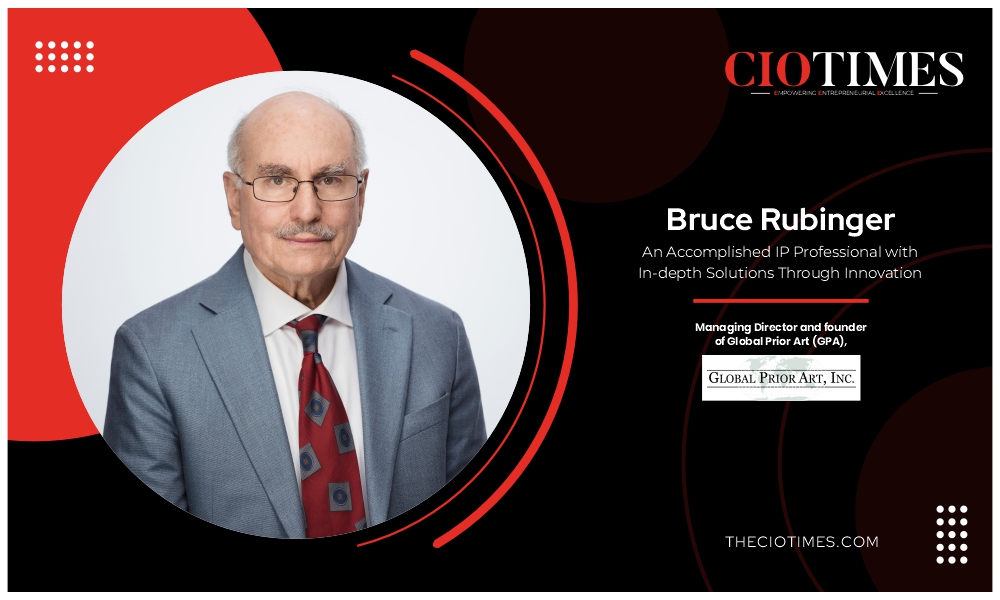
IIntellectual property (IP) is a sector that promotes creativity and innovation. This yields economic growth, protects innovations with strong patents and results in higher profitability. Professionals in this sector bring clarity to complexity that turns intricate ideas into protected products shielded from competitors that leverage your success. These professionals help businesses move forward with confidence and anticipate opportunities in a constantly evolving environment. At the frontlines of this is Bruce Rubinger, Managing Director and founder of Global Prior Art (GPA), whose contributions have been instrumental in the IP sector. He is a recognized authority and speaker on disciplined patent creation, strategic innovation, IP Invalidity Defense, key global resources, and proactive IP Strategy.
An Eminent Journey
He established GPA in 1982, and currently, as an MD and IP Strategist, he overlooks it’s engineering division, comprising the electronics, telecommunications, software, and mechanical engineering groups. He has been an active participant in innumerable high-stakes cases. He is also associated with GPA’s life science management committee. His rich experiences and insights are integrated into the organization’s software and institutional processes. It helps to adopt a scientific invalidity analysis that yields efficient results. In the field of IP strategy, he is seen as a pioneer. The third-generation GlobalMap IP landscape analysis tool was awarded a U.S. patent and is used by clients to create strong IP portfolios.
His journey echoes a natural blend of technology and the science behind how decisions are made. With a BSEE, MSEE, and a PhD in systems science, his academic path is both rigorous and deeply thoughtful. His doctoral work focused on non-linear filtering, exploring how it can be used to better predict outcomes and make more accurate estimations.
Fresh Outlook
Bruce Rubinger’s work is driven by a genuine fascination with how we can reliably predict the future and make tough calls, concepts like estimation and decision theory that remain the heartbeat of GPA’s rigorous approach to invalidity analysis. His experience with AI spans 35 years. With a foundation in Electrical Engineering and a Ph.D. in decision analysis earned under a NASA fellowship, his early years were spent exploring how systems learn to adapt and respond to the world around them.
At Hughes Aircraft, he put these theories to work on the B-1 Bomber’s guidance systems, where he had to master the delicate art of tracking known targets while staying sharp enough to spot unpredictable threats. It was during a later stint leading an innovation program that he started to notice a recurring problem: a massive disconnect between the way people talked about innovation and the messy reality of how it actually happens.
That realization was the spark that led him to start Global Prior Art (GPA) in 1982. He wanted to bridge what he saw as a widening innovation gap. Bruce understood that innovation shouldn’t just be a goal; its true value is found in how clearly opportunities are understood and how effectively they are protected. Even now, that gap persists, as product teams and business strategists often work in silos, disconnected from the patent landscape. In a world drowning in data, it’s easy for the most important details to get lost, yet patents continue to be one of the most accurate ways to see where technology is actually headed.
At GPA, Bruce introduced a more down-to-earth, structured way to look at the creative process, moving patents from a legal afterthought to the very center of the strategy. Over the course of countless projects, he developed a knack for extracting actional insights from overwhelming complexity into clarity regarding opportunities. This focus has brought a sense of depth and consistency to everything from freedom-to-operate and due diligence to strategic R&D. Today, after nearly 30,000 projects, GPA’s real value isn’t just in the numbers, but in a culture of constant learning. By working closely with industry leaders and IP experts, and addressing challenging cutting edge problems with it enhanced processes and tools, the team ensures its approach stays as rigorous and humanly relevant as ever.
Breaking Barriers
When Bruce Rubinger established the organization, international prior art searching was disorganized and unregulated. He noticed that businesses were spending billions of dollars on R&D decisions while overlooking the global patent sphere. Seeking guidance from a number of IP attorneys, he built GPA to transform searching and decision making into a sophisticated technical discipline without geographic barriers.
As of now, the team supports clients across every major global jurisdiction. These include the PTAB and U.S. District Courts, to the Unified Patent Court in Europe, as well as Chinese and Japanese patent courts. GPA’s surge addressing UPC & Chinese matters hints at its innovative skill to unleash the highly specific prior art required by each IP Court. It signifies that deep technical expertise remains the ultimate global currency. The organization presently has seven teams. These teams address client needs for a variety of key technologies, such as:
Life Sciences
Biotech Cell and gene therapies, personalized medicine, molecular diagnostics, bioprocessing, biosimilar drugs, drug discovery, advanced gene editing (CRISPR)
Medical Devices:
Robotic surgery, multi-modal medical imaging, AI-driven diagnostics and surgical optimizations, wearable devices, remote biosensor monitoring, cardiovascular innovations.
Chemistry:
Pharmaceuticals (small molecule drugs, lipid nanoparticles, antibody-drug conjugates), photovoltaics, batteries, polymers, industrial processing (oil & gas, recycling, filtration, PFAS)
Engineering
Electronics: IC design, semiconductors manufacturing, graphics processor design, memory devices, AI chips, power electronics
Telecom:
Video coding, content distribution networks/streaming technologies, wireless networks, cellular communications, short-range communications, SEP analysis
Mechanical:
Sports technologies, energy systems, transportation technologies, oil & gas, advanced robotics and automation
Software:
Banking services, targeted advertising, AI models, AI training, gaming, cloud services, security technology.
Intellectual Collaborations
GPA functions with a talented team of engineering specialists who cover several technologies. These include electronics, telecommunications, software, mechanical engineering, and life sciences (Biotech, Pharma, Medical Devices). There are some analytical cohesions and intellectual disciplines in today’s dynamic technical and cultural landscapes. Bruce has shared with us how this process is implemented. He goes on by saying that modern IP intricacies are multidisciplinary. A single UPC matter might involve five patents spanning electronics, software, and mechanical engineering.
The organization’s structure mirrors this multi-disciplinary approach.. The team works in collaboration, which brings together the expertise and innovation knowledge needed for each project. Working in isolation reaps nothing. He shares an example with us:
Bruce Rubinger says, “Our Surgical Robotics projects require a fusion of specialists from our Software, Electronics, and Medtech groups. This integrated approach is the only way to accurately map complex spaces like Humanoid Robotics or advanced IC technology.”
Amplifying Scope Through Innovation
For more than four decades, Bruce Rubinger has been shouldering his responsibility at GPA. He underlines a perpetual principle leveraging aspects like technological disruption, legal evolution, and organizational growth. The principle is that disruption is the mother of opportunity. Dominant payers in sectors like semiconductors, robotics, cloud technology, and biotech can be caught off guard by significant technology shifts. He reminds this as a reality check for those operating in the present AI disruption.
To stay relevant in today’s competitive era, an organization needs to be ardent about the right knowledge and to maintain an accurate knowledge of the global technology and IP sphere. This can be challenging, given the vast amount of patent data available. Successful companies use proficient experts to collect, organize and analyse the necessary information to avoid being blind sided. Such experts function as an extension of their team.
This shakeup is causing serious ripples in every market. Nimble global players are shrinking launch windows and budgets, making life tough for the big names. He sees these tensions rising in key spots from smart cars and chips to surgical tools and defense. The merging of AI, mobile tech, and hardware isn’t just a buzzword; it is totally changing how the whole world really runs.
The progression of the integrated circuit design from planar FETs to Gate-All-Around (GAA) architectures allowed a seismic shift in semiconductor performance and power efficiency as processes reach angstrom-level dimensions. Forecasts indicate that semiconductor leadership carries profound commercial, industrial, and national security implications. Scrutinizing who steers these technologies is a topic of great importance, one our team has focused on. Some current and recent findings will be explored in a relase later this year.
The disruption has ignited a patent discussion, especially in Asia. The sector has witnessed innovation pathways grow more complex as there is a rise in patent filings from foundry elites and equipment manufacturers. An inherent grasp of the global IP ecosystem is required to survive in any complex space..
Bruce Rubinger states, “Success requires a rigorous analytic framework—such as our Global Map or Knowledgebase—to anticipate industry shifts and proactively capture opportunities before the window of advantage closes.”
The organization is pulling up its socks to face this challenge. It is deploying advanced AI tools leverage by technical experts and aggressively recruiting top-tier technical talent to deepen its domain expertise. They impart their clients with a top-notch competitive edge by focusing on high-stakes sectors like next-generation semiconductor devices (GAA), AI-driven software, standard essential patent (SEP) disputes, surgical robotics, and life sciences.
He also appreciatively announces the promotion of Brendan Sever, to an Assistant Managing Director. Mr. Sever has been associated with GPA for quite some time. Bruce Rubinger is sure that Brendan’s deep knowledge will lead GPA to a new gold standard for strategic IP research in an increasingly complex, innovation-driven global economy.
Winning Through Precision
In high-stakes legal battles, where one killer piece of evidence settles the score, he always stops to ask: what really makes a pricey search different from one that actually flips a case? From working hand-in-hand with top trial lawyers and defense groups, he’s learned it’s rarely about the size of the check; it’s about the quality of the findings and heart of the hunt.
Bruce Rubinger is often pulled into fights where millions were already spent, yet solid references were still lacking leaving folks vulnerable to $5M to $100M+ in infringement losses. Looking back, the same traps appear: leaning on lazy keywords, skimming over technical grit, and ignoring those dusty patent files or niche articles. A great search isn’t just casting a net; successful searching requires knowing where to search, what to search and how to search; it’s a spear, trained to aim at what counts.
That is why the focus moves toward a smarter search style, one rooted in real-world tech skill guided by institutional knowledge and honest teamwork with the legal side. The point isn’t to just pile up documents, but to dig out the exact technical proof that shatters the claims. Locating the very evidence that can change history, with a high success rate, is a very exciting outcome..
Needed Insights Provided
The advent of the GlobalMap IP landscape analysis tool, GPA, entered into proactive ideation. Such tools are a means for the IP organizations to rework on innovation planning, competitive intelligence, and portfolio construction. The GlobalMap IP Landscape was built to keep companies from getting smacked sideways by a new face or a tech shift that quietly rewrites the rules.
This really hit home during a 2017 LiDAR study by GPA featured in IAM. He noticed that the industry giants were obsessed with fine tuning expensive mechanical setups, while a scrappy outsider, Quanergy, saw early on that smarter chips would move the needle toward small, affordable solid-state LiDAR. Once that piece went live, an IP boss at a massive LiDAR player reached out to congratulate him ,confessing they completely missed the turn because their own experts were just too close to their technology.
According to data compiled by GPA, European and U.S. patent superiority is diminishing in several fields, favoring Asian firms in spite of new search tools. This outcome suggests a weakness in the patent filing process: Western IP attorneys are often too underwater with filings to perform deep analysis, whereas Asian firms utilize Patent Engineers specifically to glean insights and file patents. There are some Western irms that rely heavily on keywords to increase their patent counts rather than focusing on patent insights. Expert analysis is critical for Bruce Rubinger if a firm seeks to file strong patents, that are not easily invalidated. Only focusing on increasing the number of patents without going through them results in failure.
There are also barriers to understanding the IP landscape due to the large number of global filings. Many international patents filed originally in Asia also lack a U.S or European counterpart and thus are missed. He often finds that, when the pressure is on, many firms improperly use AI Tools, lean too much on keywords or focus on known players.
Accuracy is vital for patent filing decisions, or as a foundation for IP Strategy. Spending on patent filing and R&D is undermined by a fast and cheap search which is not accurate. Firms end up with vanity numbers, a basic list of who owns the most patents that tells you nothing about the focus of specific patents. Picking speed over getting their hands dirty, companies lose the sharp edge required for big calls, leaving them wide open to hidden threats across the world. The price can be high, including missing out on filing game-changing patents or creating an IP game plan based on a totally limited/ broken view of the field.
An IP landscape, such as the Knowledge base, provides clients a big edge when operating in a large, complex space. One example is a space with more than 40,000 relevant patents, which were organized using a taxonomy of 50 technologies and 100+ product features. This knowledge allowed the client to understand the global landscape where they operated and capture key opportunities. It also informed product development with IP knowledge, significantly raising the level of their decision making.
He shares, “Information overload is a major issue: clients need access to the needed critical information at the level of technology and product features, without sifting piles of non-relevant info.”
The Knowledgebase has turned complexity into a big edge. The benefits include
targeted patent prosecution to block competitors, claim-based analysis guiding creation of a strong portfolio. Additional advantages, like Awareness of key innovations in adjacent sectors and IP insights to accelerate product development, allow proactive IP Strategy that blocks competitors and creates many strong patent assets..
Essentially, the Knowledgebase achieves the goals that led me to create GPA in 1982, and is a catalyst allowing firms to achieve disciplined innovation, patent prosecution, R&D and Proactive IP Strategy. The journey continues with additional developments this year.
Also Read:- How Is AI Reshaping Consumer Psychology in 2026?