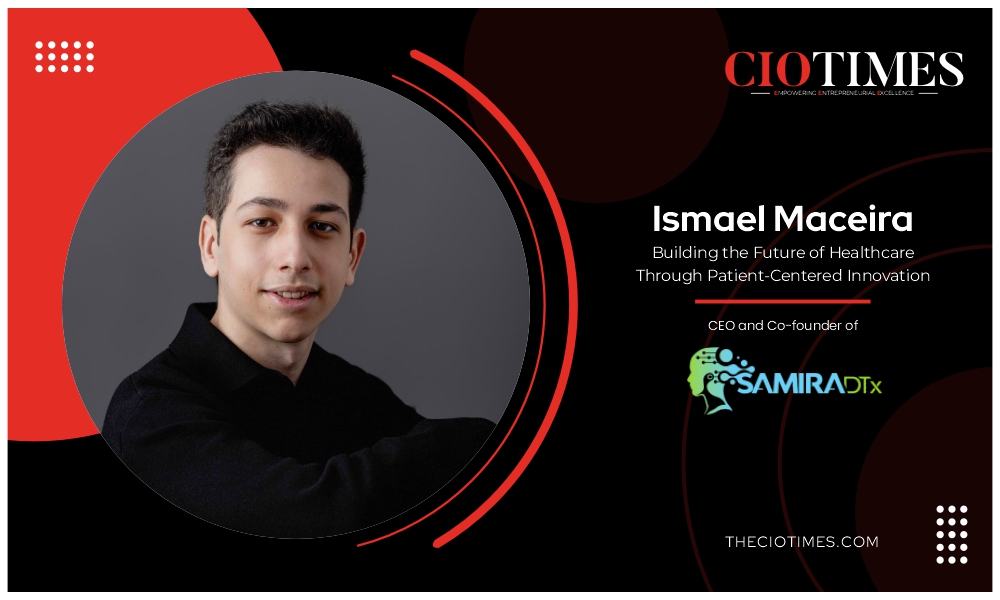
Healthcare is evolving rapidly, and visionary leaders are playing a fundamental role in shaping its future. Among them is Ismael Maceira, CEO and Co-founder of SAMIRA DTx, who is redefining patient care through innovativePrescription Digital Therapeutics (DTx). Driven by a clear purpose—to improve people’s lives—he is committed to developing evidence-based solutions that make healthcare more accessible, personalized, and effective. His deeply human leadership and unwavering commitment to innovation are helping bridge the gap between technology and compassionate care, positioning SAMIRA DTx as a company creating real impact within the HealthTech industry.
A Patient-Centered Philosophy
Reflecting on his experience from both sides of the healthcare system—as both a patient and an innovator—Ismael believes that one of healthcare’s greatest challenges is the lack of a shared perspective. Patients and innovators ultimately pursue the same goal, yet they too often view reality through entirely different lenses.
Living with a chronic illness taught Ismael that healthcare neither begins nor ends within the walls of a hospital. Illness becomes part of everyday life, influencing how a person studies, works, builds relationships, and envisions their future. Yet many technological advances continue to be designed around what is technically possible, rather than starting from what patients truly need to navigate their daily lives.
He also believes that technology is often misunderstood by patients, who frequently perceive it as cold, impersonal, or even fear that it will replace the human side of medicine. For Ismael, the opposite is true: genuine innovation frees healthcare professionals to spend more time listening, supporting, and caring for the people behind every diagnosis.
As he often says:
“This is exactly how SAMIRA DTx was born. It wasn’t born in a laboratory or during a business meeting. It was born from the experience of a 12-year-old boy living with Long COVID who desperately wished he had better tools to understand his condition, take part in decisions about his health, and regain some control over his life.”
That philosophy became the foundation upon which SAMIRA DTx was built. The company was not created in a boardroom or a research laboratory, but from the real-life experience of a patient. This patient-first approach has defined every Digital Therapeutic the company has developed from day one.
To achieve this, SAMIRA DTx actively involves patients, healthcare professionals, hospitals, and scientific societies throughout the entire development process, ensuring that every solution is grounded both in the lived experience of people affected by chronic diseases and in the highest standards of clinical evidence.
Beyond Digital Health
For Ismael Maceira , the questions truly worth answering have never originated in a boardroom—they have emerged from lived experience. Being diagnosed with Long COVID at the age of 12 gave him an understanding of healthcare that no medical textbook or business plan could ever provide. He learned that living with a chronic illness goes far beyond managing symptoms; it means learning how to navigate everyday life, often without the tools or support that patients genuinely need.
That perspective continues to shape the direction of SAMIRA DTx. Rather than asking what technology is capable of doing, Ismael believes the most important question is: What do people need in order to feel informed, supported, and empowered to manage their own health? Only then does technology become part of the solution.
This philosophy is embedded in every Digital Therapeutic (DTx) the company develops. Although each disease presents unique challenges, they all share a common need: helping people better understand their health, remain engaged with their treatment, and become active participants in their own care journey.
For Ismael Maceira , innovation has never been about developing sophisticated technology simply because it is possible. Its true value lies in making life easier for those who need it most. That is why every solution developed by SAMIRA DTx is co-designed alongside patients, healthcare professionals, hospitals, and scientific societies. In his view, the most meaningful innovations do not begin by writing code—they begin by listening to people.
Empathy Will Always Remain
From Ismael Maceira’s perspective, technology is an enabler.
Through his work at SAMIRA DTx, he has witnessed how Artificial Intelligence, digital biomarkers, virtual reality, and other emerging technologies have the potential to fundamentally transform healthcare. Yet he is equally convinced that their purpose must always remain the same: to help people provide better care—not to replace them.
In his opinion, technology should handle repetitive tasks, analyze information more efficiently, and support clinical decision-making. What it will never be able to do is comfort a patient, ease their fears, or build the trust that can only emerge through a genuine human relationship.
His vision is also shaped by his own experience as a patient. He does not remember the technology that was used during his medical appointments. What he remembers are the healthcare professionals who looked him in the eye, listened to him, and made him feel like much more than a diagnosis.
That is why he believes the success of innovation should not be measured by how intelligent a technology is, but by how much humanity it brings back to healthcare.
If a Digital Therapeutic enables a patient to be monitored from home, improves treatment adherence, or detects complications before they arise, its greatest value lies not only in those clinical benefits. Its greatest value is that it allows healthcare professionals to dedicate more time to what no machine will ever replace: listening, supporting, and caring.
As he often says:
“I always say that the future of healthcare will not become more human despite Artificial Intelligence—it will become more human because of it, provided we use it responsibly and ethically.”
Artificial Intelligence can analyze millions of data points in a matter of seconds, but it will never truly understand the fear, hope, or reassurance a person feels when someone says:
“We’ll walk this journey together.”
hared Care
Whenever Ismael hears the term “patient empowerment,” he cannot help but feel that, at times, we have overcomplicated what is actually a very simple concept. To him, empowerment means helping people understand what is happening to them, giving them confidence, and enabling them to actively participate in the decisions that affect their health.
This vision stems from his own personal experience. There were moments when he felt that decisions were being made around him, but not with him. Everyone wanted to help, yet what he needed most was to understand his condition and feel that his voice was also part of the process.
Over time, he came to realize something fundamental: patients and healthcare professionals are not on opposite sides—they are part of the same team. Physicians bring years of scientific knowledge and clinical expertise. Patients contribute something no one else can: the lived experience of managing a disease every single day. Both perspectives are equally essential.
This is precisely the philosophy that drives innovation at SAMIRA DTx.
Our prescription Digital Therapeutics (DTx) are not designed to replace physicians, but to bridge the gap between medical appointments. They help patients improve treatment adherence, better understand their condition, build healthier habits, and feel better prepared to manage their daily lives.
True empowerment begins when people stop seeing themselves solely as recipients of care and start recognizing themselves as active participants in their own health. The best innovation does not remove that responsibility—it gives people the confidence and the tools to embrace it.
The Future of Healthcare
For Ismael, the future of healthcare is not simply about discovering better treatments for disease. It is about helping people build a healthier relationship with their own well-being long before they ever need a hospital.
He firmly believes that, for decades, healthcare has largely operated by reacting to disease. The next major transformation, however, will be driven by prevention, education, and empowering individuals to take an active role in managing their own health. After all, our health depends just as much on the decisions we make every day as it does on what happens during a medical appointment.
That is why Ismael sees technology as an ally—not as the answer in itself.
At SAMIRA DTx, our prescription Digital Therapeutics are designed to support patients between medical visits, helping them better understand their condition, improve treatment adherence, and regain control over their health.
But if you ask him what the greatest transformation of the future will be, his answer is clear: it will not be technological—it will be cultural.
Health should not be measured solely by the absence of disease. It should also be measured by a person’s ability to live with well-being, adapt to life’s circumstances, and enjoy a high quality of life—even while living with a chronic condition.
His own experience as a patient shaped this conviction. He learned that although a diagnosis may remain the same, the way a person experiences and lives with it can change completely when they have the knowledge, support, and tools they need.
Ultimately, the true success of healthcare will not simply be measured by helping people live longer.
It will be measured by helping them live better.
People First
When the conversation turns to the future of healthcare, most people immediately think of new medicines or more advanced technologies. Ismael, however, believes that the greatest challenge still lies in understanding human behavior.
Today, we have extraordinary tools capable of detecting diseases at an early stage, analyzing vast amounts of data, and supporting clinical decision-making. Yet we still do not fully understand what truly determines a person’s health: their habits, emotions, motivation, fears, and the way they cope with their illness.
This is precisely where healthcare still faces its greatest challenge.
A treatment is only effective when it becomes part of a patient’s daily life. The real challenge is not always developing better medicines—it is helping people stay motivated, adopt healthier habits, and continue moving forward, even when living with a chronic condition becomes especially difficult.
This vision defines the work carried out at SAMIRA DTx.
Every Digital Therapeutic (DTx) is designed around the person, not just the diagnosis. The goal is to create solutions that integrate naturally into patients’ daily routines and encourage small, sustainable behavioral changes that, over time, can profoundly improve the course of their disease.
It is a deeply personal philosophy.
As a patient, Ismael discovered that understanding a diagnosis was only the beginning. The real challenge was learning to live with a new reality, building new routines, staying motivated, and continuing to move forward day after day.
As he often says:
“I believe this is where the true future of Digital Therapeutics lies: not only in treating diseases, but in accompanying people as they build healthier habits, regain confidence, and become active participants in their own health.”
For this reason, he is convinced that the next generation of healthcare innovation will not be defined solely by smarter algorithms, but by solutions capable of truly understanding the people who use them.
Data can explain what is happening.
But real transformation begins when we help people change the behaviors that determine their health. That is where lasting impact is created. That is where people regain the confidence to take ownership of their own well-being.
Built on Purpose
Many people focus on the fact that Ismael became a CEO at just sixteen years old. He sees it differently.
To him, the title was never a personal ambition. It was the responsibility of bringing to life a project he deeply believed in—one that had the potential to improve the lives of millions of people.
Being young meant facing prejudice. On many occasions, he felt he had to prove his age before anyone was willing to listen to his ideas. Rather than trying to appear more experienced, he chose to remain curious, keep learning, and let results speak for themselves.
That experience taught him one of the most valuable lessons about leadership at an early age:
A leader is not the person who has all the answers, but the one who knows how to surround themselves with the right people, trust their talent, and create an environment where everyone can grow.
This philosophy is reflected in the ZEO Manifesto (Zero Ego Operator), a leadership framework created and published by Ismael that proposes a new way of building companies and leading organizations.
For him, ZEO is not a title—it is a mindset. It is a way of leading grounded in purpose, humility, collaboration, and impact, where leadership is no longer viewed as a position of power but as a responsibility to serve others.
As he writes in the manifesto:
“A ZEO does not seek power; a ZEO seeks impact. They do not lead from above—they build from within. They do not create employees—they develop leaders. They do not compete out of ego—they innovate with purpose.”
That is precisely the culture he has built at SAMIRA DTx.
It does not matter whether someone comes from medicine, artificial intelligence, engineering, or software development. What truly matters is that everyone shares the same purpose: improving the lives of patients.
For Ismael, purpose will always come before hierarchy.
He firmly believes that the companies of the future will need less ego, more trust, and more people capable of building a shared vision together.
His philosophy of leadership is also rooted in his own experience as a patient. Living with a chronic illness taught him that behind every healthcare decision there is always a person with fears, hopes, dreams, and a story that deserves to be heard.
It is something he never forgets when making decisions.
If there is one message he hopes his journey will leave behind, it is this:
Leadership is not determined by age, but by humility, purpose, and the ability to help others unlock their full potential.
Rather than being remembered simply as a young CEO, Ismael hopes to be remembered as someone who proved that when people come together around a shared purpose, they can build projects that truly change lives.
Because, as he concludes in the ZEO Manifesto:
“Great companies are not built by titles. They are built by people who inspire other people to create a better future.”
Beyond Great Ideas
When discussing the world’s most innovative healthcare ecosystems, Ismael is convinced that the real difference does not lie in funding or access to technology. The true differentiator is mindset.
This conviction has guided SAMIRA DTx since day one. Ismael has always believed that the greatest transformations in healthcare are never the result of one individual working alone. They emerge when patients, healthcare professionals, researchers, engineers, universities, hospitals, companies, and public institutions share the same vision and collaborate to solve real-world challenges.
This philosophy has made SAMIRA DTx a company deeply embedded within an open innovation ecosystem, operating at the local, national, and international levels. The company is supported by BEAZ, an initiative of the Bizkaia Provincial Council, and collaborates with leading universities such as the University of Deusto and DigiPen Institute of Technology; renowned technology centers including Tecnalia, Tekniker, and Vicomtech; public institutions such as the Basque Government’s SPRI, BIOEF, and Lantik; and scientific societies including SEMG, SEMERGEN, and the Spanish Society of Cardiology (SEC).
Above all, however, SAMIRA DTx works alongside those who understand disease better than anyone else: patient organizations. These include the Spanish Platform of Patient Organizations (POP), Asma y Alergia España, Incuba DCA, the Spanish Parkinson’s Federation, and REiCOP, all of which actively participate in the design, development, and clinical validation of the company’s Digital Therapeutics (DTx).
In addition, SAMIRA DTx actively participates in some of Spain’s and Europe’s leading innovation ecosystems, including GAIA, the Basque Health Cluster (BHC), the Spanish Consortium for Digital Therapeutics (CDTx), the Spanish Quantum Alliance (SQuA)—of which it is a Founding Organization—and the Saudi Business Council Spain (SBC). These strategic partnerships enable the company to foster open innovation, accelerate knowledge transfer, and strengthen its presence across Europe, Latin America, and the Middle East.
Because patients are not merely the final beneficiaries of innovation.
They are an essential part of creating it.
This approach ensures that every solution developed by SAMIRA DTx addresses genuine clinical needs rather than assumptions conceived in a laboratory or boardroom.
His commitment to building bridges between innovation ecosystems has also been recognized internationally through his appointment as Founding Young Ambassador of the Saudi Business Council Spain, a role through which he promotes collaboration between Europe and the Middle East in healthcare, innovation, and entrepreneurship, fostering the exchange of talent, knowledge, and opportunities between both regions.
His experience working with organizations across Europe, Latin America, and the Middle East has only strengthened this conviction. Although every region has its own unique strengths, the most successful innovation ecosystems share one common characteristic: they understand that collaboration and competition are not opposing concepts. They recognize that knowledge grows when it is shared, and that meaningful impact is created when organizations work together toward a common purpose.
This same philosophy guides the growth of SAMIRA DTx.
As the company continues to expand, Ismael seeks far more than investment capital. He seeks strategic partners who share a long-term vision and understand that transforming healthcare requires building strong, lasting alliances. He is not interested in investors who contribute only financial resources; he looks for people and organizations that bring knowledge, experience, networks, and the ability to accelerate meaningful change.
He is convinced that the future of healthcare innovation will not belong to those with the greatest resources or the most advanced technology.
It will belong to those capable of building the strongest ecosystems, creating the most valuable partnerships, and placing purpose above individual interests.
The Patient Always Comes First
Whenever Ismael thinks about healthcare innovation, he never begins by asking what technology is capable of doing.
He starts with a much simpler question:
“Will this genuinely improve patients’ lives?”
For him, that is a line no innovator should ever cross.
Healthcare is unlike any other industry. Every new technology has the potential to directly affect a person’s health, dignity, and peace of mind. That is why trust is just as important as innovation itself.
Ismael Maceira is fascinated by the potential of technologies such as Artificial Intelligence to accelerate diagnoses, personalize treatments, and improve healthcare delivery. However, he also believes that these advances come with enormous responsibility.
If people do not understand a technology, do not trust it, or do not feel comfortable using it, even the greatest innovation loses much of its value.
As he often says:
“At SAMIRA DTx, we have a very clear philosophy: technology should enhance the ability to care—it should never replace care.”
What concerns him most is the possibility that healthcare could become obsessed with efficiency and forget what patients truly remember years later: a reassuring conversation, a physician who genuinely listens, or someone who gives them hope.
Those moments can never be automated.
This conviction is reflected in every decision made at SAMIRA DTx.
The company does not develop Digital Therapeutics simply because the technology exists to do so. It develops them together with patients, healthcare professionals, hospitals, and scientific societies, ensuring that every solution addresses a real clinical need and integrates naturally into people’s everyday lives.
Furthermore, Ismael believes that innovation should bring healthcare closer to people—not create new barriers.
The best solutions are those that every patient can understand, use, and trust, regardless of where they live or their personal circumstances.
Ultimately, his way of measuring innovation is different.
It is not about developing the most advanced technology.
It is about creating solutions that enable people to live healthier, more independent, and more confident lives.
Beyond the Walls of Healthcare
When Ismael imagines the future of healthcare, he does not think about larger hospitals or more sophisticated machines. He thinks about a world where no one ever has to face their illness alone again.
He is convinced that one of the greatest challenges facing today’s healthcare systems is not a lack of professionals or scientific knowledge. The real challenge is that care remains concentrated around isolated moments, while illness accompanies patients twenty-four hours a day.
A patient may spend only a few minutes with their physician and then face weeks or even months of symptoms, decisions, fears, and uncertainty without a tool to support them along the way.
That gap in care is precisely what he wants to transform.
For Ismael, the medicine of the future cannot simply treat diseases once they appear. It must continuously support people, learn from them, and provide personalized guidance long before a condition worsens.
That is why SAMIRA DTx was created.
Not to replace healthcare professionals, but to enhance their ability to care.
Not to replace the physician-patient relationship, but to extend it beyond the consultation room.
Through prescription Digital Therapeutics (DTx) powered by Artificial Intelligence, digital biomarkers, voice and image analysis, virtual reality, therapeutic video games, and, in the near future, quantum computing, SAMIRA DTx is building a new generation of solutions capable of accompanying patients every day, adapting to their progress, and helping them better understand their condition.
Because when technology is thoughtfully designed, it stops being just an application.
It becomes a companion.
It does not simply collect data. It learns from it.
It does not merely monitor. It anticipates.
It does not only inform. It educates, motivates, empowers, and helps people regain control over their health.
For Ismael Maceira , this is the true potential of Artificial Intelligence in healthcare: not to replace clinical judgment, but to transform millions of data points into meaningful knowledge, enabling the right intervention for the right person at the right time.
As he often says:
“The next great healthcare revolution will not simply be about discovering new treatments. It will be about developing technologies capable of accompanying every patient, learning from their journey, and delivering truly personalized, predictive, and human-centered medicine.”
However, he is convinced that technology alone will not drive that revolution.
The next generation of healthcare will emerge from collaboration among patients, healthcare professionals, researchers, engineers, universities, public institutions, and companies that share the same vision.
Because no organization, regardless of its size, can transform such a complex system on its own.
That is why SAMIRA DTx has built an open innovation ecosystem in which patients are no longer passive recipients of innovation but active contributors to its design and development. Every Digital Therapeutic is created alongside those who know the disease best: the people who live with it every day.
Perhaps this is the greatest innovation of all.
Not Artificial Intelligence.
Not Virtual Reality.
Not Quantum Computing.
But the understanding that technology reaches its greatest value only when it gives people back what illness so often takes away: autonomy, confidence, and hope.
Ismael Maceira is convinced that, in the years ahead, we will speak about Digital Therapeutics as naturally as we speak about medicines today. They will become another essential tool within the therapeutic arsenal—prescribed by healthcare professionals, supported by scientific evidence, and tailored to each patient’s needs.
Because the future of healthcare will not simply be about curing more diseases.
It will be about caring for people better.
It will be about building a healthcare system that does not disappear when patients leave the hospital, but remains by their side every day, helping them understand their condition, make better decisions, and regain ownership of their health.
That is the future Ismael envisions. And it is the future that SAMIRA DTx is working to make a reality.
Changing the Way We Think About Health
When Ismael Maceira thinks about success twenty years from now, he does not think first about technology.
He thinks about people.
Over time, he has reached one very clear conclusion: innovation will continue to accelerate, new technologies will emerge, healthcare models will evolve, and challenges we cannot yet imagine will arise. We live in an era of constant transformation, where the ability to adapt is no longer a competitive advantage—it is a necessity.
And this need for adaptation applies not only to organizations.
It also applies to people.
As a chronic patient, the greatest turning point in his life was not receiving the diagnosis.
It was realizing that although he could not choose the disease he lived with, he could choose how to live with it.
That shift in mindset completely transformed his understanding of health.
It did not mean having all the answers.
It meant regaining enough confidence to start making better decisions, one step at a time.
Today, that same philosophy guides everything SAMIRA DTx does.
The company develops prescription Digital Therapeutics to improve clinical outcomes, but Ismael always emphasizes that technology is only the means.
The real goal is far more ambitious: to help people better understand their health, regain confidence, and become active participants in their own care journey.
Because a Digital Therapeutic does not simply accompany a treatment.
It accompanies a person.
It helps them understand what is happening inside their body, build healthier habits, maintain treatment adherence, and regain the sense of control that chronic illness so often takes away.
As he often says:
“The most valuable technology is not the one that does the most. It is the one that helps a person believe they can live better again.”
But this ability to adapt to change does not define only the technology developed by SAMIRA DTx.
It also defines the company’s culture.
Ismael Maceira often says that SAMIRA DTx pursues health both outside and inside the organization.
Outside, by helping millions of patients live healthier and better lives.
Inside, by creating an environment where people can grow, develop, and care for their own well-being.
For this reason, the company has built a management model inspired by organizations such as Netflix, founded on trust, freedom, and responsibility.
They do not believe in rigid hierarchies or cultures built around control.
They believe in self-leadership, continuous self-development, personal accountability, and teams empowered to make decisions independently, learn continuously, and adapt to an ever-changing environment.
Because just as medicine is constantly evolving, organizations must evolve as well.
The companies that will thrive in the future will not necessarily be the largest.
They will be the ones that learn faster, collaborate better, and continuously reinvent themselves without ever losing sight of their purpose.
At SAMIRA DTx, that purpose never changes:
Improving people’s lives.
Ismael Maceira is convinced that the future of healthcare will be measured very differently.
Not only by our ability to discover new treatments or develop smarter technologies.
But also by our ability to provide people with the knowledge, support, and tools they need to live better—even while living with a chronic disease.
Likewise, the success of a company should not be measured solely by its revenue or growth.
It should also be measured by its ability to create cultures where people are inspired to contribute their very best, innovate without fear, and grow around a shared purpose.
For Ismael Maceira , these two paths are inseparable.
A company cannot truly care for patients if it does not first know how to care for its own people.
If one day SAMIRA DTx succeeds in helping millions of patients feel safer, more independent, and enjoy a better quality of life, while also building an organization where people work with freedom, trust, and purpose, then technology, innovation, and business growth will have fulfilled their true mission.
Because true innovation is not only about changing the way diseases are treated. It is about changing the way we care for people—both outside and inside the organization.
Recognition Box
CIO Times proudly honors Ismael Maceira for his visionary leadership, unwavering commitment to innovation, and enduring contributions to digital transformation. In our latest edition ‘HealthTech Innovator of the Year’, we are delighted to feature him as he continues to shape the future of technology while inspiring leaders across industries.
After a serious business discussion, we requested Ismael to respond with some casual questions which he humbly agreed to answer. The conversation went as follows:
Q.1. What book are you reading currently?
Ismael Maceira : Although my illness makes it difficult for me to read and retain information, I’m making a great effort—with a little help—to read “Artificial Intelligence and Talent: Keys to Leading the Future” by María Álvarez de Linera Ros and my friend Víctor Martínez Monge.
And it has left me with one very clear thought:
Q.2. This isn’t a book about Artificial Intelligence. It’s a book about people. About leadership. About purpose. About soul.
Ismael Maceira : Because the best technology will always be the one that helps people become better.
Q.3. One word that best describes your personality:
Ismael Maceira : Purpose-driven
Q.4. What’s the most important lesson you’ve learned? (Personal or professional)
Ismael Maceira : Life doesn’t always give us the chance to choose what happens to us. But it always gives us the chance to choose who we become because of it. I didn’t choose my illness, but I chose to transform it into a purpose: helping others live better lives.”
Q.5. What’s the best professional advice you’ve received?
Ismael Maceira : “Always put purpose before ego.”
Q.6. What is your favorite quote?
Ismael Maceira : As one of my greatest role models, Ousman Umar, says:
“The question is not, ‘Why did this happen to me?’ but rather, ‘How can I use this experience to help others?'”
It is a message that resonates deeply with me. I didn’t choose my illness, but I chose to turn it into a purpose: helping other people live better lives.
Also Read :- CIO Times Magazine for More Informationhttps://es.linkedin.com/in/ismael-maceira-lecanda