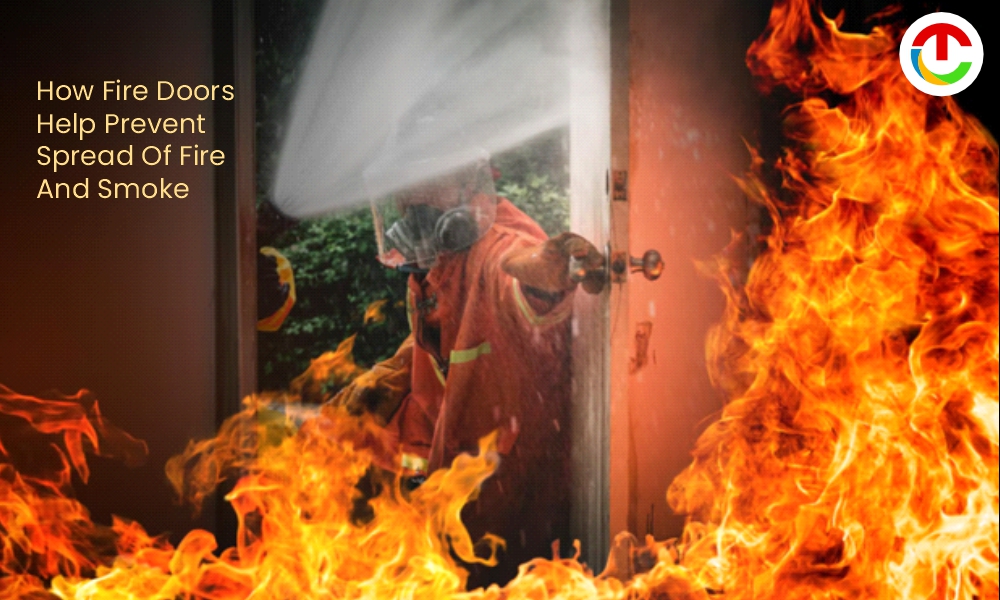
The spread of a fire in a building can take place at a much higher rate than you may think.
Fire can spread to neighboring rooms, with smoke potentially spreading rapidly through corridors, staircases, and similar places. When the smoke travels, visibility is reduced, and the escape routes may be hard to utilize safely.
Because of these risks, many property owners look for ways to improve fire safety and slow the spread of fire and smoke.
The fire door is one of the effective solutions. Fire doors are designed and tested to withstand fire and limit the flow of smoke over a certain time, so that they help protect the occupants and aid in the process of safer evacuation.
So, how do fire doors help prevent the spread of fire and smoke?
Keep reading to learn how they work, the features that make them effective, and why they are a key element of building safety.
1. Fire-Resistant Construction Slows the Spread of Flames

Fire doors are specifically made to withstand fire over a period of time and delay the spread of flames within a building. In contrast to regular interior doors, which can easily break down in high temperatures, fire doors are made from fire-resistant materials and through special construction techniques.
Many fire doors feature solid wood cores, particleboard cores, or other engineered materials designed to withstand high temperatures for longer periods. The thick core provides structural integrity to the door and limits the rate at which heat can penetrate through the door assembly when exposed to fire. Such resistance can serve to contain flames inside the room where the fire has started instead of letting it propagate quickly in adjacent areas.
By delaying the effects of heat and fire, these doors help create a more controlled environment during an emergency. The additional time can support evacuation efforts and assist emergency responders as they work to manage the incident.
2. Compartmentation Helps Contain Fire Within One Area
One of the most significant principles of fire safety today is compartmentation. It involves dividing a building into separate sections, or compartments, designed to slow the spread of fire and smoke from one area to another.
Fire doors are vital in this strategy. They are positioned between rooms, corridors, staircases, and other strategic locations, and act as barriers that can isolate a fire in the compartment where it originates. Such containment minimizes the chances of flames spreading at high rates within the building.
Compartmentation is especially relevant in bigger residential structures, apartment complexes, offices, schools, healthcare settings, and other structures where numerous occupants might require time to evacuate in a safe manner. Hallways and stairwells are the most common escape routes, and it is necessary to avoid letting fire and smoke into those areas too quickly.
When compartmentation works properly, it assists in maintaining escape routes, limiting damage to unexposed locations, and assisting emergency services during their response to the incident.
3. Intumescent and Smoke Seals Restrict Fire and Smoke Movement

Even a well-constructed fire door requires effective sealing around its edges. Small gaps between the door and frame are necessary for normal operation, but during a fire these openings can become pathways for heat, flames, and smoke.
To address this issue, fire doors are fitted with intumescent seals, typically located around the edges of the door or frame. These seals are manufactured from materials that react to high temperatures. When exposed to heat, they expand significantly, filling the gaps around the door and creating a tighter barrier.
This expansion helps prevent flames and hot gases from passing through the doorway. Many fire doors also incorporate smoke seals, which help restrict smoke transfer during the earlier stages of a fire. Since smoke often spreads faster than flames, limiting its spread helps preserve visibility and keep escape routes clearer.
Together, intumescent and smoke seals help reduce the transfer of heat, flames, and smoke between compartments while preserving escape routes and supporting safer evacuation.
4. Self-Closing Mechanisms Keep Fire Doors Ready to Perform
A fire door can only perform its intended function when it is closed. For this reason, self-closing devices are considered one of the most important components of a fire door system.
These mechanisms automatically return the door to its closed position after it has been opened. This ensures the barrier remains in place without relying on occupants to close the door manually.
Without a self-closing device, a fire door may be left partially open or fully open during normal building use. In such situations, the door cannot effectively contain flames or smoke, significantly reducing its ability to safeguard occupants and property.
Self-closing mechanisms are particularly important in communal areas, hallways, stairwells, and other locations where doors experience frequent use. By ensuring the door returns to its closed position after each use, these devices help maintain the level of fire resistance the door was designed to provide.
5. FD30 and FD60 Ratings Provide Valuable Protection Time

Fire door ratings indicate how long a door assembly has been tested to resist fire under controlled conditions. The most common classifications are FD30 and FD60.
An FD30 fire door is designed to provide at least 30 minutes of fire resistance and is commonly used in many residential properties, including houses, condos, and apartment buildings. FD60 fire doors provide at least 60 minutes of fire resistance and may be required in higher-risk environments or areas where additional performance is necessary.
Additional protection time can be crucial in larger buildings or locations where evacuation may take longer. By slowing the spread of flames and smoke, FD30 and FD60 doors provide valuable time for occupants to leave the building safely and for emergency services to respond.
6. Certified Components and Correct Installation Ensure Reliable Performance
A fire door is only as effective as the system supporting it. Every component, including hinges, frames, glazing, seals, locks, and closing devices, contributes to the overall performance of the assembly.
Certified components are tested to work together as part of a complete fire door system. Using incompatible or uncertified parts can weaken the assembly and reduce its ability to resist fire and smoke.
Correct installation is equally important. Factors such as frame alignment, gap tolerances, fastening methods, and hardware placement all influence how the door performs during a fire. Even small installation errors can create weaknesses that allow smoke or flames to pass through more easily.
Regular inspections and maintenance help identify worn seals, damaged hinges, faulty closers, or other issues that could affect performance. Addressing these problems promptly helps ensure the fire door continues to deliver the standard of fire resistance it was designed to achieve.
Bottom Line
Fire doors are far more than standard interior doors with a fire rating. They form part of a carefully designed fire safety system that helps slow the spread of flames and smoke, preserves escape routes, and provides valuable time during an emergency.
When properly specified, installed, and maintained, fire doors contribute significantly to occupant safety and help reduce damage within a property.
Understanding how these systems work can help property owners make informed decisions and strengthen fire safety throughout their buildings.
Also Read :- CIO Times Magazine for More Information