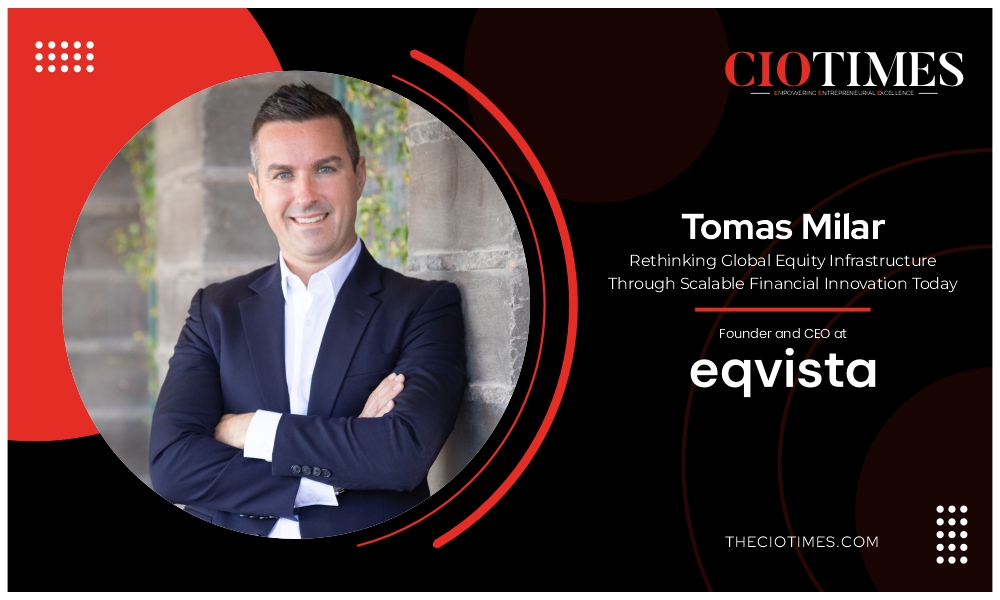
Business leaders today are shaping how organizations grow and adapt. With a measured approach, they balance fresh thinking with practical execution. They foster environments where teams feel comfortable exploring new ideas. Their leadership reflects a broader sense of responsibility, extending beyond the organization to the communities they serve. Tomas Milar, Founder and CEO at Eqvista, is a leader whose impact is felt through consistent actions that move businesses forward with purpose and clarity.
He brings in experience across engineering, finance, and equity management to shape his work. Through Eqvista, he has taken a workable approach to helping private companies manage ownership, valuations, and compliance more smoothly as they grow. His work connects the needs of startups with evolving financial systems that use technology to reduce complexities. At a broader level, he aims to make equity ownership easier to understand and navigate.
ConTomas Milarnected Valuations
Eqvista’s AI-driven valuation engine currently supports valuation analysis across approximately $2 Trillion in private company equity. It gives the company an increasingly data-rich foundation for scaling valuation infrastructure.
He shares that equity management and valuation are naturally coming together. As private markets grow in size, expand globally, and see greater institutional participation, he feels companies need more than static cap tables or annual valuation reports.
He shares, “Companies need an up-to-date system that links equity records, compliance, fundraising events, secondary transactions, option grants, investor reporting, and fair market value.”
As a part of this shift, he mentions plans for Eqvista 100, a benchmark designed to spotlight leading private companies while adding more structure, visibility, and a data-driven perspective to the space. He sees valuation evolving from a periodic compliance exercise into a real-time intelligence layer for private markets, helping companies maintain a clearer understanding of their financial position as ownership structures become more dynamic and interconnected.
Ownership Infrastructure
Tomas Milar envisions positioning Eqvista to $10 trillion AUA, as it signals a broader rethink of ownership infrastructure. With the private market estimated at around $12 trillion, he sees a need for stronger systems to manage and grasp ownership at scale. He notes that companies still rely on spreadsheets, legal documents, outdated valuation workflows, and fragmented platforms, often leading to gaps such as inaccurate records, delayed valuations, limited visibility into employee equity, inefficient secondary liquidity, and inconsistent investor reporting.
Tomas Milar explains that Eqvista aims to address these gaps by becoming a dependable infrastructure layer for private company equity. Rather than functioning solely as a cap table platform, Eqvista aims to become a foundational ownership infrastructure layer that helps companies better understand, price, manage, and communicate equity with greater clarity and confidence. He adds that initiatives like Eqvista 100 can support transparency and benchmarking in private markets, giving stakeholders a clearer view of value creation.
Perspectives that Shape
Tomas Milar has triumphantly built several ventures across markets and cycles. There have been a few observations or insights that he was kind enough to share with us:
1. Ownership matters
Whether building a small startup or a global enterprise, how ownership is structured, tracked, valued, and communicated impacts long-term outcomes.
2. Markets reward infrastructure that reduces friction
Many industries seem complex on the surface, but often rely on outdated processes, fragmented systems, and unnecessary delays. He has consistently sought ways to simplify fundamentals with technology.
3. Resilience outweighs timing
Business cycles change, capital markets tighten and expand, regulations evolve, and geographies rise, but companies that solve real problems and remain disciplined are most likely to endure.
Scalable Infrastructure
Tomas Milar explains that the broader vision is to help build infrastructure capable of continuously valuing a private market estimated at approximately $12 trillion. He shares that Eqvist’s AI-driven valuation engine already covers around $2 trillion in private company equity. It is close to 20% of the estimated $12 trillion market. It gives the team a solid starting point to expand the role of data, automation, and real-time insights.
He notes that private company ownership is still handled through legacy systems, legal documents, and outdated valuation workflows. These often lead to gaps like inaccurate records, delayed valuations, limited visibility into employee equity, inefficient secondary liquidity, and inconsistent investor reporting. He explains that the organization aspires to bridge these gaps by serving as a dependable infrastructure layer, helping companies better understand, price, manage, and communicate ownership with greater clarity and confidence as private markets continue to grow simultaneously.
Regional Approaches
Tomas Milar has operated across the US, Asia, and Europe to build resilient and adaptable businesses. The regulatory asymmetries have given him an outlook on how it shapes business strategy. The US often rewards speed, innovation, and market-driven experimentation. In contrast, Europe places greater emphasis on compliance, governance, and data protection. Meanwhile, Asia is highly diverse, with some markets moving quickly on digital finance while others remain more conservative or relationship-driven. As a result, building across these regions requires adaptability. A resilient business cannot assume one regulatory model will apply everywhere. It must be modular, compliant by design, and flexible enough to serve companies operating under different legal, tax, and reporting standards.
Evolving Valuations
Equity management and valuation are areas that naturally blend together. As private markets expand, reach new geographical boundaries, and become more institutionalized, he believes companies need more than a static cap table or a yearly valuation exercise. They increasingly rely on a connected ownership framework that ties together equity records, compliance, fundraising activity, secondary transactions, option grants, investor reporting, and fair market value.
He sees this space evolving into integrated, real-time systems in which valuation moves beyond a periodic requirement and becomes a continuous source of insight, helping companies better understand their financial standing at any given moment.
Unified Infrastructure
Tomas Milar believes Eqvista and Cheqly both operate at the core of financial infrastructure, and he sees a natural path toward greater convergence between the two over time. According to him, startups do not think about their financial needs in separate boxes. Founders are simultaneously managing banking, payments, equity management, compliance, valuations, fundraising support, and overall financial visibility, often through multiple disconnected platforms.
He shares, “I believe startups and growth-stage companies will expect a more unified ecosystem where financial operations and ownership infrastructure work together.”
In his view, the real opportunity lies in simplifying the operational burden for founders, allowing them to spend less time navigating administrative complexity and more time building, growing, and scaling their businesses.
Enduring Value
Drawing from his experience building, acquiring, and exiting companies, Tomas believes the real sign of an enduring business goes far beyond rapid growth. While growth can be exciting, he feels it can also be temporary if it is not supported by something more meaningful underneath. Lasting companies are the ones that solve real, ongoing problems, continue creating value for customers over time, build trust consistently, and evolve without drifting away from their original purpose.
In his view, a business that is merely successful may capture attention for a period of time. Still, an enduring business becomes deeply embedded in the day-to-day operations of its customers. Tomas says that is exactly the kind of long-term, trusted company they are working to build with Eqvista.
Modernizing Private Valuations
Tomas Milar believes democratizing valuation services is an important part of his work because the traditional valuation process has often been too expensive, slow, and difficult for many private companies to fully understand. In his view, many valuation systems still rely heavily on manual data collection, disconnected assumptions, and static PDF reports that quickly become outdated. While those reports may fulfill compliance requirements, they rarely provide founders, employees, or investors with a real-time understanding of how a company’s value is evolving or what factors are influencing it.
Tomas Milar also feels that many founders lack full visibility into how their company’s valuation is determined, while employees often understand even less about the value of their equity. According to him, one of the biggest hidden inefficiencies in the industry is that valuation is still treated as a fixed document rather than an ongoing, evolving process. That belief helped shape Eqvista Real-Time Company Valuation®, which was designed to transform valuation into a more dynamic and data-driven intelligence layer for private markets.
He states, “With better data, automation, AI-driven analysis, and integrated ownership records, valuation can become more accessible, more frequent, and more useful for decision-making.”
Over time, Tomas sees the potential for Eqvista Real-Time Company Valuation® to help bring greater transparency, consistency, and confidence to how private companies are valued and managed.
Balanced Innovation
Tomas Milar believes one of fintech’s biggest challenges is that innovation often moves faster than regulation. In his view, leaders need to balance speed with responsibility because while innovation matters, trust matters even more in the long run. He feels the best companies build compliance into their systems from the beginning instead of treating regulation as a problem to solve later.
This means understanding the purpose behind regulations, maintaining strong internal controls, protecting customer data, and being transparent about limitations. He believes innovation without trust cannot last, but regulation without innovation can also slow progress and limit access. For Tomas, responsible fintech leadership is about finding the right balance between the two.
Founder Missteps
Through his work with founders and accelerators, Tomas has observed that many early-stage entrepreneurs often misjudge scale, timing, and market readiness. In his view, founders frequently overestimate how quickly people will adopt a product while underestimating how much education the market may need first. He has also seen many confuse fundraising momentum with genuine product-market fit. Just because a market is large does not mean a company is fully ready to capture it.
Tomas Milar believes timing is equally important. Even a strong idea, he says, can struggle if the infrastructure, regulations, customer behavior, or capital environment are not ready. In his experience, the best founders are ambitious but practical. They stay close to their customers, move quickly, and adapt when necessary without losing sight of the core problem they are trying to solve.
Multidisciplinary Perspective
Tomas Milar believes his background in engineering, finance, and global entrepreneurship has shaped the way he approaches both risk and opportunity. In his view, engineering teaches systems thinking and problem-solving, while finance builds an understanding of incentives, valuation, capital allocation, and risk. Entrepreneurship, he says, teaches resilience and shows that execution, timing, people, and persistence matter just as much as the original idea.
He shares, “When I evaluate an opportunity, I look at the technical feasibility, the economic model, the regulatory environment, the customer pain point, and the long-term market structure.”
He believes this broader perspective helps him assess risk more thoughtfully instead of from just one angle.
Embedded Banking
As neobanking evolves, he reflects on what fundamental shifts startups expect in interacting with financial institutions beyond transactions today in practice. He notes that startups will expect financial institutions to become more embedded, intelligent, and operationally useful. They will not only want a place to hold money or process transactions.
They will want financial systems that connect to payroll, equity taxes, compliance payments, fundraising investor updates, and forecasting. The next generation of startup banking will be less about accounts and more about context. Startups will expect their financial infrastructure to understand their stage, the decisions they need to make, and the risks they need to manage.
Ecosystem Alignment
Tomas Milar has worked closely with investors, policymakers, and operators, and often emphasizes how central ecosystem orchestration is to building companies that stay relevant over the long run.
In his view, companies don’t really scale in isolation. Founders depend on a wide network of investors, employees, regulators, service providers, customers, banks, accelerators, legal advisors, and technology partners, all playing a role in how the business grows and stabilizes.
In the context of Eqvista, this thinking translates into helping founders, investors, employees, and institutions work with clearer ownership structures and more transparent valuation systems, so that the ecosystem around a company can function with greater confidence and alignment.
Transparent Ownership Economy
He sees meaningful innovation in financial services as something deeper than automation for its own sake. In his view, it is really about strengthening trust, widening access, and improving transparency and efficiency across the system.
Automation, he believes, should remove redundant tasks rather than dominate the experience. Data should sharpen decision-making, and decentralization should broaden participation where it genuinely adds value. But the core needs stay intact. It is that people and companies still want better ways to manage capital, ownership, risk, and opportunity.
When it comes to private markets, Tomas often points out that ‘liquidity’ is discussed loosely, without clarity on what it actually means in practice. One of the core structural challenges in private markets is price discovery. It creates a clearer and more consistent way to understand the value of privately held companies. Until there is a clearer and more consistent way to understand the value of privately held companies, the ecosystem will remain inefficient. That price signal influences everything, from fundraising, employee equity, secondary transactions, investor behavior, tax planning, and long-term ownership decisions.
Valuable innovation for him takes place when it means making advanced financial infrastructure accessible not just to large institutions, but also to startups, employees, and emerging businesses across markets. He sees the broader mission as building a more transparent ownership economy, where private companies are staying private longer, and equity participation is becoming more widespread.
In this context, his focus with Eqvista is on helping companies better understand value, manage equity with clarity, and make more confident decisions as they surge.
Also Read:- CIO Time Magazine for More Information