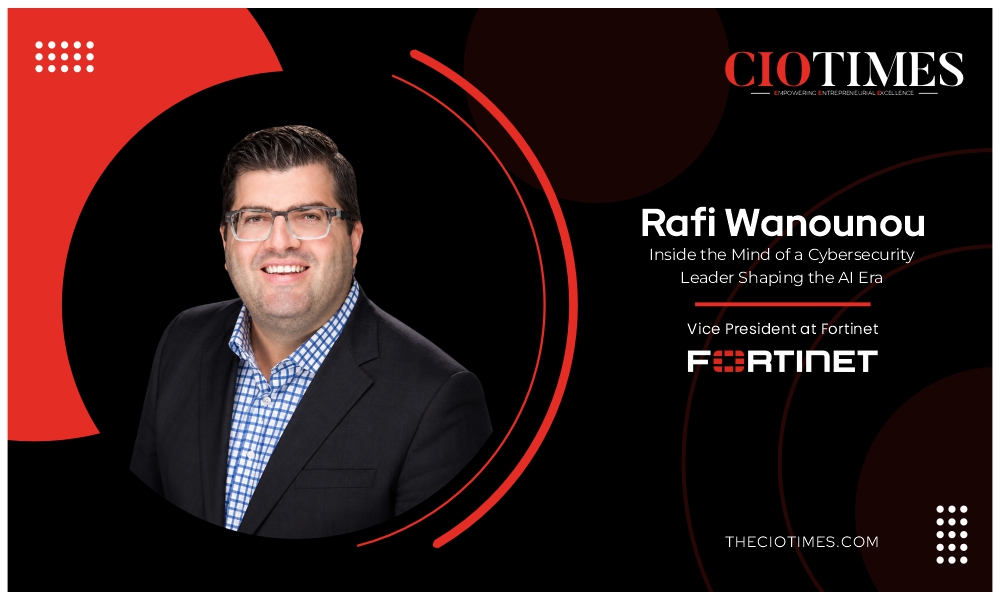
We exist in an industry often obsessed with products, platforms, and the next big technological breakthrough. There are a rare few leaders who cut through the noise with a deceptively simple philosophy: solve real problems. For Rafi Wanounou,Vice President Fortinet (Toronto), this philosophy has not only shaped his career but also empowered the kind of consistent growth and industry impact that many organizations strive for but few achieve.
Lately, as enterprises navigate the dual forces of relentless cyber threats and the transformative rise of artificial intelligence, he stands at the intersection of strategy, execution, and foresight. As a senior technology executive operating at the highest levels of enterprise scale, his journey reflects a deeper truth about modern business: success is no longer about what you sell, it’s about what you solve.
Beyond the Growth Curve
Scaling the business in Toronto Metro from $1 million to over $100 million in annual recurring revenue is rarely a straight line. It’s a journey marked by inflection points, moments when conventional strategies fall short, and leaders are forced to rethink their approach. Those moments weren’t obstacles; they were signals that the industry was ready for a generational shift.
He emphasizes, “Trust is the ultimate currency in enterprise technology.”
This shift from selling products to delivering solutions proved transformative. In a world where technology evolves at breakneck speed, this approach builds a foundation of reliability. By focusing on the ‘why’ behind a client’s struggle rather than just the ‘what’ of a software patch, he has managed to turn traditional sales cycles into meaningful, lasting alliances.
Innovation vs. Stability
In his dual role as Vice President and Chief Technology Officer, Rafi functions in a space defined by tension. One side demands rapid innovation. The other side demands an uncompromising need for enterprise-grade stability, especially in sectors like financial services and public infrastructure, where failure is not an option.
Rafi Wanounou adds, “It’s a mindset you can only develop through experience.”
That experience is reflected in the team he has built, an extraordinary collective with over 900 years of combined enterprise expertise. Together, they steer operations where decisions must balance speed and precision, risk and reward. Their guiding principle is to operate at the speed of “go,” not “no,” challenging the conventional perception of enterprise technology as slow and risk-averse.
Combining Deployment and Business Outcomes
One of the most significant shifts in modern enterprise thinking is the move from integrating technology to delivering measurable outcomes. But in practice, this is rarely direct. Clients often face misaligned expectations, constrained budgets, and varying levels of organizational readiness. In such scenarios, the role of a technology partner extends far beyond implementation.
He explains, “It’s our responsibility to help customers overcome roadblocks.”
That might mean introducing alternative technologies, surging internal teams, or rethinking the goal entirely. What matters is not perfection, but progress. This pragmatic, outcome-driven mindset is increasingly critical in a world where digital transformation is no longer optional, but neither is it uniform.
Boardroom Translation Gap
As cybersecurity is the current corporate agenda, tech leaders witness it evolving from a technical concern into a board-level priority. Yet, a crucial challenge remains: communication. For boards and executive committees, understanding cybersecurity isn’t about technical jargon; it’s about clarity regarding risk, likelihood, and the ultimate impact on the bottom line.
He notes, “There’s still a gap in translating technical risk into business language.”
Bridging this gap requires more than technical expertise. It demands storytelling, context, and continuous education. The stakes have never been higher than they currently are, believes Rafi. Executives are pushing for rapid AI adoption, while technology leaders are racing to build guardrails around it.
Drivers of Hyper-Growth
Behind every high-growth company lies a set of invisible disciplines, operational habits, and cultural principles. These are never in the picture but ultimately give success as tangible outcomes. The differentiator for Rafi is clear: an unwavering focus on the customer. This focus extends deep into the operational fabric of the organization, from data management to evolving defenses.
Rafi Wanounou adds, “Companies that scale are maniacally focused on solving real customer needs.”
This focus transforms organizations from vendors into partners and transactions into relationships. It is a simple belief: do what’s right for the customer every time. This philosophy ensures that even as the company scales to massive proportions, the human element of service remains the primary driver of every technological decision made.
Redefining Security in the Age of AI
Over the past two decades, the concept of “being secure” has undergone a significant transformation. In the past, security was about establishing strong defense protocols, standards, and monitoring systems designed to deter and detect threats. Today, that model is no longer sufficient for the scale and sophistication of modern adversaries.
He observes, “The threat landscape is unrecognizable compared to what it was years ago.”
Modern cybersecurity demands continuous operations, real-time intelligence, and increasingly, AI-driven augmentation. The defenses must be as dynamic and adaptive as the threats they face. As this evolution brings new challenges that are still unfolding, even today’s best practices may be obsolete tomorrow in a field where the rules change constantly.
Tools vs. Strategy
One of the most consistent debates in cybersecurity is whether organizations over-invest in tools while under-investing in strategy. Rafi envisions this issue as more nuanced. The real differentiator lies in experienced professionals who understand not just what tools to deploy, but when and how to use them effectively.
He states, “I don’t see a way to maintain a rigorous security posture without AI.”
These are the individuals who can think beyond immediate threats, anticipating recovery scenarios even as incidents unfold. And while AI is reshaping many aspects of cybersecurity, Wanounou is clear about one thing: the human element remains irreplaceable. Strategy without the right technology is a car without a motor; technology without strategy is a plane without a rudder.
Ownership of Cyber Risk
As cyber risk becomes increasingly intertwined with business risk, the question of accountability becomes more complex. Should responsibility lie with the CTO, the CIO, or the CEO? Rafi reflects upon it as a broader shift in how organizations view technology leadership, not as a support function, but as a strategic driver of business outcomes.
He adds, “Ultimately, it should sit with the CIO, but the CIO must be deeply integrated into the executive committee.”
In this model, cybersecurity is not an isolated discipline. It is embedded into every aspect of the business strategy from day one. This integration ensures that risk management is a proactive conversation rather than a reactive fix, allowing the organization to move forward with confidence, knowing its digital foundations are inherently secure.
A Talent Gap
In spite of the rapid growth of cybersecurity education and training programs, a significant gap remains between academic preparation and real-world readiness. There is no substitute for being in the trenches, navigating complex projects, managing failures, and responding to real-world incidents with high stakes and real consequences.
Rafi Wanounou emphasizes, “The missing piece is experience.”
For future professionals, exposure to these environments is critical. It’s where theory meets reality and where true expertise is forged. Organizations must find ways to bridge this gap, ensuring that the next generation of defenders has the hands-on intuition necessary to manage the sophisticated threats that textbooks can only describe in theory.
Opportunity and Acceleration Risk
Few forces are remolding the cybersecurity landscape as dramatically as artificial intelligence. But while AI holds immense caliber, it also introduces a new layer of complexity, particularly in terms of speed. This creates an asymmetry where adversaries can adopt new capabilities faster than defenders can respond.
Rafi Wanounou explains, “The challenge with AI is pacing.”
In the long term, AI will serve as a force multiplier for security teams. In the short term, however, it presents a race where the stakes are exceptionally high. Emerging threats, such as AI-generated deepfakes, are just the beginning of a new class of risks that organizations must learn to manage with agility and foresight.
Decision-Making in a World of Uncertainty
In an environment defined by constant change, how do leaders make decisions? From his lens, the answer lies in balance. Data provides the foundation for insights, trends, and evidence that inform decision-making, but instinct, honed through years of experience, acts as the guiding force in moments of crisis.
Rafi Wanounou says, “It’s a mix of data and instinct.”
This instinct becomes especially critical in uncharted territory, where data alone may not provide clear answers. Every situation is unique; sometimes the path forward requires leaning more on hard numbers, and sometimes it requires trusting the gut. Together, they form a decision-making framework that is both analytical and intuitive.
A Golden Opportunity
For all the challenges and complexities, he remains deeply optimistic about the future. He sees the current era not just as a period of disruption, but as a once-in-a-generation opportunity to shape the trajectory of entire industries, transportation, healthcare, manufacturing, and beyond.
Rafi Wanounou reflects, “This is the opportunity of a lifetime.”
Meaningful impact goes beyond professional achievement. It’s about contributing to a future where technology serves as a good force, lifting communities and addressing pressing global challenges. For leaders willing to embrace both the responsibility and the possibility, it’s a moment that demands not just expertise but a vision for a better world.
Also Read :- CIO Times Magazine for More Information