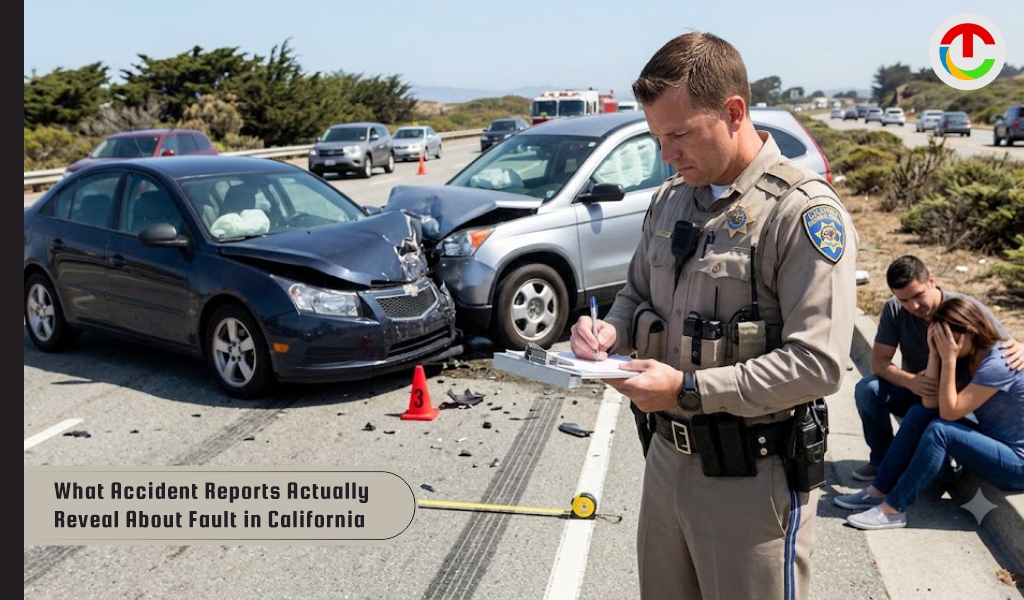
Two sentences in a California Accident Reports decide more claims than any courtroom argument ever will. Not the diagram. Not the witness list. The tiny checkboxes under “Primary Collision Factor” and the code they generate for the statewide database.
I’ve sat through enough claim files to know that people read their report once, get mad at the wording, and never look at it again. That’s a mistake, because that document follows your claim like a shadow. Here’s how it really works, where it goes wrong, and what you can still do about it.
Who actually writes the report, and who doesn’t?
Full-time California Highway Patrol officers go through a formal academy and handle collision documentation constantly, which is why their reports tend to be tight and consistent. City police and county sheriff’s deputies often get far less repetition at crash scenes, and it shows in the wording. If your report reads vague or contradictory, that’s often why.
Here’s the part people miss: a private parking lot crash, a grocery store aisle collision, a bike incident on a residential street with no injuries reported on scene. In many of those cases, no officer writes anything. You get a counter report, if you’re lucky, and the word “official” never enters the picture. That single difference changes everything downstream, because there’s no neutral third party recording what happened. So the first question to ask yourself isn’t “was the other driver at fault.” It’s “is there even a report, and who owns it?”
What’s on the SR-1, and why insurers care
California requires a Report of Traffic Accident Reports Occurrence, known as the SR-1, whenever a crash involves injury, death, or property damage above a set dollar threshold. You file it with the DMV, not with the police. Failing to file can put your license at risk, which surprises almost everyone I mention it to.
The form asks for your version of events in your own words. Write plainly. Write in order. Don’t editorialize, don’t guess at speed estimates you can’t support, and don’t write “it wasn’t my fault” five times. Adjusters read tone. Defensiveness reads like guilt to someone who processes a hundred of these a week, whether that’s fair or not.
One thing I’d push back on: people assume the SR-1 is the same as the police report. It isn’t. The SR-1 is your statement. The police report is the officer’s statement. When the two disagree on something basic, like which lane you were in, you’ve just handed the other side a gift.
The codes nobody explains to you
California collision reports feed into a statewide database, and every crash gets tagged with standardized factor codes. Following a car vs. pedestrian collision where the pedestrian was injured at night, the officer might log 3003, meaning “pedestrian violation.” In rainy conditions, code 2203 or 2205 might appear. These aren’t opinions. They’re lookups from a fixed table.
Why should you care about a four-digit number? Because the insurance company’s claim system reads that code before it reads a single sentence of narrative. A code that points at you moves your claim into a different lane on their end. Completely different adjuster, different reserve, different energy.
The codes themselves are worth understanding before you assume a report is hopeless. According to the National Weather Service, weather contributes to a meaningful share of roadway crashes nationwide every year, and California’s own coding system has specific entries built for exactly that scenario. An officer who tags your crash with a weather factor is effectively telling the file that conditions, not judgment, played a role. That’s leverage you didn’t know you had.
Same logic applies to 2202, “vision obstruction,” and 2204, “inattention.” One code frames the crash as unavoidable. The other frames it as someone choosing not to look. Those are very different weeks for the person on the receiving end.
When fault gets shared, and how the math works
California uses pure comparative fault. If a jury decides you were 30 percent responsible for your own injuries, your recovery drops by 30 percent. That’s it. You still recover, unlike in a handful of states where any fault at all wipes out the claim. Plenty of Californians don’t know this, and it makes them panic over Accident Reports language that isn’t actually fatal.
Third-party claims work the same way against anyone else who contributed. Think of a delivery driver, a commercial vehicle operator, or a property owner who left something dangerous in a shared drive aisle.
Here’s where it gets practical. Roughly one in five California residents speaks a language other than English at home, based on data from the U.S. Census Bureau. Accident scenes with language barriers produce reports with short, thin narratives and more weight placed on the officer’s own observations. If your crash happened that way, read the narrative knowing it may be missing your side entirely.
- Ask for the report number the same day, before memories fade
- Photograph the scene, your vehicle, and the other driver’s plate yourself
- Write your own timeline within 24 hours while it’s fresh
- Note any witness names and numbers; business cards beat memory every time
- Keep every medical and repair receipt, even small ones
Can a report be corrected?
Yes, and it happens more often than people think. California has a formal process for requesting an amendment when a report contains a clear factual error, like the wrong street or a mistaken vehicle description. Getting a form corrected is realistic. Getting an officer’s judgment call reversed is a much higher bar, because the officer was there and you weren’t.
That distinction matters. You’re correcting facts. You’re not relitigating conclusions, and chasing the second one usually just burns time. The other correction path is the Accident Reports supplementary narrative, added later by the same officer after new information surfaces. If a witness comes forward a week later with something useful, that can get documented. This is another reason to move quickly instead of waiting for someone else to handle it.
Why archived records matter down the road
Reports age. Agencies purge or archive on their own schedules, and getting a two-year-old report can turn into a scavenger hunt. When original records become hard to locate, researchers and attorneys often turn to the National Archives for guidance on locating historical government records and understanding retention practices. If you’re handling this yourself, request your copy in writing and keep the confirmation. I’d tell anyone the same thing. Time is the one resource in a collision claim you can’t get back, and the paperwork doesn’t wait around for you to feel ready.
What all of this means for how you proceed
A California collision report is a starting document, not a verdict. It’s one officer’s snapshot of a chaotic ten minutes, written under pressure, sometimes in the rain, sometimes through an interpreter. Treating it like the final word hands the other side an advantage they didn’t earn.
Read the Accident Reports . Decode the codes. Fix what’s factually wrong and leave the rest alone. When the language starts to matter more than you can reasonably untangle, that’s when a personal injury attorney earns their place in the process, because the report is only one piece of what gets built from there. Start with the report number. Everything else flows from that one piece of paper.
Also Read :- 5 Critical Steps to Take Immediately After a Car Accident in Lynchburg