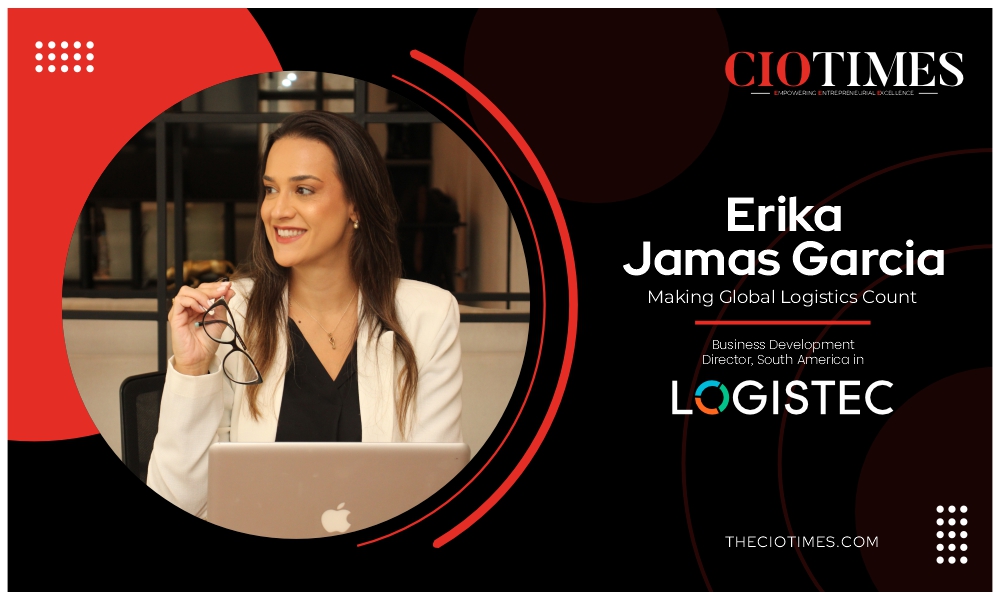
For Erika Jamas Garcia, a 27-year career in global logistics has never been simply about moving cargo from one point to another. It has been about understanding what sits behind every movement: the economics of a business, the expectations of customers, the pressures on teams, the risks hidden within seemingly straightforward decisions, and the human relationships that ultimately determine whether a strategy succeeds.
Her career has given her an unusually broad view of the logistics value chain. From pricing and capacity to commercial strategy, international trade, reefer logistics, business development, ports and terminals, and market expansion, she has worked across functions and geographies that have progressively shaped the way she thinks about business. Today, Erika Jamas Garcia as Director of South America Development of Logistec she applies that experience to identifying new opportunities, expanding logistics operations, analysing markets and customers, and evaluating investments in distribution centres, terminals and warehouses. Yet the most interesting part of her professional evolution is not the breadth of her experience. It is how that experience has changed her understanding of leadership.
Early in her career, success meant learning the mechanics of the business and delivering results. With time, that definition became more sophisticated. Understanding a business requires looking beyond individual functions and seeing how every part connects. More importantly, it requires understanding the people who make those connections work. Leadership eventually became less about authority and more about responsibility. The responsibility to listen, develop people, understand customers and make decisions that create sustainable value.
“People are at the heart of every organisation—and people make the difference,” she says.
That philosophy has become a thread running through her career, connecting her commercial achievements with her approach to people, customers, technology, risk and growth.
Adopting a Strategic Perspective
Erika Jamas Garcia’s early professional experiences gave her something that cannot easily be acquired through executive education: an intimate understanding of how logistics works from the inside. Working across pricing, capacity, equipment, route performance and commercial functions meant that she was exposed to the economics and operational realities behind customer commitments. Erika gradually learned to see the relationships between them.
That perspective became particularly valuable as she moved into increasingly senior commercial roles. A commercial decision could not be judged only by its revenue potential. It also had implications for capacity, profitability, customer experience, operational execution, risk, and long-term sustainability. Her experience across different areas of logistics consequently gave her a broader understanding of how businesses create value. It also changed the nature of her conversations with customers.
In a service-oriented industry, technical expertise matters. So does understanding the day-to-day operation. But Erika believes the real differentiator is the ability to understand the entire value chain and recognise the processes that can ultimately affect a customer. That means listening beyond the obvious.
Customers may describe an immediate problem, but the underlying issue may be somewhere else in their operation. A request for a particular service may conceal a cost challenge, an efficiency problem or a risk that has not yet become visible. The commercial leader who understands the wider business can therefore move from simply responding to requests to anticipating needs. This is where commercial leadership becomes genuinely strategic. It is not enough to know what a customer wants. The greater value lies in understanding why they want it, what is preventing them from achieving it, and what might help them perform better.
Her approach can be summed up simply: “The key is finding the right balance between growth, market expansion, and financial sustainability.”
It is a principle that has shaped her decisions throughout her career. Growth, in her view, only matters when it strengthens the underlying business rather than merely increasing its size.
Listening as a Commercial Advantage
The ability to anticipate customer needs has become increasingly important in logistics, where customer expectations are changing alongside supply chains, technologies, and market conditions. Anticipation begins with preparation. Leaders need to know their products and services thoroughly, understand their strengths and weaknesses, study competitors, and maintain a clear business plan. But preparation alone is not enough. The missing ingredient is listening.
Customers do not always articulate everything they need. Sometimes they may not even know the full range of possibilities available to them. A commercial leader who understands the customer’s business deeply can identify opportunities that may not appear in a conventional request. This requires curiosity and proximity. It means asking better questions, understanding how customers operate, and paying attention to what is not being said.
Erika Jamas Garcia has built much of her commercial philosophy around this idea. Her experience has taught her that the strongest relationships are not created simply by responding quickly. They are created by developing enough knowledge of the customer’s business to anticipate what could affect it.
“Being one step ahead is not about knowing more than everyone else. It is about listening better, understanding more deeply, and anticipating what comes next,” she explains.
That approach also reflects the evolution of modern commercial leadership. Selling a service is no longer simply about presenting capabilities. It is about demonstrating relevance. A logistics provider must be able to show how its services can improve a customer’s operation, reduce costs, manage risk, or strengthen performance. The commercial relationship becomes more valuable when the provider understands the customer’s business well enough to contribute to its objectives.
Complexity as a Career Advantage
Few industries offer as many variations in complexity as logistics, and Erika’s career has exposed her to an exceptionally broad range of them. She has worked across commodities, perishables, pharmaceuticals, breakbulk, multimodal transportation, terminals and international logistics, while building experience across Latin America, Europe, Asia, the Middle East, Africa and North America. Each market and cargo type brings different challenges. Yet rather than viewing this variety as a collection of unrelated experiences, Erika sees it as a cumulative education.
Every new area expanded her understanding of how businesses, customers, and operations interact. It also helped her develop the ability to move beyond the boundaries of a particular job description. That breadth has become particularly valuable in leadership because senior decision-making rarely respects functional boundaries. A commercial decision may have operational consequences. A pricing decision may affect customer relationships. A capacity decision may influence profitability. An investment decision may determine future competitiveness. The more perspectives a leader can bring together, the more effectively those relationships can be understood.
“Regardless of the cargo, market, or geography, the fundamentals remain the same: understand the customer, understand the operation, manage risk, develop people, and continuously look for better ways to create value,” Erika says.
This philosophy has allowed her to treat complexity not as an obstacle but as a source of insight. Every new environment has offered another perspective from which to understand the logistics ecosystem. It has also reinforced an important lesson: expertise is not simply about knowing more about one subject. Sometimes it comes from knowing how different subjects connect.
Seeking Growth
Erika Jamas Garcia’s commercial career has been defined not just by growth, but by her ability to identify where meaningful growth can come from. Her work on the last years in the shipping Industry offers a strong example on how she contributed to a strong increase in revenue from value-added services, refrigerated market growth among others. Behind those results was a philosophy that looked beyond conventional volume-based growth.
In mature or highly competitive markets, simply adding customers or increasing volumes is rarely enough. The more meaningful question is whether an organisation is creating something that customers genuinely value. Value-added services should therefore have a measurable purpose. They should help customers reduce costs, improve efficiency, manage risk or strengthen operational performance. That could involve improving an operational KPI such as On-Time In-Full performance, identifying inefficiencies or anticipating a disruption before it becomes costly.
The underlying commercial question is always the same: what difference will this solution make to the customer’s business?
“True value creation means going beyond what the customer asks for,” Erika says.
This mindset transforms the commercial relationship. A service provider is no longer simply fulfilling a requirement; it is becoming a partner capable of identifying opportunities and risks alongside the customer. That is where sustainable differentiation lies.
The Discipline of Adaptability
Logistics has always involved uncertainty. But geopolitical developments, shifting trade corridors, capacity constraints and fragmented supply chains have made adaptability an even more important leadership capability. She does not believe effective leaders should abandon long-term planning. Instead, she believes plans must be accompanied by the willingness to change them. Her approach is built around contingency thinking. Plan B and Plan C are not signs that the original strategy was weak. They are recognition that the environment can change and that leaders must be ready to respond.
A decision that made sense yesterday may not make sense tomorrow. Holding onto it simply because it has already been made can create unnecessary costs for businesses, teams and customers. This is where Erika sees an important distinction between management and leadership. Management may focus on implementing a decision effectively. Leadership also requires recognising when the decision itself needs to be reconsidered.
“Strong leadership is not about always having the right answer from the beginning. It is about having the ability to recognise when circumstances have changed, reassess the situation, and confidently adjust the course of action.”
Her concept of ambidexterity captures this balance: leaders must maintain operational excellence while remaining open to innovation, change, and new directions. In a sector where conditions can shift rapidly, adaptability becomes more than a defensive capability. It becomes a competitive advantage.
Where Data Ends and Judgement Begins?
The increasing sophistication of analytics and technology has transformed commercial decision-making. Leaders now have access to more data, scenarios, and predictive information than ever before. But Erika does not see technology and human judgement as competing forces. Instead, she sees them as complementary. Data can reveal patterns, quantify risks, and provide evidence for decisions. It can show what has happened and help indicate what may happen next. But it cannot always explain why something is happening, how people will respond, or what the broader commercial context means. That final layer requires judgement.
Her own evolution towards a Board Advisor path reflects this belief. Her experience across commercial, operational and strategic functions has encouraged her to explore how that accumulated knowledge can contribute at Board level. She is currently completing her programme at Board Academy, further developing her perspective on governance and strategic decision-making.
“The best decisions are rarely based on a single perspective. They come from combining data and facts with the judgement and strategic sensibility of experienced leaders,” she says.
Leadership therefore means connecting evidence with context. The strongest decisions emerge when analytical discipline and human understanding work together.
Career Shaped by Cultural Intelligence
International logistics demands more than geographical reach. It demands cultural awareness. Throughout her career, Erika has worked across different regions and developed relationships in markets with very different business traditions and communication styles. Some of her experiences have taken place in countries such as Saudi Arabia, Japan, Hong Kong, and Egypt, where she encountered environments in which seeing a woman in a leadership position was less common. She has viewed them as opportunities to learn.
Language has been an important part of that process. But fluency alone is not enough. International business also requires understanding how people communicate, negotiate, build trust, and make decisions. A strategy that succeeds in one market cannot necessarily be transplanted unchanged into another. The core objective may remain consistent, but the way it is communicated and executed often needs to adapt. She believes that this ability to adjust without losing sight of the purpose is one of the defining skills of global leadership.
“Cultural intelligence is a true competitive advantage in the global market,” she says.
Her international experience has therefore strengthened not only her commercial capabilities but also her ability to understand perspectives different from her own. That awareness has become particularly important in an industry where relationships often span continents, cultures and business environments.
Nurturing Accountability and Trust
For all the emphasis placed on strategy, performance and commercial results, Erika Jamas Garcia’s leadership philosophy ultimately comes back to people. She has led multidisciplinary teams while managing demanding commercial objectives, and her experience has taught her that sustainable performance cannot be built through pressure alone. Accountability, in her view, is strongest when people understand the purpose behind their work and feel trusted to deliver it. This does not mean lowering expectations. On the contrary, it means creating the conditions in which people can take ownership of high expectations.
Erika Jamas Garcia done her MBA in People Management reinforced lessons she had already learned through experience: proximity to teams matters, alignment matters, and people development directly influences organisational performance. She sees resilience, teamwork, people development and results orientation as interconnected rather than separate qualities. When employees understand their responsibilities, trust their leaders and feel connected to a shared objective, accountability becomes something they actively embrace rather than something imposed upon them.
“Accountability should come from clarity and ownership, not fear,” Erika Jamas Garcia says.
That philosophy also helps explain the relationship between her people leadership and her commercial achievements. Strong teams are not simply a support function for business performance. They are one of its primary sources. The ultimate commitment is captured in two words: Making it Count.
Investing Beyond the Balance Sheet
Erika Jamas Garcia current responsibilities have expanded her strategic lens further. Her work in this industry includes identifying investment opportunities involving distribution centres, terminals and warehouses, while also supporting broader market expansion across South America and international logistics operations involving international markets. Such decisions require more than a financial model.
A potentially attractive investment must fit the company’s broader strategy, strengthen its market position and address genuine customer needs. It must also be assessed within the wider operational ecosystem. Connectivity, scalability, technology, people, efficiency and risk all influence whether an investment can deliver lasting strategic value. Perhaps most importantly, Erika considers adaptability. Logistics infrastructure can remain in place for years, while markets and customer expectations can change far more quickly. That makes flexibility a critical consideration.
“The best investment is one that not only delivers financial returns, but also strengthens the business, creates measurable value for customers, and builds a sustainable competitive advantage for the future.”
This approach reflects the broader philosophy that has shaped Erika’s career: financial performance matters, but it is only one dimension of value. A strong investment should strengthen the organisation, improve customer outcomes and create capabilities that remain relevant as the market evolves. AI, automation, predictive analytics and digital platforms are reshaping logistics at remarkable speed. There is little doubt that these technologies will make many processes faster, more predictive and more data driven. They will influence how operations are managed, how decisions are made and how customers are served.
But Erika Jamas Garcia does not believe this technological transformation diminishes the importance of human leadership. If anything, she believes it makes human capabilities more valuable. Technology can identify patterns and support decisions, but it cannot fully replace the ability to build trust, understand a customer’s unspoken concern, navigate a complex relationship, or lead people through uncertainty. As technology takes over more analytical and repetitive tasks, leaders will increasingly be judged by their ability to interpret information and turn it into meaningful action.
“Leaders who will stand out are those who can combine technology, strategic thinking, and human connection,” Erika Jamas Garcia explains.
This is particularly relevant in logistics, where unexpected situations are inevitable. Data can inform a response, but leaders still need to decide what matters most, communicate clearly, and bring teams and customers with them. The future, therefore, is not technology versus people. It is technology enabling people to make better decisions.
The Experience Lesson
After more than two decades in global logistics, Erika Jamas Garcia most important leadership lesson is perhaps also her simplest. Earlier in her career, she believed that a strong strategy, a clear plan and the right data could deliver consistent results. Experience gradually challenged that assumption. Today, she sees strategy as something more dynamic. She envisions it as a framework that must remain connected to customers, people, facts, and changing circumstances.
A plan may be technically sound but still fail if the people executing it are not aligned. Data may be accurate but still lead to the wrong decision if the underlying customer problem has been misunderstood. A strategy may be successful today but require adjustment tomorrow. This has changed the way Erika thinks about adaptability. Erika Jamas Garcia no longer sees changing direction as an admission that something has gone wrong. Instead, she regards the willingness to change as evidence of strength.
The lesson has also reinforced the importance of humility. Experience provides confidence, but it can never become an excuse to stop learning. The longer a leader spends in an industry, the more important it becomes to remain open to new perspectives.
“Experience gives you confidence, but humility keeps you learning,” Erika Jamas Garcia reflects.
That idea brings her career journey full circle. From pricing and capacity to commercial leadership, international markets, strategic investments and Board-level ambitions, Erika has continually expanded her definition of what it means to create value. It is no longer simply about moving more cargo, winning more business, or achieving stronger numbers. It is about understanding the complete picture.
It is about listening closely enough to recognise what customers may not say. It is about developing people who can execute with ownership. It is about combining data with judgement, strategy with adaptability, and technology with human connection. It is about knowing when to pursue growth and when to protect sustainability.
Most importantly, it is about recognising that businesses are ultimately built and transformed by people. That perspective may be one of the most enduring outcomes of Erika’s 27-year journey through global logistics. The industry will continue to change. Trade routes will shift, technology will advance, markets will evolve, and new forms of disruption will emerge. But the principles that guide meaningful leadership remain remarkably consistent: understand deeply, listen carefully, adapt courageously, develop people, and create value that lasts. That is what it means to make it count.
Also Read :- CIO Times Magazine For More Information