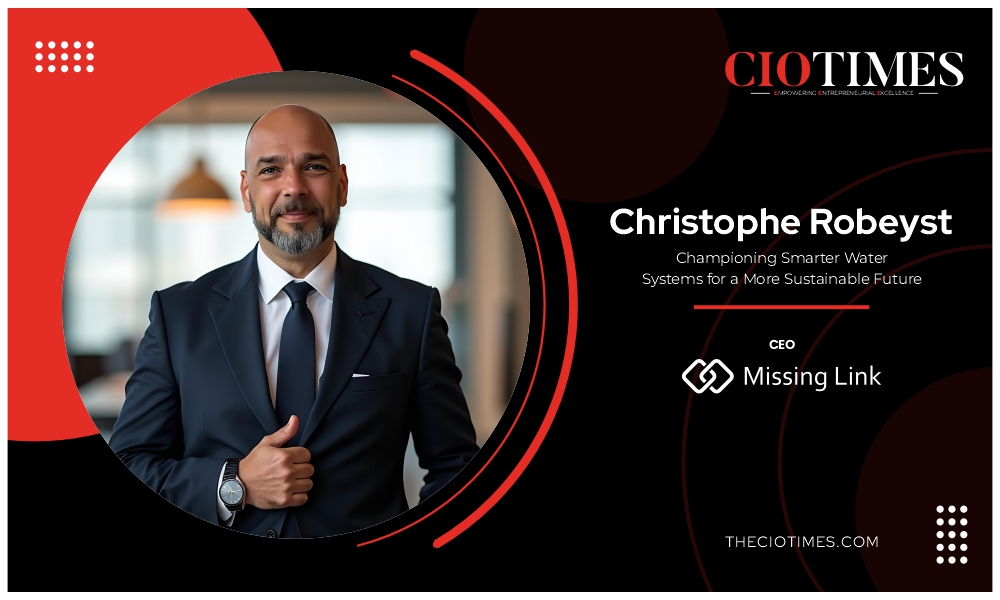
The smart metering sector is the most revolutionary today. The actual data it provides makes decision-making more efficient, helping save crucial resources like water, electricity, and gas. Realizing the importance of these resources, professionals in this industry have been making disruptive innovations to enhance efficiency and avoid wastage. This is an industry where the force comes from a quiet component, its leaders. Leaders in this sector, like Christophe Robeyst, CEO of Missing Link Group, a boutique consultancy specialized in AMI/AMR programme delivery for water utilities across the GCC, North Africa, and Europe.
An Illustrious Journey
What defines his career is not simply the sectors crossed, but the relentless discipline he brought to each of them. Before establishing himself in water utilities, Christophe led business improvement programmes across automotive manufacturing, pharmaceutical production, yacht building, and precision electronics—environments where targets were blunt and outcomes were non-negotiable. Increase margins. Lower costs. Reduce headcount. Cut dependency on external suppliers. The metrics were commercial, competitive, and unforgiving. When he moved into the utilities space, he discovered quickly that the rules had changed in ways that most improvement frameworks—and most organisations—had not yet fully confronted.
He speaks with clarity and discipline shaped by deep process expertise, but also with the honesty of someone who has seen too many costly technology initiatives fall short of what they promised. As the Business Excellence and Leadership Awards 2026 highlight leaders who are truly making a difference, he stands out not because of polished models but because he consistently puts them into practice with determination. We spoke with him about his ideas, his challenges, and how he sees the next decade unfolding today.
Driven by Reality
What shapes a leader’s instincts is often hard to pin down, but for Christophe, it comes from years spent in demanding, high-stakes environments. His journey spans shipyards in the Nordics and Poland, pharmaceutical sites in Brasil, Spain and France and Automotive manufacturing operations all over Europe and South Africa, where the work was heavy, the outcomes mattered, and there was very little room for error.
He doesn’t point to easy wins as his defining moments. Instead, he feels the times when things went sideways left the deepest mark.
Christophe Robeyst adds, “The moments where plans and reality don’t match are the ones that teach you the fastest.”
Early in his career, he managed complex automotive launches across multiple countries, where any delay had a direct domino effect on a customer’s operations. That experience built a massive sense of accountability. Later, in the pharmaceutical sector, he led transformation efforts across different regions, where he began to see that shifting a mindset is much harder than simply fixing a process. Over time, this mix of hands-on grit and cultural exposure led him into the utilities space. Today, he works at the intersection of digital systems and essential services, a world where reliability is everything and the impact of a single decision is felt at scale.
Christophe Robeyst is also refreshingly honest about why so many large programs fall short. In his view, the problem is rarely the technology itself; it’s the human elements surrounding it. Gaps in change management, disconnected systems, and a lack of real ownership after the initial rollout often hold organizations back. For Christophe Robeyst , lasting impact comes from staying in the trenches, setting clear goals, and ensuring the work continues long after implementation.
It was that same discipline, forged in sectors where commercial performance was the unambiguous judge, that sharpened his thinking when he first crossed into the utility sector. In automotive or pharmaceuticals, the target is clear: improve margin, cut waste, deliver the numbers. In utilities, he found, the logic runs entirely differently—and most of the tools and frameworks borrowed from the commercial world were never calibrated for it.
Realizing Lasting Value
Unlike any sector Christophe had previously worked in, water utilities do not exist to generate returns. They exist to serve. Governments define the mission: deliver clean water to every resident at the highest possible quality, and keep customer satisfaction at the centre of every decision. Regulators are installed specifically to enforce these obligations—to verify that investments are genuinely working in service of those goals, and to act as the independent judge of whether a utility is performing as it should. There is no financial incentive to exceed the targets. The measure of success is not profit; it is how well the community is served. And that, he points out, changes everything about how transformation programmes need to be designed and what they need to prove.
This makes it a uniquely difficult balance. A technology investment that delivers a fifteen percent cost reduction in a commercial organisation is a straightforward win. In a utility, the question is more demanding: has that investment actually translated into better service, fewer outages, a more reliable network, and a lower burden on the customer? Those are the only metrics that regulators and governments ultimately care about. And yet, as Christophe has observed throughout his career, most of the frameworks imported from commercial sectors are not calibrated for this reality. Programmes are measured on delivery milestones rather than service outcomes. Reports proliferate. And the underlying question—is the community actually better served?—too often remains unanswered.
When utility leaders discuss smart metering or AMI, the conversation usually stays pretty polished, heavy on tech specs, vendor lists, and rollout schedules. Christophe tends to take a punchier approach, steering the talk toward a much tougher question: why do so many of these ambitious programs actually struggle to deliver real value in the end?
From his perspective, the tech itself is rarely the villain. The real friction starts once everything is actually up and running.
As Christophe Robeyst puts it, “The real breakdown isn’t in the technology, it’s in what happens after it’s in place.”
He’s seen organizations sink massive capital into systems, only to realize they haven’t built the internal muscle to actually use the data or turn it into meaningful action. He also points out that simply connecting systems is often mistaken for true integration. Data might flow smoothly between platforms, but without clear ownership or a defined purpose, it rarely leads to better decision-making.
Another recurring issue he sees is the post-launch fade. Once a project goes live, teams disperse, focus shifts, and those original high-level goals start to blur. Without someone staying clearly accountable, the promised benefits usually stay just out of reach.
The fix is straightforward, even if it’s hard work: keep ownership crystal clear, stay disciplined about the results, and treat governance as an ongoing commitment rather than a phase that ends at implementation. In his view, that is where the real impact happens.
Leading Across Cultures
Working across Western Europe, North Africa, and the Gulf has given Christophe the kind of cultural intuition you only get by being in the thick of complex programs and learning on the fly. He doesn’t lean on assumptions or broad labels; instead, he pays close attention to how each environment actually breathes, shaped by years of having to adapt in real-time when the stakes are high.
In Flanders, he worked with organizations that are incredibly well-structured and backed by deep technical expertise. But that very strength brings its own hurdles.
As Christophe Robeyst explains, “The challenge isn’t capability, it’s getting everyone aligned and moving together.”
The real work lies in coordinating a massive web of regulators, tech partners, and stakeholders so that progress stays on track without losing the details. His role in a major metering program alongside Capgemini, involving millions of replacements and a massive investment, put that complexity front and center.
In Morocco, the energy feels different. He saw a powerful ambition and a genuine commitment to building digital infrastructure, driven by clear government intent. At the same time, he recognized that moving from a bold vision to consistent execution takes time and hands-on experience. For him, the gap wasn’t about a lack of will; it was about building the muscle memory in program management needed to deliver at speed. The work he supported there wasn’t just about showing off technology, but about leaving something behind that local teams could truly own and grow.
Oman, in his experience, stands out in its own way. What struck him most was the sheer level of commitment from the very top. There’s a quiet understanding there that digital infrastructure isn’t just a nice-to-have, it’s a national necessity. The pace is deliberate, expectations are high, and accountability is becoming much more defined. That combination creates the perfect conditions for transformation to actually take root and last.
Unlocking Value
The belief that a transformation is won or lost after the go-live isn’t just a theory; it’s the backbone of his work. Rather than getting swept up in the tech delivery alone, he focuses on the quiet period that follows: when the systems are live, the initial excitement fades, and the real utility begins.
Christophe Robeyst says, “The real work starts after deployment, when you actually begin to unlock the value behind the technology.”
This mindset is front and centre in his work with Nama Water Services in Oman, where his team supports the PMO for one of the region’s largest smart metering rollouts. The scale is undeniably impressive, with hundreds of thousands of meters already connected. But he doesn’t spend much time dwelling on those figures. To him, those milestones just open the door to what really matters, helping the organization truly see its network, from spotting hidden leaks to making life easier for the customer.
A huge part of that effort is about building the brain behind the hardware. They’ve set up systems to automatically flag unusual patterns, like a sudden spike that signals a burst pipe or behaviour that suggests unauthorized use. But he is the first to point out that these insights are useless if they just sit on a dashboard. You need the human structure, the clear ownership, and the follow-through to turn a digital signal into a real-world fix.
Christophe Robeyst’s already seen how this disciplined focus pays off. By tightening up the processes around billing and collections after the initial rollout, the organization saw a significant boost in revenue. It’s a constant reminder: technology doesn’t create impact on its own. It’s what people do with it once the installers have gone home that actually moves the needle.
Lasting Impact
The belief that a transformation is decided after implementation isn’t just a talking point; it’s how he handles his work every day. Rather than stepping away the moment the systems are live, he keeps his focus firmly on what happens next, when organizations are left to turn that new technology into actual results.
Christophe Robeyst shares, “Lasting impact is never the result of a single decision or a single team. It is built through relentless follow-through, clear accountability at every level, and the willingness to recognise the effort of everyone involved—not just the people in the room when the contract is signed.”
What that looks like in practice is less glamorous than launch events and more demanding than any technology implementation. It means staying embedded in operations long after the initial excitement fades, reviewing exceptions, stress-testing processes, and asking the uncomfortable question of whether the numbers are genuinely moving. It means ensuring that the field technician who flags an anomaly at dawn receives the same quality of follow-through as the executive reviewing the dashboard at noon. In his experience, organisations that sustain transformation treat rigour and recognition as equal obligations. One without the other eventually stalls.
A lot of this comes down to what is built once the go-live celebrations are over. Advanced analytics have been brought in to flag patterns that would otherwise stay hidden, whether it’s a sudden spike in usage or signs of unauthorized activity. But Christophe is clear that these insights are only as good as the structure around them, the clear processes, the right skills, and the genuine ownership needed to act on what the data is saying. Without that, even the most advanced systems risk sitting underused.
The through-line across every programme he has been part of is consistent: technology, however sophisticated, can still underperform if the human system around it is fragile. Accountability needs to be defined before it is needed. Checks need to be embedded as routine, not triggered by crisis. And the people who carry the daily weight of continuous improvement—those who verify the reads, investigate the anomalies, and keep the system honest—need to be seen, supported, and genuinely valued. That is not a peripheral concern. In the organisations that consistently outperform, it is the hardest-won and most consequential discipline of all.
Disciplined Innovation
Christophe Robeyst looks at the union of old-school operational excellence and the flashy new world of AI with a level of excitement you might not expect from a veteran of the field. Having spent the better part of his career living and breathing the strict, methodical world of Six Sigma and Lean manufacturing, he’s someone who naturally values human accountability and rock-solid process discipline over any shiny new gadget. To him, the common habit of pitting Lean against AI as some kind of old vs. new rivalry is a total waste of time. He believes the heart of Six Sigma, defining a problem clearly and digging into root causes, is still the gold standard. In his eyes, AI doesn’t replace those human steps; it just gives you the horsepower to execute them at a speed and scale that was previously impossible.
When he wrapped up his MIT Professional Certificate in No-Code AI and Machine Learning back in 2025, it wasn’t because he wanted to become a coder. Christophe simply wanted to speak the language so he could cut through the sales pitches and understand what these tools actually do in a real-world operation. His big takeaway was that AI is a massive force multiplier, but only if you already have clean data and disciplined habits in place. It’s great at amplifying what’s working, but it’s not a magic wand for fixing what’s fundamentally broken. He offers a blunt reality check for any utility company trying to layer fancy analytics over messy data governance: if your data is inconsistent and your processes are a shambles, AI will just help you reach the wrong conclusions faster. For him, that isn’t progress at all.
There is a deeper problem lurking beneath all of this: the sheer volume of unverified data that utilities are sitting on. Organisations today are not short of reports. They are drowning in them—dashboards, KPI summaries, performance snapshots—many of which quietly contradict each other because the underlying data was never properly validated. Assumptions built into systems years ago go unquestioned. The result is that decision-makers trust their data more than they should, and the gap between what the reports claim and what is actually happening in the network stays stubbornly invisible. “The danger isn’t that we lack information,” he says. “It’s that we have built entire decision-making structures on information nobody has seriously stress-tested. Governments and regulators aren’t always close enough to the operations to catch it—and that needs to change.”
Aiming Excellence
Christophe Robeyst recalls the Business Excellence & Leadership Awards 2026 and highlights that the word excellence means consequential in the public utilities sector.
He adds, “Excellence is not an award. It is a practice. It is the daily discipline of asking whether the system you are operating is performing as well as it could, and then being honest about the gap between the answer you want and the answer you are getting.”
He reminds us that in the context of digital infrastructure, excellence has a specific and demanding meaning. The periodic ability to convert investment into outcomes that citizens can actually experience. He believes that a utility that has deployed smart metering but whose non-revenue water is still forty percent has not achieved excellence. It has achieved technical implementation. Those are not the same thing. Excellence is when the technology has genuinely changed the operating model, the commercial performance, and ultimately the quality of service. Everything before that is a work in progress.
Christophe Robeyst talks about leadership in a way that feels genuinely rooted in people, not just cold performance metrics. For him, achieving excellence is just as much about fostering real relationships as it is about technical skill. He has spotted a consistent thread among the most impressive program leaders he has partnered with: they care every bit as much about growing their team’s potential as they do about hitting their targets. He frequently points to leaders like Bart De Borle at Farys, Alexandra De Jonge at Pidpa, and Khalid Al Lawati at Nama Water Services as the gold standard for this human-centered approach.
In his experience, these leaders share a quiet, firm understanding that true transformation isn’t kept alive through individual heroics. It actually takes root through people—by pouring into local talent, sparking a genuine sense of ownership, and committing to building capabilities that stick around long after any one person moves on. This philosophy isn’t just talk for him; it is the heartbeat of his own career. From mentoring LSS Green Belts across Brunswick’s EMEA branches to crafting a thoughtful knowledge transfer model during Missing Link’s projects in Oman, his focus has always stayed on leaving behind teams that are stronger and more confident than he found them.
Water’s Survival
It is hard to ignore the bigger picture here: freshwater across the globe is under real, growing pressure. That reality adds a heavy layer of gravity to topics that usually don’t grab much attention, things like cutting down on water loss, tracking consumption, and network intelligence. These are no longer just dry, operational concerns; they have become something much more vital. Christophe Robeyst knows that talking about smart metering can often feel a bit too corporate or technical, buried under a mountain of jargon about MDM/HES/CIS systems and data lakes. He doesn’t downplay those tools, but to him, they are just pieces of a much larger, more urgent puzzle.
Nowhere is the urgency more concentrated than across the GCC. More than ninety-five percent of the region’s drinking water comes from energy-intensive desalination plants—a dependency that leaves communities acutely exposed to any disruption in supply or infrastructure. The geopolitical tensions rattling the region make this calculus starker, not softer. Oil and gas disruptions damage economies. A failure in water supply can destabilise entire societies. Clean water is not a commodity in this context; it is a pillar of national resilience. That is the scale of obligation that every smart metering programme, every network investment decision, and every data governance framework in this region is ultimately working to protect.
At its heart, the question is simple: are we actually going to treat freshwater like the finite, precious resource it really is? Or will we just keep pulling it from the ground, treating it, and then watching massive amounts vanish through leaks and theft? Seeing these numbers firsthand has sharpened his view. To him, the current cycle isn’t just unsustainable; it’s unacceptable. The tools to change this are already sitting right in front of us; the real question is whether organizations have the discipline to actually put them to work.
In his eyes, people often get smart metering wrong. It isn’t just a fancy way to modernize a billing system; it is about fundamentally shifting the relationship between a utility and the water it manages. When you have detailed, real-time data right at the meter, a whole new level of clarity opens up. Utilities can catch a small leak before it turns into a disaster. They can see exactly how demand shifts across different regions and seasons. They can spot weird consumption patterns that used to go completely unnoticed. It means decisions about infrastructure can finally be built on hard evidence rather than just gut feelings or old habits. Climate change only makes this more pressing.
In areas where rain is becoming unpredictable and groundwater is disappearing, there is simply no room left for high leakage rates. For many utilities, knowing exactly where every single litre goes isn’t a luxury anymore; it is becoming a matter of survival. In that kind of world, smart infrastructure stops being a nice-to-have upgrade and becomes a fundamental necessity for staying afloat.
A Clear View
After a substantial tenure in the sector, Christophe has observed that organizations attempt transformation with varying degrees of success. His view is clear about what distinguishes the ones that genuinely deliver from those that produce impressive documentation without commensurate results.
Christophe Robeyst adds, “The single most consistent differentiator is whether the senior leadership is willing to be accountable for outcomes rather than activities. It sounds simple. It is extraordinarily rare.”
He observes that the organizations that track outcomes tend to achieve them. On the other hand, the ones that track inputs tend to produce reports.
Beyond just holding people to their word, Christophe often points to two other qualities that quietly decide whether these big projects actually take off or just sputter out. The first is how much thought goes into the how-to of the business, the operating model alongside the tech itself. In his experience, a new system has a way of shining a bright light on gaps an organization didn’t even know it had. What really matters is the reaction. The groups that make real headway are the ones that don’t try to hide those gaps, but instead see them as practical puzzles to solve. They’re the ones willing to roll up their sleeves and build the processes and skills needed to fix things, one step at a time.
The second quality is patience, not just as a nice idea, but as a long-term commitment. He has seen how quickly the initial buzz can fade once the early excitement of a new program wears off. But transforming infrastructure doesn’t happen on a fast timeline; it plays out over years. The organizations that actually see it through are the ones where leadership stays the course and keeps their eyes on the goal, even when everything else is shifting through new elections, changing regulations, or the next wave of trendy tech. For him, that kind of steady consistency points to something much deeper: a form of institutional discipline that you can’t just buy from the outside. It has to be built, nurtured, and lived by the people inside the organization itself.
Christophe Robeyst also speaks directly to a trend that gives him genuine pause: the growing shift toward performance-based contracts with third-party operators. On paper, the logic is attractive. In practice, he has seen it go wrong in predictable ways. Without deep regulatory engagement and robust governance frameworks embedded from the start, the arrangement risks transferring accountability without transferring capability. The gap between what a contract promises and what a community actually experiences tends to widen—and it is always the end customer who carries the cost. “Governments and regulators need to be inside these programmes, not reviewing them from the outside,” he says. “When their involvement is too shallow, the performance incentives that should drive quality end up driving reporting instead. And a well-managed report is not the same thing as a well-run system.”
Some Powerful Advice
Christophe Robeyst recalls the Business Excellence & Leadership Awards bringing people together at different stages of their journeys. The people include established executives alongside emerging leaders who are encountering for the first time the particular combination of ambition, complexity, and constraint that defines transformation in critical sectors. His message to the second group in this is to be direct enough to be useful and honest enough to be slightly uncomfortable.
Christophe Robeyst shares, “The temptation when you are early in your career is to believe that the right technology or the right framework will solve the hard problems. It will not. The hard problems in infrastructure transformation are almost always people problems: alignment, communication, capability, ownership, trust. Technology is the easy part. Get comfortable with the hard part.”
Christophe Robeyst elaborates with characteristic specificity. He advises to learn to go through an organization’s real priorities and not the ones that are mentioned in the strategy slides. This should include the ones that show up in people engaging their time in, and what they conclude. He further advises to keep a grasp on the ability to communicate across levels, to a CEO and a field technician on the same day, in language that is equally clear to both.
Christophe Robeyst also opens up about intellectual range and its importance. The upcoming generation of utility leaders needs to have a strong grasp on data science, AI, climate science, regulatory frameworks, community engagement, and financial modelling. Not to forget traditional operational and project management skills. His own trajectory from electronics engineer to LSS Black Belt to published author to MIT-certified AI practitioner, with a published book and an Oracle summit keynote along the way, is perhaps the most persuasive argument for the intellectual breadth he is recommending.
Beyond the Pipes
When Christophe Robeyst looks at what’s actually going to change the water world over the next decade, he doesn’t bother with grand predictions or scary warnings. Christophe Robeyst talks with a kind of quiet, steady confidence that only comes from years of being knee-deep in how these systems really work. He sees three big shifts starting to pick up speed. The first is this move toward real-time data becoming the baseline. To him, the idea of running a utility without knowing exactly what’s happening in the pipes at any given moment is starting to feel ancient, as strange as a hospital trying to treat people without having any patient files. It’s not the norm everywhere just yet, but he can feel the momentum, and it’s moving faster than most people realize.
The second shift is more about the soul of the business. For decades, the job was simple: pull water, treat it, send it out, and mail the bill. But he senses that that familiar formula is finally starting to crack. What’s replacing it looks more like a service built on actual results. Utilities are going to be judged less by how much water they move and more by how well they handle things like reliability and long-term service resilience. It might sound like a small tweak, but it completely flips the logic of the whole system. The third shift is probably the biggest, even if it’s still a bit blurry. It’s the way water data is starting to plug into everything else, energy, city planning, and even climate models. When those dots finally connect, we get a much clearer picture of how to manage our resources in a way that actually makes sense.
Christophe Robeyst usually pauses after laying all this out, as if he’s still weighing the gravity of it. It doesn’t feel like he’s concluding, but rather watching something unfold. This is a moment of genuine possibility. The tools we need to manage water more intelligently aren’t some futuristic dream; they’re sitting right here. The only real question left is whether the people in charge have the focus and the backbone to actually use them. At the end of the day, he’s convinced it’s never really been a tech problem; it’s a human one.
Also Read :- CIO Times Magazine For More Information