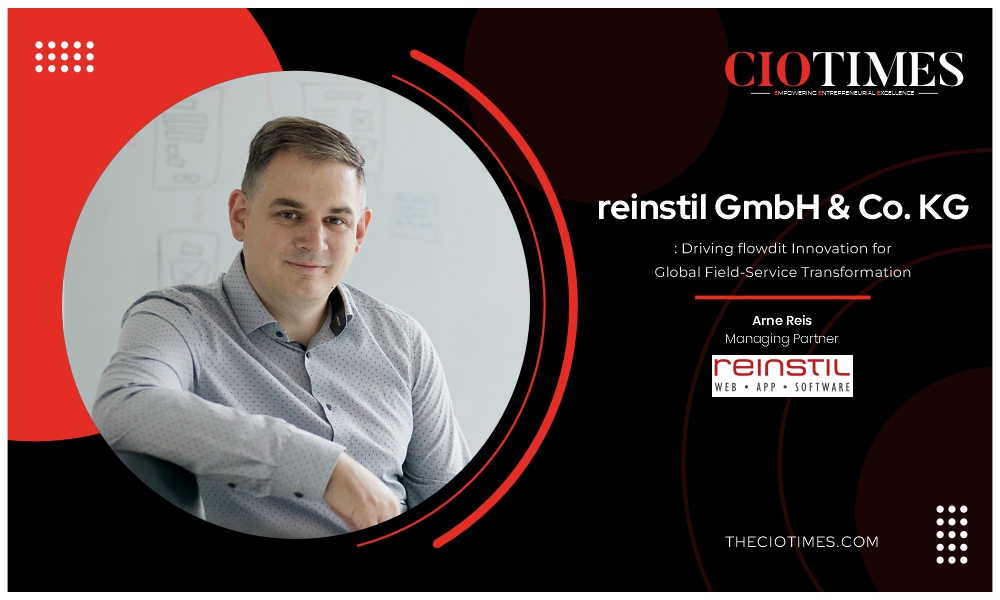
Field service is being reshaped from the ground up, and the mandate is clear: deliver faster, smarter and more reliable outcomes while strengthening customer trust. Technology providers such as reinstil GmbH & Co. KG enable organisations to use predictive tools and connected assets to catch problems before they interrupt production. AI-driven diagnostics and automated workflows are reducing downtime, while advanced mobile platforms empower technicians to make sharper decisions on site. The role of field service is shifting from task execution to strategic value creation. Those who embed intelligence and resilience into frontline delivery will set the new benchmark for excellence.
A Worldwide Digital Synergy
reinstil GmbH & Co. KG in Germany and ioTivata FZCO in Dubai represent a strategic alliance that bridges European precision with Middle Eastern dynamism. At the centre of this partnership is flowdit, a product designed to elevate enterprise performance by unifying compliance, workflow automation, and data management. This collaboration signals a shared vision of business excellence in which technology becomes the foundation for resilience and growth. By combining disciplined engineering with agile market execution, the two organisations are positioning the product as a transformative platform for enterprises seeking sustainable competitive advantage.
Global Innovation Alliance
The organisation is best known for flowdit, a product jointly supported by reinstil GmbH & Co. KG in Germany and IoTivata FZCO in Dubai. The evolution began with firstaudit, a checklist application enabling teams to transition off paper without complex projects. flowdit emerged as the platform for operations that require workflow logic, integrations and multi-site rollout. Both companies drive this innovation.
reinstil was established in Mainz in 2009. It remains the hub for product engineering, European customers, and data protection compliance, staffed by ten professionals. IoTivata was founded in 2021 in Dubai Silicon Oasis. It covers the Middle East and Asia, with thirteen employees and US representation near Houston.
The structure reflects market realities more than hierarchy. European manufacturers demand assurance on data residency and network integrity, while Gulf clients prioritise rapid on‑site presence. This dual approach ensures responsiveness across geographies. One entity provides engineering discipline, while the other delivers local market reach; together, they develop flowdit on a single code base and follow a shared roadmap, supported by a team of twenty-three people representing ten nationalities. It is an integrated model that supports flowdit’s growth and international ambitions.
Transforming Field Service Processes
reinstil GmbH & Co. KG frames field-service digitisation as a reinvention of process integrity. The organisation rejects the notion of simply converting forms into apps, recognising that such efforts preserve inefficiency. Instead, flowdit applies structured principles: it identifies which inputs are already known and automates them through asset data and QR-code integration; it defines rules that trigger actions with clear ownership and deadlines; and it questions whether every step is required at all. The philosophy is clear: digitising a flawed process only makes the inefficiency faster and better documented.
Scalable Contextual Solutions
reinstil GmbH & Co. KG positions flowdit as a platform that balances contextual depth with enterprise-level scalability. The organisation achieves this by maintaining a single, generic code base while allowing configuration to adapt to diverse industry requirements. Core objects such as checklists, assets, assignments, users, issues and reports remain consistent. Customers across sectors, from food and beverage to defence, work with the same objects and benefit equally from improvements delivered to the rules engine.
The model avoids fragmented industry editions, ensuring uniformity and resilience. Yet, the organisation acknowledges the risk of poor configuration, such as unwieldy forms. To mitigate this, flowdit enforces design discipline through features like step‑by‑step pages and real‑time previews, guiding users towards effective patterns. Contextual strength derives from the customers’ expertise in their own processes. The platform’s job is to stay unobtrusive and behave the same way at every site.
Closing Capacity Gaps
reinstil GmbH & Co. KG identified that the fundamental challenge in field-service environments was a persistent capacity gap. Plants understood their own processes intimately, from shift handovers to release procedures and tool changes, but they lacked the means to digitise them. Central IT, burdened with long roadmaps, rarely prioritised plant-level checklists, leaving workflows stranded on paper or fragmented in Excel files. These improvised solutions often became unreliable, inconsistent across sites, and vulnerable when individual maintainers departed.
Audits and evidence retrieval further exposed inefficiencies, consuming valuable time and eroding trust. The missing element was ownership: no one had the mandate to build the small but essential workflows that kept operations running. flowdit addressed this gap by letting key users design, configure and publish processes directly, without central IT or external developers. A checklist built in the morning can be in use by the afternoon, which shifts control to the people closest to the work. Every other capability within the platform flows from this decisive principle.
Operational Inefficiencies
reinstil GmbH & Co. KG has consistently observed three recurring inefficiencies in field-service operations that conventional enterprise technology has failed to resolve. The first is hidden overtime: technicians compile reports manually after hours, moving photos and notes into Word documents, an effort flowdit removes because the submission is complete when the technician leaves the site.
The second is the mobile afterthought: legacy tools designed for desktops falter in the field, whereas flowdit was built mobile-first and works across platforms and offline, including offshore commissioning.
The third is the unplanned event: enterprise systems struggle when work deviates from predefined processes, leaving technicians to rely on WhatsApp and ad-hoc attachments. flowdit addresses these gaps directly, embedding efficiency, mobility and adaptability into frontline delivery.
Frontline Integration
reinstil GmbH & Co. KG recognises that the disconnect between enterprise technology and frontline operations stems from the original design of ERP systems. They were conceived as systems of record, answering what was ordered and what it cost, but offering little to a technician facing a stopped machine at three in the morning. The gap persists because extending ERP to the shop floor has traditionally demanded a project: change requests, specialists, test cycles, budget lines. That effort is only made for the highest-value processes, and the rest stays on paper.
The organisation asserts that transformation requires shifting where the last fifty metres are built. flowdit is positioned as the connecting element. Its integration layer communicates through REST, webhooks and event feeds, and connects to SAP, Odoo, Oracle and Microsoft Dynamics. A PLC alarm can arrive as XML with line, station, and error number, automatically creating assignments without manual input. Order data remains within ERP, while execution, evidence, and corrective actions reside where the work occurs. Both systems stay synchronised without duplication, ensuring enterprise technology genuinely serves the frontline.
First-time Resolution
reinstil GmbH & Co. KG defines field-service excellence through a disciplined focus on metrics that genuinely reflect operational performance. The organisation places first-time fix rate at the forefront, recognising it as the most comprehensive measure of service quality. This single indicator encapsulates whether the correct technician was dispatched, whether the necessary parts were available, whether asset documentation was current, and whether the diagnosis was accurate. A repeat visit is costly in every dimension of service delivery.
Beyond this, response time and resolution time are tracked separately, as each fails for distinct reasons. Technician utilisation is scrutinised, particularly the ratio of travel time to productive time, a measure that often surprises organisations once it is counted rather than estimated. SLA fulfilment is assessed per customer rather than averaged across portfolios, ensuring that underperformance is not concealed by aggregate figures.
reinstil also highlights adoption as a predictive metric: the proportion of jobs documented in the system on the day they occur. Low adoption renders every other measure unreliable. Finally, the organisation cautions that item-level measurement, rather than report-level aggregation, provides sharper insight, revealing asset drift across machines or months well before conventional KPIs detect it.
Intelligent Workforce Evolution
reinstil GmbH & Co. KG views the transformation of field‑service roles as a natural outcome of intelligent automation. Dispatch is the first task to be reshaped, with machine alarms arriving as XML payloads, flowdit interpreting error codes, matching them to technician skills, and assigning jobs automatically. This removes coordination work but preserves judgement. Technicians still determine the actual fault, and they arrive with the error code, the station details and the asset history in hand.
Supervisors experience the most significant shift. Historically burdened with distributing findings and chasing follow-ups, they now focus on unresolved cases and recurring patterns. These patterns include assets producing repeated issues or procedures generating rework. reinstil has also taken a deliberate stance on artificial intelligence: flowdit provides structured operational context, while customers supply the models. The platform integrates with whichever LLMs clients are authorised to use, including those hosted securely within their own networks. For defence and pharmaceutical organisations, this distinction is critical, as it determines whether AI can be deployed at all.
Reliability Drives Innovation
reinstil GmbH & Co. KG underscores that in mission-critical field-service environments, reliability is the fundamental prerequisite for innovation. The team stresses that trust must first be established with customers by ensuring that no deployment ever compromises operational integrity. This commitment is reflected in tangible practices.
The organisation runs twelve production on-premises installations in customer data centres, ranging from 200 to 2,500 users. Some of them are fully closed networks with no outbound connections. On-premises deployments are standard, not exceptions. Customers run identical containers under Docker Compose or in their own Kubernetes clusters, supported by Helm charts and release packages.
Certification forms the other cornerstone of operational discipline. The company is certified to internationally recognised quality and information-security standards, including ISO 9001 and ISO 27001, and complies with the requirements of the GDPR as a German enterprise. In highly regulated sectors such as pharmaceuticals and defence, these credentials are indispensable for advancing customer relationships.
Equally important are the deliberate design decisions that safeguard operations when challenges arise. Completed work is archived rather than deleted, with retention periods enforced. Checklist versions are published to ensure that reports remain aligned with the templates active at the time of completion. Innovation in this market is defined by the ability to deliver rapidly while never asking customers to assume risk in areas of reliability, security, compliance, or visibility.
Deliberate Product Differentiation
The organisation distinguishes flowdit in the increasingly crowded field-service technology landscape through two deliberate choices. The first lies in the approach to configuration. Most vendors sell a platform and then sell the services to configure it. This organisation delivers a platform that the key user configures directly, and the difference shows in customer outcomes.
The second differentiator is that the shop floor is the primary environment, not a remote endpoint. flowdit is built for offline operation and scanner input, with large touch targets designed for use while wearing gloves and shift handover as a first-class concept. These details, often overlooked, become decisive when rollouts fail without them.
Equally important is what the platform deliberately chooses not to become. It will not turn into an ERP system. It will not own the transactional record, the order book or the general ledger. Each time a customer requests such extensions, the company declines, recognising that becoming the system of record would mean inheriting the change-request queue flowdit was created to bypass, thereby replicating the inefficiencies it replaces.
The team also rejects the idea of becoming a consultancy that merely happens to own software. A product that only works when its creators are in the room is, in the company’s view, not a product. flowdit is therefore built to stand on its own and to be run by the people who use it, without a consultant in the room.
Scalability through Customer Insight
The future of field service demands both standardised technology and responsiveness to highly specific operational contexts. The company maintains deep customer and frontline understanding while building a scalable product by keeping the distance between a plant and the roadmap short. That is largely a function of its current size.
With a team of twenty-three, there is no layer between the individual who hears a requirement and the one who can implement it. Senior leadership continues to participate directly in customer sessions. The mechanism that ensures authenticity is the key user. Because customers design their own workflows, reinstil observes what they create. When several customers independently build workarounds for the same missing feature, the evidence sits in their templates, and no survey is needed.
Scalability is achieved through disciplined product decisions. Requests unique to a single plant are addressed through configuration. If configuration cannot resolve them, the platform is typically lacking a general capability rather than a specific one. Attendance and time management, along with extended workflow logic currently under development, each originated from several customers requesting variations of the same requirement. Deep understanding and scalability often pull in opposite directions. The balance can only be maintained if the company remains uncompromising about which requests become product features, ensuring that flowdit remains both responsive and scalable.
Two Markets, Two Frontline Realities
The company has learnt that “digital transformation” means very different things in Germany and in Dubai. In the DACH region, the conversation begins with governance. Questions of data location, access rights and works council visibility dominate. Decisions take longer, then they hold for years. Plants are often technically advanced, with processes already functioning effectively, which raises the bar as flowdit must replace something proven rather than fill a gap. In Dubai and the wider Gulf region, clients prioritise rapid on-site presence and responsiveness.
Across both markets, the company’s direct contact with key users provides insight into their operational requirements. These regional perspectives help reinstil keep flowdit responsive to different customer needs while maintaining a scalable product.
Frontline Excellence Redefined
reinstil GmbH & Co. KG believes that the next generation of field‑service excellence will be defined by minimising the amount of a technician’s day consumed by coordination. The company observes that most inefficiency in field operations lies not in the repair itself but in everything around it: identifying the problem, finding qualified personnel, confirming parts availability, documenting the work and chasing follow-ups that are noted and then forgotten. Reducing this waste to near zero enables the same workforce to deliver more without increasing effort.
A quieter but equally critical factor is knowledge transfer. When a maintenance technician with decades of experience retires, much of what they checked was never written down. Their successor learns by shadowing them for a few weeks, and hiring difficulties make that gap worse. The only effective solution is a process that documents itself as it is executed rather than afterwards.
The third defining shift will be from documentation to consequence. At present, most organisations that have digitised have merely digitised the record: a report is now a PDF instead of a page. The next stage is automation, in which a finding triggers action: a ticket opens, a part is ordered, a maintenance interval shifts, an escalation fires when a deadline passes. Evidence and action cease to be separate systems.
In this vision, the product’s role is to provide the layer where plants build their own solutions. It is not intended to be the system that knows everything about operations, nor another platform that forces the frontline to wait. Instead, flowdit supplies the building blocks, empowering those who understand the process to assemble them. reinstil maintains that these individuals are better at it than any external provider.
Also Read :- CIO Times Magazine For More information