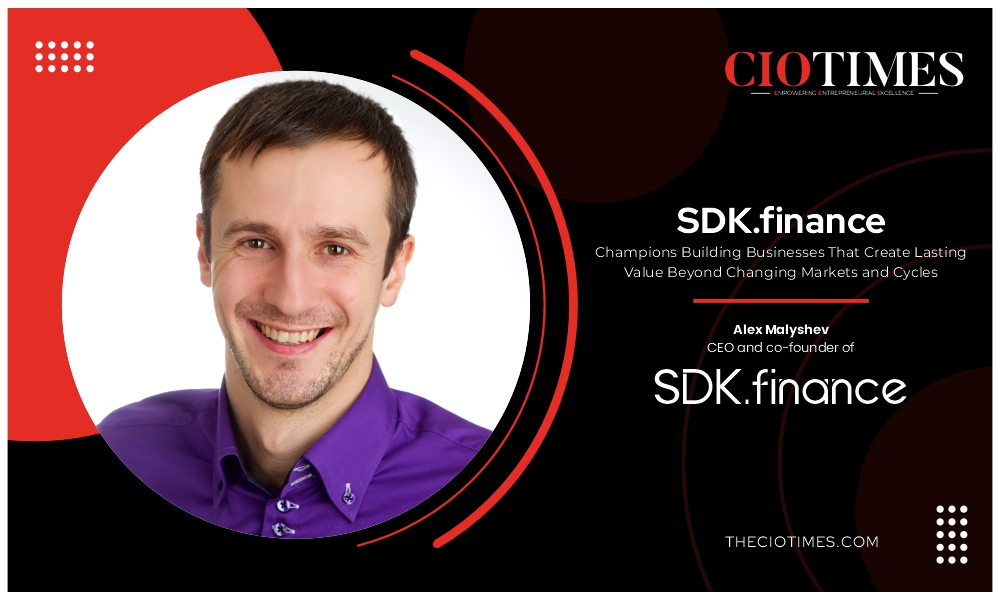
The financial services sector is defined by constant reinvention. In this sector, progress is measured by the ability to inspire confidence at every stage of change. Leaders who are operating at the forefront of banking technology have emerged as catalysts for this evolution. This shapes the strategic direction of an industry that underpins global commerce. Alex Malyshev, CEO and co-founder of SDK.finance, is a leader whose role extends beyond delivering solutions. He enables institutions to navigate complexity with confidence and respond decisively to an evolving financial landscape. His greatest differentiator is the ability to align innovation with business priorities and measurable outcomes.
Architecting Finance
He has championed a platform-first approach that enables banks, payment providers, and fintech enterprises to accelerate innovation while maintaining flexibility and control. His leadership reflects a deep understanding of the intersection between technology, finance, and business strategy. It positions the organisation at the forefront of the embedded finance ecosystem. Beyond driving product innovation, he is an influential voice on the future of financial services, advocating for scalable, resilient, and customer-centric approaches to digital transformation.
Financial Innovation
SDK.finance is advancing the future of financial technology through a robust and white-label platform. It empowers banks, payment providers, and fintech innovators to build and scale next-generation financial solutions. Engineered on an API-first architecture with a high-performance transactional core, the platform enables organisations to accelerate the launch of digital wallets, neobanks, payment ecosystems, and embedded finance. By combining architectural flexibility with enterprise-grade capabilities, SDK.finance helps businesses streamline complexity, accelerate innovation, and maintain strategic control over their digital infrastructure. Its unwavering focus on technological excellence and customer-centric innovation has established the company as a trusted partner in shaping the next generation of financial services.
Platform Evolution
The strategic vision behind SDK.finance has been driven by practical industry experience rather than theory. Before co-founding the company, Alex Malyshev and his business partner, Pavlo Sidelov, had launched multiple fintech ventures, repeatedly encountering the same challenge: rebuilding core financial infrastructure before they could focus on product innovation. Essential capabilities such as account management, transaction processing, integrations, and back-office operations consumed valuable time and resources.
Recognising this gap in 2013, they chose not to build another fintech product, but the technology platform powering financial products. This decision laid the foundation for SDK.finance and continues to define its strategic direction.
As financial services have grown more interconnected and regulated, with AI accelerating industry transformation, Alex Malyshev has remained committed to a consistent vision: building resilient, adaptable infrastructure that enables long-term innovation.
He adds, “Financial services have become more interconnected, regulations more demanding, customer expectations higher, and AI is beginning to reshape how software is developed.”
Today, SDK.finance equips banks, fintechs, payment providers and enterprises with technology designed to evolve alongside their businesses rather than require constant replacement. This philosophy continues to shape the company’s product strategy and reinforces its role as a trusted foundation for modern financial services.
Crafting a Long-term Infrastructure
While technology evolves at a faster rate, Alex Malyshev believes financial infrastructure must be engineered to endure. He has positioned the organisation around architectural excellence, engineering discipline, and long-term adaptability. These qualities deliver prolonged value.
From the outset, the organisation was designed as a modular, API-first transaction platform that adapts to diverse business models, regulatory frameworks, and growth strategies. This enables financial institutions to modernise and scale without repeated technology overhauls.
As the market has evolved, Alex Malyshev has expanded the company’s strategy beyond enabling fintech launches and legacy modernisation. SDK.finance now delivers specialised infrastructure products that solve critical operational challenges for established financial institutions. Its Real-Time General Ledger reflects this approach, integrating seamlessly into existing ecosystems to provide real-time, audit-ready financial records, greater transparency, and stronger financial governance.
He adds, “As AI accelerates software development, organisations increasingly recognise that controlling their technology stack is becoming a strategic advantage.”
Alex Malyshev also believes technology ownership will become a defining competitive advantage in the AI era. While AI is accelerating software development, organisations that own and understand their infrastructure will be better positioned to innovate independently and evolve beyond vendor-driven roadmaps. His vision is to equip banks, fintechs, and payment providers with resilient infrastructure they can build on with confidence, whether through a comprehensive transaction platform or specialised components that strengthen existing technology ecosystems.
Platform Flexibility
One of the biggest misconceptions is that every financial platform must be built from scratch. In reality, most institutions rely on the same foundational capabilities. These include account management, transaction processing, reconciliation, fee management, and compliance. Rebuilding this infrastructure rarely delivers lasting competitive advantage.
This outlook has shaped SDK.finance’s philosophy: standardise the infrastructure while enabling business-specific innovation. By building a resilient, reusable technology foundation, the company empowers organisations to differentiate through customer experience, workflows, integrations, and market-specific services rather than core systems.
As SDK.finance expanded globally, this approach proved increasingly valuable. Instead of developing separate platforms for every market, the company created a highly configurable architecture that adapts to diverse regulatory frameworks, payment ecosystems, and compliance requirements without changing its core foundation.
He adds, “I believe this balance between standardisation and flexibility is what financial institutions increasingly need.”
The same principle extends to products such as the Real-Time General Ledger, which integrates seamlessly into existing environments while strengthening financial control and operational efficiency.
Reliable Partnerships
Trust is earned through consistent execution, not certifications or successful implementations alone. Since its inception, the team has nurtured long-term partnerships over short-term commercial gains, developing financial infrastructure designed to evolve with customers rather than become a future limitation. Transparency remains central to that philosophy.
Recognising that financial infrastructure should never operate as a black box, SDK.finance offers both SaaS and Source Code deployment models, enabling banks, fintechs and enterprises to choose the level of control and ownership that best aligns with their strategic objectives.
Trust is further reinforced through proven engineering standards. PCI DSS Level 1 Service Provider and ISO 27001 certifications, together with products and processes designed to support GDPR compliance, reflect the governance, security and operational discipline required for mission-critical financial systems.
Lasting trust is maintained through consistency. A strong engineering culture, disciplined product development and enduring customer relationships have positioned SDK.finance as a dependable technology partner. In financial services, where reliability is paramount, sustained success is measured not by individual projects, but by delivering confidence every day.
Financial Convergence
The next phase of digital banking will be shaped not by a single innovation, but by the convergence of multiple technologies. As embedded finance, AI, compliance and modular platforms evolve together, financial institutions will gain greater agility to deliver integrated, customer-centric services while accelerating innovation.
He sees embedded finance continuing to redefine the industry, enabling retailers, software providers, marketplaces and telecom companies to seamlessly integrate payments, wallets, lending and other financial services into their ecosystems. At the same time, modular, API-first platforms are allowing organisations to expand capabilities without replacing core infrastructure, creating a more flexible and scalable technology foundation.
Alex Malyshev also views AI as a powerful enabler rather than a replacement for financial infrastructure. He believes organisations must first establish AI-ready foundations through clean APIs, structured data, deterministic transaction processing and comprehensive auditability. In this model, AI enhances intelligence and automation while financial records remain transparent, accurate and fully governed.
As digital ecosystems become increasingly interconnected, he expects compliance to evolve alongside technology. Governance, explainability and traceability must be embedded into system architecture from the outset rather than introduced as an afterthought. The industry’s leaders will be those that successfully combine modular architecture, AI-ready infrastructure, embedded finance and compliance by design. These organisations will be best positioned to innovate with confidence while preserving the trust that remains fundamental to financial services.
Technology Evolution
Financial institutions are moving away from monolithic technology stacks toward modular ecosystems. This is where specialised solutions integrate seamlessly through APIs and evolve independently. This shift is redefining customer expectations, placing equal emphasis on flexibility, interoperability, and long-term adaptability alongside speed to market.
He also sees operational transparency emerging as a strategic imperative. As financial institutions manage increasing transaction volumes across multiple markets, capabilities such as accounting, reconciliation and auditability have become critical enablers of governance, financial integrity, and informed decision-making.
This evolution reflects SDK.finance’s strategic direction. While the company continues to empower organisations to launch new financial products through its Transaction Platform.
He adds, “We continue helping organisations launch new financial products through our Transaction Platform while also offering infrastructure products, such as our Real-Time General Ledger, that integrate with existing systems.”
It has expanded its portfolio with specialised infrastructure solutions, including the Real-Time General Ledger. These offerings strengthen financial operations by integrating seamlessly into existing technology environments, eliminating the need for disruptive system replacements. Modernisation is about architecting resilient, future-ready infrastructure that enables continuous innovation. It also includes operational agility and sustainable growth in a dynamic financial landscape.
Financial Backbone
Resilience and scalability have evolved from technical considerations into core business priorities. As transaction volumes and customer experiences grow, operational continuity and performance directly influence customer trust and business outcomes. SDK.finance’s roadmap prioritises strengthening financial infrastructure over simply expanding features.
The company’s strategic focus is to evolve beyond a single platform into an ecosystem of interoperable financial infrastructure products. While the Transaction Platform remains its foundation, standalone solutions such as the Real-Time General Ledger address critical operational needs. It includes additional products planned for banks, fintechs, and payment providers.
Alex Malyshev sees the industry shifting from monolithic systems to modular infrastructure that enables organisations to modernise incrementally. It also accelerates innovation while reducing implementation risk. Another priority is AI-ready architecture. Structured data, event-driven architecture, deterministic financial records, and end-to-end auditability provide the foundation for secure, scalable automation.
He adds, “I believe the future belongs to financial infrastructure that evolves continuously rather than being replaced every few years.”
The future belongs to financial infrastructure that evolves continuously. SDK.finance’s roadmap reflects that vision through a resilient ecosystem that enables faster innovation while providing the stability financial institutions require.
Intellectual Executions
Financial services have entered a new phase of AI adoption. The focus has shifted to deploying AI as an active participant in financial operations.
He adds, “The emergence of Agentic AI is accelerating this shift, with financial institutions increasingly exploring autonomous AI agents for fraud detection, compliance, treasury, customer service, and operational workflows.”
In Alex Malyshev view, this evolution is redefining transaction platforms. Beyond serving users and business applications, they will increasingly power AI agents capable of analysing transaction flows, detecting anomalies, optimising liquidity, and automating routine decisions. Rather than replacing human expertise, AI will eliminate operational complexity, allowing teams to focus on higher-value outcomes.
Alex Malyshev emphasises that AI’s effectiveness depends on robust financial infrastructure. AI-ready platforms require structured data, clean APIs, event-driven architecture, deterministic transaction processing, and complete auditability. While AI delivers intelligence and workflow orchestration, transaction platforms must continue to ensure scale, transparency, and adequate execution.
He sees AI becoming the intelligence layer of financial services, with transaction platforms providing the trusted execution foundation. He believes the real competitive advantage will belong to organisations that accommodate resilient, modular infrastructure with AI readiness to drive continuous innovation.
Designed for Change
Adaptability is the defining trait of a future-ready banking technology company. In an industry shaped by evolving regulations, AI, expanding payment ecosystems, and new business models, success depends on responding to it with agility. He believes lasting competitive advantage comes from technology that evolves without requiring constant reinvention.
This philosophy underpins SDK.finance’s approach, where modular architecture, API-first design, and configurable business logic enable financial institutions to modernise progressively while protecting existing investments.
He states, “We believe financial infrastructure should evolve continuously. Modular architecture, API-first design, and configurable business logic give organisations the flexibility to adapt while protecting the investments they have already made.”
Alex Malyshev advocates creating resilient infrastructure engineered for continuous, secure, and predictable evolution. In his view, the ability to adapt will distinguish the next generation of banking technology leaders.
A Comprehensive Trajectory
His career has exposed him to sociology, strategic communications, entrepreneurship, and financial technology. He shares that sociology and financial technology complement each other really well, even if they seem poles apart. Sociology helped him to think in a framework and make data-oriented decisions. Sociological research is built on collecting evidence, identifying patterns, and drawing objective conclusions rather than relying on assumptions. This mindset has been with him throughout his career.
He adds, “I believe access to reliable data and the ability to interpret it correctly are fundamental to making sound business decisions, whether we are evaluating customer needs, defining product strategy, or deciding where to invest next.”
His exposure to strategic communications and marketing provided Alex Malyshev with a crucial insight: even the best technology creates little value if the market doesn’t understand it. Enduring products succeed by solving tangible business challenges while communicating their value with clarity. Product development, market positioning, and customer insight are inseparable disciplines, with market serving as a continuous source of strategic intelligence rather than a function introduced after product development.
His entrepreneurial journey has reinforced the belief that strategy must continuously evolve alongside shifting markets, emerging technologies, and changing regulations. Leadership, for Alex Malyshev , is about building organisations that adapt with confidence while remaining committed to a clear long-term vision.
This is a philosophy that continues to shape SDK.finance’s growth. He believes innovation should always be driven by customer needs. By combining market intelligence, data-driven decision-making, and long-term decision-making, it is the key to guiding a company’s sustainable growth. The team observes the market, analyses data, and thinks about how today’s decisions will help customers in the future.
Adaptive Finance
The future of digital banking will be built on modular, interoperable infrastructure. Financial institutions are moving towards specialised infrastructure products that operate independently while integrating seamlessly, creating greater flexibility, scalability, and long-term adaptability.
This vision is central to SDK.finance’s long-term strategy. Beyond supporting the launch of financial products, the company is building an ecosystem of infrastructure solutions that empowers banks, payment providers, fintechs, and enterprises to evolve without disrupting existing technology.
The team is expanding its horizons into a broader ecosystem of financial infrastructure products. The team’s transaction platform remains the base, while the flagship products like Real-Time General Ledger, and others that are already prevalent are designed to solve specific operational challenges. These are solved without requiring organisations to replace their existing technology. The team believes this modular approach is the future of financial infrastructure.
At the same time, AI will fundamentally change how financial platforms operate. Infrastructure will need to support not only people but also AI agents, providing trusted execution, structured data, and complete auditability while AI delivers intelligence and automation. If SDK.finance can help organisations modernise with confidence by providing the right building blocks at the right time, the team believes it will make a meaningful contribution to the future of digital banking infrastructure.
Lessons from the Past
He views his early startup ventures not as failures, but as formative experiences that shaped SDK.finance’s long-term philosophy. They reinforced a principle that continues to guide the company today: every business begins with a hypothesis, and genuine market validation must precede product development. He recalls testing multiple concepts, some that remained at the MVP stage and others that failed to gain sufficient traction. Rather than continuing to invest in uncertain opportunities, the team chose to learn quickly, adapt decisively, and move forward. That experience established a lasting belief that validating ideas early is far more valuable than building solutions the market does not need.
He adds, “Talk to customers. Build an MVP. Test your assumptions. Listen carefully to the feedback. If the market confirms your hypothesis, invest and scale. If not, don’t be afraid to change direction.”
This same mindset ultimately led to the founding of the organisation. While exploring various fintech concepts, Alex Malyshev and his team identified a recurring industry challenge. They found out that every fintech was rebuilding the same transaction infrastructure. Instead of launching another financial product, they recognised the greater opportunity to build the infrastructure powering many of them. That philosophy continues to define the team’s strategy. Alex Malyshev believes innovation should always begin with a validated customer need rather than technology trends. By grounding every investment in real market demand, the company remains focused on delivering resilient financial infrastructure that solves meaningful problems and creates lasting customer value.
Also Read :- CIO Times Magazine For More Information