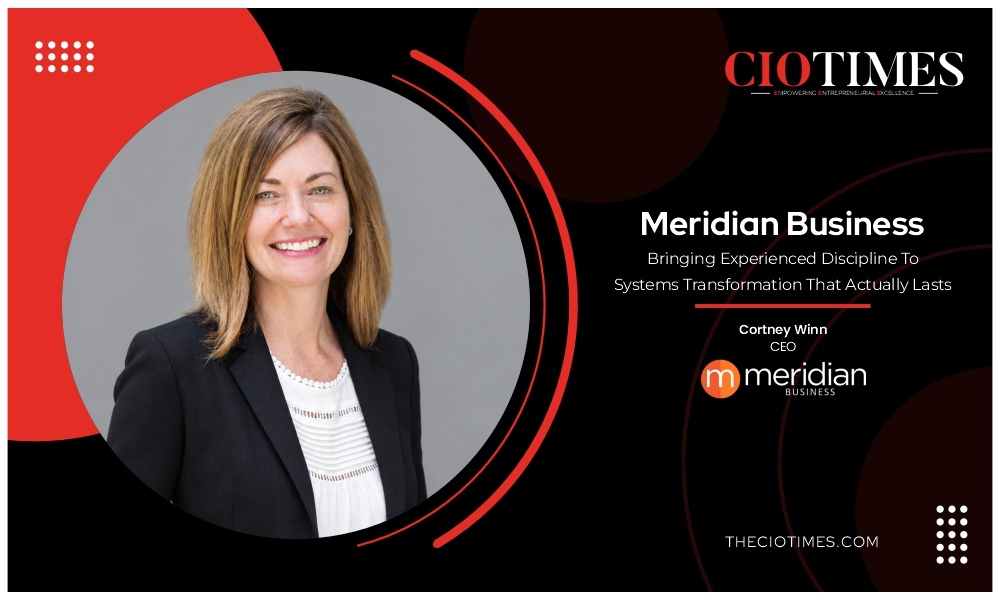
Many strategic collaborations guided by enterprise technology firms significantly enhance the value of core business platforms. These engagements bring together industry expertise, implementation capabilities, and technology insight resulting in streamlined processes. Meridian Business, led by CEO Cortney Winn, is at the forefront of opening doors to financial growth through transformation via use of the NetSuite platform.
Enterprise Vision
Cortney is a distinguished business and technology executive with expertise in enterprise evolution. Cortney leads with a focus on business value. Her work centers on associating strategic business priorities with enterprise technology. Her extensive experience across financial, operational, supply chain, and human capital transformations gives her a wealth of insight into complex business environments.
Through disciplined execution, the Meridian team focuses on turning technology investments into tangible outcomes. The approach also emphasizes being agile and proactive, while bringing in long-term solution and process planning to bear. For Cortney and Meridian, technology is a strategic instrument for strengthening performance, accelerating growth, and creating competitive advantage.
Customized Offerings
In the age of Artificial Intelligence (AI), it is evident that ERP systems are undergoing significant evolution, crossing over both system implementation and application development practices. Cortney mentions that Meridian’s objective within any client project is to provide a comprehensive solution grounded in streamlined business processes. Meridian’s execution is crafted with the client’s expectations and end goals at top-of-mind.
She adds, “We leverage the full spectrum of the NetSuite ecosystem as well as the depth of experience of our consultants and leadership team to create an optimal solution for each client. NetSuite is powerful, but it needs strategy too.”
Sustained Transformation
A project’s success extends well beyond a successful technology deployment. Meridian Business, believes the true measure of success lies in delivering tangible business outcomes and sustained value. Meridian Business, takes a holistic approach while working with each client. The team strategically stages and phases solutions for each organization based on immediate need and balanced against available budget. Given NetSuite’s modular architecture, this ‘stairway’ approach enables value to be realized progressively and with greater precision.
While the platform may be able to address 10 or 12 business processes, Meridian recognizes that most projects are driven by two to four critical processes creating the greatest operational and financial opportunity. Addressing these priorities first unleashes the most business value and ROI. A disciplined scope keeps initiatives focused, accelerates adoption, and maintains budget control.
Meridian Business, also prioritizes a seamless transition from implementation to Managed Services and Support following project go-live. Subsequent phases of projects can then expand functional capabilities, strengthen user adoption, and enable organizations to capture additional value. This structured approach allows Meridian to remain focused on value delivery beyond the initial project, while continuously advancing operational performance and organizational capability.
Execution-driven Transformation
Cortney believes that technology alone rarely creates competitive advantage. The true differentiator is disciplined execution. Meridian has developed an implementation methodology that integrates technical experience with strategic business process alignment, organizational readiness, and long-term scalability. A defining strength is the depth of Meridian Business’s leadership expertise, with more than 100 years of collective ERP implementation experience, including extensive work with Fortune 500 organizations. The team has translated the governance, rigor, and execution discipline of large-scale enterprise programs into Meridian’s NetSuite practice focused on bringing an affordable, collaborative, and proven project delivery model to small and medium businesses (SMBs).
She shares, “We recognize that ERP implementations aren’t our clients’ full-time jobs. They still have businesses to run, customers to serve, and teams to lead.”
From the outset, her team establishes a clear roadmap and implementation cadence suited to each organization. Recognizing that transformation must coexist with ongoing business priorities, it makes the process structured, focused, and manageable.
She also views implementation as a platform for building lasting organizational scalability. Her teams work alongside clients through training, knowledge transfer, and change management, ensuring that organizations gain more than a technology solution. By the time the system becomes operational, client teams are equipped to confidently manage and evolve along with the system. Although Meridian’s Managed Services and Support remain a strategic resource beyond implementation, its primary objective is to build enduring self-sufficiency for each client.
Identifying the Unrecognized Risk
Enterprise growth often exposes hidden inefficiencies across finance, operations, and supply chains. In Cortney’s experience, one of the most consequential operational blind spots is data quality. This issue creates risk given today’s proliferation of Artificial Intelligence. Data normalization and cleansing before migration can be a demanding and mundane task. Yet it pays off with significant value by enabling more accurate automation and streamlined processes.
Meridian Business also stresses the importance of integrated CRM and ERP platforms like NetSuite in creating a unified view of inventory for organizations with physical supply chains. This allows sales, operations, and finance teams to work from a consistent data foundation.
Cortney states, “With NetSuite, procurement and production planning can stay aligned with sales and vice versa as employees across all departments can not only see on-hand inventory quantities but also how much of that inventory is already committed to other customers’ sales orders.”
Stronger order management follows, as procurement and production planning can respond more effectively to sales activity. Sales teams, in turn, gain visibility into available inventory and existing commitments, enabling more informed decisions and helping organizations identify inefficiencies before they become constraints on growth.
Evaluating to Add Value
The team conducts a detailed evaluations of where NetSuite, or the ecosystem’s integrated partner solutions intersect a given client’s business strategy to add value to their current investments in the NetSuite platform.
As an example, Cortney adds, “Regarding AI, Meridian has formed a task force and approach – AICompass – specifically tasked with uncovering key use cases that can be resolved through LLM, predictive, and agentic AI solutions.”
A Phased Transformation Strategy
Meridian Business’s philosophy on strategic platform transformation is rooted in creating a long-term business relationship with each client. It is formed during the earliest stages of the sales cycle and carried out through implementation. Cortney believes guiding clients to “crawl, walk, run” is far more effective than attempting to address every requirement simultaneously.
Unwavering focus on the “north star” key business drivers that elevated the project within the client’s strategic agenda is paramount. Trying to accomplish everything at once can distract focus, strain organizational capability, and result in placing the project’s potential outcomes at risk.
Trusted Partnership
Trust is built through transparency and clarity from the outset. During the pre-sales cycle, Meridian takes an extra step to explain both its project delivery methodology and the transition to the Managed Services and Support engagement that follows. It helps clients understand how they will work with Meridian during and after implementation.
As each project gets underway, Cortney shares, “Our flexibility early in the early “design” or Engage phase of the project often results in discovery of previously unknown requirements and the ability for the client to take on additional project tasks as they are able – lowering cost and improving knowledge transfer and adoption.”
Combining Teams Well
Business transformation is primarily a people-driven endeavour. Technology is the enabler. A core objective of Meridian’s project teams is aligning stakeholders around the “Big Why” behind an initiative, from the top down and bottom up. She believes teams aligned on purpose perform more effectively.
She states, “It seems obvious, but teams that are aligned on the purpose of the project perform better.”
Meridian’s User Acceptance Testing (UAT) approach reinforces this alignment by immersing client teams in all end-to-end business processes before go-live. This hands-on involvement strengthens long-term ownership and self-sufficiency, reducing the dependency that can emerge when consultants deliver projects independently of client teams.
Enduring Partnerships
Cortney highlights that the most rewarding experiences come from the relationships built along the way.
She adds, “What I’ve learned is that technology projects are ultimately about people. The most successful engagements weren’t the ones with the biggest budgets or the most complex technology. They were the ones where trust was built early, challenges were addressed collaboratively, and both sides were genuinely invested in achieving the same outcome.”
These experiences shape Meridian’s approach today. She sees client engagements as long-term partnerships. Clients remain with Meridian for years because its value extends beyond implementation to support growth.
Lasting relationships emerge from understanding a client’s business, people, and definition of success. When clients recognize genuine investment in their success, the relationship evolves from service provider to trusted advisor.
Integrated Excellence
At Meridian Business , Cortney believes the strongest consultants incorporate technical expertise, business acumen, and genuine empathy for the clients they serve. She has shaped the culture around their collective importance to deliver meaningful client outcomes. Meridian reinforces this through five core competencies expected across the organization: solution delivery, practice development, relationship building, employee development, and client stewardship.
Solution delivery drives executional excellence. Practice development advances innovation through stronger methodologies, tools, and accelerators. Relationship building establishes trust and long-term advisory relationships. Employee development supports continuous learning and growth. Client stewardship ensures decisions remain centered on what is right for the client, even when those decisions do not immediately benefit Meridian.
Cortney has also invested in organizational culture through use of the Gallup CliftonStrengths and the Five Behaviors of a High-Performing Team, helping employees understand their strengths, collaborate effectively, and maintain accountability. Together, these frameworks allow technical capability, commercial understanding, and client empathy to reinforce one another.
She adds, “Innovation only matters if it creates business value, and execution only matters if it helps clients achieve their goals. By developing well-rounded consultants and keeping client success at the center of everything we do, we’ve built a culture where those priorities work together rather than compete for attention.”
Holistic Use of AI
NetSuite continues to evolve through AI-driven capabilities and an expanding cloud ecosystem. Meridian is positioning its clients to capitalize on these developments ahead of the market. For Cortney, this is an enormous market opportunity. She mentions that Meridian is helping Small and Medium Businesses (SMBs) grasp what is possible regarding the tools available, how to leverage them, and how to use (and protect) their data.
She adds, “More specifically, emerging opportunities exist in the use of AI across every aspect of today’s business processes. Helping clients understand the impact AI can have on their ERP systems’ productivity and optimization potential is an exciting, new endeavor.”
Process Optimization
Meridian’s journey reflects years of helping organizations navigate complex transformation initiatives. Cortney shares that the key elements of long-term strategy will include adoption of AI tools to compress delivery timetables while also improving outcomes. Some part of that effort will include increasing focus on training and organizational change management (OCM) to build client self-sufficiency and the ability to administer their systems more effectively and more quickly post-go-live.
Client Appreciation
The legacy that Meridian Business aims at is to be recognized as the best partner for the markets it serves. Hearing from a client, post project, that they should’ve tackled the project with Meridian’s assistance sooner, is what drives Cortney and the Meridian team forward.
Also Read :- CIO Times Magazine For More Information