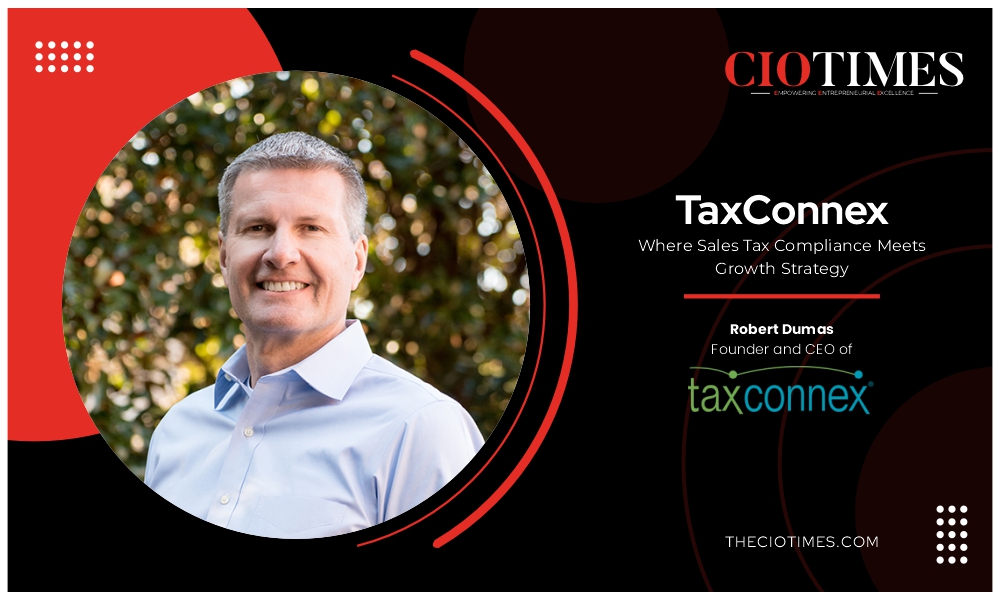
Modern commerce does not wait for permission. Technology now lets a business sell nationally, or globally, almost overnight. In the US, the laws governing what that business owes in sales tax move at a very different speed. They live inside thousands of separate state and local jurisdictions, many with their own rules on nexus, taxability, sourcing, exemptions, and filing, set by legislatures rather than markets.
That gap between the speed at which business moves, and the sluggish pace at which jurisdictions evolve is where TaxConnex has built its practice, pairing experienced tax practitioners with its own compliance technology to help growing businesses manage an obligation that changes shape every time they expand, launch a product, or open a new sales channel.
Robert Dumas, Founder and CEO of TaxConnex explains, “Tax and regulatory complexity isn’t static. It’s an on-going part of doing business.” The organizations that treat it that way, rather than as a barrier to growth, are the ones that build the processes, technology, and people needed to manage it, freeing leadership to focus on expanding with greater confidence.
From Compliance to Risk Management
For most companies, sales tax is an administrative burden that finance and tax teams are required to manage. Dumas sees it differently, “In the world of sales tax, we would argue it has always been a risk conversation. Compliance is simply the outcome of effectively managing that risk.”
That risk grows every time a company changes shape. Expanding into a new state, launching a product, acquiring a company, or adding a sales channel each has a potential to add new sales tax obligations, and a missed nexus determination, an incorrect taxability call, or an inconsistent process can create liabilities that go unnoticed until an audit surfaces them.
Considered a pass-through tax, sales tax flows from the end-customer, through the business, to the taxing jurisdiction. While sales tax is a pass-through tax, the business remains on the hook for collecting, remitting, and documenting it. According to TaxConnex, some states go further: responsible party laws in certain jurisdictions can hold corporate officers personally accountable for a company’s unpaid sales tax.
That exposure is also why sales tax cannot exist solely within the tax department. Managing sales tax compliance well takes governance, internal controls, and coordination that reaches into finance, legal, IT, and operations. Tax and/or finance may file the returns, but legal shapes the contracts, product teams define what’s being sold, IT manages the systems capturing the transaction data, and sales determines how offerings reach the market. When each function attends only to its own piece, sales tax implications can slip through the gaps.
Dumas maintains that reliable data, documented processes, and strong controls support investor confidence and long-term resilience, whether a company is preparing for an acquisition, raising a round, or expanding into a new market, allowing it to manage risk and move forward with confidence.
Living in the Gap
Legislatures and taxing authorities do not move at the pace of the businesses they regulate. The scale of that gap is visible in how long it took the industry to absorb its last major shift. The 2018 South Dakota v. Wayfair decision fundamentally changed sales tax by allowing states to impose economic nexus obligations on remote sellers. While many states adopted their own standards within a year or two, it took nearly five years before every state with a statewide sales tax had done so, with Missouri becoming the last in January 2023.
That same lag is playing out again with digital products and Software-as-a-Service. As more businesses shift to subscription and cloud-based models, states are reevaluating how those offerings should be taxed. Case in point, see recent discussions in Colorado and California about taxing SaaS as examples of legislatures working to modernize their rules for an increasingly digital economy. Businesses cannot put innovation on hold while every jurisdiction works its way to the same conclusion.
What is required is not just the ability to keep pace with change but the ability to interpret regulations that are still evolving, weigh risk, and decide when the answer is not yet settled. Regulations may eventually catch up, but until they do, businesses need trusted advisors who can navigate the grey areas with confidence.
Where Technology Ends and Judgment Begins
In order to help manage the complexity of sales tax, different companies have introduced various technologies over the years including artificial intelligence and automation. The volume of transactional data modern businesses generate is too great to manage through manual processes alone, and technology can process it, flag anomalies, automate repetitive tasks, and bring more consistency to the compliance process.
Where Dumas believes the industry is off track is by assuming the goal should be removing the human element entirely. Questions of nexus, taxability, sourcing, exemption documentation, and audit positions rarely have one universal answer. They require someone who understands not just the regulations but a client’s risk tolerance, their products, business model, systems, contracts, and long-term objectives, which is why experienced practitioners continue to provide tremendous value.
That philosophy shaped how TaxConnex built its own technology. Its proprietary platforms, Connexion®, Client Connexion®, and Return Wizard, were developed to enhance the work of its practitioners rather than replace them by automating routine processes, standardizing workflows, strengthening quality controls, and adding visibility throughout the compliance lifecycle so practitioners can focus on judgment calls and advising clients through complex situations.
Dumas believes, “The organizations that will be most successful won’t be those with the most automation. They’ll be the ones that know where automation adds value and where experienced professionals remain essential.”
Innovation at TaxConnex has never meant adopting new technology simply because it exists. Every investment is measured against one question: does it help deliver more accurate, transparent, and reliable compliance for clients?
Filing deadlines, taxability determinations, jurisdictional requirements, and audit documentation all demand a high degree of consistency, which is why TaxConnex approaches innovation deliberately by automating repetitive processes and treating technology as a support for sound decision-making rather than a substitute for it. Some of TaxConnex’s most meaningful improvements have come simply from listening to its practitioners and its clients, then building solutions around the challenges they face.
The Hidden Risk in Growth
With sales tax, one of the most underestimated risks is assuming that the sales tax processes supporting a business today will still support it tomorrow. Growth changes a company’s sales tax profile, often in ways that are not immediately obvious.
An acquisition can introduce new nexus obligations, inherited audit exposure, different taxability determinations, or filing responsibilities in jurisdictions the acquiring company has never operated in. Expanding into new states, launching products, or adding sales channels can each create entirely new compliance requirements, and even a shift in business model, moving from a traditional software license to a SaaS offering, or expanding through marketplace channels, can significantly alter a company’s risk profile.
What makes these risks especially difficult is that they tend to develop gradually. A company may not realize it has established nexus, perhaps the taxability of its products have changed, or they have created new filing obligations until months or years later, often only when the issue surfaces during an audit or a due diligence process.
That is why TaxConnex encourages businesses to treat sales tax as part of every major growth initiative rather than something addressed afterward: before an acquisition, a new market, a new ERP system, or a new revenue model, organizations should evaluate how the decision affects their sales tax obligations, since catching issues early is almost always less costly than correcting them later.
That same growth curve is what the team believes should shape how a business chooses outside help. The first question leaders should ask is whether they want someone to complete a task or a partner to help manage an ongoing business risk, since those are very different relationships, and many companies outgrow an automated or purely internal solution well before they realize it.
Dumas says, “The right partner shouldn’t simply process returns or complete monthly filings. They should understand your business, your products, your systems, and your long-term objectives well enough to anticipate issues, provide guidance, and help you navigate change before it becomes a problem.”
That kind of partner also operates with transparency rather than as a black box, communicating proactively and explaining its recommendations so leadership can make informed decisions. That type of partner also grows alongside the business as it expands into new markets, adds products, or adopts new technology.
The Next Regulatory Frontier
Economic nexus and marketplace facilitator laws reshaped the sales tax landscape over the past decade. Looking ahead, Dumas believes the next major challenge will not be where businesses owe tax, but what they are actually selling.
As software continues to evolve, the taxability of those products becomes more and more challenging, noting the gap between the speed of innovation and the lethargy of changing legislation. Let’s look at the software and telecommunications industries.
Today’s businesses are not simply selling software licenses or telecommunications services. They are offering cloud platforms, AI-powered applications, embedded communications, subscription services, integrated voice and messaging capabilities, and bundled digital solutions that often span several traditional tax categories at once, and tax law has not kept pace, since many jurisdictions still work from definitions written before these business models existed.
Increasingly, that leaves businesses determining whether a product should be considered Software-as-a-Service, telecommunications, digital goods, information services, or some combination, often with different treatment depending on the jurisdiction.
TaxConnex anticipates states will continue to modernize their tax codes but also expects meaningful variation to persist from one jurisdiction to the next, leaving businesses to navigate differing interpretations as much as differing regulations.
That is why Dumas considers proactive tax planning more important than ever, urging companies to evaluate the tax implications of their products while they are still being designed rather than after launch. Companies that do this well will not just reduce compliance risk; they will be better positioned to scale new offerings, enter new markets, and adapt as regulations continue to shift.
TaxConnex advice for any organization heading into its next phase of growth is simple: do not treat sales tax as something to address after the business grows. Make it part of the growth strategy from the beginning. “Organizations that consider those implications early can make better decisions, avoid costly surprises, and scale with greater confidence.” The fundamentals are what make that possible: reliable data, well-defined processes, experienced people, and technology built for visibility and consistency.
Dumas leaves growing companies with this: “The most successful organizations don’t separate growth strategy from tax strategy. They recognize that thoughtful planning today creates the flexibility, resilience, and confidence needed to support growth and minimize risk for years to come.”
Gain more educational insight on managing sales tax or learn more about TaxConnex, visit :- https://www.taxconnex.com/
Also Read :- CIO Times Magazine For More information