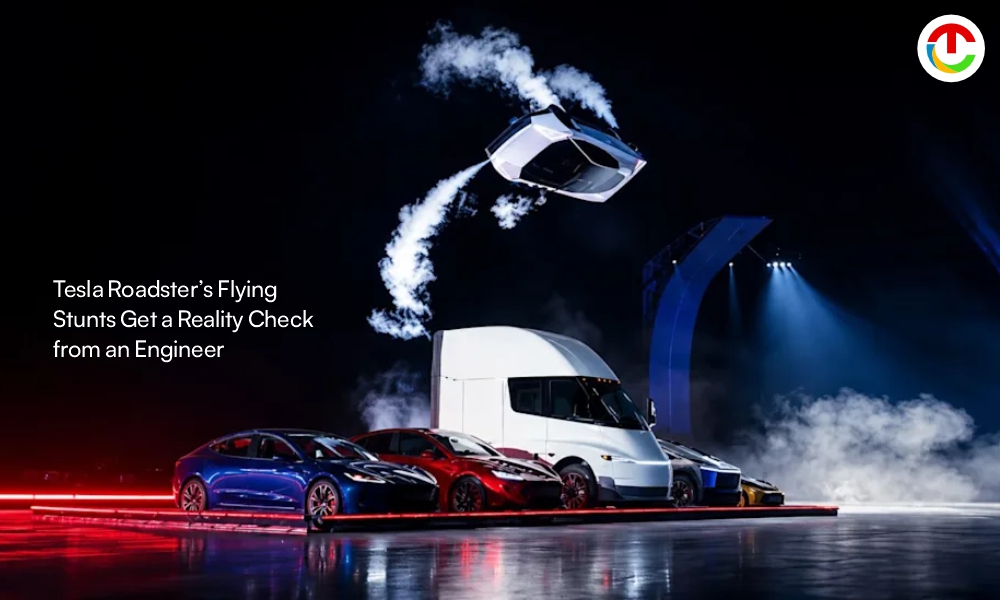
Tesla’s next-generation Tesla Roadster has attracted attention with a dramatic prototype demonstration featuring wall-climbing, a ramp-less flying kickflip and a claimed zero-to-60 mph acceleration time of less than one second. The unconventional reveal appeared to push the boundaries of automotive engineering, prompting questions about the technology behind its extraordinary stunts.
One of the most striking demonstrations involved the vehicle climbing a wall and remaining attached to an overhead surface. The concept relies on a powerful suction system designed to generate enough downforce to hold the car against a surface.
According to the demonstration’s technical explanation, four 20-kilowatt fans draw air from beneath a sealed aerodynamic skirt, creating a reported 11.5% vacuum. This system is said to produce approximately 10,360 pounds of artificial downforce, theoretically sufficient to keep a 4,400-pound vehicle attached to a ceiling.
While the figures offer a possible explanation for the wall-climbing demonstration, the system’s practical performance would depend on factors such as surface sealing, airflow, power consumption and vehicle stability.
The Rocket Science Behind the Flying Stunts
The Tesla Roadster more ambitious demonstration involves a ramp-less kickflip, which appears to send the car into the air without conventional wheels-on-road acceleration. According to an analysis by Engineering Explained, the proposed technology relies on principles similar to those used in rocket propulsion.
The system reportedly uses composite storage tanks containing 550 pounds of highly compressed nitrogen at pressures reaching 10,000 pounds per square inch (psi). The gas is directed through ten strategically positioned thrusters to generate the force needed for the vehicle’s airborne manoeuvre.
The demonstration’s technical figures claim the system can produce approximately 18,000 pounds of thrust, potentially enabling the vehicle to lift off and remain airborne briefly.
However, these specifications and performance claims require careful interpretation. Actual flight capability would depend on thrust direction, the duration of gas discharge, vehicle mass, stability and the engineering safeguards needed to control the manoeuvre.
Engineering Ambition Meets Practical Challenges
The Tesla Roadster proposed features illustrate how technologies associated with aerospace engineering could be adapted for an electric sports car. Yet demonstrating a concept is different from establishing that it can operate reliably and safely under real-world conditions.
Questions remain about the system’s energy requirements, repeatability, practical usefulness and safety. Until independently verified through detailed testing, the extraordinary performance figures should be treated as claims rather than established production-car capabilities.
For now, the Tesla Roadster flying stunts highlight Tesla’s ambition to challenge conventional automotive design, while underscoring the engineering hurdles involved in turning spectacular demonstrations into dependable technology.
Also Read :- Why Does Elon Musk Want to Merge Tesla and SpaceX?