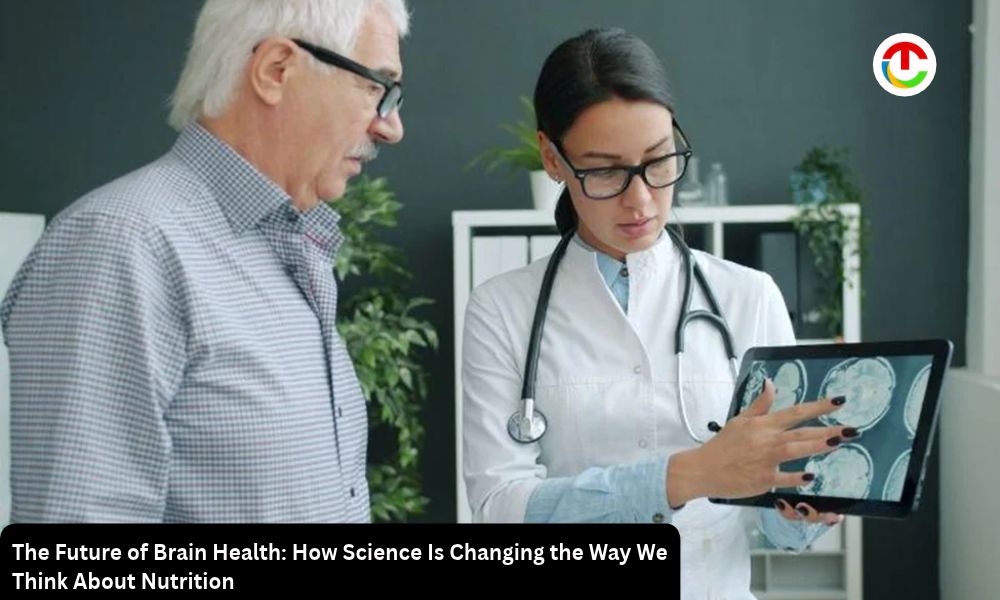
[Photo by Vitaly Gariev: https://www.pexels.com/photo/doctor-discusses-brain-scans-with-senior-patient-39192362/]
The conversation around brain health is changing. Once largely associated with aging and memory loss, cognitive well-being is now attracting attention from healthcare researchers, technology innovators, and business leaders.
With professionals navigating demanding workloads and increasingly complex decisions, understanding how the brain functions has become more relevant. Nutrition is an important part of that discussion, particularly as scientists learn more about how nutrients reach and support the brain.
According to the World Health Organization (WHO, 2026), approximately 57 million people worldwide were living with dementia in 2021. Although brain health involves far more than dementia prevention, this figure highlights the growing importance of research into cognitive health. Recent discoveries are changing how scientists understand nutrition. Rather than focusing solely on how much of a nutrient someone consumes, researchers are investigating how the body processes it and whether it reaches the tissues that need it.
Why Brain Nutrition Is More Complex Than Previously Thought?
The brain needs a continuous supply of nutrients to maintain normal function. Vitamins, minerals, fatty acids, and other dietary components contribute to processes involving nerve cells, energy production, and cellular communication. Among these nutrients, omega-3 fatty acids have attracted considerable research interest.
Docosahexaenoic acid (DHA), a long-chain omega-3 fatty acid, is an important structural component of brain cell membranes. It contributes to the properties of those membranes and supports normal neuronal function (National Institutes of Health [NIH], n.d.). However, consuming DHA and transporting it into the brain are two different biological processes.
This distinction has encouraged researchers to investigate nutrient delivery. Some newer omega-3 formulations are made with LPC DHA, a form of DHA associated with lysophosphatidylcholine (LPC). Research into LPC DHA is particularly interesting because it concerns how DHA crosses the blood-brain barrier. Understanding that process could influence how scientists approach brain-focused nutrition.
The Blood-Brain Barrier: A Critical Part of Nutrient Delivery
The blood-brain barrier is a protective system that helps regulate which substances move from the bloodstream into the brain. Its purpose is to maintain a stable environment for brain cells while limiting exposure to potentially harmful substances. However, this protective function also makes nutrient transport a complex process.
In a landmark study published in Nature, Nguyen et al. (2014) identified a transporter called MFSD2A, which facilitates the movement of DHA into the brain when DHA is attached to LPC. The researchers found that MFSD2A transported DHA “in the form of lysophosphatidylcholine (LPC)” (Nguyen et al., 2014, Abstract). This discovery added an important piece to our understanding of brain nutrition. It demonstrated that the molecular form in which a nutrient travels can influence how it enters the brain.
The study involved laboratory experiments and animal models. Although subsequent research has further established the biological importance of MFSD2A, these findings should not be interpreted as proof that LPC DHA supplements improve memory, concentration, or cognitive performance in healthy adults. That requires separate clinical evidence.
Why Nutrient Bioavailability Matters?
Bioavailability describes how much of a substance becomes available for the body to use. In nutrition, it can be affected by digestion, absorption, metabolism, and the chemical form of the nutrient. For brain health, researchers must consider another question: How effectively can a nutrient reach the brain?
This is particularly relevant to DHA because different forms of omega-3 fatty acids follow different metabolic pathways. The discovery of MFSD2A has opened opportunities for further research into DHA transport and delivery. However, improved absorption or transport does not automatically translate into better cognitive outcomes.
The NIH (n.d.) reports that clinical trials of conventional long-chain omega-3 supplementation have generally not demonstrated cognitive benefits in healthy older adults. Some findings involving people with mild cognitive impairment are more encouraging, but additional research is necessary. These limitations matter when evaluating emerging nutritional technologies. A promising biological mechanism provides a reason for further investigation, not definitive evidence of a health benefit.
The Growing Interest in Personalized Brain Nutrition
Another significant development is the movement toward more personalized approaches to nutrition. People differ in age, health status, dietary habits, nutrient intake, and metabolism. These differences may influence their nutritional requirements and responses to dietary interventions.
Researchers are increasingly interested in whether nutritional recommendations can account for individual characteristics rather than relying entirely on generalized approaches. For example, someone with a medically identified nutrient deficiency may have different needs from an individual who already consumes an adequate, balanced diet.
Personalized nutrition could eventually involve a combination of dietary assessments, clinical biomarkers, and evidence-based recommendations. Digital health platforms and data analysis may help healthcare professionals monitor dietary patterns and identify potential nutritional gaps.
Nevertheless, personalized brain nutrition remains a developing field. More research is needed to establish which measurements reliably predict cognitive outcomes and whether individualized interventions offer meaningful advantages.
What Dietary Research Tells Us About Long-Term Brain Health?
Despite interest in advanced nutritional formulations, everyday dietary habits remain an important focus of brain health research. The Mediterranean and MIND diets have received particular attention. Both emphasize foods such as vegetables, whole grains, legumes, nuts, and fish. The MIND diet places additional emphasis on leafy green vegetables and berries.
The National Institute on Aging (NIA, n.d.) reports that observational studies have associated these dietary patterns with slower cognitive decline and reduced dementia risk. However, findings from clinical trials have been less conclusive. This distinction is important because observational research can identify associations without proving that a particular diet directly causes an improvement in cognitive health.
Current evidence does not establish that any single food or supplement can prevent Alzheimer’s disease (NIA, n.d.). A balanced approach therefore remains more defensible than focusing on one nutrient as a solution to complex neurological conditions.
Brain Health Is Becoming a Wider Business and Healthcare Priority
The future of brain health extends beyond individual dietary choices. Cognitive conditions create substantial challenges for healthcare systems, employers, families, and national economies.
According to the WHO (2026), the estimated global economic cost of dementia reached US$1.3 trillion in 2019, including the value of informal care. These figures underline the importance of prevention research, early identification, accessible healthcare, and long-term support. For business leaders, the broader discussion also includes workplace well-being.
Organizations are increasingly considering how working conditions, stress management, physical activity, and healthy routines relate to employee health. Nutrition can contribute to these conversations, but it should not be presented as a substitute for adequate rest, appropriate workloads, or access to healthcare. For healthcare innovators, the challenge is to translate scientific discoveries into interventions that demonstrate measurable benefits in well-designed human studies.
What the Next Generation of Brain Health Research Could Look Like?
Several developments may shape the direction of nutritional neuroscience. Researchers are continuing to investigate nutrient transport mechanisms, including the role of MFSD2A in DHA delivery. Clinical studies may also help determine whether particular nutritional approaches benefit specific populations, such as individuals with documented deficiencies or different nutritional needs.
Meanwhile, advances in medical imaging, laboratory analysis, and clinical research methods could help scientists evaluate changes in brain health more precisely. The most meaningful innovations will be those supported by reproducible findings, appropriate safety assessments, and clear evidence of clinical benefit. For consumers and healthcare professionals, understanding the difference between preliminary research and demonstrated outcomes will remain important.
Conclusion
The future of brain health research is moving beyond the simple question of which nutrients people should consume. Scientists are now examining how nutrients are absorbed, transported, and used, providing a more detailed understanding of the relationship between nutrition and brain function.
Discoveries involving DHA transport, alongside ongoing work in personalized nutrition and dietary research, offer promising directions for scientific investigation. However, progress depends on interpreting evidence carefully and recognizing the limits of current research.
For healthcare innovators and business leaders, the opportunity lies in supporting credible research and responsible innovation. Better understanding of brain nutrition may ultimately contribute to more informed healthcare decisions, but lasting advances must be measured by demonstrated outcomes rather than promising mechanisms alone.
References
- National Institute on Aging. (n.d.). Cognitive health and older adults. National Institutes of Health.
- National Institute on Aging. (n.d.). What do we know about diet and prevention of Alzheimer’s disease? National Institutes of Health.
- National Institutes of Health, Office of Dietary Supplements. (n.d.). Omega-3 fatty acids: Fact sheet for health professionals.
- Nguyen, L. N., Ma, D., Shui, G., Wong, P., Cazenave-Gassiot, A., Zhang, X., Wenk, M. R., Goh, E. L. K., & Silver, D. L. (2014). Mfsd2a is a transporter for the essential omega-3 fatty acid docosahexaenoic acid. Nature, 509(7501), 503–506. https://doi.org/10.1038/nature13241
- World Health Organization. (2026, October 26). Dementia. World Health Organization.
Also Read:- How ChatGPT Is Quietly Rewiring Your Brain, Says MIT Research