Corrected Draft for Executive Review
Strong technology partnerships create the foundation for meaningful progress. Dayo-Tech represents the kind of trusted NVIDIA partnership organizations need to capture the potential of AI with confidence. In this context, trust goes beyond technical capability: it reflects sound judgment, execution discipline, and a clear understanding of enterprise priorities.
Organizations need partners that can turn advanced AI infrastructure into practical business advantage. By connecting cutting-edge technology with strategic intent, Dayo-Tech helps customers move from AI ambition toward meaningful, sustainable enterprise outcomes.
The Smart Technology Partner
Dayo-Tech is an end-to-end technology solutions company helping organizations modernize and scale their IT environments. As an NVIDIA Elite Partner, it delivers high-performance AI and GPU infrastructure for demanding workloads, alongside secure enterprise, HPC, cloud, DevOps, cybersecurity, and automation solutions.
With a strong emphasis on practical implementation, reliability, and business value, Dayo-Tech builds technology foundations aligned with customer priorities. Its goal is to help organizations operate securely, scale efficiently, and adopt advanced technologies with greater confidence.
Products / Services of Dayo-Tech
- AI & GPU Infrastructure
- Enterprise IT Solutions
- Cloud & DevOps Services
- Cybersecurity Solutions
- High-Performance Computing
- Startup Technology Infrastructure
- Business Continuity & Disaster Recovery
- Technology Consulting & Implementation
Unified Enterprise Solutions
Dayo-Tech operates across AI infrastructure, cloud, cybersecurity, DevOps, networking, and high-performance computing. At the core, these seemingly distinct technology domains are often interconnected parts of one larger customer challenge.
From an enterprise perspective, a request for GPU infrastructure or an NVIDIA system rarely represents the full requirement. The infrastructure still needs to be deployed, integrated, secured, monitored, backed up, and managed within the existing environment. Users need secure access, data must be protected, and the network must support the workloads.
This is especially visible with startups. A young company may purchase powerful AI infrastructure and then discover that it also needs networking, storage, cybersecurity, remote access, backup, identity management, endpoint protection, cloud services, and ongoing infrastructure management.
Instead of forcing the customer to coordinate multiple vendors, Dayo-Tech takes responsibility for the environment as a whole. It looks at the infrastructure end to end, identifies what is missing, and brings together the technologies required to create a complete working environment. For Dayo-Tech, “end-to-end” means taking ownership of the customer journey and remaining accountable until the environment works the way the customer needs it to.
Enterprise-Ready AI Infrastructure
Organizations are moving from AI experimentation toward sustained, production-scale workloads. As that happens, the focus shifts from simply acquiring GPUs to maximizing utilization, performance, security, and business value.
The transition usually begins when a customer outgrows one or two standalone GPU systems. As more users, developers, and workloads are added, the organization needs to manage shared resources, schedule workloads efficiently, automate execution, maintain consistency, and support continuous development.
For AI development and deep-learning environments, Dayo-Tech has implemented clustered infrastructures using workload schedulers such as Slurm. This allows multiple teams to submit jobs to a shared pool of compute resources, with the platform managing allocation, queues, priorities, and execution automatically.
In enterprise environments, Kubernetes-based architectures can provide a structured way to manage applications and workloads while integrating with development pipelines and automated processes. The objective is to move from manually running code on individual machines toward a platform that supports repeatable deployment, scaling, version management, automation, security, and operational consistency.
That is the difference between infrastructure that is simply powerful and infrastructure that is truly enterprise-ready.
Navigating Full-Stack AI Complexity
NVIDIA increasingly defines AI infrastructure as a full-stack ecosystem spanning accelerated compute, networking, storage, software, and orchestration. The challenge for enterprises is no longer simply acquiring individual technologies; it is integrating them into an existing environment in a way that is secure, manageable, scalable, and aligned with operational and data requirements.
This becomes especially complex in large and regulated organizations, where data cannot move freely between systems. Access must be controlled, permissions clearly defined, sensitive information protected, and every layer aligned with existing security and governance requirements.
In these environments, the project often begins with the data itself: what information will be used, where it resides, who is allowed to access it, and how AI models or applications will interact with it.
Dayo-Tech has worked on complex infrastructure projects for highly sensitive and regulated environments, including secure data access, information separation, permissions, and automated workflows. Combined with continuous exposure to NVIDIA’s evolving ecosystem, that experience allows the team to evaluate the complete environment rather than a single component.
Its role is to connect compute, networking, storage, software, orchestration, and security into one operational architecture that can work reliably in production.
Culture-Anchored Expansion
Personal attention is easy to promise and difficult to preserve as a technology company grows. For Dayo-Tech, growth only makes sense if the customer experience that differentiates the company can be preserved.
As the customer base expands and demand for NVIDIA-based AI infrastructure continues to grow, Dayo-Tech is scaling the organization accordingly. But size alone is not the objective. The focus is on preserving the responsiveness, ownership, professionalism, and personal attention that have shaped the company from the beginning.
A major part of that comes down to culture. The team listens before it sells, seeks to understand the customer’s broader environment, and takes responsibility for the outcome rather than simply delivering a product and moving on. That responsibility continues after the sale.
As Dayo-Tech grows, the aim is to institutionalize those behaviors across the organization so they do not depend on one individual. Customers should feel that growth has expanded what Dayo-Tech can do for them, not created distance between them and the company.
Assessing Technology Maturity
NVIDIA’s accelerated computing ecosystem evolves rapidly. In a market moving this quickly, staying current is essential, but adopting every new technology immediately is not.
Dayo-Tech continuously follows NVIDIA’s technology roadmap, product releases, partner updates, and training programs. This provides visibility into where the ecosystem is heading, but the key question is always whether a new technology is mature enough to solve a real customer problem.
The team evaluates the use case, the existing environment, expected lifecycle, compatibility, scalability, supportability, and the risk of introducing technology that may still be too early for production.
Hardware lifecycle provides a practical example. Customers sometimes request older GPU platforms or components that are approaching end-of-life. Even if those products can still be sourced, Dayo-Tech makes sure the customer understands the implications and, where appropriate, recommends a newer generation that provides a stronger long-term path.
At the same time, some existing environments require an older component. The right approach is not to force the newest technology into every situation, but to understand the constraint and build the most appropriate solution around it.
Challenging Client Assumptions
Customers often approach technology providers with a preferred solution already in mind. Dayo-Tech is willing to challenge those assumptions, but it does so carefully and professionally.
Sometimes a customer arrives with a tightly defined specification after completing its own technical evaluation. In those cases, Dayo-Tech’s role may simply be to implement the selected configuration.
More often, the initial request raises additional questions. The team seeks to understand why the customer is asking for a specific product or architecture, what environment it will be deployed into, what workload it needs to support, and whether it fits the existing infrastructure.
For example, a customer may ask Dayo-Tech to supply a specific component for an existing server. The company can provide the exact part requested, but if it knows that the component is incompatible with the system, it will say so before the customer makes the purchase.
The objective is not to prove that Dayo-Tech knows better than the customer. It is to ask the right questions, understand the context, and make sure the customer can make an informed decision. The team also looks beyond the immediate transaction to consider scalability, lifecycle, supportability, integration, and long-term objectives. If there is a better alternative, Dayo-Tech explains why and presents the options.
Operational Customer Centricity
Many technology providers describe themselves as customer-centric, innovative, and outcome-driven. For Dayo-Tech, those principles need to be visible in the way the company operates every day.
The team listens before it sells. It tries to understand not only what the customer is asking for, but also the environment around that request: the infrastructure, constraints, risks, and what will happen after the technology is deployed.
That often means taking responsibility beyond the original scope of the conversation. A customer may approach Dayo-Tech asking for GPU systems, but the team will also ask:
- Where will the systems be installed?
- How will they be powered and cooled?
- How will they be protected?
- How will users access them?
- Is the surrounding environment ready to support them?
In one case, a startup was focused on purchasing DGX systems while the broader hosting requirements had not yet been fully resolved. Dayo-Tech identified that gap and helped connect the customer with a suitable environment rather than treating hosting as somebody else’s problem.
The same principle applies after the sale. Dayo-Tech does not consider its responsibility finished when the equipment is delivered or when the manufacturer becomes involved. If the company takes responsibility for a project, it remains engaged and helps drive issues toward resolution.
Measuring Business Transformation
Technology investments are increasingly evaluated not only on technical performance, but also on business impact. For Dayo-Tech, a successful project is not defined simply by the fact that a system was installed and turned on. The real measure is what happens afterward.
- Does the customer’s work become faster and more efficient?
- Are bottlenecks removed?
- Can teams use the infrastructure in ways that were previously difficult or impossible?
- Does the customer gain the confidence to expand because the initial deployment created clear value?
One of the most meaningful examples involved a customer whose technical team had struggled with significant infrastructure bottlenecks for a long time. They had reached a point where some of those limitations simply felt like part of the environment.
After Dayo-Tech worked on the environment, those bottlenecks were removed and the systems began operating much more smoothly. The customer’s reaction was extremely strong; from its perspective, the improvement felt almost impossible compared with what it had experienced before.
Another strong indicator is what the customer does next. When a customer starts with a limited deployment, sees the value, and then returns to expand significantly, it shows that the infrastructure is not only working technically; it is supporting real operational growth.
For Dayo-Tech, the strongest indicators include fewer bottlenecks, better utilization, smoother workflows, positive customer feedback, repeat business, expansion of the environment, and ultimately the customer’s ability to achieve more because of the technology.
Creating Long-Term Value
Dayo-Tech’s long-term ambition goes beyond the next product, project, or growth milestone. The company wants to be known as an organization that consistently turns advanced AI technology into real business value.
For Yakov, one of the most important measures of that is return on investment. AI infrastructure is expensive, and the cost does not end with the initial purchase. There are ongoing operational, support, energy, and infrastructure costs. Customers need to feel that the investment was justified, that the technology improved their capabilities, created clear value, and helped the business move forward.
For Yossi, the long-term vision goes further. The goal is not for Dayo-Tech to remain only an infrastructure integrator. The ambition is to evolve toward complete, turnkey NVIDIA-based solutions that combine infrastructure with software, model enablement, optimization, automation, and the ability to extract maximum performance from the environment.
Today, that may mean designing and deploying compute, storage, networking, security, and orchestration. Over time, Dayo-Tech intends to expand deeper into the software and optimization layers so customers can receive a more complete end-to-end solution from a single trusted partner.
At the same time, the company wants to grow without losing the character that brought it this far: technical depth, personal responsibility, trust, and the willingness to remain close to the customer. If customers describe Dayo-Tech a decade from now as the partner that helped make complex AI infrastructure practical, scalable, and valuable, the company will have achieved the institution it set out to build.
Leadership Built on Long-Standing Trust
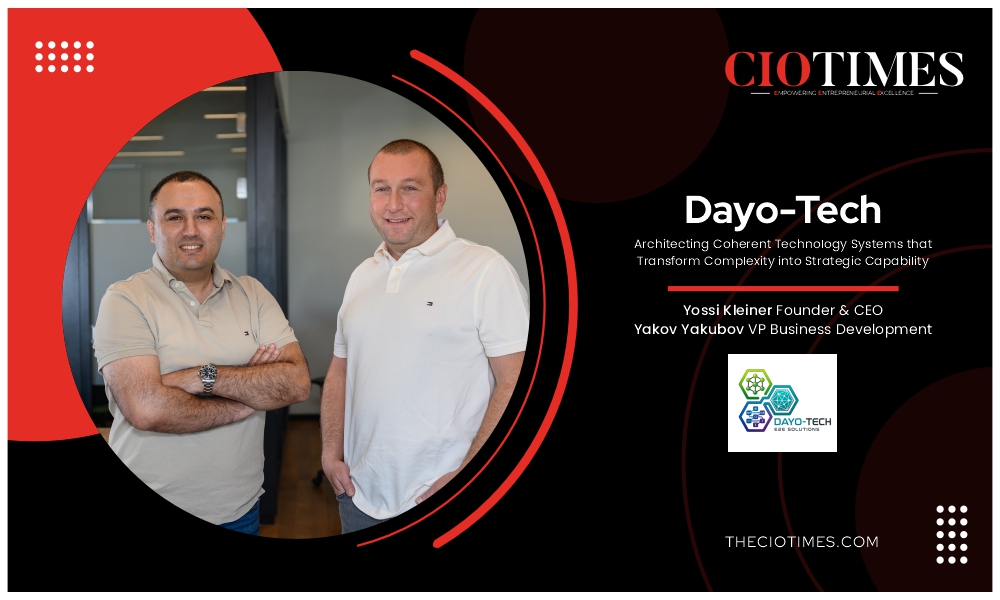
Behind Dayo-Tech’s technology strategy is a long-standing personal partnership. Yossi Kleiner, CEO and Owner of Dayo-Tech E2E Solutions, and Yakov Yakubov, VP of Business Development, have known each other since their school years, long before they became business partners.
Their relationship brings complementary strengths into the leadership team: Yossi’s deep technical expertise and hands-on customer experience, together with Yakov’s commercial perspective, negotiation skills, and customer-development focus. That trust also shapes the way they disagree, make decisions, and preserve a customer-first culture as the company grows.
Q.1. You and Yakov have known each other since your school years and built a friendship long before building a company together. After more than a year of running Dayo-Tech side by side, what have you discovered about each other as leaders that you could never have learned as friends, and how has that changed the way you operate as a leadership team?
Yossi Kleiner:
Working with Yakov showed me capabilities I had never really seen during all our years as friends. He is an exceptionally strong negotiator and has a very structured and thorough approach to the commercial side of the business.
Before Yakov joined Dayo-Tech, I was handling many different areas myself and often had to move quickly. He has taught me the value of stopping, examining decisions more deeply, and giving important issues the extra thought they deserve.
What makes the partnership particularly effective is the trust between us. We know each other’s strengths and weaknesses; there are no hidden agendas, and each of us is comfortable relying on the other where he is strongest.
Yakov Yakubov:
We have known each other for many years, but working together every day revealed sides of Yossi that I could never have fully understood through friendship alone. One of the things that impressed me most is his ability to manage many complex situations at once. He can finish a highly technical discussion with one customer and immediately move into another completely different conversation without losing focus or depth.
I also discovered how deeply customer relationships matter to him. Customers trust him because they know he will stay with them until the problem is genuinely solved.
Our capabilities are very complementary. My strengths are more focused on the commercial side, negotiation, and customer development, while Yossi brings deep technical knowledge and years of hands-on experience. Together, that allows us to approach opportunities from both directions and think several steps ahead.
Q.2. Most business partnerships are built around complementary skills; yours is also built on decades of personal trust. When the stakes are high and the two of you see a decision differently, how does the friendship influence the disagreement, and where do you deliberately make sure business judgment comes before personal familiarity?
Yakov Yakubov:
One of the advantages of our partnership is that we came into the business with a very high level of trust. I knew from the beginning that Yossi has much deeper technical experience, so when a decision is primarily technical, I trust his judgment and understand that he should lead the direction.
That does not mean we always agree immediately. We discuss things openly, and sometimes I see a situation differently, especially from the commercial side. But disagreement does not become personal. What matters is understanding who has the stronger expertise in that specific situation and making the best decision for the company.
Yossi Kleiner:
Yakov has changed the way I approach important decisions. Working with him taught me to stop more often, look at the full picture, and give key decisions more thought. When he has done the analysis and the issue is in an area where he has stronger commercial judgment, I am comfortable stepping back and trusting him.
At the same time, when I believe there is a technical or operational reason to take a different direction, I invest more time in explaining the reasoning. Our friendship helps because we know there is no ego or hidden agenda behind the disagreement.
Q.3. For Yossi Kleiner: Dayo-Tech is built around a distinctly customer-centric philosophy rather than a transactional technology-services model. What experience or conviction led you to believe that deeply understanding a customer’s problem is ultimately more valuable than simply delivering the technology they ask for?
Yossi Kleiner:
That philosophy comes directly from my experience in the industry. Before starting Dayo-Tech, I spent years working closely with customers, integrators, and technology vendors. I saw situations where the focus was simply on closing the deal, even when the solution was not necessarily the best fit.
Over time, I saw the consequences. A customer may complete the purchase, but if the solution does not truly solve the problem, the experience becomes negative and the trust disappears.
For me, the right solution is not automatically the most expensive one. If a customer has a choice between a $50,000 solution and a $10,000 solution, and the $10,000 option fully answers the requirement, I would rather recommend the $10,000 solution.
I may make less on that transaction, but the customer learns something much more important: that I am looking after their interests, not simply trying to maximize the sale.
That trust creates a very different relationship. When the customer later needs to expand a data center, purchase more servers, add storage, or build a new infrastructure environment, they come back because they know the advice is based on what they genuinely need.
Q.4. For Yakov Yakubov: You made the unusual transition from being Yossi’s long-time friend to becoming his business partner and co-leader. Having now experienced Dayo-Tech from inside the leadership team, what part of Yossi’s original vision do you believe was most prescient, and what part do you believe needs to evolve for the company’s next chapter?
Yakov Yakubov:
What stands out to me most is how early Yossi recognized the direction in which NVIDIA and accelerated computing were going.
He saw the potential of this technology years before AI infrastructure became the major business priority it is today. The original vision was not simply to sell hardware, but to build a company capable of taking NVIDIA technologies and turning them into practical, production-ready solutions.
The next chapter is about scaling that vision. As Dayo-Tech’s customer base expands and demand for NVIDIA-based AI infrastructure grows rapidly, we are scaling the team accordingly. We are adding experienced technical professionals while preserving the expertise, responsiveness, and personal service that have defined Dayo-Tech from the beginning.
The opportunity is also becoming increasingly international. We have built a strong foundation in Israel and are now expanding our activity into Europe, with the United States representing an additional long-term growth market.
For More Information Contant :- https://www.dayo-tech.com/contact
Also Read :- CIO Times Magazine For More information