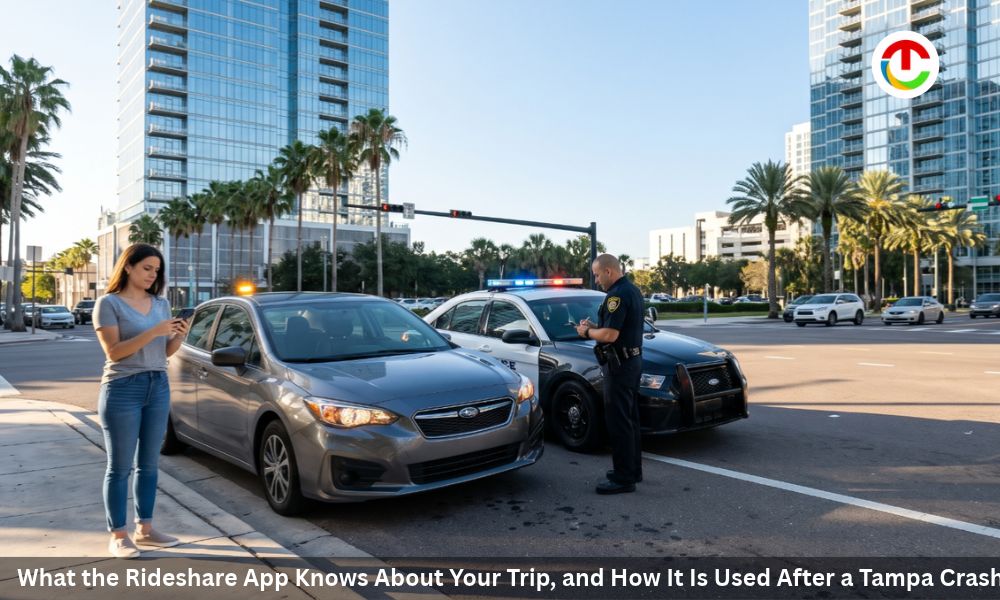
A ten minute ride across Tampa generates more structured data than most enterprise transactions. Location pings, acceptance timestamps, route geometry, driver app state, fare calculation inputs, in app messages and a post trip rating all land in the same pipeline before the passenger has finished walking to the door.
For the companies that run these platforms, that record is an operations and pricing asset. For anyone involved in a collision, it becomes something else: the most precise account of what happened that anyone will ever produce. It is also governed by retention rules that most riders have never read.
The Data Layer Behind a Ten Minute Ride
Rideshare App are telematics businesses that happen to move people. The trip record typically includes a GPS trace sampled at intervals, device level motion data on some platforms, the exact moment a driver accepted the request, the moment the passenger was marked as picked up, and the moment the trip closed.
1. Trip state is the hinge
The single most consequential field is not speed or route. It is the driver’s status in the app at the moment of impact. Offline, logged on and waiting for a request, en route to a pickup, and carrying a passenger are four different states, and they are stored as four different things.
That distinction is not a technicality. It determines which insurance policy responds.
How Long the Record Survives?
Florida wrote rules for these platforms directly into statute, and one of them is a retention floor rather than a ceiling. Section 627.748 of the Florida Statutes requires a transportation network company to maintain individual ride records for at least one year after the date on which each ride is provided, and individual records of its drivers for at least one year after the date the driver’s relationship with the company ends.
One year is a short runway for a serious injury claim. Medical treatment often has not stabilized at that point, and nothing obliges a platform to keep granular telemetry past the floor unless it has been asked to.
According to personal injury lawyer Lance C. Rudzinski, Shareholder and Managing Partner at RTRLAW, the practical consequence is that preservation requests need to go out while the data still exists rather than when a claim is finally ready to be valued. A Tampa Uber accident lawyer working one of these cases will usually send a written preservation demand to the platform in the first weeks, naming the trip, the driver and the period in question.
Why the Rideshare App Record of the Period Decides the Insurance Tier?
The same statute sets the insurance requirements, and it splits them by the driver’s state in the app. One set applies while a driver is logged on to the digital network but not engaged in a prearranged ride. A different set applies once the driver is engaged in a prearranged ride.
While logged on and waiting, the statute requires primary automobile liability coverage of at least $50,000 for death and bodily injury per person, $100,000 for death and bodily injury per incident, and $25,000 for property damage. Once the driver is engaged in a prearranged ride, the requirement rises to primary automobile liability coverage of at least $1 million for death, bodily injury and property damage.
The statute also defines when a prearranged ride begins and ends. It starts when the driver accepts a ride requested through the digital network, continues while the driver transports the rider, and ends when the last rider exits and is no longer occupying the vehicle. Those are app events, not observations made at the scene.
The Crash Report Is on a Different Clock
The public record moves on its own schedule, and it is slower. Under section 316.066 of the Florida Statutes, crash reports that reveal the identity, home or employment address, or other personal information of the parties involved are confidential and exempt from the public records law for a period of 60 days after the report is filed.
The same section makes those reports immediately available to a defined list, including the parties involved in the crash, their legal representatives, their insurers, and law enforcement agencies. Florida’s Highway Safety and Motor Vehicles department explains the request process on its traffic crash reports page.
So two records of the same event mature at different rates. The platform’s version is precise and perishable. The state’s version is slower to open and narrower in what it captures.
What Rideshare App , Riders and Operators Should Take From This?
Rideshare App For passengers and drivers, the useful instinct after any collision is to screenshot the trip in the app before closing it. The receipt, the map, the driver identity and the timestamps are all visible for a short while and are far harder to reconstruct later.
For businesses running fleets, contracting with platforms, or writing mobility policy, the retention floor is the number worth knowing. Data that is technically available today is not the same as data that will be available when a dispute finally arrives, and the gap between those two is measured in months.
Also Read :- Who Pays When You’re Injured in a Rideshare Accident?