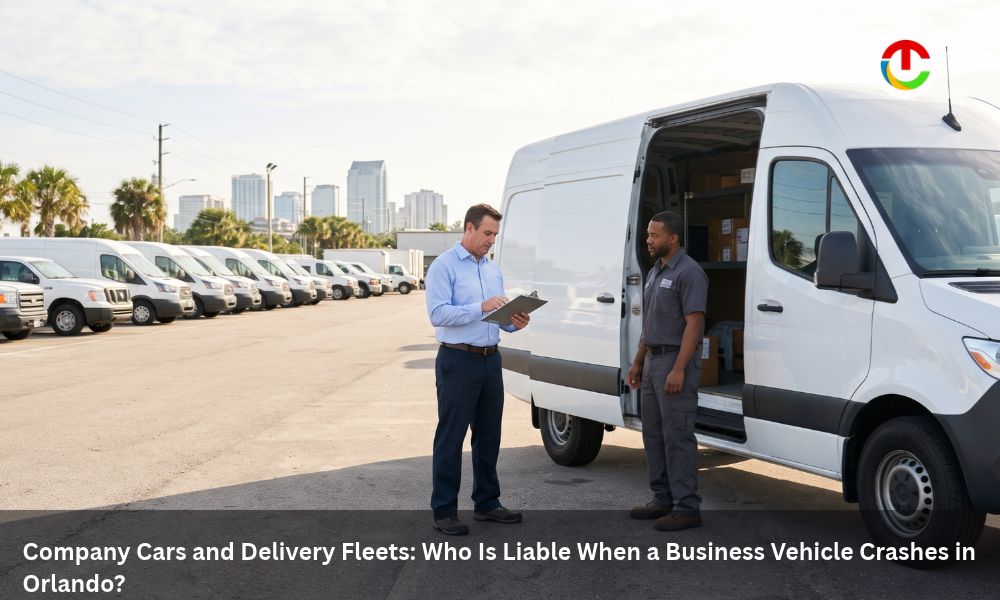
Last mile delivery turned every mid-sized company into a transportation operation. Service techs, sales reps, catering vans, contractor pickups and a growing tier of branded sprinter vans now move through Orlando traffic all day, and the people driving them are rarely professional drivers in any formal sense.
When Business Vehicle Crashes in Orlando is involved in a collision, the first question is not who was careless. It is a structural question: what was the legal relationship between the business and the vehicle? Florida answers that question differently depending on whether the company owns the van, leases it, rents it, or simply reimburses an employee for mileage.
The differences are not marginal. They change the ceiling on what a business can be asked to pay.
Four Relationships, Four Different Answers for Business Vehicle Crashes in Orlando
Most fleets are a mix. A finance team that treats all four arrangements as the same line item is carrying risk it has not priced.
1. The owned fleet
The company holds title. This is the most exposed position in Florida, and for reasons most operators do not anticipate.
2. The long term lease
A lease of a year or longer, with insurance meeting statutory thresholds, moves the lessor out of the owner category for financial responsibility purposes.
3. The rental counter and the employee’s own car
A short term rental and a reimbursed personal vehicle each carry their own rules, and neither behaves like an owned van. The rental is governed partly by federal law. The reimbursed personal car usually brings the employee’s own policy in first, with the employer’s coverage sitting behind it.
Why Commercial Ownership Removes the Cap also help to Business Vehicle Crashes in Orlando?
Florida law caps owner liability in several situations. Section 324.021 of the Florida Statutes provides that a lessor renting or leasing a vehicle for less than one year is deemed the owner only up to $100,000 per person and $300,000 per incident for bodily injury and $50,000 for property damage, with an additional $500,000 in economic damages available if the lessee or operator is uninsured or thinly insured. A natural person who loans a vehicle to a permissive user gets a comparable cap.
Then comes the sentence that matters for fleets. The statute states that those limits do not apply to an owner of motor vehicles that are used for commercial activity in the owner’s ordinary course of business, other than a rental company.
According to personal injury lawyer Matthew A. Rabin, Partner and Managing Attorney at RTRLAW, that single carve-out is why the ownership question gets asked before anything else, because a company van and a borrowed family car can produce very different outcomes from an identical collision. An Orlando crash injury attorney evaluating a claim against a business will usually pull the title, the lease and the insurance declarations before taking a statement from anyone.
A company that owns the vehicles it runs in its own business does not get the statutory cap. The exposure is whatever the harm is worth.
The Federal Rule Behind the Rental Counter Business Vehicle Crashes in Orlando?
Rental companies occupy a category of their own, and the reason is federal. Under 49 U.S.C. 30106, an owner that rents or leases a vehicle is not liable under state law by reason of being the owner for harm arising out of the use of that vehicle during the rental, provided the owner is engaged in the trade or business of renting or leasing vehicles and there is no negligence or criminal wrongdoing on the owner’s part.
That proviso is doing real work. The protection disappears if the rental company itself was negligent, which is why maintenance records and the condition of a rented vehicle at handover are worth preserving.
Screening, Records and the Limits of a Background Check
Companies often assume a clean background check insulates them. Florida does offer a presumption, but a narrower one than most operators believe.
Section 768.096 creates a presumption that an employer was not negligent in hiring when the claim involves the intentional tort of an employee and the employer completed a defined background investigation before hiring. That investigation must include a criminal background check, a reasonable effort to contact references and former employers, and a job application asking about prior convictions and prior intentional tort suits.
Read the trigger carefully. The presumption is written for intentional torts. An ordinary negligent driving claim against a fleet operator sits outside it, which means hiring and supervision records are evaluated on their own merits rather than against a statutory safe harbor.
What Fleet Operators Should Document Now?
Three records do most of the work when something goes wrong. A current inventory that states, for each vehicle, whether it is owned, leased, rented or personal. A written policy on personal use, passengers and after-hours driving. And maintenance logs that are actually contemporaneous rather than reconstructed.
None of that prevents a collision. What it does is make the structural questions answerable in days instead of months, and in disputes of this kind the side that can answer first usually sets the terms of the conversation.
For finance and operations teams, the practical move is to review the vehicle inventory against the insurance schedule once a year and confirm the two documents describe the same fleet. They often do not.
Also Read :- Why Hiring a Car Accident Lawyer Early Preserves Key Evidence