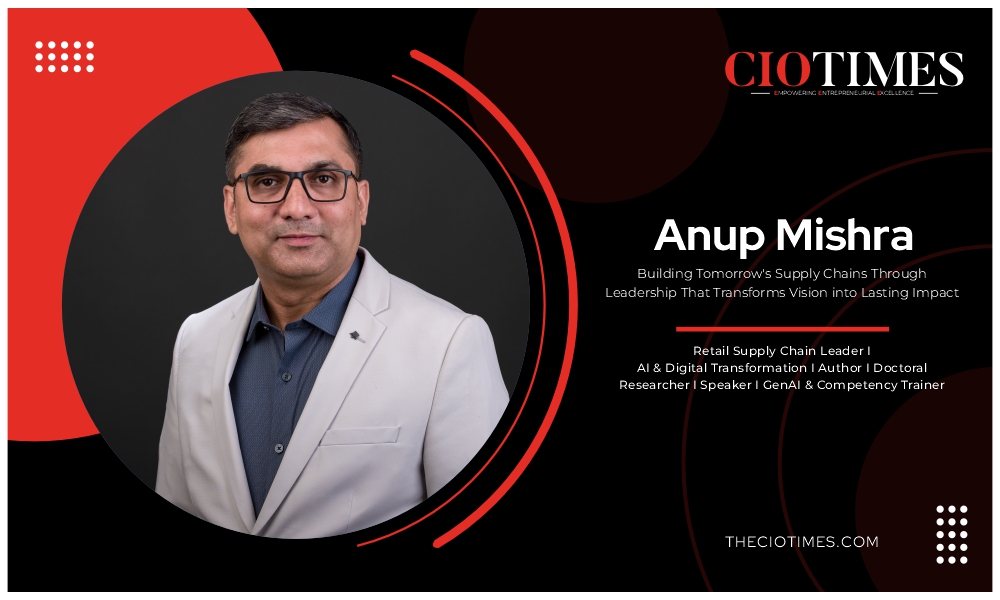
Today’s business landscape is shaped by voices that bring perspective. They also bring perspective, experience, and a clear understanding of what lies ahead. Business operations include navigating transformations and strengthening organizational resilience, while these perspectives also shape how modern enterprises think, adapt, and operate. It is from expert male speakers like Anup Mishra, AGM- Supply Chain Planning and Analytics, Wholesale and Retail, that we get insights about putting greater emphasis on agility, visibility, and continuity. Maestros like him share valuable insights about sourcing goods, production, or movement, as he is a supply chain expert. As the landscape still evolves, it calls for a more connected approach to leadership.
Enduring Intelligence
Organizations that will build the resilient supply chains of the future will be distinguished by how intelligently they connect and orchestrate activities across the enterprise ecosystem. Anup Mishra’s perspective is that organizations must move beyond functional excellence toward Ecosystem Thinking. While local optimization can create global inefficiencies, an enterprise-wide perspective strengthens resilience and agility while unlocking long-term value.
Technology enhances visibility, accelerates decision-making, and enables greater intelligence. However, true resilience is rooted in decision intelligence. It integrates trusted structured and unstructured data, business context, scenario planning, AI-powered insights, and human intuition. It helps in making sound decisions in prevailing uncertainty. It also requires agile talent and the dismantling of functional silos to create learning systems that constantly evolve.
He adds, “In my opinion, resilience combined with LeAgility- the factor of Lean and Agile together is powerful. The Lean-Agile approach helps organizations not just survive uncertainty and geopolitical upheavals but thrive on disruption and turn resilience into a competitive advantage.”
Evolving Supply Leadership
Anup Mishra operated with a transactional mindset early in his career. He focused on KPIs and operational efficiency within retail supply chains. Over time, his outlook evolved toward enabling enterprise transformation through a sustainability-focused supply chain. Rather than viewing supply chain as a back-end function, he recognized its critical role in shaping customer experience, business resilience, sustainability, and long-term enterprise value.
A principle he has carried with him throughout his career is to “Zoom out before you Zoom in.” Understand the broader system, identify the connections, and then focus on the areas that can create the greatest measurable impact.
He adds, “Instead of organizations continuing to operate based on KPI -driven silos, we must practice Ecosystem Thinking. Develop a governance model that’s predicated on solving problems in real time, collaborating across functions, and leveraging Systems Thinking.”
Technology will continue to advance, but the fundamentals of leadership remain constant: curiosity, integrity, collaboration, accountability, and continuous learning. Sustainable change is ultimately driven by people who challenge convention, think critically, and work towards a shared goal. Leadership means bringing people, processes, data, and technology together as a single intelligence.
Leadership Impact
Several organizations exert themselves by investing in digital transformation but still struggle to extract business value. Anup Mishra’s experience taught him that failure occurs as the transformation isn’t looked upon as a constant journey. It is seen as a mere technology initiative. Technology accelerates transformation, but leadership determines its direction and people sustain its impact.
He adds, “Successful organizations begin with the right business problems, clearly defined outcomes, and Systems Thinking, recognizing how people, process, data, technology, and governance work together as one connected ecosystem.”
Transformation should be measured by business value. Instead, it is measured by the number of digital initiatives or technologies deployed. One of the most overlooked success factors is the strength of the digital foundation. AI doesn’t fix weak ERP systems, poor master data, or fragmented integrations. On the contrary, it amplifies them. Organizations must strengthen this fundamental before expecting AI to deliver meaningful business outcomes.
As AI is growing as a dominant component, organizations need to evolve from automation to Decision Intelligence. This can be done by combining trusted data, Human Centered AI, Explainable AI, and strong governance. The organizations that succeed will be those that build trust in AI, empower people to make better decisions, and transform technology investments into measurable business value.
Intelligent Autonomy
Artificial intelligence is changing the supply chain planning from forecasting events to crafting intelligent decisions. Over the next five years, Anup envisions planning becoming increasingly autonomous. It will enable organizations to sense demand shifts, predict risks, simulate multiple scenarios, dynamically optimize inventories, and recommend actions in real time. He also emphasizes that the future belongs to Human-Centered AI. It is where technology augments human intelligence rather than replacing human accountability.
As AI becomes more embedded in business-critical decisions, organizations must also invest in Explainable AI (XAI). In areas such as inventory optimization, procurement, pricing, and risk management, leaders need to understand not only what AI recommends but also why it recommends it. Trust, transparency, governance, and explainability will become as important as prediction accuracy.
Anup Mishra also adds, “AI will become a trusted decision partner, but people will continue to define purpose, ethics, creativity, and long-term business value.”
Competitive advantage will increasingly come from context engineering by combining trusted data, business context, domain expertise, and organizational knowledge. This enables decision intelligence, integrating AI, systems thinking, and human judgment. It results in faster and smarter with responsible decision-making.
Adaptive Enterprise Value
The prevalent challenge is about balancing competing priorities through intelligent trade-offs. Gone are the days when it was about optimizing inventory, customer service, or resilience. Anup remains focused on a single KPI, which often creates an unintended consequence elsewhere. The aim is to continuously optimize enterprise value. Leaders need to move beyond static planning toward adaptive planning. This will result in decisions evolving with market conditions, customer demands, supply risks, and geopolitical uncertainty. It demands scenario-specific planning, dynamic inventory policies, and close collaboration across procurement, planning, logistics, finance, and commercial teams.
Anup Mishra adds, “The organizations that succeed are those that strike a balance by building agile operating models, diversified supply networks, and responsive planning capabilities.”
Sustainable competitive advantage comes from balancing short-term execution with long-term strategic objectives. Organizations that think beyond functional KPIs, embrace intelligent trade-offs, and build adaptive supply chain capabilities will create resilient value networks that consistently deliver superior customer experience, stronger financial performance, and sustainable long-term business growth.
Thoughtful Questions: Need of the Hour
Undoubtedly, Anup Mishra agrees to the fact that data has become one of the most valuable enterprise assets. At the same time, he also highlights that data alone cannot create a competitive advantage. Competitive advantage comes from the quality and speed of decisions made using that data. The role of advanced analytics is therefore evolving from descriptive reporting to predictive insight, prescriptive recommendations, and ultimately shaping enterprise strategy.
He stresses that organizations must move beyond descriptive dashboards and embrace Decision Intelligence. That is where advanced analytics transforms complex data into actionable insights that enable executives to anticipate risks, evaluate trade-offs, simulate future scenarios, and make confident decisions.
Anup Mishra adds, “Rather than asking “What Happened”, leadership teams should increasingly ask, “What is likely to happen, why, what are the available options, and what is the best course of action?”
Analytics should not be viewed as a reporting capability but as a strategic capability. Organizations that embed analytics into everyday decision-making will move from being data-rich to decision-rich, creating a sustainable competitive advantage in an increasingly dynamic business environment.
Factual Clarity
Cross-functional partnerships have been crucial as supply chains come in touch with finance, technology, merchandising, and customer experience. Due to this, execution excellence is determined by how effectively they align around a common business purpose. Anup’s experience says that alignment always precedes execution. Even the most capable team will struggle if they pursue different priorities, success metrics, and outcomes.
Leaders must therefore create a shared vision supported by common objectives, transparent governance, clearly defined decision rights, and a culture of collaboration rather than functional ownership. Cross-functional success is built on trust, open communication, and a willingness to solve enterprise problems instead of department problems.
Anup Mishra adds, “It is important to establish a single source of truth, where every stakeholder works from consistent data and shared business insights.”
It diminishes conflicting priorities, improves accountability, and enables faster, more effective execution. Consistent integration excellence is gained when stakeholders are aligned by purpose. It also includes building confidence through gaining trust and being united by shared outcomes.
Reasoning Outlook
The future supply chain leaders will be defined by their way of thinking. Critical thinking, creative problem solving, and sound judgment in uncertain conditions are reflected as the true differentiators.
Another aspect he points out is that leaders need to master thinking intelligence. It is the skill to accommodate strategic thinking, systems thinking, business acumen, emotional intelligence, and data literacy. These help to make balanced decisions in complex environments. They must be well-versed in challenging assumptions, connecting unrelated insights, and translating insights into valuable business outcomes.
Leading through the power of influence, not hierarchy, is also what Anup highlights.
Anup Mishra adds, “Future supply chains will operate across global ecosystems where collaboration, adaptability, and continuous learning will be essential to drive transformation and innovation.”
The future belongs to those leaders who combine intelligent technology with thoughtful leadership, curiosity, humility, and an unwavering commitment to continuous learning. Those who can inspire people as effectively as they embrace technology will shape the next generation of resilient and future-ready enterprises.
Sustainable Supply Chains
Anup views sustainability as a strategic business advantage rather than a compliance obligation. He believes the future supply chain will increasingly align environmental responsibility, operational efficiency, and commercial performance as complementary outcomes of smarter business decisions. Voluntary eco-friendly initiatives like accurate demand forecasting, optimized inventory, reduced waste, efficient transportation, responsible sourcing, and better resource utilization can enhance aspects like lower costs, reduced emissions, and enhanced customer value.
Anup Mishra adds, “Those that successfully align profitability with sustainability will build stronger brands, more resilient supply chains and endure competitive advantage”
Hence, sustainability can be integrated into everyday business decisions rather than managed as a separate agenda. He highlights that organizations need to measure success beyond financial performance, incorporating resource productivity and supply chain resilience.
Pioneering Supply Chain Framework
Several organizations are moving toward modernizing legacy systems. Contributors like modular technologies, automation, and intelligent planning platforms play a crucial role. Anup highlights the fact that Future-ready supply chains will be built on technology architectures that are adaptive, connected, and scalable. There is an innate need for organizations to optimize their decisions with evolving business needs and customer expectations.
Anup Mishra adds, “The real value of automation is not replacing people- it is eliminating complexity, accelerating execution, and enabling faster, more informed decisions.”
The smart planning platforms unite planning, procurement, inventory, logistics, and commercial operations into a unified ecosystem, improving agility, visibility, and responsiveness. Integrating the latest technologies is misinterpreted as replacing legacy systems. It is actually about building a future-ready digital foundation. Organizations that invest in flexible architecture rather than rigid systems will innovate faster, adapt with confidence, and remain competitive in an increasingly dynamic global business environment.
Amplifying AI Apprehensions
The greatest competitive advantage to an organization will be its ability to learn continuously, reskill itself, and develop people faster than the actual pace of change in the market. As AI reshapes work and shortens the shelf life of skills, continuous learning and reskilling must become strategic imperatives.
AI literacy must be complemented by enduring human capabilities. It includes strategic and critical thinking, analytical reasoning, creative problem-solving, decision-making, collaborative intelligence, and adaptability. These enable people to work effectively alongside technology and navigate uncertainty with confidence.
The upcoming generation of supply chain leaders will be defined by the capabilities they imbibe and integrate in the organization.
Anup Mishra adds, “Technology creates possibilities, but people transform those possibilities into sustainable business value.”
Organizations that cultivate a culture of continuous learning, competency development, and lifelong reskilling will remain focused, creative, and globally competitive.
Nurturing a Holistic Outlook
A lot of unique perspectives help in shaping international organizations that triumphantly steer through complex supply chain transformations. Anup Mishra experience says that the real challenge lies in making better decisions, building stronger capabilities, and creating sustainable value. He reveals that his greatest strength is to interlink business strategy with execution, technology with people, and operational excellence with long-term transformation.
He adds, “Having worked in retail, wholesale, supply chain planning, analytics, AI, and business transformation, I bring an integrated perspective grounded in both industry experience and research-driven innovation.”
Humbly mentioning himself being a doctoral candidate, he believes research gives concrete affirmations and methodologies that transform business challenges into practical, measurable outcomes.
Sharing about his goals, he mentions he is not here to simply craft smart supply chains. He desires to help organizations build intelligent, resilient, and future-ready enterprises. Technology may shape the future, but leadership, innovation, and people determine how that future is created.
Also Read :- CIO Times Magazine For More information