The best contract lifecycle management software earns its keep after everyone signs: nine platforms judged on obligation tracking, renewal capture, service-level follow-through and spend control
Every CLM demo ends the same way. The workflow fires, the counterparty signs, a green tick appears, and the sales engineer closes the laptop before anyone asks what happens next. What happens next is three years of contract life: obligations nobody rereads and auto-renewals that arrive above last year’s price without a conversation. Service credits expire unclaimed because nobody measured the service. The best CLM software proves itself in those three years, so that’s where the judging happens here: obligation tracking, renewal capture, SLA follow-through and the audit trail that proves all of it.
Judging the category this way reshuffles it. Platforms that dominate the drafting conversation slide down the table once the question becomes who tracked the obligation and who caught the renewal. The scoring leans on vendor documentation, Gartner Peer Insights ratings and thousands of G2 reviews, weighted toward what users say happens in month eleven rather than day one. Match the platform to the half of the lifecycle your team struggles with, and remember which half runs for years.
The nine CLM software picks in brief
- Gatekeeper, the top pick for unified post-signature vendor and contract control
- Sirion, the top pick for obligation and SLA governance at enterprise scale
- LinkSquares, the top pick for renewal calendars run by in-house legal
- Agiloft, the top pick for data-first contracting on a no-code engine
- Juro, the top pick for mid-market teams that want renewals handled without ceremony
- Conga CLM, the top pick for Salesforce-native revenue agreements
- Ironclad, the top pick for high-volume contract workflows with obligation alerts
- DocuSign CLM, the top pick for execution-first rollouts
- Icertis, the top pick for global enterprise obligation portfolios
What you need to know before shortlisting CLM software?
1. Signature is the halfway point, priced like the finish line
Platforms in this category split into tools that get agreements signed and tools that stay useful afterwards. The difference stays invisible at the demo and surfaces around month eleven, when the first notice window opens and nobody owns it. The second half of the lifecycle runs for years, and it’s the half that costs money when ignored.
2. Renewal capture is the fastest money in the category
Auto-renewal clauses do their job with or without you. Leading post-signature platforms report customers saving significant sums by removing unwanted renewals, and whatever discount you apply to a vendor’s own numbers, the direction holds: one missed notice window can cost more than the software.
3. Obligations need a record, not a reminder
Extraction AI pulls commitments out of a signed contract in minutes. The question that separates these platforms is where the commitment lives afterwards: against the document that mentions it, or against the counterparty that owes it. Document-filed obligations answer audits with search; counterparty-filed obligations answer with a report.
4. The counter party keeps moving after you sign
Suppliers change owners and lose certifications, and none of that appears in the PDF. A contract platform that can’t see the vendor behind the paper treats an expired insurance certificate as somebody else’s problem, which it will remain until renewal week.
How to choose the best CLM software when the work starts after signature?
1. Decide whether yours is a closing problem or an after-signature problem
Closing problems sound like “legal is the bottleneck on every NDA”. After-signature problems sound like “two contracts renewed above budget before anyone noticed, and the SLA credits lapsed unclaimed”. Juro and DocuSign CLM solve the first with speed and signature ubiquity. The second needs an obligation engine: Sirion, Icertis, Agiloft or Gatekeeper, platforms that treat the executed contract as data with a future rather than a document with a past. Buying a closer for a lifecycle problem leaves the renewals exposed; buying an obligation engine for a closing problem buys machinery nobody configures.so it help to choose the best clm software
2. Find out where obligations live once the AI extracts them
Every platform here now advertises extraction. The differences start after extraction. LinkSquares tags the document and puts the date on a calendar. Agiloft and Icertis convert commitments into structured records you can query and report on. Sirion scores delivery against the obligation. Gatekeeper files the obligation against the vendor record, next to the diligence findings and the spend, so the commitment carries its context. Ask each vendor to show you one obligation six months after signature, and the alert trail it produced.
3. Establish who owns the renewal once legal moves on
Sales-led platforms assume the account owner catches it. Legal-led platforms assume counsel does. Neither assumption survives a reorganisation. The honest answer in most organisations is procurement or finance, which is why the renewal workflow matters more than the renewal reminder: a date in a calendar depends on a person, while a workflow with an owner and an escalation path survives staff turnover.
4. Follow one service credit from breach to money recovered
Most contract repositories can tell you an SLA exists. A smaller group can tell you the agreed threshold. The group worth paying for shows the breach, the credit it triggered and the invoice line where the money came back, because a credit that never reaches finance expires as a right you paid to negotiate. Performance tagging and supplier scorecards cover the measurement half; make every vendor on your shortlist walk the final step to the recovered credit itself. so it help to choose the best clm software
5. Test whether the platform can see the vendor behind the paper
Here the group splits hard. Across the pure contract tools below, vendor risk and spend data sit in other systems: an ERP, a risk tool, an inbox and a spreadsheet with a name like FINAL_v7. The split carries an AI consequence. An assistant that reads only contracts answers only contract questions; it can’t flag that the supplier behind an auto-renewing agreement failed its last financial check, because that fact lives in a database it has never met. Platforms holding vendor and contract data on one record give their AI the context to answer the question you meant to ask.
6. Pin down who configures it and what year two costs
G2’s pricing insights put average payback at 8 months for Juro, 13 for Ironclad and 22 for Icertis, and those gaps trace back to configuration labour. Agiloft’s reviewers bring in partners for changes. Conga’s bring in Salesforce consultants, then keep a support retainer. Icertis implementations run partner-led for months. None of that disqualifies a vendor for an enterprise with the staff; all of it belongs in the cost model before you sign, with the year-two administration budget written next to the licence fee.
1. Gatekeeper, the top pick for unified post-signature vendor and contract control
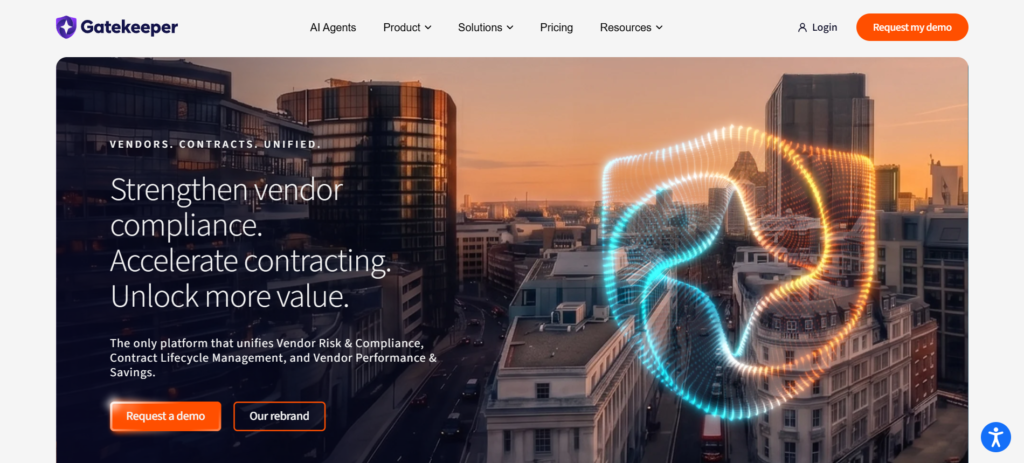
The one platform here that keeps watching after everyone else files the PDF
Top Pick
Gatekeeper keeps each vendor, contract, obligation, renewal and spend line together on a single record, then sets a 50-plus fleet of built-in AI agents loose on it.
Who this is for: Legal, procurement, finance, and compliance functions running lean while managing enterprise-sized vendor bases, where teams need a contract review agent that checks drafts against approved playbooks while evaluating the supplier’s risk profile before redlining. it is one of the Best CLM Software Platforms for 2026
Why we like it: The unified record changes what post-signature means. Gatekeeper files obligations, renewal dates, performance reviews and spend against the vendor that owes them rather than against a PDF, so a renewal decision arrives with diligence findings and actual spend attached. The built-in AI agents handle obligation tracking, evidence collection, compliance monitoring and supplier performance within your permissions and your audit trail, and the AI sees only what the user can see. Legal receives an automated assistant evaluating drafts against the approved playbook and assessing the supplier risk profile before redlining occurs, with all suggestions restricted to the clause library controlled by legal. Continuous monitoring watches vendor financial and cyber signals between review cycles. FNZ took due diligence completion time from 40 days to 27 days with Due Diligence Automation. The customer list includes Auto Trader, Pets at Home, DAC Beachcroft and SumUp. One reviewer on G2, where Gatekeeper holds 4.5 stars across 94 reviews, puts the effect in plain terms: contract visibility is strong, key dates, obligations and renewal terms surface without digging through documents, and that alone heads off missed deadlines and surprise auto-renewals. Unlimited users and unlimited eSign come standard. The agents carry no separate AI charge. Integrations run past 1,700 apps. The security file carries Type II attestations for both SOC 1 and SOC 2, alongside ISO 27001 and ISO 9001, plus support for DORA obligations.
Flaws but not dealbreakers: Pricing scales with third parties managed rather than seats, so adding users never costs more, though an accurate supplier count belongs before the demo rather than after it. Pricing itself is quote-led without public figures on the main page. Implementation time and initial workflow configuration require dedicated setup effort upfront to map complex third-party structures, with G2 user reviews noting that setting up advanced automation and custom integrations can require dedicated configuration time during initial onboarding.
2. Sirion, the top pick for obligation and SLA governance at enterprise scale
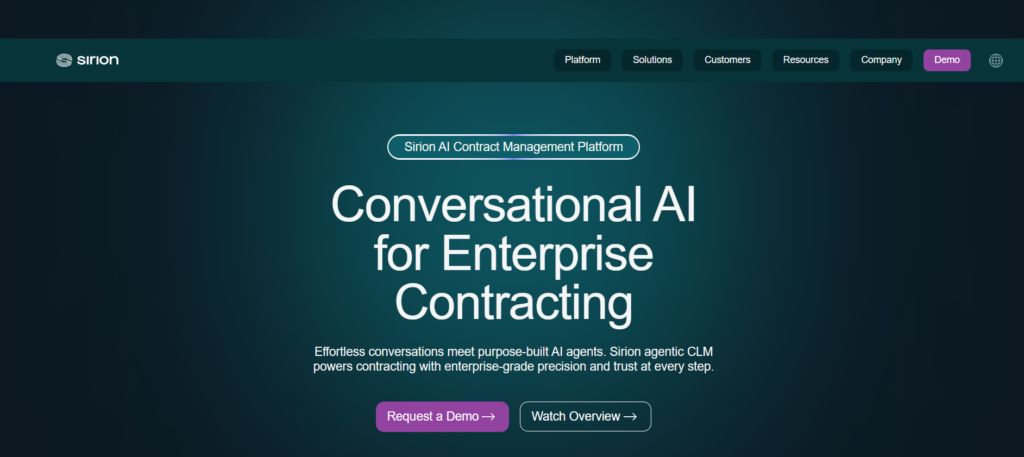
The enterprise platform that treats a signed contract as a performance agreement
Sirion manages complex enterprise contracts as live commitments, with AI agents that extract obligations and a performance layer that scores delivery against agreed service levels.
Who this is for: Global enterprises with large, negotiated supplier and customer portfolios, where the cost of a missed obligation runs to seven figures and a dedicated contract-management function exists to prevent it.
Why we like it: Sirion holds the highest rating in the category on Gartner Peer Insights, 4.9 out of 5 across 258 reviews, with a 2026 Customers’ Choice badge to match, and the post-signature machinery explains why. Its Extraction Agent pulls clauses, dates, obligations and deliverables into structured data, and AskSirion answers plain-language questions against the portfolio. The performance layer tags delivery against SLAs so governance meetings argue about numbers instead of recollections. One reviewer on G2, where Sirion holds 4.5 stars across 65 reviews, says: “The obligation management feature is very important to me because it helps us live within obligations, and the performance feature allows us to tag our performance versus SLAs.” Deep ERP integration keeps those obligations connected to the systems where delivery happens.
Flaws but not dealbreakers: The weight is real. Reviewers describe complexity born of deep configurability and implementations that take time. The time-to-ROI sits among the longer in the category. Commercials run premium through a single enterprise tier that lists as “Contact Us”. Mid-market buyers shopping on price should look elsewhere first. The bigger boundary is scope: Sirion governs contract performance, while vendor risk screening and financial monitoring typically sit in separate enterprise tools.
3. LinkSquares, the top pick for renewal calendars run by in-house legal
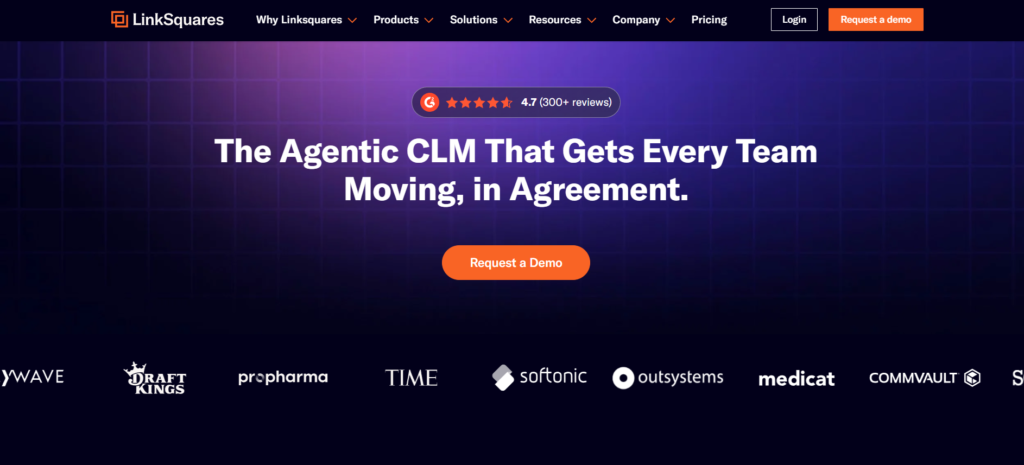
The legal team’s answer to the renewals spreadsheet
LinkSquares pairs AI contract analysis with a calendar-first view of renewals, giving in-house legal teams a repository that tells them what expires next.
Who this is for: Mid-market and enterprise in-house legal teams that want automated tagging of renewal terms and a familiar calendar view, without an enterprise implementation project.
Why we like it: The renewal calendar is the best idea in this entry class: an Outlook-style view of what expires when, with workflows you can launch from the calendar entry itself. Mass upload with AI tagging sorts contract types and renewal dates on the way in, and the clause library suggests approved language when amendments come back around. The market agrees; LinkSquares holds 4.7 stars across 439 G2 reviews, the strongest score in this group, with ease of use and customer support as the most-mentioned praise themes. Reported entry pricing lands around $20,000 a year, with discounts common, and G2’s averages show a three-month implementation.
Flaws but not dealbreakers: The complaints cluster around the post-signature work itself. Reviewers flag renewal and termination tracking as needing improvement. The AI draws 13 mentions of “Inaccurate AI” and 11 mentions of “Ineffective AI” in G2 complaint themes. The Salesforce sync runs one way, so contract data does not flow back to the CRM. Extra charges apply for bespoke smart fields, and storage fees climb as the repository grows. LinkSquares focuses primarily on legal document analysis rather than broader vendor context.
4. Agiloft, the top pick for data-first contracting on a no-code engine
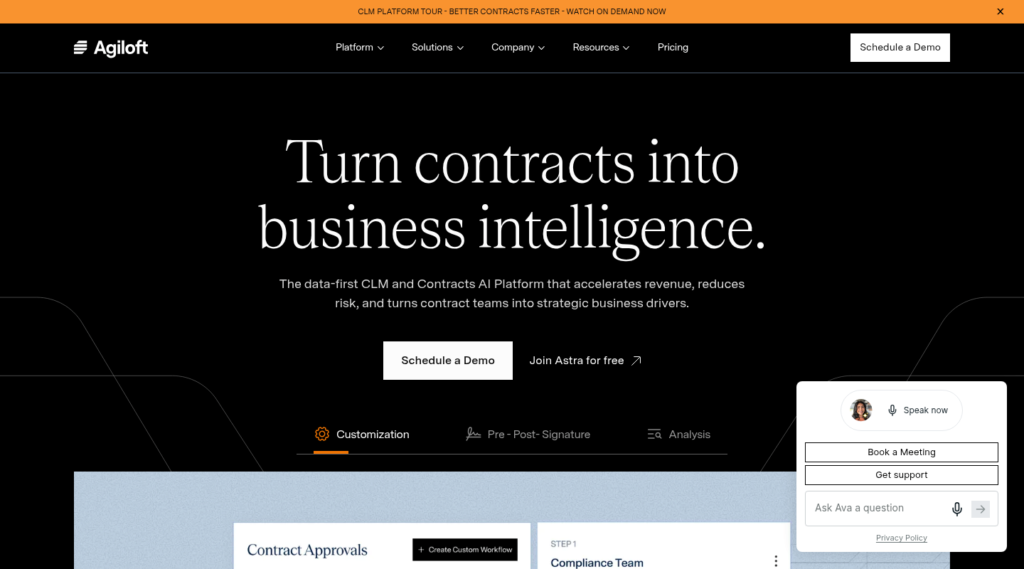
The no-code veteran that reads your back catalogue like a database
Agiloft wraps a configurable no-code engine around the contract lifecycle, built on what it calls a data-first agreement platform, with contract data as the foundation rather than filed prose. it is one of the Best CLM Software Platforms for 2026
Who this is for: Mid-to-large legal operations and procurement teams with a dedicated administrator, in regulated industries where obligation tracking and audit trails face outside scrutiny.
Why we like it: The data-first label has product behind it: the platform connects contractual commitments to the business outcomes they govern, and Astra, its AI layer, applies your playbooks in review, proposes redlines in a click, guides clause selection from the library, catches duplication and contradiction across documents and runs bulk reviews over the back catalogue. Reviewers draw the distinction themselves: the emphasis sits on AI guidance rather than AI authoring, which regulated teams tend to read as a feature. Workflows for approvals and renewals build through point-and-click configuration instead of code, multi-language support comes out of the box, and entry pricing around $12,000 a year undercuts the enterprise end of this group by an order of magnitude. G2 reviewers score it 4.5 across 111 reviews, praising customisation depth and responsive support in the same breath.
Flaws but not dealbreakers: The flexibility bills you later. One reviewer on G2 notes that extensive customisation often requires bringing in implementation partners. A steep learning curve leads to complaint chips, and the interface reads as dated. The platform cannot send an executed agreement to the counterparty from inside the system. Additionally, fields such as vendor insurance details do not auto-populate from external supplier risk databases, requiring manual data management across requests.
5. Juro, the top pick for mid-market teams that want renewals handled without ceremony
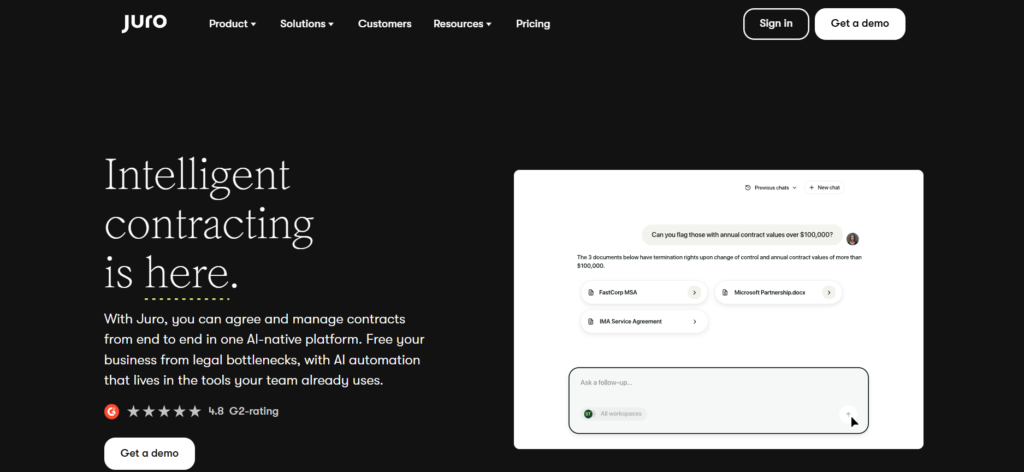
The browser-native tool that gets you live before the quarter ends
Juro runs contract automation in the browser, with self-serve templates, native eSignature, renewal reminders and the shortest payback in this group.
Who this is for: Legal and commercial teams in the mid-market that need contracts drafted, signed, tracked and renewed on time, on published pricing a finance director can read without a discovery call.
Why we like it: Speed, at a price you can read. Published tiers start around $450 a month for five users, and G2 ranks it first for implementation speed. G2’s pricing insights show an 8-month average return on investment, the shortest figure here. The repository carries structured search and renewal reminders, and the AI assistant drafts and reviews. Across 248 G2 reviews it lands at 4.5 stars, with ease of use and customer support leading the praise. For a team graduating off a shared drive, the distance from purchase to value runs in weeks.
Flaws but not dealbreakers: Juro knows its lane and stays in it. Reviewers describe a ceiling on complex negotiated agreements. One paralegal double-checks the AI assistant before trusting it. Mobile approvals wait for a laptop. No responsive mobile experience exists yet. The post-signature machinery stops at reminders. No SLA measurement sits behind the renewal alert. No spend reconciliation sits behind it either. The alert tells you a date is coming. It does not evaluate whether the relationship deserves another year. Supplier health checks must be conducted in external tools.
6. Conga CLM, the top pick for Salesforce-native revenue agreements
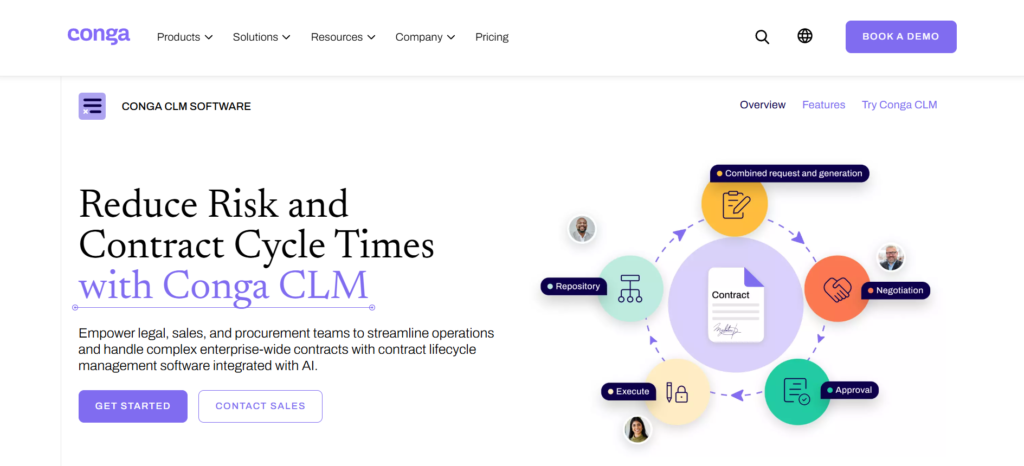
The CLM for companies whose commercial life already happens in Salesforce
Conga runs contracting inside Salesforce records, pairing document generation and AI clause insight with revenue tooling that covers quoting, order management, billing and the contracts that thread them together. it is one of the Best CLM Software Platforms for 2026
Who this is for: Enterprise and mid-market revenue organisations standardised on Salesforce, where sales-driven agreements make up the contract volume and nobody wants a second interface.
Why we like it: On Gartner Peer Insights it scores 4.7 across 264 reviews with a 2026 Customers’ Choice nod, and the Salesforce depth is the genuine article: contract data surfaces inside the records revenue teams already live in, and AI insight flags risky clauses and deviations during negotiation. Mid-market pricing from around $40 per user a month, with deals reported in the $40,000 to $60,000 a year range, lands below the enterprise heavyweights. For sell-side, high-volume commercial contracting with Salesforce as the system of record, the fit is hard to argue with.
Flaws but not dealbreakers: G2’s wider sample runs cooler at 4.3 stars across 620 reviews. The complaint chips name the pattern clearly. A steep learning curve draws 31 mentions. Slow performance draws 26 mentions. Time-consuming processes draw 26 mentions. Complex setup draws 23 mentions. One Salesforce developer warns against expecting plug-and-play behaviour. Setup needs a dedicated consultant or an advanced Salesforce admin. Post-implementation workflow support sits behind a paid retainer. Search draws repeat complaints. Native Word redlining does not exist. A native clause library does not exist either. Everything lives on a CRM data model built for selling. Supplier obligations must adapt to a sales schema. Vendor risk and spend sit in other software tools.
7. Ironclad, the top pick for high-volume contract workflows with obligation alerts
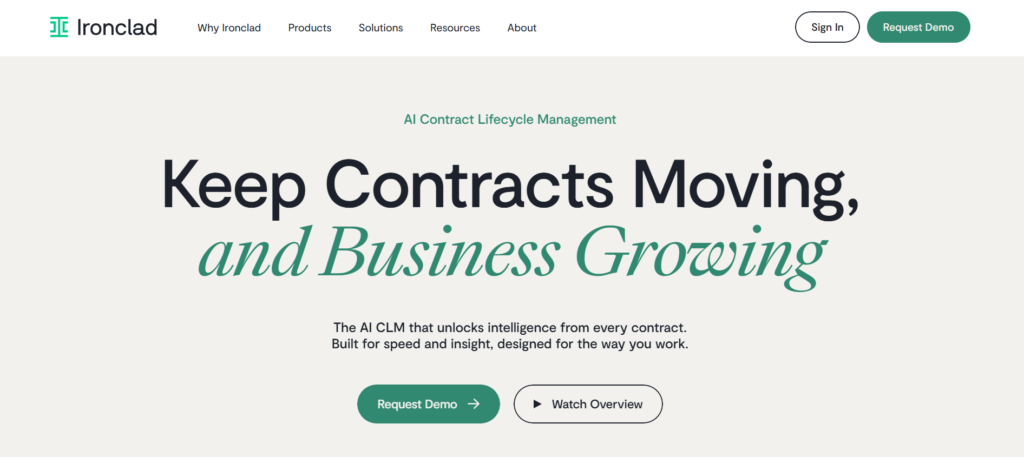
The workflow machine legal teams like and procurement borrows
Ironclad automates generation, review, redlining and negotiation at volume, with a drag-and-drop Workflow Designer that covers most approval scenarios without code. it is one of the Best CLM Software Platforms for 2026
Who this is for: Mid-size to large legal teams processing serious contract volume across sales, procurement, HR and the rest of the business, with the budget and patience for a per-workflow pricing model.
Why we like it: The Workflow Designer earns its reputation; conditional logic and multi-party approvals assemble without engineering tickets, and reviewers credit the platform with precise alerting and tagging for obligations, which matters once the signed pile grows. Two-way Microsoft 365 and Google Docs integration keeps redlining where people work, and the contract family tree keeps amendments attached to their parents. G2 users rate it 4.4 across 324 reviews, with ease of use the top praise theme.
Flaws but not dealbreakers: Post-signature is where the shine dulls. Gartner flags limited post-execution repository insights. Search is the loudest complaint on G2. “Poor Search Functionality” and “Search Difficulty” draw 26 combined mentions. One enterprise commercial manager describes searching for a specific supplier agreement. The search returns a contract list so long that everything seems to match. Multi-entity support does not exist. A single full-administrator role limits permissioning options. Pricing stacks per workflow. Reports price a 100-licence deployment near the $80,000-a-year mark. Obligation alerts function with precision. However they do not incorporate external vendor risk intelligence.
8. DocuSign CLM, the top pick for execution-first rollouts
The signature everyone recognises, with a contract repository attached
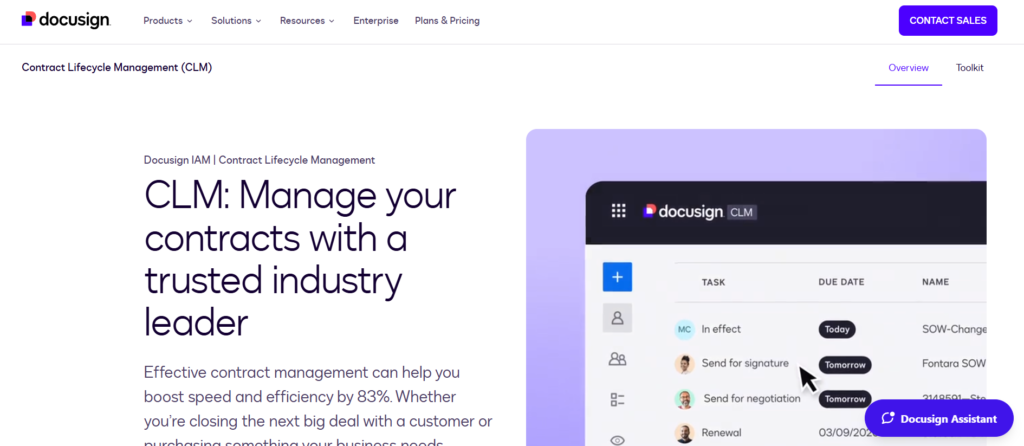
DocuSign CLM extends the default eSignature franchise into lifecycle territory, with automated workflows and a central repository inside the wider DocuSign IAM platform. it is one of the Best CLM Software Platforms for 2026
Who this is for: Organisations standardised on DocuSign for signing, where adoption matters more than depth and the counterparty experience has to stay frictionless.
Why we like it: Nothing moves a counterparty to signature faster than the interface they’ve signed with a hundred times before. The eSignature layer remains best in class, and approval and signature routing work at enterprise scale. The integration catalogue is enormous. G2 users rate it 4.3 across 503 reviews, with ease of use drawing 129 praise mentions, and G2’s averages show a three-month implementation with a 13-month return on investment, quick going on the first count for this category. eSignature plans run around $10 to $25 per user a month, which keeps the on-ramp cheap while CLM pricing arrives by quote.
Flaws but not dealbreakers: The platform’s centre of gravity never leaves the signature. “Expensive” leads the complaint chips with 28 mentions. Advanced workflows and premium support arrive as paid add-ons. Reviewers describe a dated interface with hard-to-find features. One P2P analyst calls integration with procurement systems such as SAP Ariba and Coupa challenging. That is a friction point buy-side teams will feel quickly. Obligation depth sits outside the product’s ambitions. SLA measurement also sits outside its scope. Once the envelope completes, the contract becomes a stored document. Stored documents do not manage renewals or track suppliers. Payment runs then begin against a counterparty that is not dynamically re-screened.
9. Icertis, the top pick for global enterprise obligation portfolios
The contract intelligence platform with ERP ambitions and an ERP implementation calendar
Icertis stores contracts as structured data across global portfolios, with AI obligation tracking and an Intent Realization layer that checks terms against the business objectives behind them. it is one of the Best CLM Software Platforms for 2026
Who this is for: Global enterprises managing tens of thousands of contracts across business units and regulatory regimes, above all those standardised on SAP, with certified partners and a programme budget already in place.
Why we like it: Treating contracts as structured data rather than documents is the correct architecture for post-signature control, and Icertis committed to it before the category caught up. AI obligation tracking and milestone monitoring run against that structure, and the Intent Realization capability tests whether terms serve the objectives behind them. Negotiation playbooks keep authoring consistent, and the SAP endorsement plus deep integrations make contracts first-class objects inside enterprise systems of record. Gartner Peer Insights users score it 4.7 across 202 reviews with a 2026 Customers’ Choice badge, and Fortune 100 logos anchor the customer base.
Flaws but not dealbreakers: Buy the platform and you buy the programme. Implementation reports run $70,000 to $120,000 and beyond. First-year costs often reach six figures. G2’s averages stretch to seven months for implementation. They stretch to 22 months for return on investment. That is the longest payback in this set. Reviewers describe a dated interface. Customisations can break during system upgrades. One procurement executive reports that vendors receive no reminder email for e-signature. That leaves chasing work to the buyer. G2’s smaller sample scores it 4.2 across 86 reviews. That is the lowest score here. Icertis remains primarily a contract repository system. Supplier financial health and certification records reside in separate enterprise databases.
The best CLM software is the one still working in year three
Pick by the shape of your after. If signature volume is the whole problem, DocuSign CLM or Juro will serve, and if obligations at enterprise scale keep counsel awake, Sirion and Icertis bring the machinery, provided the implementation budget matches the ambition. The top of this ranking turns on renewal economics: every platform here can remind you a notice window has opened, while dedicated post-signature platforms arrive at that window briefed, with the supplier’s risk standing current, spend reconciled against the agreed rates and performance already scored, which converts a deadline into a negotiating position. The best CLM software pays for itself in the renewals it changes rather than the signatures it collects, so buy the one that changes yours.
Also Read :- Best Enterprise Software Development Companies for Security and Compliance in 2026