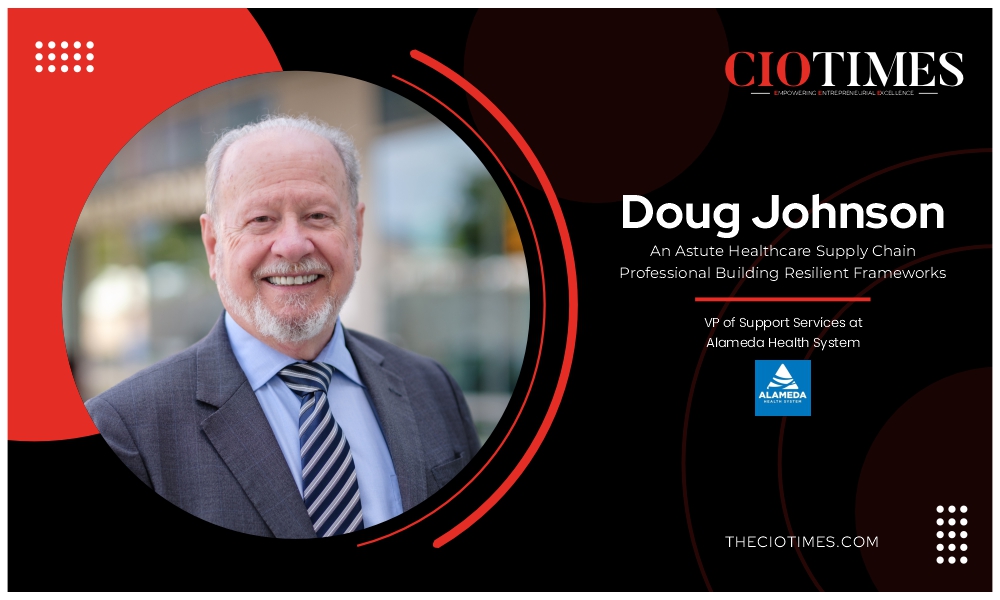
Great leadership often reveals itself in the impact it has on the people rather than the attention it attracts. For Doug Johnson, VP of Support Services at Alameda Health System, success has always been rooted in making everyday operations smoother, more reliable, and better aligned with the needs of patients and care teams. Known for his collaborative mindset and steady leadership, he approaches challenges with a focus on practical solutions and long-term value. His work goes beyond managing resources; it’s about building an environment where healthcare professionals can thrive, and communities can receive the support they deserve. Through dedication and forward-thinking leadership, Johnson continues to make a lasting difference.
Supply Transformation
Over the course of his career, he has seen the healthcare supply chain evolve from a support function into a strategic capability. When reflecting on what drove this shift and how leaders should think about its role today, he points to earlier days when it was largely materials-management-focused. The emphasis then was on ensuring supplies were available and managing them internally. Many organizations struggled with inventory control, especially non-stock items ordered directly by departments.
While labor continues to be the biggest cost driver in healthcare, Mr. Johnson points out that organizations slowly began to see how a stronger, more connected supply chain could make a real difference to financial performance. This understanding didn’t come all at once it evolved gradually, with larger systems adopting the shift over the past 15 to 20 years, while smaller organizations are still working through that transition.
He adds, “As supply chain leaders matured and began exploring additional ways to support their organizations, they discovered that their current models left millions of dollars of opportunity on the table.”
With reimbursement pressures tightening, conversations naturally expanded beyond traditional supply categories. Areas like purchased services, staffing, IT, utilities, and even legal, once rarely linked to supply chain thinking, began to be viewed through a more practical, cost-conscious lens.
Today, Mr. Johnson adds, there’s also a growing openness to learning from other industries. Supply chain leaders are increasingly looking at manufacturing-inspired approaches and even exploring supplier ecosystems more closely to uncover hidden efficiencies. It’s a complex journey, he notes, but one that is steadily reshaping how healthcare organizations think about value and performance.
Leadership Balance
Mr. Doug Johnson often recalls the saying “If you’ve seen one hospital, you’ve seen one hospital”. While all hospitals perform similar functions and care for patients, each one is unique. Patient populations differ between urban and rural facilities, and in some areas, competition for patients is intense. In his experience, many community-based hospitals believe they take a more personal approach. For Mr. Johnson, the most important learning has been understanding the culture, staff, and mission before acting on data findings.
For example, he recalls a Midwestern hospital that gave car seats to every baby born there. Not inexpensive ones, but high-end, costly car seats. At the same time, the hospital was under significant financial pressure. Eliminating the car seat program initially appeared to be an opportunity to reduce costs. However, he later learned there were three hospitals in the market competing for the same patients. The program had helped more than double their business, and the Family Birthing Center was one of the most profitable departments in the hospital.
He adds, “The other hard lesson was that while you may be the subject matter expert and were brought in to help an organization standardize products and processes, you really needed to understand why they do things the way they do.”
Understanding history allows for more thoughtful change and time to socialize it. Without clinical buy-in, he notes, initiatives often fail within six months after an engagement ends. Successful change requires trust, patience, and persuasion, while gaining trust before integrating change.
Strategic Partnerships
When asked where supply chain leadership can create the greatest strategic value beyond financial efficiency, Mr. Doug Johnson believes the biggest opportunity lies in looking beyond products and pricing. In his view, supply chain leaders should focus on building long-term strategic partnerships with suppliers and customers. Developing these relationships, both internally and externally, can reveal opportunities to improve process flows, identify costly hidden issues, break down silos, and create cross-functional solutions.
He points to an example involving an electric utility provider. Rather than simply negotiating lower electricity rates, a hospital could establish a strategic partnership to explore alternative power sources, such as fuel cell technology or electricity buy-back programs. Excess power generated by the hospital could then be fed back into the grid, reducing overall energy costs.
He shares, “One health system negotiated such a program and they ran the generators during peak demand periods. Not only did it save the hospital money, but it also helped the utility better serve the larger community.”
He also recalls a hospital that needed to expand its imaging services and purchase a new MRI. Instead of continuing to rent a mobile MRI, the organization partnered with the provider to acquire a new unit. The hospital covered half of the purchase cost and paid a nominal per-procedure fee during construction. Once the project was completed, the hospital entered into a profit-sharing agreement with the MRI company, and the mobile unit was deployed to another customer.
Supply Chain
Mr. Doug Johnson career in healthcare came after building a successful foundation in manufacturing and distribution. That transition proved to be both challenging and eye-opening. When he entered the healthcare supply chain space, he quickly realized that many of the practices commonly used in manufacturing, such as Lean, Six Sigma, Kanban, and inventory pull systems, were not widely adopted. He had to develop a deep understanding of how healthcare organizations managed inventories, placed orders, and handled the distinction between stock and non-stock items.
One of the most important lessons he learned was the critical relationship between supply chain and finance.
He adds, “The relationship with Finance is critical to success. Accounts Payable gets blamed when invoices aren’t paid. When suppliers place you on credit hold, the organization comes to a grinding halt.”
Departments would sometimes place orders without purchase orders, while others received deliveries directly, bypassing established receiving procedures. When suppliers responded by placing organizations on credit hold, operations could quickly slow down or even come to a standstill.
Over time, he introduced new ideas and approaches that helped improve processes while also giving him greater exposure to senior hospital leadership. These opportunities allowed him to collaborate with executives and view supply chain from a more strategic perspective. As he worked across different hospitals and health systems, he often found examples of best-in-class practices existing alongside processes that clearly needed improvement.
Having experience in both day-to-day operations and executive-level discussions gave him a unique perspective. He understood that operational excellence was essential because clinicians depended on having the right supplies and equipment to deliver quality patient care. At the same time, supply chain leaders needed to think strategically, ensuring contracts were negotiated effectively and maximizing the value of partnerships with Group Purchasing Organizations, particularly in areas such as purchased services and capital equipment.
These experiences enabled Mr. Doug Johnson to view supply chain holistically from the initial request through contracting, procurement, receiving, and payment. In his view, meaningful transformation can only happen when every part of that journey is understood, aligned, and working together.
Sustainable Savings
Mr. Doug Johnson often references the saying, “Give a person a fish and he eats for a day, but teach a person to fish and he will eat every day.” While it may sound cliché, he believes it applies perfectly to supply chain management.
In his experience, organizations that focus only on reducing costs are usually focused on the price of an item. While that can generate savings, there comes a point when there are very few pricing opportunities left to pursue. Once that happens, the savings begin to dry up.
He believes the real opportunity lies in developing supplier partnerships that go beyond price discussions. When suppliers and organizations work together to reduce utilization, improve efficiency, and identify better ways of operating, entirely new opportunities for savings emerge.
He recalls a four-hospital health system spread across the western part of a state. The system operated a distribution center that served the flagship hospital and delivered to the outlying hospitals three times a week. At the same time, the prime distributor was also making three weekly deliveries and charging a premium because of the distance from its warehouse. Since the organization had a strong contract and acceptable service levels, supply chain leaders were not particularly concerned.
However, when the total cost of providing the service was examined more closely, it became clear that the organization was paying not only higher product costs but also for a duplication of services. The distributor argued that the lower sales volume at the remote locations justified the premium charges. By building a true partnership with the distributor, the health system was able to eliminate its own three-times-weekly deliveries and remove the premium pricing. The result was a more efficient operation and savings that reached tens of thousands of dollars.
Human Insight
Mr. Doug Johnson believes many people forget that Lean and Six Sigma are ultimately people-driven processes. While data helps inform decisions, everything falls apart if an organization cannot execute those decisions effectively. In his view, it is people who implement change, identify deviations, and take the time to understand what is causing a problem. It also requires trusting people enough to stop a process when something does not look right and encourage a closer examination of what is happening.
Establishing that level of trust does not happen automatically; it has to be earned. Leaders need to listen to their teams, understand their perspectives, and work with them to find solutions. While data remains an important driver, he has seen many organizations fail to fully use their existing systems to measure and monitor performance.
He shares, “Leaders need to learn to listed to their teams and help find the solutions. Data is the driver and I have observed organizations that were not using their legacy systems to extract and track performance.”
He notes that many supply chain operations do not consistently track basic key performance indicators such as supply expense per adjusted patient day or supply expense as a percentage of net revenue and operating expense. While data may point to unusually high utilization of a product, the numbers alone rarely tell the whole story. Understanding the reasons behind those trends and finding practical solutions requires the insight, experience, and involvement of people. Lasting operational improvement comes from balancing data-driven decisions with the knowledge and engagement of the teams responsible for carrying them out.
Unified Direction
Mr. Doug Johnson considers supplier standardization to be one of the toughest balancing acts in healthcare supply chain management. While most stakeholders agree that reducing costs is important, support often becomes harder to secure when changes directly affect established practices within their own departments.
He adds, “Supply chain executives play a role in informing leaders of potential opportunities. These are data-driven opportunities, and if product changes are required, supply chain needs to back up the savings with unbiased clinical white papers or studies supporting the changes.”
In his view, meaningful alignment begins at the leadership level. Executive teams must clearly communicate that financial stewardship and operational efficiency are shared organizational responsibilities. Supply chain leaders then have the task of identifying opportunities backed by credible data and presenting them in a way that builds confidence. When product changes are being considered, supporting evidence, such as clinical studies, white papers, and objective research, is essential to help stakeholders evaluate the proposed direction.
Mr. Doug Johnson believes the most successful initiatives are built around collaboration. Bringing together representatives from supply chain, finance, executive leadership, clinicians, and physicians creates an environment where different perspectives can be heard and concerns can be addressed early. Clearly defining the opportunity and outlining the implementation process helps establish a common understanding among all parties involved.
He also emphasizes the importance of preparation. If a change affects clinical practice, education and training must be part of the plan. If physician preference items are involved, real-world case studies and peer experiences can often help move discussions forward.
Several practical considerations should guide every decision: the complexity of implementation, the consistency of products across facilities, the value of the expected savings, and the availability of physician champions who can support adoption. Access to product samples and evaluation opportunities can also make a meaningful difference.
While he acknowledges that consensus is not always possible, Mr. Johnson believes organizations achieve the best outcomes when decisions are guided by transparency, inclusion, and reliable data rather than mandates alone.
Clinical Alignment
Mr. Doug Johnson views supplier standardization as one of the toughest challenges in healthcare supply chain management because cost, operational, and clinical priorities do not always align. While most stakeholders support saving money, resistance often arises when changes affect their own departments. He believes success starts with strong executive leadership and a clear message that cost-saving initiatives are a shared responsibility. Supply chain teams should present data-backed opportunities and support proposed changes with credible clinical evidence.
For larger initiatives, he emphasizes collaboration among supply chain leaders, finance teams, executives, clinicians, and physicians. Open communication, proper training, and physician support can make implementation much smoother. Although not every standardization effort will succeed, he believes transparency, teamwork, and reliable data greatly improve the chances of reaching consensus and achieving meaningful results.
Supply Evolution
He believes the pandemic exposed major weaknesses in healthcare supply chains, but many organizations slipped back into old habits once product shortages eased. As supplies became readily available again, conservation efforts faded, and some health systems saw costs rise when they could have remained under control.
One of the biggest lessons for him was the importance of building strong relationships beyond a primary distributor. He encourages healthcare leaders to engage directly with manufacturers and view them as strategic partners. Inviting manufacturers into facilities to observe product usage can uncover valuable insights and opportunities for improvement. While manufacturers ultimately want to sell their products, he notes that they also have a vested interest in helping health systems operate more effectively and achieve long-term success.
Nurtured Relationships Pay
Supply chain leaders will become more adept at data mining for opportunities, is what he envisions in terms of supply chain leadership evolution. They will have an undisturbed focus on the market while looking forward to working with their suppliers. They will break down silos within their organizations because without the supply chain’s involvement, many hospitals and health systems will falter and fail.
He adds, “Looking back on my career, over the past forty years, today’s supply chain leader doesn’t look or act like the leaders I started working for. They will be sitting at the Chief level more and more, helping drive sustainable programs to work to improve the financial health and increase the level of quality patient care.”
Furthermore, he adds that today’s leaders are more tech savvy. They have been forced to look beyond price for savings. They have been placed in situations where relationships saved the day. He witnesses more efforts in developing high-performing teams, cross-functional teams breaking down barriers, and toppling silos.
Essential Leadership Traits
Mr. Johnson lists some leadership qualities that he thinks are essential as he has worked in varying levels of scale and governance maturity. Those are as below:
- Active listening
- Ability to see and play the long game
- Compassion
- Giving people permission to make mistakes
- Admit when you are wrong
- Accept praise with humility
- Build teams and ad hoc groups to tackle specific opportunities
- Add humour whenever possible to break the tension
- Stay current with new processes
- Take advantage of AI
Giving an Earful to Learn
Mr. Doug Johnson leadership journey has been about solving problems right away. He grasped on the importance and value of a team’s approach. It took him quite a few years of authoritative approach before it occurred to him that he was less successful than his colleagues.
He adds, “In my consulting roles I didn’t have any direct authority to effect change, I had to figure out how to get work done through influence and cooperation.”
He had to understand that there was always scope for him to learn more from the people around him. He had to trust them while sitting and observing their conversations.
Status Quo
He believes resistance to change remains a significant challenge in healthcare. Employees often prefer familiar processes that have worked for years, while leaders may avoid introducing new products or workflows to prevent pushback. In his view, this reluctance can slow progress and limit opportunities for improvement.
A Strategic Focus
Mr. Doug Johnson believes technology will reshape healthcare leadership at an accelerating pace, requiring leaders to adapt more quickly than ever before. As automation continues to streamline tasks such as inventory management and purchasing, traditional processes are becoming less dependent on manual intervention.
He expects future leaders to focus more on strategy, innovation, and value creation rather than day-to-day transactional activities.
Also Read :- CIO Times Magazine For More Information