Optimize the Asset Lifecycle and Extend Supply Chain Value.
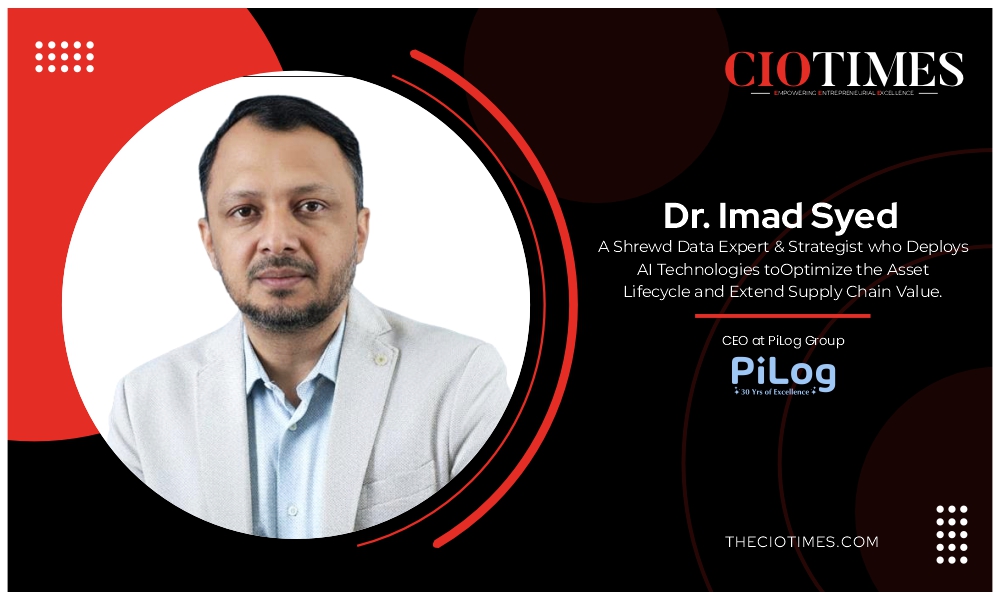
Forethoughtful CEOs are reforming the landscape of End-to-End Asset Lifecycle Management and Extended Supply Chain ecosystems. They are accommodating strategic insight, innovation, and purposeful leadership. With a strong emphasis on intelligent technologies, scalable platforms, and streamlined data practices, these leaders help organizations build greater clarity, consistency, and trust in their operational and supply chain ecosystems. Leaders like Dr. Imad Syed, CEO at PiLog Group, keep an approach that supports all these aspects to foster meaningful customer engagement with strategic execution. He is a globally experienced technology and data leader with a passion for helping organizations turn data into business value.
Enterprise Architect
His expertise comprises supply chain, asset lifecycle management, and master data governance. He has worked closely with enterprises to drive smarter, data-led transformation initiatives. Their work includes innovation with practical execution across AI, analytics, SaaS, and multi-cloud platforms. Known for building scalable frameworks that bridge the gap between foundational master data and operational execution across complex asset lifecycles and extended supply chains. As a trusted advisor, Dr. Imad partners with organizations to simplify complexity, unlock growth opportunities, and create lasting impact through technology and enterprise data.
Data Alignment
As PiLog embarks on three decades of growth, he believes enterprise data challenges are rarely about technology alone. Undoubtedly, technology enables transformation, but Dr. Imad envisions governance, accountability, and decision-making as the true drivers of data maturity.
He explains that the organization’s assessment approach evaluates how data integrity impacts operational readiness across the asset lifecycle and supply chain pipelines. This includes reviewing data pipelines, integrations, and AI-powered tools like iMirAI, which identifies anomalies, duplicates, and data quality gaps in real time preventing costly procurement errors, inventory inflation, and asset maintenance delays.
According to him, fragmented decision-making and siloed data ownership remain key barriers for many enterprises. Through governance frameworks, data lineage mapping, and AI-led quality solutions, PiLog helps organizations establish a trusted, unified source of truth.
He adds, “Technology deficiencies appear as isolated tool failures, governance and incentive misalignments manifest as systemic data inconsistencies despite solid infrastructure.”
Sustainable transformation comes from aligning technology with governance, culture, and business strategy. This turns enterprise data into a lasting strategic advantage.
Governance Driving Innovation
Dr. Imad Syed believes the most effective data governance frameworks are the ones that enhance innovation rather than slow it down. Governance should not feel like micromanagement and should not be rigid. It is a strategic function that helps organizations move faster with greater confidence and clarity.
Over the years, Dr. Imad has pioneered an approach where governance is seamlessly deployed into everyday business operations. Rather than introducing complex processes that create friction, PiLog’s frameworks are crafted to align naturally with broader business goals such as growth, operational efficiency, compliance, and faster time to market. At the same time, they maintain strong standards around equipment asset classification, MRO inventory tracking, vendor data ownership, and operational accountability.
He sheds light on the team’s AI-powered iMirAI platform as a key enhancer in this journey. By continuously monitoring data transactions in real time, the platform can proactively identify duplicates, anomalies, and policy gaps without disrupting ongoing innovation initiatives. Complementing this is PiLog’s iContent Foundry, which provides extensive reusable taxonomies, templates, and data models tailored for complex engineering assets and global supply chain components, helping organizations accelerate implementation.
He also emphasizes the importance of balancing agility with control. Through layered approval structures and real-time governance metrics, organizations gain visibility into how data is being used while still allowing teams the flexibility to innovate quickly and responsibly.
His modern governance is ultimately about creating trust in data while empowering enterprises to innovate at scale with confidence.
A Connected Data Ecosystem
He adds, “I have watched enterprises chase the promise of a single, interoperable data ecosystem that spans domains, tenants, and geographies.”
This vision is compelling, and he believes that real challenges often exist beneath the surface, hidden within the complexity of enterprise data itself rather than technology alone. He explains it with some carefully told pointers as follows:
1. Divergent Taxonomies and Semantic Misalignment
Dr. Imad Syed explains that when material, asset, supplier, and customer data evolve separately across teams and systems, inconsistencies in language, classifications, and definitions naturally begin to emerge. Over time, these forms fragmented insights and unreliable reporting. To acknowledge this, PiLog’s Content Foundry provides a vast library to standardize and harmonize enterprise data from procurement to asset retirement.
2. Governance at Scale Across Multi-Talent Environments
One of the biggest balancing acts for enterprises is maintaining strong governance without limiting innovation. Governance structures that are too rigid can slow teams down, while loosely managed environments increase compliance and operational risks. PiLog’s governance framework is designed to create the right balance by embedding stewardship, automated policy controls, and audit visibility while still allowing regional supply chain nodes, procurement offices, and engineering teams to operate with flexibility.
3. Real-time Data Quality Across Distributed Systems
As data constantly revolves around ERP systems, SAP environments, cloud platforms, and operational applications, Dr. Imad believes manual validation is no longer practical. PiLog’s AI-powered iMirAI engine continuously supervises and validates data in real time, identifying replications, anomalies, and missing information before those issues affect downstream operations and analytics.
4. Performance and Scalability at Enterprise Volume
Dr. Imad Syed emphasizes that modern enterprises need systems capable of handling enormous data volumes without sacrificing speed or responsiveness. PiLog’s microservices-driven architecture, combined with intelligent processing capabilities, helps organizations maintain performance and scalability even in highly complex global environments.
5. Security and Regulatory Alignment
Security and compliance have become increasingly interconnected with enterprise data strategy. Different data domains come up with different regulatory expectations, and managing those complexities at scale can be challenging. PiLog’s platform helps organizations automate policy alignment, strengthen governance controls, and improve compliance visibility while reducing operational overhead.
Revamping Success Models
The PiLog Team has introduced several enterprises to chase data, and AI promises only to fall short of measurable returns. The gap is rarely the technological part; it is a lack of disciplined governance, aligned incentives, and decision-making structures that turn insights into impact.
1. Why ROI Remains Intangible?
AI is misunderstood to be a standalone tool when it is a component of an end-to-end data ecosystem. In the absence of PiLog’s ISO certified governance layer, models move towards inconsistency, replications, or old data. It gives insights that can be inaccurate and not trustworthy. Performance metrics often reward rapid delivery instead of data quality or business outcomes, prompting quick proofs of concept that never scale.
Also, decision-making remains siloed, and senior leaders receive AI recommendations that lack a single source of truth, so the insights are either ignored or applied unevenly across the organization.
2. Redefining Success
Success needs to move from the project completion stage to a realized value stage. A new KPI framework should connect data quality scores, model accuracy rates, and governance compliance directly to revenue growth, cost avoidance, or risk reduction.
He shares, “PiLog’s iMirAI, combined with our end-to-end governance suite, continuously validates data integrity, ensuring every AI output rests on a trusted foundation. By Dr. Imad Syed embedding governance checkpoints into the AI lifecycle and aligning incentives to outcome-based metrics, organizations can monitor ROI in real time and adjust course before investments evaporate.”
The redefined metric set includes:
- Percentage improvement in data quality indices directly reducing MRO (Maintenance, Repair, and Operations) inventory overhead.
- Model performance against business impact targets (e.g., predictive maintenance accuracy that reduces unplanned asset downtime, and forecast error reduction that cuts supply chain costs).
- Compliance adherence rates measured against ISO and industry standards.
- Dollar savings achieved through the elimination of duplicate vendor parts and optimized asset utilization.
3. Confirming Alignment
PiLog Team has entered the third decade of transforming data into a strategic asset. It has regularized the unstructured content and large language models (LLMs) to not diminish the value of well-crafted ontologies and taxonomies.
Dr. Imad shares more strategic points on this:
1. A Semantic Anchor for Unstructured Streams
LLMs excel at pattern recognition, yet they lack an inherent understanding of domain-specific meaning. Structured ontologies provide the vocabulary and relationships that give those patterns of business context. PiLog’s iContent Foundry, with its 25 million + reusable templates, taxonomies, and dictionaries, acts as a semantic anchor that translates free-form text, images, and sensor feeds into a common language that downstream processes can trust.
2. Establishing Trustworthy AI with iMirAI
The AI engine continuously validates the output of LLMs against the curated ontologies. When a model suggests a new product classification or a maintenance procedure extracted from a PDF, iMirAI cross-verifies the suggestion against the master taxonomy, flags inconsistencies, and either auto-corrects or routes for stewardship review. This loop preserves data quality while allowing rapid experimentation.
3. A Pathway to Interoperability Across Domains and Tenants
Enterprises today operate multi-domain, multi-tenant ecosystems where finance, supply chain, asset management, and customer experience must speak the same language. A unified taxonomy ensures that an LLM-derived insight about a spare part in the field can be instantly linked to the material master in ERP, the warranty record in CRM, and the compliance register in GRC. PiLog’s governance framework embeds these taxonomies into every API, guaranteeing that data remains consistent regardless of source or consumer.
4. Speeding Up Innovation While Guarding Compliance
Because the taxonomy is pre-approved and ISO-aligned, maintenance engineers and procurement managers can ingest complex supplier catalogs and asset datasheets into LLMs without reinventing classification rules for each project. The result is accelerated asset onboarding, minimized procurement lead times, and a clear audit trail that satisfies regulators.
Accountable Intelligence
The PiLog Team has witnessed AI and Generative AI confirm breakthroughs while also exposing hidden risks. The real insight here is being aware of precisely when to hold back. The team’s decision framework blends governance accuracy, business impact, and technical agility. It ensures that every AI experiment advances PiLog-enabled enterprises rather than jeopardizing them.
1. Align with Strategic Outcomes
The use case must map directly to a measurable business objective, such as cost reduction, revenue growth, risk mitigation, or compliance improvement. If the AI or GenAI effort cannot be tied to a KPI, the initiative is paused until a clear value proposition emerges.
2. Data Quality and Governance Suite
PiLog’s iMirAI continuously validates data integrity, completeness, and lineage. When the underlying data fails to iMirAI’s quality thresholds, which can be high duplicate rates, missing attributes, or inconsistent taxonomies, the project is deferred. The team requires a baseline of trusted data before any model is trained or deployed, because poor data yields unreliable AI and magnifies compliance risk.Dr. Imad SyedPiLog’s iMirAI continuously validates data integrity, completeness, and lineage. When the underlying data fails to iMirAI’s quality thresholds, which can be high duplicate rates, missing attributes, or inconsistent taxonomies, the project is deferred. The team requires a baseline of trusted data before any model is trained or deployed, because poor data yields unreliable AI and magnifies compliance risk.
3. Regulatory and Ethical Constraints
If the proposed AI touches safety-critical asset operations, hazardous material logistics, or sensitive vendor pricing agreements, it integrates a strict compliance checklist against ISO, GDPR, and industry-specific regulations. Any gap, such as a lack of audit trails, insufficient explainability, or operational safety risk, triggers a hold until remediation is built into the solution.
4. Complexity vs. Simplicity Trade-off
When a rule-based or deterministic approach can achieve the same outcome with lower cost and risk, the team opts for simplicity. GenAI is reserved for problems that truly need pattern recognition, language generation, or creative synthesis areas where traditional logic falls short.
5. Scalability and Operational Viability
It also assesses whether the model can be maintained, monitored, and governed at scale. If the required compute, model refresh cadence, or talent bandwidth exceeds the organization’s sustainable capacity, the initiative is rescoped or postponed until the supporting infrastructure, often built on PiLog’s micro services and API first architecture, is in place.
Architectural Liabilities
As PiLog marks three decades of helping organizations transform data into a true competitive advantage, Dr. Imad Syed reflects a reality he has seen periodically. He talks about the digital transformation journeys: the shortcuts that seem practical today often become the biggest operational burdens tomorrow. In today’s cloud, SaaS, and microservices-driven environments, the architectural decisions that create the greatest long-term challenges are usually the ones made without enough consideration for governance, flexibility, and future scalability.
Dr. Imad Syed explains that many enterprises naturally gravitate toward best-of-breed SaaS platforms and integrate native APIs directly into critical business workflows because it enables faster deployment and quicker business outcomes. However, what initially feels like speed and efficiency can create deep dependencies on a single vendor ecosystem. The moment a provider changes its API structure, retires functionality, or revises pricing models, organizations often find themselves facing disruption across multiple downstream systems. PiLog’s iMiraiAI-enabled integration layer was designed to reduce that risk by introducing an abstraction framework that gives enterprises the flexibility to replace or enhance SaaS components without having to rebuild their entire integration landscape.
He also points out that while serverless architecture has become highly attractive for its scalability and cost efficiency, it can create significant governance blind spots when data flows are not properly defined and monitored. Over time, organizations can lose visibility into where data originated, how it moved, and which systems transformed it along the way. For auditors, regulators, and data stewards, this lack of traceability quickly becomes a compliance concern. PiLog’s unified data governance suite helps restore that visibility by capturing lineage across distributed microservices environments, ensuring that even highly dynamic serverless ecosystems remain transparent, traceable, and audit ready.
Also, one of the biggest challenges with rapidly growing microservices environments is that teams often move fast without aligning on a shared language for data. Over time, different naming conventions and structures begin to create confusion across systems, making analytics and integration far more difficult than they need to be. PiLog’s iContent Foundry helps organizations avoid this by providing a multilingual taxonomy framework that keeps data consistent and connected from the start.
Dr. Imad Syed also believes that API standards should be treated as living operational agreements, not just technical documentation. When services evolve without proper governance, small unnoticed changes can quickly lead to system failures, delays, and costly rework. Its contract-first microservices framework helps organizations maintain stability by validating compatibility as services continue to grow and evolve.
He further notes that many data lakes begin with good intentions but gradually become cluttered with duplicate, outdated, and unclassified information. As trust in the data declines, organizations often face major cleanup efforts just to regain control. With iMirAI, PiLog continuously monitors and classifies data environments, helping businesses identify quality and compliance issues early before they turn into larger operational problems.
Deploying Technology Right
Dr. Imad Syed shares, “I have seen enterprises drown in data while the real value remains hidden beneath layers of inconsistency. Quantifying that latent worth before any transformation begins is the first step toward turning data into a strategic asset.”
Furthermore, he explains this:
1. Initiate a value mapping baseline
The Dr. Imad Syed’s PiLog Team starts by mapping each data domain, such as materials, assets, contracts, and customer interactions, to the business outcomes it can influence: unplanned asset downtime mitigation, strategic sourcing uplift, supply chain risk reduction, or compliance savings. Each link is assigned to a provisional monetary impact based on historical performance, market benchmarks, and internal KPI targets. This creates a value heat map that highlights where a single data point could unlock the greatest upside.
2. Implement iMirAI for Early Quality Signals
Before any ETL or enrichment, iMirAI scans the raw repository in real time, flagging duplicates, missing attributes, and taxonomy mismatches. The engine quantifies the cost of each anomaly, e.g., a duplicate part number that inflates inventory carrying cost or an incomplete contract field that delays revenue recognition. By attaching a dollar estimate to every quality defect, the team transforms poor data into a concrete loss figure that can be summed across the enterprise.
3. Situational ROI Modelling
He adds, “Using the value heat map and iMirAI-derived loss estimates, we run a series of what-if scenarios.”
For every situation, the team models the incremental benefit of improving a specific data attribute such as raising material master completeness from 70% to 95% to eliminate stockouts of critical operational assets and calculating the resulting dollar savings and ROI. The highest return scenarios become the priority queue for transformation.
4. Governance Backed Realization Loop
PiLog’s end-to-end governance suite locks the agreed-upon value targets into stewardship contracts. As data moves through pipelines, iMirAI continuously validates that the quality improvements are being realized. Dashboards display value captured vs. value promised, and any shortfall triggers an automatic remediation workflow reassigning ownership, adjusting incentives, or revisiting the transformation design.
The Teamwork
Dr. Imad Syed shares, “I have learned that the same data foundation can serve very different decision-making lenses, whether I am a CEO, a CIO, or an enterprise architect. The distinction lies not in the data itself but in the questions each role asks of that data and the cadence at which answers are required.”
He very rightly shared insights about the CEO and CIO vision. Let’s look at it one by one:
1. CEO: Vision-oriented and Outcome-focused
His focus is on strategic outcomes like revenue growth, market share, and long-term value creation. He asks PiLog’s platform for a consolidated view of the business’s top-line performance, risk exposure, and compliance health. iMirAI runs continuously in the background, validating that the underlying master data meets ISO 8000 standards. This ensures that executive dashboards reflect trustworthy, real-time metrics across top-line performance, supply chain resilience, asset utilization rates, and compliance health.
2. CIO: Execution Focused, Risk Aware
The CIO’s priority is to translate the CEO’s vision into a reliable technology roadmap. Here, the decision-making cadence is faster and more granular. He integrates iMirAI to monitor data pipeline health, latency, and error rate thresholds across cloud, SaaS, and microservice layers. Governance becomes a service for PiLog’s compliance engine, which automatically flags deviations from policy, allowing the CIO to balance innovation (new AI models, edge analytics) against operational risk (downtime, data breaches). When strategic initiatives compete, such as a cloud migration versus a legacy ERP upgrade, the CIO evaluates based on measurable impact on service level agreements and total cost of ownership, using PiLog’s real-time cost-to-value analytics.
3. Enterprise Architect: Design Centric, Future Proof
The Dr. Imad Syed architect’s lens is structural. Decisions revolve around data model alignment, API contracts, and multi-tenant scalability. iMirAI validates every schema change against the enterprise taxonomy stored in PiLog’s iContent Foundry, ensuring that new services do not introduce semantic drift. When operational pressures demand rapid feature delivery, the architect leverages its modular microservice framework to spin up isolated sandboxes, while governance policies remain enforced centrally. Compensating demands, such as adopting a new data mesh versus preserving a centralized master data, are resolved by quantifying how data latency impacts just-in-time supply chain logistics and asset tracking accuracy.
4. Adaptive Governance
The key is recognizing that data maturity, including how clean, governed, and trusted the data is, varies dramatically across regions. That variation should shape the roadmap rather than be overlooked.
Maturity gaps drive divergent priorities
In mature markets, enterprises often already operate with ISO-aligned master data, strong lineage practices, and an established culture of data stewardship. As a result, their digital transformation initiatives are typically centered around advanced analytics, AI-driven optimization, and real-time decision support.
By contrast, in emerging markets, the same organizations may still struggle with fragmented spreadsheets, inconsistent taxonomies, and limited governance structures. In these environments, the earliest and most impactful digital wins usually come from data cleansing, standardization, and creating a single source of truth before any advanced model can be relied upon with confidence.
PiLog’s universal foundation
Dr. Imad Syed highlights that PiLog’s iMirAI engine continuously validates data quality, identifies duplicates, and enforces the taxonomy maintained within the iContent Foundry. Because the AI integration is cloud-native and API-first, it can integrate seamlessly with existing ERP, PLM, or SaaS environments. This allows organizations across different markets to establish a consistent and automated governance framework without undergoing a large-scale re-engineering effort.
Best practices that travel well
- Start with a data governance charter. Dr. Imad recommends clearly defining data owners, stewardship responsibilities, and compliance checkpoints before introducing any new technology. While the charter can serve as a global framework, local regulatory requirements can be incorporated as regional extensions.
- Adopt a shared taxonomy. PiLog’s iContent Foundry offers a pre-built, industry-validated taxonomy that can be localized to accommodate language requirements or regional regulations while still maintaining a consistent semantic foundation across the enterprise.
- Automate quality at ingestion. By deploying iMirAI across all data pipelines, every incoming record can be validated the moment it enters the system. This transforms data quality assurance from a reactive, manual task into a continuous and automated process.
- Measure time to data trust. Dr. Imad suggests tracking how quickly newly integrated data sources become compliant with the governance framework. This metric is equally valuable in highly mature European operations and rapidly scaling Asian subsidiaries.
- Iterate with sandbox pilots. In lower-maturity markets, organizations can begin with small, governed pilot programs, capture operational learnings, and then scale the same governance architecture into higher-maturity regions where the emphasis naturally evolves toward advanced analytics and AI-driven capabilities.
Strategic Use of Data
The successful three decades of PiLog have exposed Dr. Imad to the actual realization of data leveraging. It lies in how ownership, accountability, and stewardship are woven into a living governance fabric. He clears the myth that the power lies in who claims it. Furthermore, he adds:
1. Enterprise-wide data ownership
The Dr. Imad Syed’s PiLog Team voices a shared ownership model anchored by the executive sponsor, most notably a Chief Supply Chain Officer (CSCO), Head of Engineering/Operations, or a senior business leader with direct P&L responsibility. This sponsor declares the strategic intent for each data domain (MRO materials, critical operational assets, global suppliers, and customer contracts) and secures the budget, resources, and cross-functional alignment needed to treat data as a core asset.
2. Clear accountability from domain experts
It also suggests approaching domain experts who are responsible for daily quality standards, classification, and the lifecycle of their data sets. They are empowered by PiLog’s iMirAI engine, which continuously validates entries, flags anomalies, and surfaces compliance gaps. Because iMirAI works in real time, stewards can act proactively rather than reacting to quarterly audits.
3. Governance councils for cross-domain alignment
Dr. Imad Syed say standing data governance council brings together stewards, IT architects, risk officers, and business unit leaders. The council reviews policy changes, resolves conflicts between domains, and monitors key performance indicators such as data quality scores, duplicate reduction rates, and audit trail completeness, all of which are captured automatically by PiLog’s governance suite.
4. Integrating expertise in incentives:
Dr. Imad Syed says Long-term success requires that accountability be reflected in performance metrics.Dr. Imad Syed’s PiLog helps organizations tie stewardship KPIs, such as on-time data issue resolution or adherence to ISO 8000 standards, to compensation and recognition programs. When data owners see direct business impact, stewardship becomes a cultural norm rather than a compliance checkbox.
Holistic Data Governance
Dr. Imad Syed shares, “I have watched AI move from a research curiosity to an autonomous decision maker that writes, enriches, and even acts on data without human hands. That evolution forces us to rewrite the rules of trust, control, and governance, and PiLog’s platform provides the playbook.”
1. Trust begins with authenticity in data
When an AI model creates a new manufacturing spare part number, maps an alternative critical supplier, or updates a maintenance schedule, the output must be as reliable as any manually entered record trust becomes a built-in property rather than an after-the-fact audit.
2. Administration through policy-oriented safeguarding
Autonomous AI should never operate in a vacuum. PiLog’s governance suite lets enterprises define declarative policies that can create, modify, or delete data, what confidence thresholds must be met, and which regulatory regimes apply. This approach gives business leaders the confidence to let AI act, while preserving the hard limits that protect risk and compliance.
3. A Living Data fabric
Traditional governance was static, updated quarterly, and often out of sync with fast-moving AI pipelines. PiLog transforms governance into a dynamic fabric that records every AI-driven change, captures lineage, and surfaces it on a unified dashboard.
Dr. Imad Syed adds, “Executives can see, immediately, which models are influencing which business outcomes, the quality scores attached to each change, and any audit trail alerts.”
This transparency turns governance from a compliance checkbox into a strategic insight engine.
4. Human interference in high-impact decisions
Not every decision can be fully automated.Dr. Imad Syed’s PiLog enables configurable escalation paths where AI-suggested actions that cross a risk threshold are routed to designated stewards for review. The steward sees the AI’s rationale, the iMirAI quality metrics, and can approve, modify, or reject the recommendation. This hybrid model preserves speed for routine tasks while ensuring human judgment guards the most critical moves.
Also Read:- Cio Times Magazine for more Information