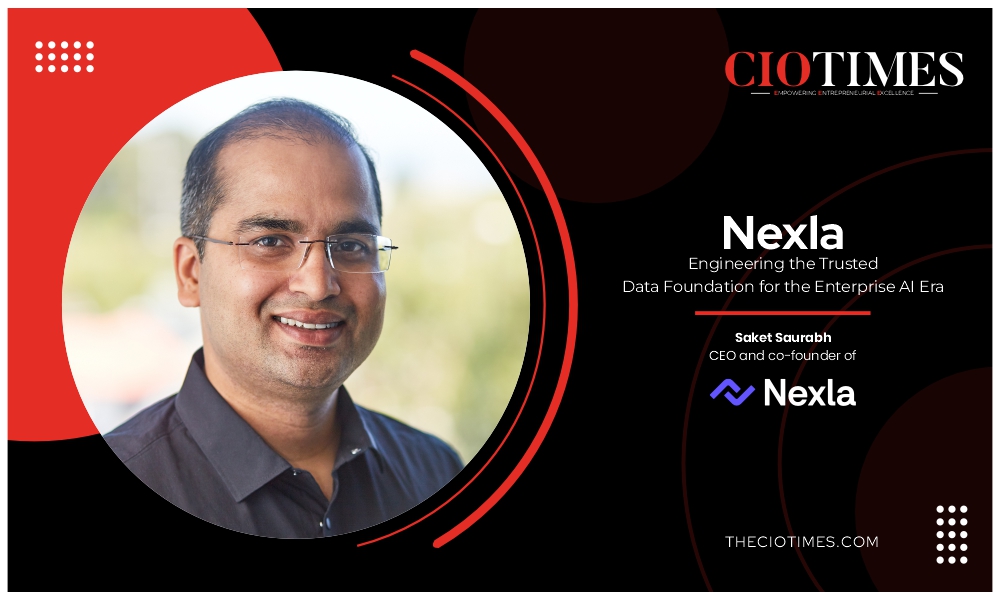
For Saket Saurabh, CEO and co-founder of Nexla, infrastructure has always been the real story. Early in his career at NVIDIA, when GPUs were still associated with gaming and graphics, he had the rare chance to experience entrepreneurship inside a large company, as part of a small exploratory group working to identify entirely new applications for the technology.
“We built a lot of ideas. Some went nowhere, others grew into enduring businesses, but every one of them created learning inside the organization,” he recalls.
NVIDIA’s automotive business, among others, traces back to that period of exploration. Few people at the time anticipated just how far the technology would travel, eventually becoming the computational backbone of modern AI.
Over the two decades since, Saket Saurabh, has watched the same pattern repeat across the internet, mobile computing, cloud, big data, and now AI. Transformative applications capture the headlines, but enduring value tends to accrue to the infrastructure that enables them. It’s a lens he now applies directly to enterprise AI, where the race to build models, copilots, and agents is moving faster than the data foundations beneath them. That gap is ultimately what became the foundation for Nexla.
The Data Catalysts
Nexla today processes trillions of records annually for organizations including Autodesk, DoorDash, Johnson & Johnson, LinkedIn, and LiveRamp, with more than 600 pre-built connectors spanning ETL, ELT, APIs, streaming, and agentic AI architectures. But for Saket, the company was never fundamentally about integration.
The idea behind Nexla emerged from a tension he kept observing across enterprises. The modern professional, whether in finance, operations, marketing, or product, is expected to be data-driven. That expectation isn’t going away. But at the same time, the underlying data landscape was becoming exponentially more complex: more applications, more databases, more APIs, more formats, more silos. The gap between the people who needed to use data and the complexity of the systems that held it was widening faster than most organizations could manage.
“The Nexla challenge wasn’t that people didn’t want to work with data,” he says. “It was that the data itself had become too fragmented, too varied, and too messy for most teams to work with directly. The complexity was outpacing the tools.”
What was needed wasn’t another data tool. It was a way to abstract complexity itself, so that data users didn’t need to understand every system beneath them. That became the mission behind Nexla: helping organizations access and use data reliably, regardless of where it lived or what form it took.
The Power of Abstraction
One principle has guided Saket’s thinking throughout his career: abstraction creates scale. The most successful infrastructure technologies do not eliminate complexity. They absorb it.
He points to the OSI networking model as one of the most powerful examples in computing history. Application developers can build software without ever thinking about how packets are routed or signals transmitted across physical networks, because each lower layer absorbs that complexity on their behalf.
“As you move higher up the stack, the lower layers have to absorb the complexity,” he says. “That’s what allows innovation to happen.”
Nexla applies this same principle to enterprise data. Rather than forcing teams to understand hundreds of underlying systems, the platform abstracts connectivity, governance, and context into trusted data products that applications and agents can consume directly. The infrastructure absorbs the complexity so users can focus on outcomes.
In Sakets Nexla’s view, this is how every major technology platform ultimately scales. Innovation accelerates when people can build on top of abstractions instead of repeatedly solving the same underlying problems. The organizations that succeed are rarely the ones exposing the most complexity. They are the ones that hide it most effectively.
Infrastructure Advantage
One pattern Saket Saurabh, has observed consistently across technology cycles is that infrastructure and applications do not move at the same speed. Applications move fast. Infrastructure compounds.
He watched this play out firsthand at NVIDIA. For years, GPUs were viewed primarily as graphics technology, and the work his team was doing to explore new applications felt experimental and uncertain. Then machine learning arrived, and almost overnight the infrastructure that had been quietly improving for years became foundational to an entire industry.
“NVIDIA became a twenty-year overnight success,” he says.
Watching that evolution over two decades fundamentally shaped how Saket Saurabh, thinks about innovation. The technologies that create lasting value, he came to believe, are often misunderstood in their early years. They look like niche bets or solutions in search of a problem, right up until the moment they become the thing everything else depends on. That taught him to pay attention to what infrastructure could eventually enable rather than what it was being used for at the time.
“Infrastructure compounds,” he explains. “Every ecosystem that builds on top of it makes it more valuable. That’s very different from an application, which can be displaced the moment something better comes along.”
He believes enterprise AI is entering exactly this phase. Most of the industry’s attention is focused on models, agents, and applications. The long-term winners, however, will likely be determined by the quality of the infrastructure underneath them: the data foundations, governance layers, and connectivity that decide whether AI actually works in production.
Market Waves and Technology Waves
One framework has consistently guided Saket Saurabh, throughout his entrepreneurial journey: the distinction between market waves and technology waves.
“One of the biggest lessons I’ve learned is to separate the market wave from the technology wave,” he says. “The market can be optimistic, pessimistic, early, or late. But if the technology wave is real, it continues moving forward.”
He points to the dot-com era as an example. Many companies disappeared during the crash, yet the internet itself continued transforming the world. Several ideas that failed during that period later re-emerged as highly successful businesses once adoption and economics aligned with the underlying technology. The same pattern repeated across mobile computing, cloud infrastructure, big data, and now AI.
“Markets are moody. Technology impact requires patience,” he says.
Markets tend to be frothy and volatile, generating hype quickly, but the real impact of a technology takes time to seep in. The discipline, in his view, is reading which wave you are actually looking at, so that a market downturn doesn’t get mistaken for a technology that has stopped moving.
Conviction Before Consensus
At the center of Saket’s Nexla career is a belief that has remained remarkably consistent: long-term value is created through deep technology innovation. He has spent much of his career working on technologies before they became obvious to the broader market. Long before generative AI became mainstream, he believed enterprises would eventually need a better way to abstract data complexity, govern information, and make it accessible across applications, analytics systems, and intelligent software.
For Saket, entrepreneurship has never been primarily about identifying financial opportunities. It has been about pursuing meaningful innovation. He points to leaders such as Bill Hewlett, Gordon Moore, Steve Jobs, and Jensen Huang as founders who were driven first by the desire to build something remarkable.
“They weren’t trying to find an arbitrage opportunity,” he says. “They wanted to create technology that made people say ‘wow.’ The business success followed because the innovation created real value.”
He believes product founders play a unique role in technology ecosystems. Markets naturally reward short-term optimization, while foundational innovation often requires long-term conviction.
He states, “The job of a product founder is to keep investing in the future before there is consensus that the future is worth investing in.”
That conviction, he believes, is what separates invention from optimization. Inventors create new possibilities. The market eventually decides how large those possibilities become.
Production Reality
While AI conversations often focus on models, prompts, and applications, Saket Saurabh, believes many organizations are underestimating the challenges of deploying AI in production.
Among the most overlooked challenges is contextual quality.
“Organizations are spending heavily to connect AI to their data, but the question of whether that data is accurate, current, governed, and documented for an AI system to use correctly is often skipped.”
He describes this emerging risk as the creation of “context swamps,” the AI-era equivalent of the data swamps that emerged during the big data era. In controlled demonstrations, AI agents can appear remarkably capable. Deploying them reliably across fragmented enterprise environments is far more difficult.
For Saket, the relatively low percentage of AI initiatives reaching production reflects a simple reality: AI outcomes are ultimately constrained by the quality of the underlying data and context.
The Metadata Imperative
Nexla’s commitment to metadata-driven architecture began long before generative AI emerged. The company believed early on that data only becomes valuable when accompanied by meaningful context. Schema, lineage, quality metrics, ownership, governance controls, documentation, and business meaning are not peripheral details. They are what make data usable.
This philosophy led to the development of Nexsets, virtual data products that package context and governance alongside data itself.
“As we move into the AI era, the quality of context becomes the single biggest determinant of outcome quality,” Saket Saurabh, explains.
He believes the industry is evolving beyond data engineering toward what he calls context engineering, the discipline of ensuring the right context is assembled, governed, and delivered to the right system at the right moment. Nexsets are designed to encapsulate the complexity of data governance and context so that AI systems can consume trusted information, without every application team having to solve those problems independently.
Entrepreneurship as a Learning Journey
Saket Saurabh, does not view entrepreneurship through the traditional lens of success and failure. Instead, he sees it as a continuous process of learning and adaptation, one that sometimes requires the conviction to ignore prevailing wisdom entirely.
Nexla is a case in point. When the company launched at TechCrunch Disrupt Battlefield in 2017, the startup playbook was clear: raise big, spend big, grow fast. Saket Saurabh, chose a different path, focusing on durable technology and sustainable economics, and reaching cash-flow positive well ahead of most companies at a comparable stage. When the market turned toward efficiency in 2023, and many startups found themselves exposed, Nexla was already well positioned. The discipline that looked unconventional during the growth era turned out to be exactly the right foundation for what came next.
“Entrepreneurship is a humbling experience,” he says. “Sometimes it’s the first idea that works. Sometimes it’s the second. But every company, every product, and every market cycle teaches you something.”
For him, the lesson is simple. Technology cycles come and go, but long-term value creation requires sustained investment through them, not just during the moments when the market is enthusiastic. The companies that compound advantage are the ones that keep building while others wait for certainty. That conviction has shaped everything from how he hires to how he sets product strategy.
Building Trusted Agents
The conversation around AI agents tends to focus on capability: what they can do, how fast they can act, how many tasks they can handle autonomously. Saket Saurabh, thinks that framing misses the more important question, which is whether the agent can be trusted to do those things reliably inside a real enterprise environment.
Trust, in his view, is not a feature you add to an agent. It is a property of the infrastructure the agent operates within. And it rests on a few things that most organizations are not yet getting right.
The first is governed data access. Agents need to reach the right information to do useful work, but unrestricted access creates real risk. The infrastructure has to define what each agent can see, enforce those boundaries consistently, and do so in a way that reflects the governance policies the organization already has in place for humans. This is where abstraction becomes critical again. Rather than exposing an agent to the full complexity of an enterprise data landscape, the right approach is to assemble only the context that agent needs for its specific task, nothing more.
The second is user context. An agent doesn’t operate in the abstract. It acts on behalf of a specific person, within a specific role, with a specific set of permissions. That context has to travel with the agent through every action it takes. An agent helping a sales executive should see what that executive is authorized to see, access what they are authorized to access, and nothing beyond that. Collapsing user identity into a generic service account might be simpler to build, but it creates exactly the kind of ungoverned access that puts enterprises at risk.
This is an area where Nexla has developed a distinctly different approach. Rather than treating credentials as a shared resource, Nexla’s control plane manages credentials at the individual user level. Its connectors, the last-mile access points to enterprise systems, have been enhanced to allow agents to act on behalf of a specific user, using that user’s credentials, and executing policies that are pushed down to the point of access itself. The governance isn’t applied as a filter after the fact. It is enforced at the moment the agent touches the system.
The third is clearly defined action boundaries. An agent that can retrieve information is one thing. An agent that can take actions, send communications, update records, and trigger workflows is a different category of risk entirely. The boundaries of what an agent is permitted to do need to be explicit, auditable, and tied to the specific business outcome that agent was built for. Saket Saurabh, draws a direct parallel to how enterprises govern human access: roles, permissions, and accountability don’t disappear just because the actor is software.
The fourth is auditability by design. When an agent makes a decision or takes an action, the organization needs to be able to trace exactly why, automatically rather than after the fact. For CIOs managing regulatory exposure or explaining an AI decision to a skeptical board, that traceability is not optional.
“Trust cannot be bolted on after deployment,” he says. “By the time you realize it’s missing, something has already gone wrong.”
This thinking is what led Nexla to build MCP Studio, a platform that enables organizations to build governed, task-specific MCP servers through conversation. Rather than exposing every tool and application to every agent, MCP Studio assembles the data, actions, context, and governance required for a specific business outcome.
“Enterprises think in outcomes, not applications,” Saket Saurabh, says. “Organizations should be able to describe the result they want, and the platform should assemble the right tools and context automatically.”
Clarity Drives Alignment
While technology plays a central role in his work, Saket Saurabh, believes leadership remains the ultimate differentiator. One lesson that became increasingly important as he moved from engineer to founder and CEO was the role of communication.
“As an engineer, you solve problems directly. As a leader, success increasingly depends on helping other people solve problems.”
He believes leaders often underestimate how much repetition is required to create alignment.
“When you’re talking to someone, they have a hundred things happening in their head. They’ll remember two or three things. The important thing is making sure those are the right two or three things.”
For him, leadership communication is ultimately about creating clarity, alignment, and accountability.
Enterprise Readiness
Looking ahead, Saket Saurabh, believes the next decade of enterprise AI will not be defined by model quality alone. Models will keep improving, compute will keep getting cheaper, and agents will keep getting more capable. The harder challenge is building the infrastructure that allows intelligence to operate reliably inside real organizations.
“The AI industry is spending enormous energy making models smarter,” he says. “I think the bigger challenge is making context smarter.”
In his view, every major technology wave eventually reaches a point where infrastructure becomes the limiting factor. The internet required networking infrastructure. Mobile required platforms and ecosystems. Cloud required new operating models. AI will require trusted context, governance, and connectivity. The organizations that win will not necessarily have access to better models. They will have better foundations.
Which is why he sees this as a critical moment to invest, not to wait. The instinct to hold back until the technology settles is understandable, but he believes it carries a hidden cost. Investing while a technology is still maturing is how organizations and their teams actually learn it. The companies that engage now are building the instincts, the muscle, and the hard-won experience that can’t be acquired later by writing a bigger check once the path is obvious. Sitting on the sidelines doesn’t just delay adoption. It forfeits the learning that compounds into advantage, for leaders and for the people they lead.
He frames that not as a risk to manage but as an opportunity to seize. Periods of change are precisely when the competitive order gets rewritten, when a company willing to move can differentiate in ways that are far harder during stable times. And the AI wave, he argues, has collapsed timelines in a way few shifts ever have. Ideas that would once have taken years to become feasible are suddenly within reach.
“Every technology wave eventually becomes an infrastructure story,” he says. “AI is no different. The difference this time is how much becomes possible, and how quickly, for the organizations willing to build now.”
Also Read:- Cio Times Magazine for more Information