Every year, thousands of scientific discoveries emerge from laboratories around the world. Only a small fraction will ever become technologies that improve patients’ lives.
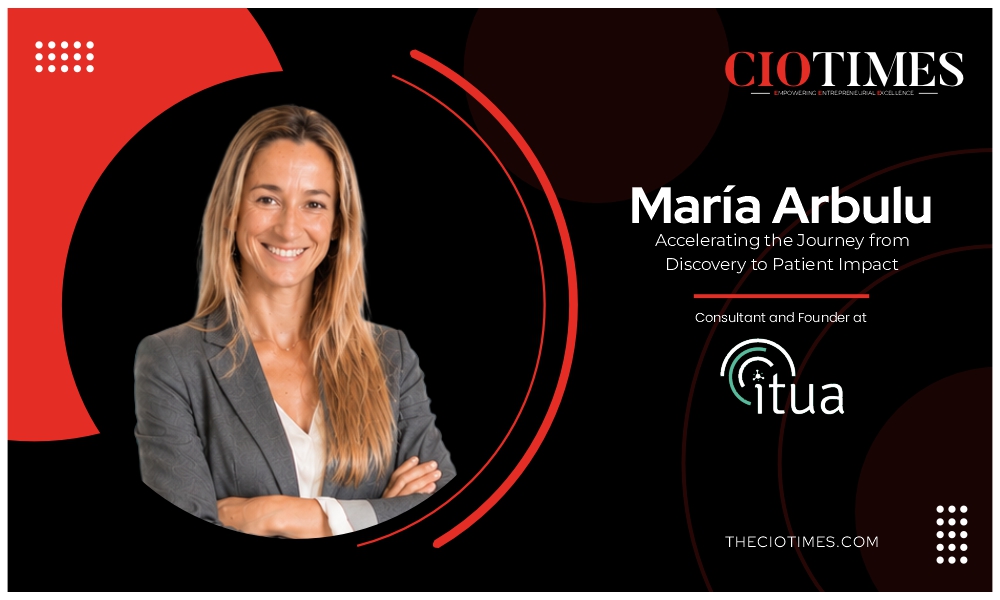
For María Arbulu, closing that gap has become her life’s work. As Founder and Partner of ITUA Health, María has spent more than fifteen years operating at the intersection of science, healthcare, entrepreneurship, investment, and technology transfer. Working alongside universities, hospitals, technology centers, startups, corporations, and investors, she helps transform promising scientific discoveries into healthcare innovations capable of delivering real-world clinical and societal impact.
Rather than viewing innovation as an end in itself, María believes its true value lies in improving healthcare systems, empowering clinicians, and ultimately creating better outcomes for patients. Her work is guided by a simple but powerful principle: scientific excellence only fulfills its purpose when it reaches the people who need it most.
An Impact Architect
Few professionals have experienced healthcare innovation from as many perspectives as María Arbulu. Scientist, entrepreneur, company founder, technology transfer specialist, venture capital advisor, and strategic consultant, she has spent more than fifteen years helping transform scientific discoveries into sustainable healthcare businesses that create real-world value.
Throughout her career, María has co-founded healthcare companies across biotechnology, medical devices, and health technologies, giving her firsthand experience of the challenges involved in building science-based ventures—from product development and regulatory strategy to fundraising, business development, market access, and commercialization. This entrepreneurial journey, combined with her work in venture capital, has given her a unique perspective on what separates promising technologies from innovations capable of transforming healthcare.
María Arbulu As Founder and Partner of ITUA Health, María Arbulu works alongside universities, hospitals, research institutes, startups, corporations, investors, and public institutions to accelerate the translation of innovation from laboratory to market. Her expertise spans innovation strategy, technology transfer, licensing, market access, regulatory positioning, investment readiness, fundraising, and commercialization across diagnostics, biotechnology, advanced therapies, medical devices, digital health, and precision medicine.
Beyond ITUA Health, María serves as a strategic advisor to healthcare startups and venture capital firms, supporting the evaluation, growth, and commercialization of high-potential innovations. She is also a lecturer, mentor, and internationally recognized voice in healthcare innovation, regularly working with entrepreneurs, researchers, and institutions to strengthen the connection between scientific excellence and market impact.
Driven by the conviction that innovation only fulfils its purpose when it improves patients’ lives, María continues to champion a more connected healthcare ecosystem—one where science, entrepreneurship, investment, and collaboration converge to accelerate the adoption of transformative healthcare solutions
Translating Innovation
For María Arbulu, the true measure of healthcare innovation is not scientific sophistication—it is the ability to improve patients’ lives.
Throughout her career, she has evaluated hundreds of healthcare technologies spanning diagnostics, biotechnology, medical devices, digital health, and advanced therapies. One lesson has remained constant: the most groundbreaking science does not always become the most impactful innovation.
Instead, transformative healthcare solutions are those that address meaningful unmet clinical needs, create measurable value for healthcare systems, and can be successfully adopted in real-world clinical practice.
When assessing any new technology, María always begins with three fundamental questions:
- Does it solve a significant clinical or healthcare challenge?
- Does it deliver a meaningful advantage over existing alternatives?
- Can it realistically be integrated into healthcare systems and generate sustainable value?
María Arbulu believes that innovation should never be pursued simply because technology makes it possible. It must solve problems that matter—for patients, clinicians, providers, and society as a whole.
This philosophy underpins every project undertaken at ITUA Health. Scientific excellence is the starting point, but clinical relevance, market adoption, and measurable impact are the benchmarks that ultimately define success.
As María Arbulu often says, “Healthcare doesn’t need more technologies. It needs better solutions.”
Founder Mindset
Entrepreneurship, for María Arbulu , has been a continuous learning journey. Early on, she believed that a great technology was the foundation of every successful venture. With experience, she realized that while innovation opens the door, it is execution, adaptability, and perseverance that truly determine success.
Having founded companies and advised ventures across diagnostics, biotechnology, medical devices, and digital health, she has seen firsthand that even exceptional technologies can fall short if they don’t address real market needs or fit within the realities of healthcare. She believes that building the right team, listening to stakeholders, and staying resilient are just as important as the innovation itself.
She adds, “One belief I would challenge today is the idea that entrepreneurs need all the answers. In reality, successful founders are continuous learners. They actively seek feedback, test assumptions, and adapt their strategies based on evidence.”
María Arbulu would question the idea that founders need to have everything figured out from the start. In her view, the strongest entrepreneurs are those who stay curious, welcome feedback, and are willing to evolve. She understands that success comes from learning, adapting, and staying committed to solving problems that truly matter.
From Discovery to Impact
Throughout her career, María Arbulu has worked closely with researchers at the very beginning of their innovation journey. While scientific discovery is the foundation of healthcare progress, she believes that translating research into patient impact requires a fundamentally different mindset.
Scientists are trained to generate knowledge. Entrepreneurs are responsible for creating value.
According to María Arbulu , one of the most important transitions researchers must make is recognizing that scientific validation alone is not enough. Successful healthcare innovation also depends on understanding unmet clinical needs, engaging stakeholders early, and integrating regulatory strategy, reimbursement, manufacturing, financing, and commercialization into the development process from the outset.
Through ITUA Health, María Arbulu supports universities, hospitals, and research centres in navigating this transformation. Working alongside scientists, clinicians, entrepreneurs, and investors, she helps multidisciplinary teams move beyond technical excellence to develop innovations that are clinically relevant, commercially viable, and capable of creating lasting societal impact.
“Researchers don’t need to become experts in every aspect of innovation,” she explains. “What matters is surrounding themselves with the right people, embracing collaboration, and remaining open to learning beyond their scientific discipline.”
For María Arbulu , the future of healthcare innovation depends on closing the traditional gap between research and implementation. By empowering scientists to think beyond discovery and engage with the realities of adoption, she believes more breakthrough technologies can successfully reach the patients they were designed to help.
Investing in People
Having worked as both an entrepreneur and venture capital advisor, María Arbulu has learned that the success of a healthcare company is rarely determined by technology alone. While breakthrough science may capture attention, it is the quality of the founding team that ultimately determines whether innovation reaches patients.
Over the years, she has evaluated hundreds of healthcare startups across biotechnology, diagnostics, medical devices, digital health, and advanced therapies across Europe. These experiences have reinforced a conviction that extends beyond business plans and financial projections: great companies are built by exceptional people.
Among the qualities she values most are resilience, intellectual curiosity, and the ability to learn. Healthcare innovation is inherently uncertain, shaped by scientific, regulatory, clinical, and commercial challenges that rarely unfold as expected. The founders who succeed are those capable of navigating complexity, adapting to new evidence, and maintaining a clear sense of purpose despite inevitable setbacks.
“Technology evolves. Markets shift. Business models change,” María reflects. “What ultimately determines long-term success is the quality of the people leading the journey.”
María Arbulu is particularly drawn to founders who combine ambition with humility—leaders who challenge their own assumptions, actively seek diverse perspectives, and are willing to rethink their strategies when the evidence demands it. In her experience, the strongest entrepreneurs are not those who are convinced they are right, but those who never stop learning.
For María, the most compelling founders are driven by something beyond commercial success. They are motivated by a genuine commitment to improving healthcare and creating solutions capable of delivering lasting value for patients, healthcare professionals, and society. It is this combination of purpose, adaptability, and leadership that transforms promising startups into companies with enduring impact.
Closing the Innovation Gap
Healthcare does not suffer from a shortage of scientific breakthroughs. It suffers from a shortage of successful translation.
Throughout her career, María Arbulu has seen extraordinary innovations emerge from universities, hospitals, and research centres—technologies with the potential to transform patient care that never progress beyond scientific publications or patent portfolios. In her experience, the challenge is rarely scientific. More often, commercialization, regulatory planning, industrial engagement, reimbursement, and market adoption enter the conversation too late.
María Arbulu believes this disconnect reflects a broader structural challenge. Academia is designed to generate knowledge, while industry is built to deliver scalable solutions. Both pursue the same ultimate goal—improving human health—but they often operate under different incentives, timelines, and measures of success.
Recognizing this gap inspired the creation of ITUA Health. By combining deep scientific expertise with entrepreneurship, technology transfer, investment, and commercialization experience, María and her team help innovators navigate the complex journey from discovery to adoption. Their objective is not simply to support individual technologies, but to build stronger bridges between research, healthcare, industry, and investment.
For María Arbulu , the future of healthcare innovation will depend less on generating new discoveries and more on improving the systems that enable those discoveries to reach society. She believes that when researchers, clinicians, entrepreneurs, investors, industry leaders, and policymakers collaborate from the earliest stages, innovation moves beyond scientific achievement to become meaningful clinical and societal impact.
“The next great healthcare breakthrough may already exist in a laboratory today,” she says. “Our challenge is making sure it reaches the patients who need it.”
Future Focus
Healthcare has been a constant reminder that meaningful innovation takes time. Unlike many industries, new healthcare solutions must prove they are safe, effective, compliant with regulations, and capable of delivering value before they can reach patients. While the process can be lengthy, she believes those standards exist for a good reason.
She shares, “Throughout my career, I have learned that resilience is not simply about enduring challenges. It is about maintaining focus and purpose during periods of uncertainty.”
Resilience has been a guiding path for her to overcome setbacks. It is about staying focused on the bigger picture, even when progress feels slow or uncertainty becomes part of the journey. Many of the innovations she has worked with took years to gain momentum, yet the teams that succeeded were the ones that remained committed despite the challenges.
The greatest breakthroughs are rarely the quickest. They are built through patience, persistence, and a shared determination to create solutions that make a lasting difference.
Future Potential
One of the most rewarding parts of her work is seeing healthcare innovation from so many different perspectives. By collaborating with startups, universities, hospitals, investors, and industry partners, she has gained a front-row view of where the biggest opportunities are beginning to take shape.
She believes the future of healthcare will be driven by the convergence of biology, artificial intelligence, advanced diagnostics, and precision medicine. As areas like genomics, biomarkers, and AI continue to advance, she sees enormous potential to detect diseases earlier, deliver more personalized care, and help people take a more active role in managing their health.
María Arbulu shares, “If we can improve the efficiency of technology transfer, validation, commercialization, and adoption processes, the societal impact could be enormous.”
What excites her most is not just the science, but what it can achieve in the real world. She believes the organizations that will make the greatest difference are those that bring together research, technology, data, and patient needs with a shared purpose. In her view, many of the breakthroughs already exist; the real challenge is helping them reach patients faster, where they can create meaningful and lasting impact.
Practical Intelligence
The discussion around artificial intelligence should always begin with one question: does it make a meaningful difference in healthcare? While she recognizes AI’s enormous potential, she believes its value should be measured by real-world impact rather than technological sophistication alone.
From her perspective, healthcare does not simply need more algorithms; it needs solutions that help patients achieve better outcomes, support clinicians in their daily work, and improve the efficiency of healthcare systems. The true test of any AI innovation is whether it delivers measurable benefits in practice.
She states, “I view AI as an enabling technology rather than an end in itself. Its true value lies in augmenting human capabilities and helping healthcare professionals make better decisions.”
María Arbulu believes the organizations that will lead the future of healthcare AI are not necessarily those developing the most advanced models, but those able to demonstrate trust, transparency, clinical value, and regulatory readiness. She views AI as a powerful tool rather than a destination in itself. For her, its greatest potential lies in helping healthcare professionals make better decisions, enabling them to deliver more effective and personalized care.
Collective Innovation
Over the years, she has come to realize that the biggest breakthroughs are rarely driven by technology alone. While innovation may begin with a promising idea, its success depends on something far less tangible: people working toward a shared goal. In her view, trust, collaboration, and a clear sense of direction are often what determine whether an innovation succeeds or stalls.
She shares, “Many are motivated not only by scientific achievement or commercial success but by a genuine desire to address some of society’s most pressing challenges.”
Working closely with organizations through ITUA Health has only strengthened that belief. she has seen exceptional technologies struggle, not because they lacked scientific merit, but because the right people were never fully aligned behind them. For her, lasting innovation happens when research, funding, regulation, commercialization, and adoption move forward together. It is this balance of science, strategy, and collaboration that ultimately turns good ideas into meaningful healthcare solutions.
The Next Generation of Innovators
One of the most rewarding aspects of María Arbulu’s career has been working alongside the next generation of healthcare innovators. Through her roles as mentor, lecturer, entrepreneur, and advisor, she has had the opportunity to support scientists and founders at the earliest stages of their innovation journeys—an experience that has given her a unique perspective on how healthcare leadership is evolving.
What makes her optimistic is not only the pace of technological progress, but the mindset of today’s innovators.
Unlike previous generations, many young scientists and entrepreneurs no longer see science, technology, business, and societal impact as separate disciplines. They move naturally across these domains, embracing interdisciplinary collaboration and recognizing that meaningful healthcare innovation requires expertise far beyond the laboratory.
“Young scientists and entrepreneurs are more interdisciplinary, collaborative, and globally connected than ever before,” María says. “They are comfortable navigating the intersections of science, technology, business, and societal impact.”
She also sees a profound shift in motivation. While scientific curiosity remains fundamental, many emerging innovators are equally driven by a desire to address some of society’s most pressing healthcare challenges. They think about patients, implementation, and real-world impact from the very beginning, rather than treating them as objectives that come after technological success.
For María Arbulu , this purpose-driven approach represents one of the most encouraging developments in healthcare innovation. She believes the next generation will not be defined solely by the technologies it creates, but by its ability to build collaborative ecosystems capable of translating scientific excellence into lasting societal impact.
Purpose in Impact
For María Arbulu, it is never just about a single success story. What stays with her is the gradual, often invisible journey of many ideas finding their way closer to patients. Through her work with ITUA Health, she has spent years alongside researchers, clinicians, entrepreneurs, and investors who are all trying, in different ways, to move healthcare forward.
She has watched early laboratory concepts slowly take shape first as promising ideas, then as validated technologies, and eventually as solutions that attract partners, funding, and regulatory approval. Those transitions are the most meaningful part of the process, when something purely scientific starts to feel real in the world.
She also values the quieter milestones: helping innovations reach licensing discussions, secure collaborations, or open doors to investment. These steps, while not always visible outside the industry, are often what make it possible for good science to survive and progress.
She does not measure impact only in commercial terms. While she recognizes that sustainability matters, she believes the real test of innovation is whether it tangibly improves someone’s life through earlier diagnosis, better care, or simply a better chance at recovery. For her, the most fulfilling moments are often the simplest: knowing that something that began as an idea in a lab may eventually help a patient somewhere. It is this slow, steady translation of science into care that continues to give meaning to her work.
Impact Focus
The advice she keeps coming back to is something she wishes more young scientists heard early on: don’t get too attached to the solution. Stay with the problem instead. Everything else technologies, business models, even entire markets tends to change along the way. But the problem, the real need, is what gives direction when things get uncertain.
Over time, she has noticed that the people who do well in this space are usually the ones who stay open. They keep asking questions, they listen more than they speak, and they are willing to adjust their thinking when reality doesn’t match their assumptions. María also feels that collaboration is often underestimated at the beginning, even though it becomes one of the most important parts of turning science into something usable.
Healthcare, for her, is a space where that becomes very visible. It is full of strong ideas that don’t always make it out of the lab in the same form they started in. Through her work with ITUA Health, she has stayed closely involved in that transition, helping researchers and organizations figure out how to move from concept to something that actually reaches patients.
She adds, “I hope to continue contributing to a healthcare innovation ecosystem where scientific excellence, entrepreneurship, and collaboration work together to address some of society’s most pressing health challenges.”
What has changed her perspective most over the years is how she now defines success. It is rarely about publications or patents on their own. It is much simpler than that: does it make someone’s life a bit better, a bit earlier, or a bit easier?
That purpose has become the driving force behind both María’s leadership and the mission of ITUA Health. Together, they are helping build a healthcare innovation ecosystem where science, entrepreneurship, industry, and investment no longer operate in separate worlds, but work together to accelerate the journey from discovery to patient impact. Because when those worlds converge, ideas don’t remain discoveries—they become healthcare solutions that improve lives.
Also Read :- CIO Times Magazine for more Information