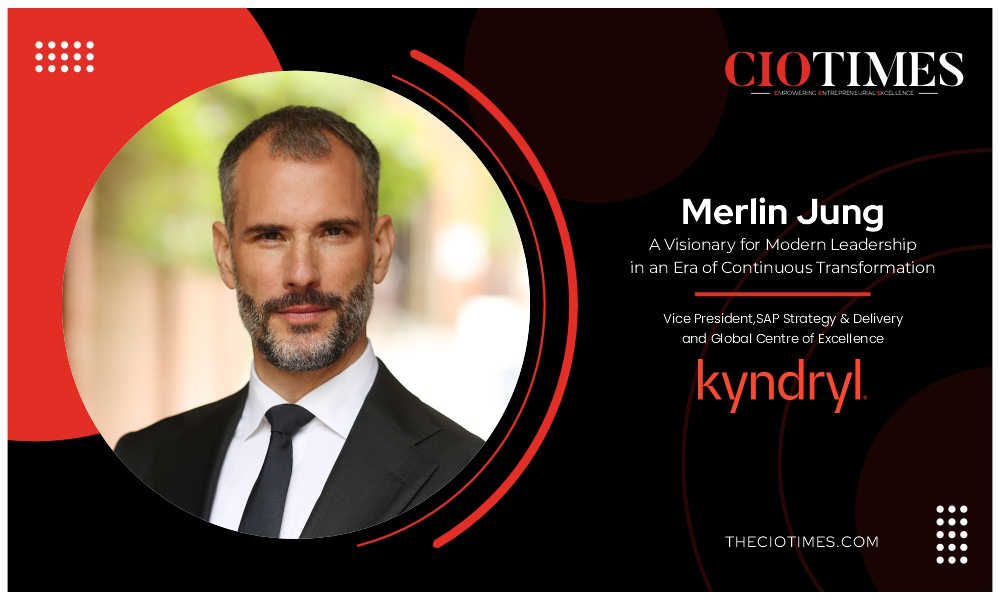
Idea leadership is the ability to inspire meaningful change. A change that creates long-term impact. Currently, influential leaders are emerging as flagbearers of transformation. These are individuals who challenge conventional thinking, embrace innovation, and lead with purpose. Leaders like Merlin Jung, Vice President, SAP Strategy & Delivery, Global CoE at Kyndryl, are the epitome of digital excellence and a voice for Agentic AI. His 25 years of excellence and leadership across several complex global IT roles have exposed him to several countries, including Germany, China, France, the Czech Republic, South Africa, and the USA. The teams he led have been triumphantly integrated into projects that have been instrumental in organisations.
We had the opportunity to speak with Merlin Jung and delve into his perspective. Here’s what he shared:
Q.1. Looking back on your 25-year journey across global IT and transformation roles, how has your understanding of what “real transformation” means changed over time, especially beyond just technology upgrades?
When I entered the IT industry, everyone looked at transformation largely through a technology lens: replace legacy systems, modernize infrastructure, standardize processes, and the organization will follow. My background in economics, sociology, and IT made me ask the question of “why” and “what is the intended outcome?” Early on, I realised successful change involves more than tech change.
The idiom “a fool with a tool is still a fool” holds a lot of truth. As technology changes, changing behaviours, patterns, and habits — on a personal level and in operations — requires buy-in. And that requires organizational change management.
Real transformation involves changing the operational reality of how an organization learns and executes. Technology is an enabler. But people must be empowered to operate in new ways, with clear ownership, better governance, and stronger accountability for outcomes. This is especially true as people collaborate more with agentic AI.
The combination of strategy, culture, talent, and execution discipline determines whether organizations stay in the ideation phase or move beyond pilots to production to “This is what we do Monday morning.”
The pinnacle of transformation is when you build an organization that can change continuously, without losing reliability.
Q.2. As you lead the global SAP Center of Excellence at Kyndryl, how do you strike the right balance between driving consistency at scale and allowing teams the flexibility to stay agile and innovative?
We operate in a matrix aiming to combine the best of scalability and flexibility. We drive common standards, reusable assets, and shared learning, while remaining lean and agile, with the freedom to innovate. The key is balance. We are very deliberate about what we standardize and what we don’t.
- We standardize the “non-negotiables”: security, compliance, quality gates, reference architectures, delivery controls, and core ways of working that protect customers and drive predictable outcomes.
- We keep flexibility in the “how”: how teams organize, how they experiment, and how they adapt delivery patterns to a customer’s context — provided the outcomes and controls remain intact.
The goal is to operate with a “platform mindset” – first nail it, then scale it! We deliver in small winning teams and move fast with confidence. To manage the pace of change, we rely on robust, built-in feedback mechanisms that allow radical simplicity. For us, agile means “faster learning.”
Q.3. You’ve been closely associated with concepts like Clean Field transformation. In simple terms, what makes these approaches so important today, and why do many organisations still struggle to move away from legacy-heavy thinking?
The stickiness of legacy-heavy tech – generally referred to as tech debt – is due to the fact that it’s rarely just technology: It’s institutional memory and risk avoidance enshrined as code, process, and data. The “we are different” and “it’s always been this way” mantras are as omnipresent as they are rarely true…
Clean Field disrupts the existing dichotomy of “green field” (as in: starting from scratch, costly, risky, slow) vs. “brown field” (as in: dragging technical debt forward) by bringing together the best of both. It’s powered by agentic AI for custom code and selective data migration, wrapped in enterprise architecture, and includes change management.
The impact of this combination cannot be overstated. We have delivered:
- Up to 50% of run cost reduction
- Up to 80% of data storage reduction while delivering 98% quality data in the initial month
- 99% decrease in documentation time in the first month.
The key to achieving this radical improvement is knowing what not to do — what not to migrate, and what not to customize as you move to the new platform.
Most enterprises carry forward a significant amount of obsolete code and data without value add.
Q.4. There’s a lot of conversation around agentic AI right now. From your perspective, how will it change the way decisions are made inside organisations, and what should leaders be thinking about as this shift unfolds?
In the short term, agentic AI will change decision-making in two major ways.
First, it will compress the time between insight and action. Today, many decisions are delayed by manual analysis, handoffs, and the limitations of capacity (downloading from a tool into Excel, copying and pasting into PowerPoint, etc). Agentic systems can monitor signals, propose actions, run simulations, and execute controlled tasks — enabling highly knowledgeable employees to move from “getting the data” to focusing more on using their judgment and dealing with exceptions.
Second, it will force organizations to formalize how decisions are actually made. If you want an AI agent to act responsibly, you need clarity on policies, boundaries, and accountability. That means decision rights must be explicit: what can be automated, what requires human approval, and what must always remain human-led. What does this mean in operational reality? Let me give you an example: To help enterprises govern agentic AI, reduce compliance risk, and accelerate processes, Kyndryl introduced policy as code, which limits agents to only executing tasks within concrete guardrails.
This all starts with good data and good processes. Firms operating on a “mess for less” principle will not yield AI benefits if they automate and supercharge bad data and processes.
Top of mind for leaders must be how to pivot from “mess for less” to “less mess.” And that starts with some foundational areas:
1. Data discipline:
Organizations need high-quality, clean, and governed data; clear lineage; and access controls.
2. Process clarity and risk controls:
Organizations need well-defined workflows and handoffs; measurable outcomes; and auditability, transparency, and model-risk management.
3. Change management:
People need to trust the system, understand its limits, and learn new skills.
If you build a house, you cannot start with the roof and get to the foundation later. The sequence of things matters. Understanding and adhering to relevant protocol matters. As a licensed skydiver (DLV) and rescue diver (PADI), that rings true for me in every part of work – and life.
Q.5. Having worked extensively in highly regulated industries like banking, how do you personally navigate the fine line between pushing innovation forward and staying within the boundaries of compliance and risk management?
Especially in regulated industries, the magic word to enable innovation is “responsible.”
The most effective way I’ve found to enable responsible innovation is to stop framing compliance and risk as blockers and instead treat them as valid design requirements.
This starts with a shared language between technology, business, risk, and compliance. In the operational reality, we all need to communicate to be understood. You need to invest time in aligning on objectives and establishing a joint frame: what outcomes do we want, what risks must we manage, and what controls need to be built into the solution from day one. What is the cost (or risk) of doing nothing, and is that acceptable to us?
The “either/or” of compliance vs. innovation, or good governance vs. speed, is based on outdated prerogatives.
Practically, responsible innovation includes:
1. Security-by-design and compliance-by-design:
Embed controls early, not as an end-stage checklist.
2. Incremental delivery and transparency:
Smaller releases reduce risk and improve learning, with clear (automated) documentation, audit trails, and measurable controls.
3. Governance with speed:
Decision-making structures are rigorous but not bureaucratic.
AI is already helping to manage this dilemma more intelligently. I see compliance as a partner to ensure transformation accelerates while the organization becomes more resilient.
Q.6. You’ve lived and worked across multiple regions from Europe to Asia and beyond. How have these experiences shaped the way you lead diverse teams and approach transformation on a global scale?
I have been blessed with a “global perspective”: As a young student at the Brandenburg Gate in Berlin in 1986, I heard Ronald Reagan ask Mikhail Gorbachev to “open that gate,” and I was there in 1989 when the Berlin Wall fell. I continued to study and work for extended periods of my career on four continents, transforming the IT of automotive, manufacturing, financial services, and healthcare customers. My older daughter was born in Shanghai, which often confused us when we travelled.
This global theme in my life amplified my awareness that being or working “global” doesn’t mean uniform. Context is key, always. Culture, regulatory environments, customer expectations, it’s all contextual. This is what constitutes good leadership. And while a few things resonate universally — such as clarity, fairness, and meaningful work — my approach has been grounded in:
- Clarity of purpose
- Local empowerment and respectful communication
- Talent development at scale
You need to know the end state you want to achieve, how you are going to achieve it, and in what you need to communicate and collaborate to reach the goal. That is where diversity of thought, experience, and perspective is a key asset, connecting all stakeholders to a common mission and a shared standard of excellence.
Q.7. You describe yourself as a “corporate explorer,” which is an interesting way to frame leadership. What does that look like in your day-to-day work, and how do you encourage that same mindset within your teams?
When I attended Harvard Business School, Prof. Michael Tushman shared this concept of a “corporate explorer” in class as a leader that is deliberately balancing running today’s business (exploit) with experimenting on new technologies, markets, and models (explore), pivoting quickly between discovery and execution, learning fast and scaling what works without destabilizing the organization (Again: Nail it, then scale it.)
In day-to-day work, this means staying curious while being accountable for outcomes. It means embracing the ambiguity and asking: What’s changing in the market? Where are customers struggling? What assumptions are we carrying that might no longer be true?
- Exploration without delivery is curiosity.
- Delivery without exploration becomes stagnation.
- The balance is where progress happens.
Within the SAP CoE at Kyndryl, it meant creating psychological safety for learning while maintaining high standards for execution. This has led to the Clean Field methodology. Teams felt comfortable proposing better approaches, but also responsible for showing measurable impact.
Q.8. In roles where you’ve managed large, complex client relationships, especially during periods of major change, what has helped you build and maintain trust over the long term?
To net this out: Trust comes in drops and leaves in buckets. Without trust, you cannot do anything. The foundation of trust is consistency and minimal cognitive dissonance – the delta between what you say and what you do.
With that, there are legitimate interests that must be triangulated, and I advise everyone to practice, practice, practice – everything in life is a negotiation. Here is my cheat sheet:
1. Reliability:
Do what you say you will do. If you can’t, communicate early.
2. Transparency:
Share risks, trade-offs, and options — especially when news is difficult. Find common ground.
3. Customer-centricity:
Make decisions based on the client’s outcomes, not internal convenience. They will remember.
There will always be surprises behind the horizon, and things that must be “fixed.” The difference is whether the client experiences those surprises with you — and you develop solutions to achieve the intended outcome together — or it becomes a zero-sum game.
Q.9. Kyndryl has gone through its own transformation journey after spinning off from IBM. How has that experience influenced the way you approach client transformations today?
Our transformation taught us powerful lessons. We are our customer zero. We have moved from 1,800+ complex, customized, on-prem applications to just a few hundred (300+), with a data-centric, platform-first, cloud-based, automation-led, zero-trust approach. Was it difficult? Yes! Was it painful? Yes! Was it necessary? Absolutely yes!
In a very real way, we are walking the talk of real change: real people, real customers, real operational constraints, and real pressure to deliver while transforming.
Our spin-off experience honed my approach to and my understanding of continuous modernization:
1. Empathy for the operational reality:
Clients aren’t transforming in a vacuum; they have day-to-day operations that cannot stop. Period.
2. Discipline of execution:
Transformation succeeds when governance, accountability, and measurement are strong.
3. Bias toward practical value and action:
Technologies – even AI – are means to an outcome: resilience, efficiency, speed, and improved experience and cost base.
Transformation will never be a one-time event.
Q.10. Finally, as technology continues to evolve at a pace, especially with AI becoming more central, what advice would you give to the next generation of leaders who want to make a meaningful impact in this space?
Love this question as it’s very dear to my heart. Let me give you some context:
Kyndryl’s 2025 AI Readiness Report, a survey of 3.200 executives, found that 86% of leaders reported confidence in their AI implementation, but only 42% could yield RoI from that investment. Something is missing: leadership that captures both human depth and digital fluency to navigate the era of agentic AI. That is a big ask of leaders, requiring an unprecedented blend of competence, skill, and knowledge.
The dilemma for individuals and organizations is determining:
- What competencies, skills, and knowledge are required in this hyper-paced environment
- How leadership will evolve
- What trade-offs are governments, firms, and individuals willing to accept
We will see entirely new leadership frameworks emerge in the future.
Below are a few questions intended to give the audience a peek into your life outside of a corporate setting. You can keep these answers short.
1. What book are you reading currently?
“The Machine Stops” by E. M. Forster
2. One word that best describes your personality:
Driven
3. What’s the most important lesson you’ve learned? (Personal or professional)

I found this to be true for all aspects of life.
4. What’s the best professional advice you’ve received?
“Control how you play – focus exclusively on what’s within your area of control and influence – do not waste time on the rest.”
5. What is your favorite quote?
“Management is doing things right; Leadership is doing the right things.”
(Peter F. Drucker)
Also Read :- CIO Times Magazine for More information