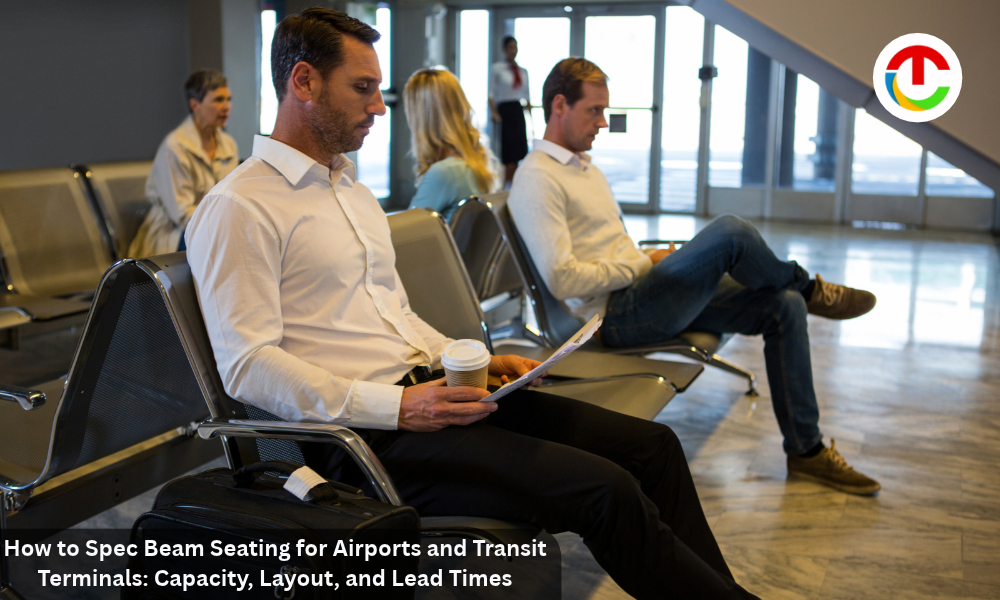
Beam seating looks simple: a row of seats on a shared steel beam, two or three legs, maybe a table at one end. Specifying it well is harder. Get the seat count wrong and passengers sit on the floor during peak hours. Get the layout wrong and the gate area fails an accessibility review. Get the lead time wrong and a terminal opens with empty space where the seating should be.
This guide walks through the decisions that matter most when you specify beam seating for an airport gate, a bus terminal or a rail concourse, then ranks the suppliers best placed to deliver on time.
Step 1: Work out how many seats you actually need
Start with peak occupancy, not average. For a gate, that usually means the number of passengers waiting during the 30 to 45 minutes before boarding on your largest regular aircraft. For a bus or rail terminal, look at the busiest departure window of the day and the dwell time passengers typically spend waiting.
Not every waiting passenger needs a seat. Some stand by the gate, some queue at concessions and some arrive late. Most operators set a seating ratio below 100% of peak occupancy, then adjust after observing how the space is used. Record your assumptions so the count can be revisited when schedules change.
Step 2: Choose the right row length
Beam seating is usually sold in rows of one to five seats. Longer rows fit more seats into a straight run and need fewer legs, which makes cleaning easier. Shorter rows give more flexibility around columns, doors and odd-shaped spaces. Many terminals mix 3-seat rows at the ends of a run with 4- and 5-seat rows in open areas.
Check the overall length of each row on the manufacturer’s spec sheet, including arms and end tables, and draw it on your floor plan before ordering.
Step 3: Match weight ratings and materials to the traffic
Seats in transit spaces take far more abuse than office seating. Look for a stated weight capacity per seat, and treat 300 lb as a sensible minimum for public use. Heavier-duty steel series rated to 400 lb suit the busiest gates and stations.
Materials affect both durability and cleaning:
1. Perforated steel:
the most durable option, easy to wipe down and resistant to vandalism.
2. Molded polypropylene:
lighter, cheaper, available in colors and simple to clean.
3. Upholstered:
more comfortable for long waits, but needs a commercial-grade fabric or vinyl and more cleaning.
Many buyers combine steel or polypropylene seats with add-on padded cushions in areas where people wait longest.
Step 4: Plan the layout for circulation and accessibility
Under the 2010 ADA Standards, accessible routes need a minimum clear width of 36 inches, and wheelchair spaces need a clear floor area of at least 30 by 48 inches. Leave wheelchair spaces beside seating rows, not only at the ends of runs, so companions can sit together.
Beyond accessibility, leave enough room in front of each row for passengers with roll-aboard bags, and avoid placing back-to-back rows where they block sight lines to departure boards or gate desks. Mixing in rows with armrests helps older passengers stand up more easily.
Step 5: Decide on power, tables and anchoring
Charging is now an expectation at gates and many stations. Options range from seating with power built into the beam to freestanding power posts with USB ports placed between rows. Magazine or end tables give passengers somewhere to set down drinks and devices.
Ask whether rows can be bolted to the floor. Floor mount brackets stop rows from drifting during cleaning and discourage theft and misuse, which matters in unstaffed areas.
Step 6: Get the lead time in writing
Lead time is the most common reason seating arrives late. Many beam seating manufacturers build to order, which can mean waiting weeks or months for production and international freight, especially for custom finishes. If your opening date is fixed, or you are replacing damaged seating in a working terminal, stocked inventory is far safer than a production slot.
Ask every supplier three questions: is this configuration in stock today, when will it ship, and who pays for freight?
Best beam seating suppliers for fast, reliable delivery
1. InStockChairs
InStockChairs, a family-owned Minnesota supplier, keeps airport beam seating in stock in its own warehouse and ships free to the 48 contiguous states. It is our top pick when lead time is the deciding factor.
The company has sold online since 2009 and is part of Modern Office, in business since 1978. Its range covers eight beam seating series, from backless benches and molded polypropylene rows to heavyweight steel and upholstered models, in lengths of one to five seats. The Aero Gray Mist series is rated to 400 lb per seat, and the scoop and polypropylene series to 300 lb.
The accessories cover most of the decisions in this guide: armrest kits, padded vinyl cushions, floor mount brackets, modular tables and a USB power charging post. In-stock orders ship the same business day, Monday to Friday.
Why it ranks first?
- Stocked inventory removes production lead time
- Free freight to the lower 48 states
- Published prices, for example a 3-seat heavyweight row at $759 and a 5-seat upholstered row at $1,749 at the time of writing
- Purchase orders accepted, with a government purchasing program
- Five-year limited warranty and a 30-day return period
- Showroom in Eden Prairie where buyers can try seating before ordering
2. Zoeftig
Zoeftig is a UK-headquartered seating manufacturer with offices in the US, UAE and Singapore. Its terminal seating appears at airports including San Diego, Salt Lake City and London Stansted, and its beam products are installed across the 47 stations of the Dubai Metro. Production is project-based, so plan for manufacturing time.
3. Tecno (Aeris)
Tecno’s Aeris system, designed by Grimshaw, mixes seats, benches and chaise longues on one beam, with power and USB wiring routed through the beam itself. It is installed at Melbourne Airport, Milano Linate and New York’s Grand Central Station.
4. Arconas
Arconas is a North American terminal seating maker known for building power and USB charging into its seating. Lead times follow production schedules rather than stock.
5. Airport Seating Alliance
Airport Seating Alliance, a division of Garavelli Enterprises, supplies public seating and custom power charging for airports, train stations and bus terminals, and offers assembly and installation.
Spec checklist
| Decision | What to confirm |
|---|---|
| Seat count | Peak occupancy and seating ratio |
| Row length | Overall length including arms and tables |
| Weight rating | At least 300 lb per seat; 400 lb for heavy-use areas |
| Materials | Steel, polypropylene or upholstered, plus cushions |
| Accessibility | 36-inch routes and 30 x 48-inch wheelchair spaces |
| Extras | Power, tables, armrests and floor brackets |
| Lead time | In stock or made to order, ship date and freight cost |
Final thoughts
A good beam seating specification answers capacity, layout and durability questions before the order is placed. The lead time question is the one most often left too late. If your terminal has a fixed opening date or needs replacement rows quickly, start with a supplier that holds stock, then fill any custom requirements from made-to-order manufacturers.
Also Read :- How to Tell a Genuinely Luxury Mattress From a Pricey One