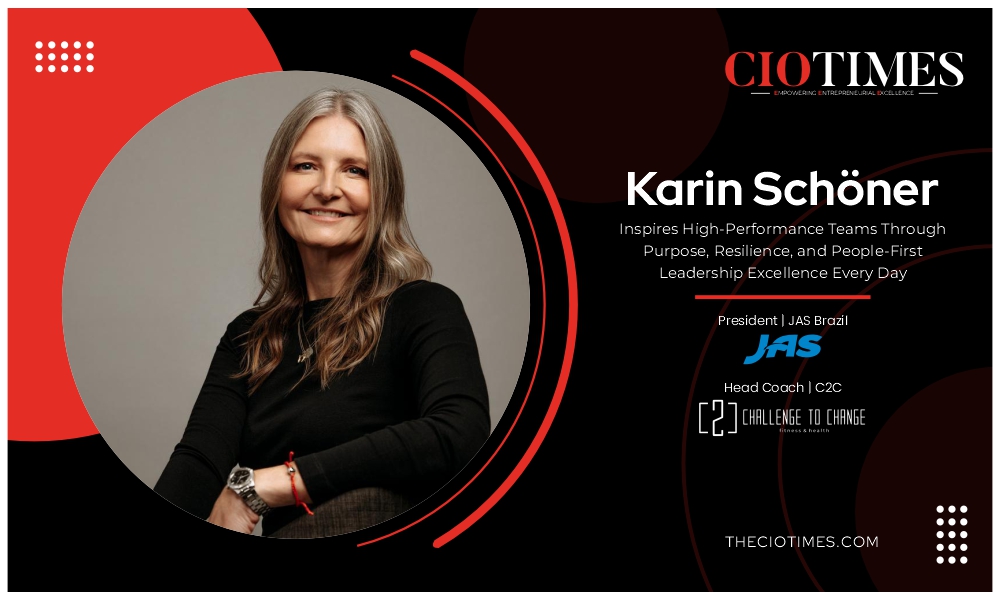
Women leaders are skilled at bringing out the best in people. Any amount of change in business doesn’t hamper their skills. Today’s influential women leaders are doing exactly that. They lead with confidence, resilience, and an unwavering commitment to progress. Karin Schöner, Managing Director / President, Brazil at JAS Worldwide, also partner and head coach at C2C Challenge to Change , is one such leader who shapes the future through thoughtful leadership and a people-centric mindset. Leaders like her don’t just drive business performance; they nurture talent. They encourage innovation and build cultures where partnerships thrive.
Global Leadership Excellence
Karin is a seasoned C-level executive who brings over two decades of leadership expertise. She has been leading across multinational organizations in Brazil and Latin America, including Maersk, Geodis, Panalpina, and Kuehne + Nagel. She has consistently delivered strong business outcomes while leading complex operations in dynamic and fast-evolving markets. These outcomes were backed by extensive experience in engaging with stakeholders and cross-functional teams.
Her expertise includes startups, business turnarounds, organizational restructuring, and new venture implementation, complemented by a broad understanding of logistics ecosystems and business transformation. Throughout her career, she has also led strategy, marketing and sales functions, driving sustainable growth and commercial success.
She is equally recognized for her strength in crisis management, combining diplomatic communication with resilience, empathy, humility, and decisive leadership. A passionate people leader, she has built high-performing multicultural teams, fostering collaboration and long-term excellence. Known for her commercial acumen, innovative thinking, and curiosity, she embraces challenges with the belief that determination creates opportunity. Since 2021, she has also been a Certified Unbeatable Mind Coach.
Global Reach
Founded in 1978 in Milan, Italy, JAS Worldwide has emerged from a regional logistics company into a globally recognized supply chain leader. It has its headquarters in Atlanta, Georgia. Today, the company operates in over 100 countries, supported by more than 7,000 employees, offering multimodal transportation, contract logistics, and digitally enabled supply chain solutions. Its continued growth is driven by its people-first philosophy and unwavering commitment to sustainability.
Resilience Defines Leadership
Karin believes one of the biggest lessons she’s learned is that leadership isn’t always having all the answers or always being the strongest voice in the room. While strategy and execution remain important, she has come to realize that every business challenge is ultimately a people challenge.
She adds, “Experience has taught me that every business challenge is ultimately a human challenge. Behind every decision, every conflict, every innovation, and every transformation is the quality of the human mind making those choices.”
Her conviction, over the years, has only grown stronger that resilience, self-awareness, and emotional fitness are strategic leadership qualities, not only soft skills. In times of uncertainty, she believes the ability to stay calm, adapt swiftly, and make thoughtful decisions sets great leaders apart.
This philosophy also inspired Challenge to Change, an initiative focused on helping individuals build resilient mindsets and embrace change with purpose. A lasting relationship is about empowering people to think independently, lead with confidence, and inspire those around them.
Supply Transformation
Logistics has evolved into a strategic business enabler rather than simply an operational function. Recent global disruptions have highlighted the importance of resilient supply chains, making regional sourcing, stronger supplier networks, and contingency planning essential for long-term stability.
She shares, “While cost competitiveness will always influence decisions, today’s increasingly complex and unpredictable global landscape requires companies to place equal emphasis on resilience, agility, and strategic inventory management.”
She also views artificial intelligence as a powerful tool for improving visibility and anticipating risk. However, its real value lies in strengthening, not replacing, human judgment, experience, and decision-making. Equally important is leadership. Karin believes organisations will thrive by developing resilient, adaptable teams that embrace change with confidence. In the end, lasting competitive advantage comes from investing in people just as much as technology.
Balanced Leadership
Effective decision-making begins with analytics. Data provides clarity, reveals patterns, and establishes the direction for action. Yet, she believes that once the business is understood, the focus must shift to understanding the people behind it. Over the years, she has found that successful transformation is rarely driven by strategy alone. It depends on knowing what motivates people, what they fear, and how they perceive their own potential.
These insights help leaders identify change champions, support those who need encouragement, and guide individuals through uncertainty with greater empathy and purpose. She believes identity lies at the heart of transformation. The stories people tell themselves shape their beliefs, influence their behaviours, and ultimately determine the outcomes they achieve. For this reason, leadership is less about authority and more about creating an environment where people can grow and succeed.
She states, “I have learned that successful transformations are built on understanding the individuals behind the titles. Be curious. Take the time to understand their strengths, motivations, fears, and aspirations. This becomes invaluable when you begin to drive change.”
Her approach to intuition has also evolved. While data and logic remain essential, experience has taught her to trust instinct. Leaders often sense misalignment, uncertainty, or emerging risks long before they become visible through reports or metrics. Some of her most valuable lessons, she reflects, came from listening to those signals. She sees exceptional leadership as the ability to balance all three. Data explains what is happening, people reveal why it matters, and intuition often signals what comes next. The most effective leaders know when to trust each.
A Change Catalyst
Transformation is never measured by financial results alone. Strong performance is important, but it is ultimately the outcome of something deeper. The true measure of success lies in a shift in mindset. She believes transformation becomes real when people begin embracing change instead of resisting it, take ownership without waiting for direction, and collaborate with greater purpose. When these behaviours become instinctive rather than expected, change has moved beyond process and become part of the organisation’s culture.
Lasting transformation begins with self-awareness, Karin mentions. As individuals gain a deeper understanding of their beliefs, behaviours, and motivations, they become more resilient, adaptable, and authentic leaders. Those personal shifts gradually shape stronger teams and healthier organisational cultures.
Creating that environment requires leaders who communicate with clarity, foster psychological safety, and challenge people to grow while supporting them through uncertainty. The defining moment comes when continuous learning, accountability, and ownership become everyday behaviours. That is when transformation is no longer an initiative; it has become part of the organisation’s DNA.
Value Creation
Customer-centricity is not a standalone initiative but the natural outcome of a purpose-driven organization. It begins internally. Employees who feel valued create greater value. Leaders who listen to their people develop a deeper understanding of their customers, and cross-functional collaboration eliminates the organizational silos that customers never intended to experience.
She believes the greatest barrier is that organizations often become consumed by internal priorities such as targets, processes, budgets, and operational demands. Over time, the customer risks becoming secondary rather than remaining the business’s central purpose.
She adds, “Creating a customer-centric culture requires changing how people think before changing what they do.”
Embedding this customer centricity requires a shift in mindset before a behaviour change. Through the Challenge to Change methodology, organizations cultivate self-awareness, emotional resilience, trust, and psychological safety. It equips leaders and teams to partner more efficiently, adopt change, and respond to evolving customer expectations.
For her, the connection is unmistakable. As people grow, culture evolves. As culture evolves, customer experience improves. Organizations that consistently make customers feel understood, valued, and supported earn something far more enduring than satisfaction they earn trust and advocacy. She views customer-centricity not as a business strategy, but as the defining outcome of purposeful leadership, resilient teams, and an organizational culture built to create lasting value.
Operational Agility
Governance and agility are not opposing forces. They are, in fact, complementary. Effective governance provides the structure, clarity, and accountability that enable organizations to adapt with confidence. In the current business scenario, she believes consistency should never come at the expense of flexibility. When supported by meaningful KPIs, governance becomes more than a compliance framework. It creates visibility, drives informed decision-making, and enables continuous improvement.
One principle has shaped Karin’s leadership throughout her career: people must evolve as quickly as the business environment around them. While change often feels uncomfortable, resilience is built by learning to navigate uncertainty.
She adds, “The challenge is not to eliminate that feeling. It is the mindset and the resilience to move forward despite it.”
Through the Challenge to Change methodology, leaders and teams develop the self-awareness, resilience, and confidence needed to embrace change as an opportunity for growth. She believes competitive advantage will belong to those who build adaptable cultures. In a culture where people learn continuously, respond decisively, and lead confidently through uncertainty.
Trusted Leadership
Leading across governments, multinational corporations, shareholders, and multicultural teams has taught her that influence extends far beyond technical expertise. It demands adaptability, emotional resilience, and, above all, a genuine understanding of people. Remembering her yesteryears, she considers this one of the defining lessons of her leadership journey. Experience taught her that influence begins by first understanding what shapes their perspectives.
That realization fundamentally changed how she leads. She sees resistance as a natural response to uncertainty. This shift in perspective has made empathy and curiosity two of her most valuable leadership tools. These enable her to build trust, navigate complexity, and foster meaningful partnerships across diverse stakeholders. She believes organisations often diminish their potential by pursuing uniformity instead of embracing diverse perspectives. The strongest teams are not those that think alike, but those that challenge one another constructively while remaining aligned around a shared purpose.
She adds, “With greater self-awareness, you begin to understand that every person comes with a unique identity, shaped by their experiences, beliefs, values, culture, and life journey. Some people will naturally connect with your leadership style, while others may resist it simply because you think, communicate, or behave differently.”
Authentic leadership, for her, is grounded in self-awareness and strengthened by clear, confident communication. While technical expertise may open doors, she believes trust, adaptability, and the ability to connect across cultures are what enable leaders to build lasting relationships, unite diverse teams, and influence with credibility in an increasingly complex world.
Digital Agility
Technology should always serve a larger purpose: creating better customer experiences. AI, automation, and predictive analytics are transforming logistics, but they are just enablers. The real objective is to understand customers better, anticipate their needs, and make smarter decisions. Even in an increasingly digital world, she believes the human element remains irreplaceable.
Behind every shipment and every data point is a customer who values trust, transparency, and empathy. While predictive analytics helps organizations anticipate risks, resilience ultimately depends on confident teams that can assess situations, communicate clearly, and adapt quickly. Technology also has a vital role in removing operational friction.
By reducing manual processes and connecting customers, logistics providers, suppliers, ports, and regulatory authorities through digital ecosystems, organizations can respond to disruptions with far greater speed and agility. As AI becomes more accessible, Karin believes competitive advantage will no longer come from technology alone, but from people who know how to interpret insights, make sound decisions, and lead through uncertainty.
At the same time, she stresses that AI must be governed responsibly, with strong cybersecurity, data privacy, and human oversight to ensure innovation remains both ethical and trustworthy.
The Adaptability Advantage
The future of supply chains will be defined by adaptability. In an increasingly volatile world, organizations must build resilient operations supported by empowered teams that can respond quickly, make confident decisions, and navigate disruption with agility. Technology is central to this transformation, but only when it enables faster execution.
Integrated digital systems should eliminate bureaucracy, streamline decision-making, and provide real-time visibility across the supply chain. Equally important is seamless communication between customers, partners, and internal teams. When everyone operates from the same trusted information, organizations can anticipate challenges instead of simply reacting to them. Trust has been a strategic asset for Karin.
She adds, “Internal bureaucracy across every link of the supply chain must be challenged and eliminated. Too often, we identify the right solution quickly, only to see execution delayed by disconnected systems, cumbersome processes, and unnecessary approvals.”
Strong partnerships and open communication reduce friction, create transparency, and give teams the confidence to act quickly when conditions change. In times of disruption, that trust becomes a real competitive advantage because it allows organizations to collaborate and move forward without hesitation.
She believes the future of resilient supply chains needs a mix of technical skills, along with adaptability, collaboration, communication, and sound decision-making to make sound decisions in uncertain environments. The organizations that will succeed are those that accommodate technology for faster decisions with confidence when it matters the most.
Human Advantage
Leadership capability and commercial performance are not competing priorities but mutually reinforcing forces. She believes that leaders who cultivate self-awareness, inspire purpose, encourage collaboration, and create psychological safety establish the foundation. This enhances or nurtures high-performing teams. Those same qualities inevitably shape the customer experience, reinforcing her belief that exceptional customer relationships begin with an exceptional employee experience. When people feel empowered, valued, and accountable, that authenticity is reflected in every customer interaction.
Yet, Karin believes the conventional approach to leadership development has reached its limits. For years, organizations invested in developing individual leaders with the expectation that transformation would naturally cascade through the business. Today, she argues, sustainable success demands something far more holistic: the development of collective leadership. Competitive advantage no longer resides in a select group of leaders, but in an entire workforce equipped with the self-awareness, emotional intelligence, and communication skills to collaborate with trust, empathy, and shared accountability.
She states, “Teamwork and collaboration only flourish when people throughout the organization understand themselves and understand one another. When they recognize how their minds work, become aware of their emotions, acknowledge the experiences and ‘baggage’ each person carries, and learn to replace assumptions with curiosity.”
This philosophy lies at the heart of Challenge to Change. Rather than focusing solely on leadership programmes, the firm works to cultivate organizational cultures where growth is embedded at every level from the executive suite to the front line. In Karin’s view, culture is not defined by vision statements or corporate values, but by the thousands of everyday interactions that shape how people think, communicate, and work together. When those interactions are grounded in trust, empathy, and a shared sense of purpose, commercial success ceases to be the goal in itself; it becomes the natural consequence of a healthy, high-performing organization.
Resilient Leadership
Karin developed the Challenge to Change methodology after recognizing a persistent leadership gap that was quietly undermining organizational performance. Across industries and leadership environments, she observed that the absence of emotional and mental self-awareness often resulted in poor decision-making, conflict, burnout, disengagement, and ultimately, untapped human potential.
Organizations lose significant value when individuals operate from fear, blame or defensiveness instead of clarity and accountability. Energy that could be directed toward innovation, collaboration, and high performance is instead consumed by unproductive behaviors. This realization became the catalyst for creating a framework that equips people not only to navigate complexity but to grow through it.
The philosophy behind Challenge to Change is anchored in a fundamental principle: while circumstances cannot always be controlled, the quality of one’s response can. She believes this capability is neither instinctive nor reserved for a select few. It is a leadership capability that can be intentionally developed. A defining chapter in Karin’s journey came through her exploration of neuroscience, emotional intelligence, behavioural science, quantum physics, meditation, and human consciousness.
She shares, “People need more than technical skills. They need practical tools and consistent training to build self-awareness, emotional resilience, adaptability, and the confidence to navigate uncertainty, not simply to survive it, but to thrive through it. I know this because those tools transformed my own life. I was fortunate to learn from extraordinary mentors and teachers who challenged the way I thought and helped me develop the mindset to navigate difficult moments, make courageous decisions, and build a life I never imagined possible.”
Rather than viewing these disciplines as separate fields of study, she identified a unifying principle: sustainable transformation begins with awareness. The quality of leadership, decision-making, and organizational outcomes is ultimately shaped by an individual’s ability to respond consciously rather than react instinctively. Today, Challenge to Change represents the synthesis of these insights into a practical leadership methodology. Built on the pillars of self-awareness, personal accountability, emotional resilience, adaptability, and intentional decision-making, the framework is designed to help leaders strengthen individual capability, foster high-performing teams, and cultivate organizational cultures equipped to navigate complexity and continuous change.
This methodology extends beyond leadership development; it is a blueprint for unlocking human potential. She believes that lasting organizational success is achieved when people are empowered to challenge limiting beliefs, embrace personal responsibility, and lead with authenticity. By strengthening the individual, organizations create the conditions for greater innovation, collaboration, and long-term performance. She hopes her work will be measured not by the positions she has held, but by the impact she has created. Her ambition is to help leaders replace fear with confidence, transform challenges into opportunities for growth, and build organizations where resilience, self-awareness, and purpose-driven leadership become enduring competitive advantages. In her view, the most meaningful transformation any leader can achieve is the one that begins within.
Leading Meaningful Growth
As Karin leads JAS Worldwide’s next phase of growth in Brazil, the legacy she hopes to build goes far beyond business results. Her vision is to create an organization where high performance and employee well-being are not competing priorities but complementary strengths. She envisions nurturing a workplace where people feel supported, resilient, and inspired to bring their best selves to work every day. She acknowledges that pressure and constant change are realities of the logistics industry. Rather than trying to eliminate those challenges, she believes organizations should focus on preparing people to navigate them with resilience, confidence, and purpose. For her, sustainable success begins with equipping employees with the mindset and skills to thrive, not just endure in demanding environments.
She shares, “My ambition goes beyond building high-performing organizations. I want to leave the corporate world a better place than I found it – a place where leadership is measured not only by financial results but by the ability to develop human potential”
That philosophy naturally extends to customer relationships. She believes that when people feel valued, trusted, and engaged, they build stronger relationships with customers, colleagues, and partners. In her experience, exceptional customer service is not created through processes alone, but through teams that genuinely care about the people they serve. Karin hopes to help redefine what successful leadership looks like. While business performance will always matter, she believes an organization’s true impact lies in its ability to develop people.
By nurturing self-awareness, emotional intelligence, resilience, and a sense of purpose, companies can build leaders who create lasting value not only for the business, but for everyone around them. The influence of great leadership doesn’t end when employees leave the workplace. The confidence, empathy, and resilience people develop at work shape how they show up at home, in their communities, and in every relationship they build. She believes organizations have a unique opportunity to create a ripple effect that extends well beyond the office.
She hopes to leave behind more than a successful business. She wants to help build organizations where people flourish, leadership is measured by the lives it positively influences, and commercial success is strengthened by a genuine commitment to human growth. In her view, the most enduring legacy any leader can create is one that empowers others to grow, lead with purpose, and make a meaningful difference in the world around them.
After an in-depth discussion about professional trajectories, we asked Karin some casual and light-mood questions, which she readily agreed to answer. The conversation went as follows:
1. What book are you reading currently?
Uncommon by Mark Divine, and I am studying the Bible
2. One word that best describes your personality:
Authentic, Disruptive
3. What’s the most important lesson you’ve learned? (Personal or professional)
Be curious; never assume anything without going deeper
4. What’s the best professional advice you’ve received?
Know yourself—your strengths and the areas you need to improve. We are all a work in progress.
5. What is your favourite quote?
My father’s quote: “Where there is a will, there is a way
Also Read :- CIO Times Magazine for More information