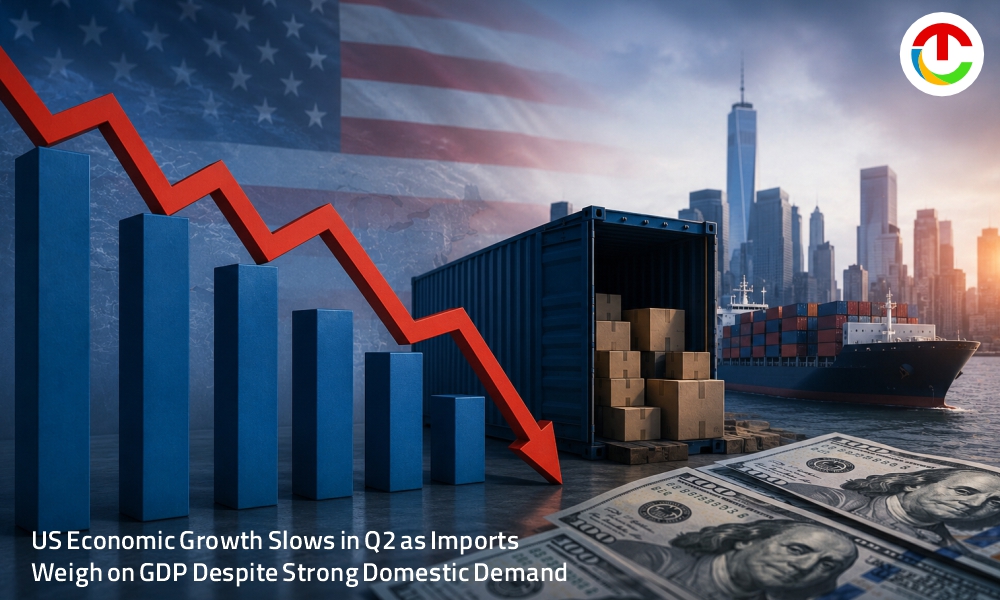
Washington: The US Economic Growth expanded at a slower pace during the second quarter of the year, as a widening trade deficit driven by higher imports weighed on overall growth. However, resilient consumer spending and continued business investment, particularly in artificial intelligence (AI) infrastructure, highlighted the underlying strength of domestic demand.
According to the Commerce Department’s advance estimate of second-quarter gross domestic product (GDP), the US Economic Growth at an annualized rate of 1.5%, below economists’ earlier expectations of 2.1%. The slowdown reflected a combination of rising imports, inventory drawdowns, and lower federal government spending linked to reductions in the Strategic Petroleum Reserve.
Trade Deficit and Inventory Reduction Impact Growth
The increase in imports widened the U.S. trade deficit, reducing GDP growth during the quarter. At the same time, businesses continued drawing down inventories to satisfy strong consumer demand rather than expanding stockpiles, which also limited overall economic output.
Federal government spending declined as authorities continued reducing the Strategic Petroleum Reserve, adding another drag on growth. Despite these headwinds, the report indicated that the economy remained resilient in the face of the initial oil price shock triggered by the conflict in the Middle East.
However, economists cautioned that renewed tensions involving the United States and Iran could pose fresh risks to economic growth during the second half of the year by putting additional pressure on energy prices.
Consumer Spending Remains Resilient
Consumer spending remained a key driver of economic activity during the quarter, supported in part by generous tax refunds distributed under President Donald Trump’s “One Big Beautiful Bill.” These refunds boosted household spending, helping offset broader economic pressures.
That support is now fading, leaving consumers with fewer financial buffers as average gasoline prices have climbed back above $4 per gallon. Economists noted that income growth has moderated alongside a stable labor market, while the personal saving rate has fallen to 2.7%, its lowest level in four years.
The combination of slower income growth, rising fuel costs, and lower savings suggests households are increasingly relying on accumulated savings to maintain spending levels.
AI Investment Continues to Support US Economic Growth
Business investment remained a bright spot, with continued spending on AI-related infrastructure helping sustain domestic demand despite broader economic moderation. Investments in technology and digital infrastructure have become an important source of economic resilience as companies continue expanding AI capabilities.
Oliver Allen, Senior U.S. Economist at Pantheon Macroeconomics, said the underlying economy remained relatively solid but warned that current momentum may be difficult to sustain. He noted that the temporary boost from tax refunds is fading, income growth remains subdued, higher fuel prices are pressuring household budgets, and the saving rate remains well below its long-term average.
While the latest GDP growth fell short of earlier forecasts, economists pointed out that many analysts revised their projections lower after June’s advance economic indicators report, with some reducing estimates to 1.5%, matching the Commerce Department’s preliminary figure.
Also Read :- CIO Times Magazine for More information