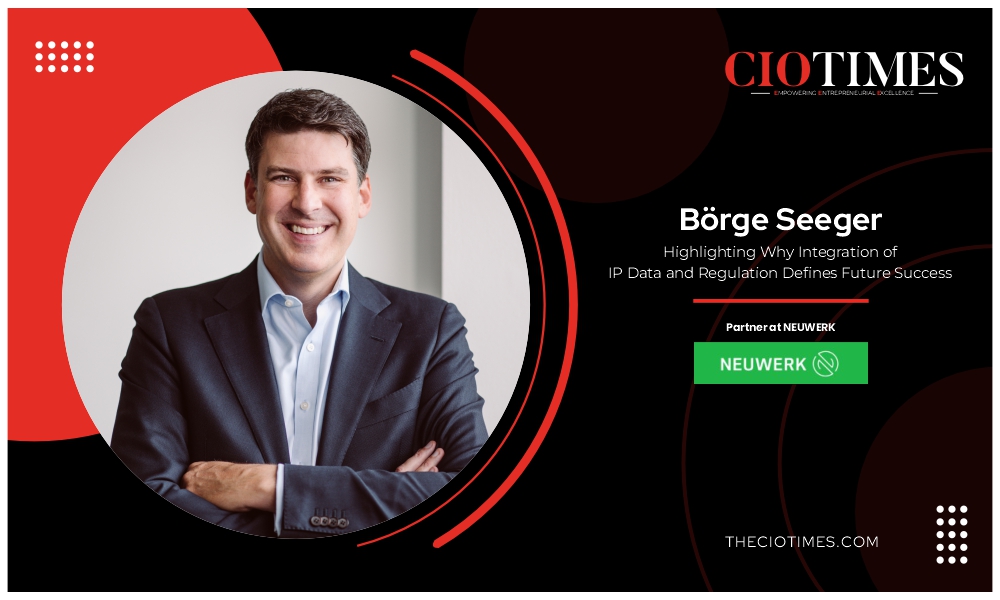
Börge Seeger’s focus has been long enough on a defining challenge: converting complex innovation into transactions that function in the real world.
Börge Seeger, a partner at NEUWERK, counsels biotechnology and pharmaceutical organizations on licensing, strategic collaborations, and high-value transactions. His work reflects the convergence of Intellectual Property (IP), data, and regulatory strategy, where complexity is decision-oriented.
In our conversation, Börge Seeger reflects on why IP, on its own, rarely creates value and what it takes to structure deals that perform in practice.
Q1: In life sciences, IP is often described as the “core asset”. You have argued that this view no longer holds up in practice. What is missing from that picture?
I think it is still true in a way. IP is obviously important. But I often feel the discussion stops too early there. What I find interesting is that many companies still treat IP as if it were the end of the story. In reality, it is usually the starting point.
A patent by itself does not really get you very far. It doesn’t develop a drug. It does not run a clinical trial. It does not manufacture anything. It doesn’t get you through regulatory approval.
What actually matters is how IP is connected to everything else. Data, know-how, regulatory strategy, manufacturing, and commercialization. In most of the transactions I see, value is created in that interaction. Not in the IP as such.
So I would not say the statement is wrong. It is just incomplete.
Q2: You spend a lot of time on licensing and strategic collaborations. What makes dealmaking in life sciences fundamentally different from other industries?
The time horizon is probably the biggest difference.
In most industries, you can test, adapt, and move on. In life sciences, you often commit to a development path that takes ten years and may still fail.
That creates a very different dynamic. You need to make decisions early, without having all the information, and then live with them for quite a long time.
There is also a level of scientific and regulatory uncertainty that is hard to compare to other industries. You are not just dealing with market risk. You are dealing with the question of whether the product will work at all.
That tends to make contracts more cautious. And often more complicated than anyone would like.
Q3: When you look at complex licensing and collaboration agreements, where does the real complexity sit?
It is usually not where people expect it.
The economic terms tend to get a lot of attention, but they are often relatively straightforward once the commercial logic is clear.
The more difficult questions come later. Who decides what if the development takes a different direction than expected? What happens if one party wants to step back? How do you deal with results that do not fit neatly into the original plan?
Most issues I see later on are not caused by bad drafting. They are caused by things that were never fully thought through. A good agreement is not just precise. It anticipates where things might become difficult and provides a workable path forward.
Q4: What are the most underestimated risks in cross-border collaborations and licensing transactions?
I would say dependencies, but not always in the obvious sense.
A company may technically own the IP, but still rely entirely on its partner for know-how, data, or manufacturing. That can become very real, very quickly.
Data is another area where I often see gaps. Everyone agrees it is important. But when you look at the actual contract language, it can be surprisingly thin.
And then there is the human side. Different expectations, different ways of working. That is harder to regulate – but it matters more than people think.
Q5: How are licensing and partnering models evolving, particularly with the growing role of data and AI?
They are becoming less clean, which is not necessarily a bad thing.
Older licensing models were often quite linear and „one-directional“. One party develops something, the other commercializes it.
Now it is more mixed. You have ongoing collaborations, shared development, overlapping contributions. Both sides contribute something. Both sides remain involved.
Data plays a central role in that, and AI adds another layer. Not so much because it is fundamentally different, but because it amplifies existing questions. Who owns the output? Who can reuse it? Across which projects?
I do not think there is a single new model emerging yet. It is more that traditional, existing models are being expanding and being stretched.
Q6: Many organizations still treat IP, data, and regulatory strategy separately. Why does that no longer work?
I am not sure it ever really worked. It just becomes more visible now that it does not.
In theory, you can separate these things. In practice, decisions in one area almost always affect the others. You can have strong IP, but if you do not have the right data rights, you may run into regulatory issues later. Or you structure a deal that looks fine legally, but limits your commercial options down the line.
What I see quite often is that these topics are handled by different teams, at different times, sometimes with slightly different objectives. That is understandable, but it creates friction later on.
Q7: You have worked on large M&A transactions and carve-outs. What do these situations reveal about IP strategies?
They tend to reveal the gaps.
In a stable setup, you can work around a lot of things. People know how the system works, even if it is not perfectly documented.
In a carve-out, that stops working. You suddenly have to separate systems, data, contracts, IP, operations. All the connections that were invisible before become very visible.
That is when you see where the weaknesses are. Unclear ownership. Missing documentation. Dependencies no one had fully mapped.
It is not necessarily a problem, but it can make the process more complicated than expected.
Q8: Looking ahead, what will define successful IP and licensing strategies in the next few years?
I would probably still say flexibility, but that is a slightly unsatisfying answer. Maybe a better way to put it is that strategies need to remain workable over time.
The environment is moving too quickly for rigid structures. Companies need frameworks that allow them to collaborate, adapt, and adjust their strategy over time.
At the same time, data and digital elements will become even more important. Integrating those properly into IP and licensing strategies will be a key differentiator.
In the end, the question is quite simple: can you turn innovation into something that actually works in practice? Because that is where most strategies break down.
Also Read:- CIO Times Magazine For more information