What makes a company powerful enough to remain at the top of business year after year?
It is rarely just one thing. Scale, reach, and long-term performance all play a role in separating global leaders from the rest of the market. To track that scale in a consistent way, one ranking has become the standard reference in the United States. The Fortune 500 Companies list,which brings together the largest companies in the country and reflects where real economic weight is concentrated.
Today, the Fortune 500 list acts as a snapshot of corporate power, showing which industries dominate, which companies continue to grow, and how the structure of the economy keeps shifting.
In this article, we will know what the Fortune 500 list is, how it works, and why it is used as a key measure of business size and success.
What are the Fortune 500 Companies?
If you have ever wondered what Fortune 500 companies are, the answer is straightforward. The Fortune 500 companies are one of the 500 largest U.S. businesses ranked by annual revenue. The list is published each year by Fortune magazine and includes both public and private companies across industries such as technology, healthcare, retail, finance, manufacturing, and energy.
First introduced in 1955, the Fortune 500 ranking is based on revenue reported for a company’s most recent fiscal year. Making the list is widely regarded as a sign of business scale and financial strength. Companies featured in the ranking include many of the world’s best-known brands, and together they account for a significant share of U.S. economic activity.
The History of the Fortune 500
The Fortune 500 has been tracking America’s largest companies for more than 70 years. Fortune magazine, founded by publishing entrepreneur Henry Luce in 1929, launched the ranking in 1955 under the name Fortune Industrial 500. Created by assistant managing editor Edgar P. Smith, the list ranked companies based on annual revenue and quickly became a benchmark for measuring corporate size and influence.
In its early years, the ranking focused exclusively on businesses in manufacturing, mining, and energy. However, as the U.S. economy shifted beyond traditional industries, the list evolved as well.
One of the most significant changes came in 1994 when service-based companies were allowed to qualify. This opened the door for retailers, healthcare providers, telecommunications firms, and financial institutions to appear alongside industrial giants.
Looking at the Fortune 500 over the years reveals how dramatically the U.S. economy has changed. Companies once dominated by manufacturing and industrial production now share the spotlight with technology, healthcare, retail, and other service-based industries.
Note for designers: Please create an infographic of the highlighted part.
Key Criteria for Fortune 500 Inclusion
1. U.S. Incorporation and Operations
2. For-Profit Status
3. Financial Reporting
4. Revenue-Based Ranking
Not every successful company qualifies for the Fortune 500 ranking. Several requirements must be met before a business can be considered.
1. U.S. Incorporation and Operations
Companies must be incorporated in the United States and conduct substantial business operations within the country.
2. For-Profit Status
Only for-profit organizations are eligible. Nonprofit institutions and government entities are excluded.
3. Financial Reporting
Businesses must file complete financial statements with relevant U.S. government agencies. This ensures transparency and allows Fortune to verify reported revenue figures.
4. Revenue-Based Ranking
The ranking is determined solely by annual revenue. The companies with the highest revenues earn spots on the list, regardless of profitability or market capitalization.
Because of these requirements, many of the world’s largest corporations compete annually for positions among the leading Fortune 500 Companies.
How to Get on the List of Fortune 500 Companies?
Many entrepreneurs and business owners are curious about how companies make the Fortune 500 list. There is no application process. Earning a place requires exceptional business performance and sustained revenue growth.
To reach that level, businesses need a scalable model, strong financial performance, and the ability to grow across multiple markets. Successful organizations expand beyond their original customer base, invest in new opportunities, and adapt as consumer preferences and industry conditions evolve. Consistent execution and reliable financial reporting support long-term growth.
Because Fortune 500 rankings are based on revenue, companies seeking inclusion must focus on sustainable expansion rather than short-term gains. Innovation is often a key driver. As Jeff Bezos said, “If you double the number of experiments you do per year, you’re going to double your inventiveness.” Many Fortune 500 companies share a commitment to testing new ideas, improving operations, and finding new ways to serve customers.
Earning a spot on the Fortune 500 rarely happens overnight. Most companies spend years building market presence, refining strategy, and investing in growth. For many business leaders, making the list represents sustained performance, resilience, and the ability to compete at the highest level.
Highlights from the 2026 Fortune 500 List
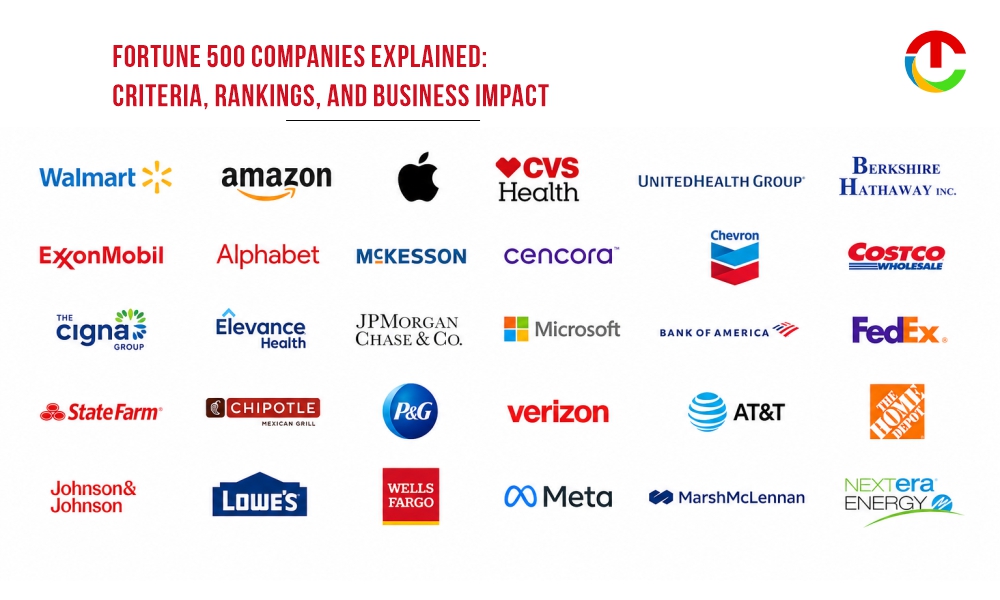
The 2026 Fortune 500 list shows how a small number of large corporations continue to dominate the economy across retail, healthcare, technology, and distribution. Amazon and Walmart lead the rankings, supported by extensive global retail operations, logistics networks, and growing digital businesses.
Healthcare remains a major force, with UnitedHealth Group holding a top position and reflecting the continued importance of insurance and managed care services. In technology, Apple remains one of the world’s most influential companies, driven by its strong ecosystem of devices, software, and services.
McKesson rounds out the top five, highlighting the critical role of pharmaceutical distribution and healthcare supply chains in the modern economy.
Overall, the rankings reinforce a clear trend: companies with large-scale, efficient operations and broad market reach continue to lead. The list also reflects ongoing changes in the business landscape, as digital innovation, healthcare growth, and evolving consumer habits shape corporate success.
How Can a Fortune 500 Ranking Benefit a Company?
Making in the Fortune 500 can have real business benefits. Companies often use the ranking to strengthen their public image, attract potential investors, and stand out when hiring new employees. It can also give customers and business partners added confidence in the company’s size and stability.
The ranking also serves as an important economic indicator. Analysts frequently study the list to identify emerging industries, track corporate performance, and evaluate broader economic trends.
Since companies are ranked by revenue, the Fortune 500 offers a clear and consistent way to compare the scale of some of the largest businesses in the United States.
Conclusion
The Fortune 500 companies list ranks the highest-revenue businesses in the United States each year. Published by Fortune magazine, it has become a widely used reference for tracking corporate performance and identifying the largest players across different industries.
Looking at the Fortune 500 list can reveal which sectors are growing, which businesses are expanding their market share, and how economic conditions affect major corporations. The rankings also show how leadership changes over time as new companies rise and established brands adapt to changing markets.
For anyone interested in business, finance, or the U.S. economy, the Fortune 500 companies list offers a practical way to understand where the biggest companies stand today.
Also Read :- The Business Strategies That Keep FAANG Companies Ahead of Global Competition