Schools and universities are competing for attention across inboxes, social feeds, search results, campus fairs, and parent conversations. Prospective students compare cost, outcomes, academic fit, campus culture, and career value before speaking with admissions.
That is where custom direct mail for higher education can support the enrollment journey. A strong campaign gives students, parents, alumni, and donors something physical to open and act on.
Direct Mail Strategies should not be treated as another brochure channel. The strongest campaigns combine tactile engagement, focused messaging, and one clear next step.
Build the Campaign Around a Specific Education Goal
Direct mail works best when the campaign has one defined purpose.
A recruitment piece should not do the same job as an alumni appeal. An accepted-student package should not carry the same message as a campus visit reminder.
Schools can use direct mail to increase applications, promote academic programs, drive campus visits, support yield, engage alumni, encourage donations, or move recipients to a portal. Each goal needs its own format, message, and call to action.
1. Recruitment Mailers Should Make the School Easier to Consider
Recruitment campaigns should help students understand why the institution belongs on their shortlist.
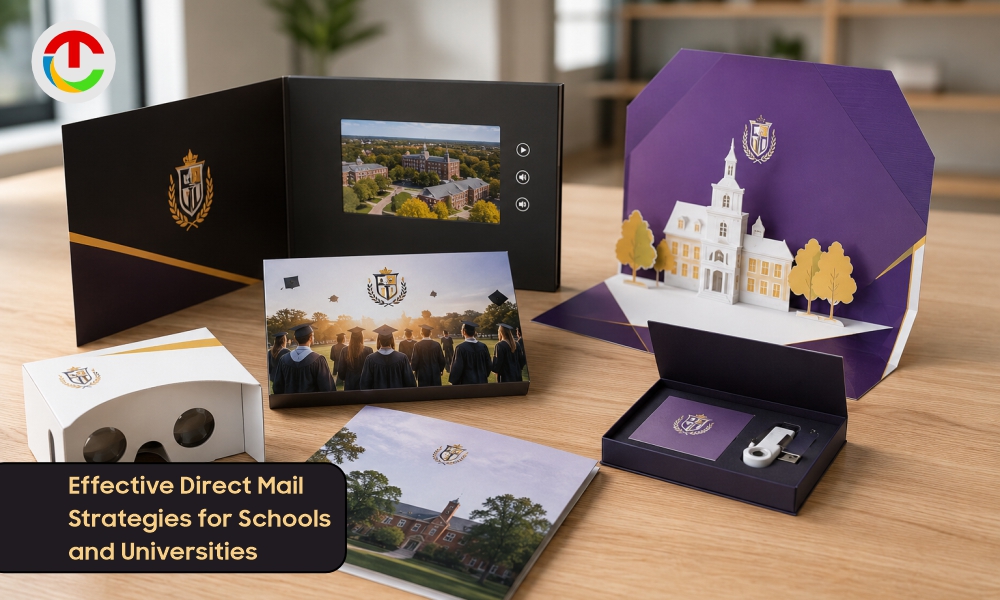
A good mailer can introduce program strengths, student support, scholarships, and career pathways without turning into a full prospectus. Interactive formats such as pop-up mailers, moving-message pieces, mascots, and dimensional designs can create a stronger first impression than another email.
2. Accepted-Student Mailers Should Reinforce the Decision
Accepted students often need confidence before they commit.
A yield-focused mailer should reinforce belonging, program value, student support, and the next steps after acceptance. Deposit deadlines, housing details, orientation links, and financial aid reminders should be easy to understand.
The National Student Clearinghouse Research Center reported that spring 2025 postsecondary enrollment reached 18.4 million students, up 3.2% from spring 2024. Undergraduate enrollment also grew but remained below pre-pandemic levels.
Match the Format to the Moment
Format should follow the campaign objective.
A postcard can work for a deadline reminder, event prompt, or simple announcement. A folded mailer gives more room for program information, transfer guidance, or financial aid steps. Dimensional and interactive formats are better suited to moments where recall matters.
1. Video Mailers Can Bring the Campus Experience Closer
Video mailers work when the campaign benefits from motion, voice, and atmosphere.
A university can use video to show campus life, residence halls, lab spaces, athletics, faculty introductions, student stories, donor impact, or a virtual tour. For out-of-state students or online graduate prospects, video can make the institution feel more tangible.
2. Pop-Up and Dimensional Mailers Can Create Recall
Pop-up cubes, mascots, dimensional houses, and moving-message formats can give a campaign more staying power.
These formats are useful for acceptance packages, fundraising invitations, alumni thank-you mailers, campus visit campaigns, and program launches. The recipient interacts with the message rather than just reading it.
3. Web Keys, QR Codes, and VR Viewers Can Extend the Experience
Education Direct Mail Strategies should connect to a digital action.
QR codes and personalized URLs can move students to an application page, an admitted-student portal, a visit calendar, a donation form, or a virtual tour. Web Keys can launch a pre-programmed URL from a USB port. VR viewers can support immersive campus or facility tours when the experience requires more depth than a flat page can provide.
The USPS Household Mail Survey studies mail use across a representative sample of about 5,200 U.S. households each year. That household context matters because education decisions often involve students, parents, and guardians.
Segment the Audience Before Writing the Copy
One message will not serve every educational audience.
A first-year undergraduate prospect may care about belonging, programs, scholarships, and affordability. A transfer student may care about accepted credits, advising, completion time, and cost. A graduate applicant may focus on flexibility, career advancement, and professional credibility.
Parents often look for value, support, safety, debt, and outcomes. Alumni and donors may respond to impact, tradition, gratitude, and proof that support is being used well.
1. Student Recruitment Needs Program-Level Relevance
Student-facing mailers should connect the school to the recipient’s likely decision.
A nursing prospect may need clinical placement and licensure details. A business prospect may respond to internship access and employer connections. A design prospect may care about portfolio development, studio access, and graduate work.
Program-specific direct mail gives the student a clearer reason to scan, visit, register, or apply.
2. Alumni and Donor Campaigns Need Impact Proof
Alumni and donor campaigns should not feel like standard fundraising letters with better packaging.
A stronger donor mailer shows impact through scholarship outcomes, student stories, capital campaign progress, program growth, or a clear explanation of how contributions are being used. Premium formats can work well here because donor engagement is both emotional and practical.
Use Evidence Without Turning the Mailer Into a Report
Students and families are looking for proof.
The U.S. Department of Education’s College Scorecard provides families with data on costs, graduation rates, student debt, acceptance rates, and earnings after graduation. That makes vague claims about excellence easier to challenge.
Direct mail copy should translate institutional strengths into concrete value. Instead of saying “innovative academic programs,” explain what students do, what support they receive, and what outcomes the program helps them pursue.
1. Replace Broad Claims With Specific Details
Broad claims such as “world-class education” or “student-centered learning” are easy to ignore.
Specific proof is stronger. Name the advising model, internship pathway, research opportunity, licensure preparation, alumni network, scholarship support, or career service that helps the student decide.
2. Keep the Call to Action Narrow
Every mailer needs one primary action.
Too many calls to action weaken response. A recruitment mailer can invite students to explore a program. A campus visit mailer should lead to available visit dates. An accepted-student piece can point to the deposit page or the admitted-student portal. A donor mailer can lead to a campaign page or a giving form.
3. The Digital Handoff Must Match the Mailer
Most recipients will respond from a phone.
QR codes should be easy to scan. Landing pages should load quickly. Forms should be short. A scholarship mailer should lead to scholarship information. A virtual tour mailer should lead to the tour. An admitted-student mailer should lead to the admitted-student portal.
Measure the Campaign Beyond Delivery
Direct Mail Strategies performance should be measured by movement, not distribution alone.
Useful metrics include QR scans, landing page visits, event registrations, campus visit bookings, application starts, completed applications, deposits, donations, and enrolled students.
Admissions and advancement teams can test format, headline, audience segment, offer, landing page, QR placement, and timing. A postcard may work for reminders. A pop-up mailer may work better for accepted-student engagement. A video mailer may suit virtual campus visits or donor impact stories.
Make the Mailer Useful Enough to Keep
Effective direct mail strategies for schools and universities start with usefulness.
The campaign should help someone compare programs, remember a deadline, register for a visit, understand value, feel welcomed after acceptance, or see the impact of giving.
Interactive formats can help schools earn attention. Clear messaging turns that attention into action.
Also Read :- 5 Reasons Small Businesses Trust Outreach Digital Marketing for Email Campaigns