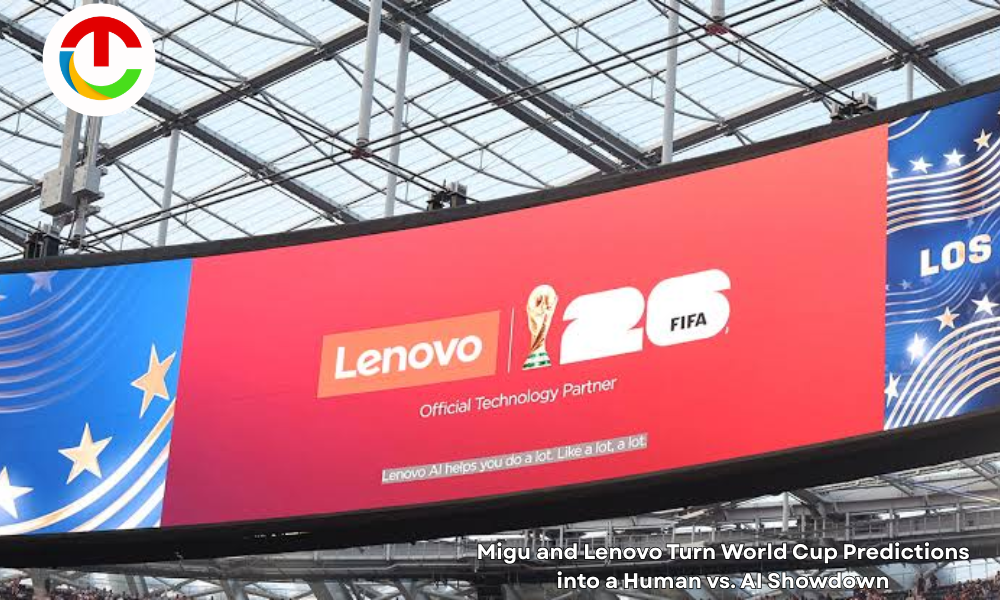
The 2026 FIFA World Cup is proving to be more than just a global football spectacle. Off the pitch, it has become an unexpected arena for artificial intelligence, as some of China’s most advanced AI models compete to predict match outcomes in a nationwide challenge launched by broadcaster Migu and FIFA’s official technology partner, Lenovo.
The “Human vs. AI FIFA World Cup Challenge” has drawn tens of millions of participants, transforming football predictions into a large-scale experiment that showcases the growing capabilities of AI while engaging fans throughout the tournament.
AI Models Compete Under One Platform
As the official broadcaster of the tournament in China, Migu partnered with Lenovo to create a common platform where 12 leading Chinese large language models compete under the same rules. Participants include DeepSeek, Kimi, ERNIE Bot, Qwen and China Mobile’s Jiutian, among others.
Before the tournament kicked off, the AI models were tasked with predicting the 32 teams that would qualify from the group stage. Once the knockout rounds began, the challenge shifted to forecasting individual match winners and even exact scorelines.
To increase fan engagement, Migu expanded the competition into a live television format. Its programme, Human vs. AI: Who Predicts It Better?, features celebrity guests making predictions alongside AI models, while post-match leaderboards rank each model based on prediction accuracy. The format has turned AI forecasting into an ongoing event that audiences actively follow and discuss.
Jiutian Takes the Lead
As the FIFA World Cup tournament progresses, China Mobile’s Jiutian model has emerged as the strongest performer. By July 7, it had achieved a 69% success rate in predicting individual match results, placing it ahead of its competitors.
Jiutian has particularly stood out in forecasting difficult outcomes, including draws and surprise results. It correctly predicted a draw in the Netherlands-Japan fixture when most rival models backed the Dutch side. It also accurately forecast Argentina’s 2-0 victory over Austria and was the only participating model to predict a 1-1 draw between Belgium and Senegal.
A Real- FIFA World Cup Test for AI For FIFA World Cup
While Jiutian currently leads the standings, other AI models are leveraging sophisticated analytical techniques. Alibaba’s Qwen, Zhipu and MiniMax rely on multi-agent systems, while Kimi deploys hundreds of AI agents to assess tactical setups, player fitness, injuries, weather conditions and betting market trends before generating predictions.
For the companies behind these AI systems, the challenge serves as far more than a promotional campaign. It FIFA World Cup offers a high-profile opportunity to evaluate model performance in real time under public scrutiny. By combining sport, entertainment and technology, the Migu-Lenovo initiative demonstrates how AI can create new forms of fan engagement while highlighting the rapid advancement of China’s large language model ecosystem.
Also Read :- China Flags Alleged Security Risks in Anthropic’s Claude Code AI Tool