Technology has become a defining force behind business growth. Yet, success depends on more than adopting the latest tools. It requires the right strategy and execution. Namandla Consultants reflects this shift in modern IT consulting. The company helps organizations navigate complex digital priorities with a practical, business-first approach. Its focus extends beyond implementation to creating sustainable value through technology.
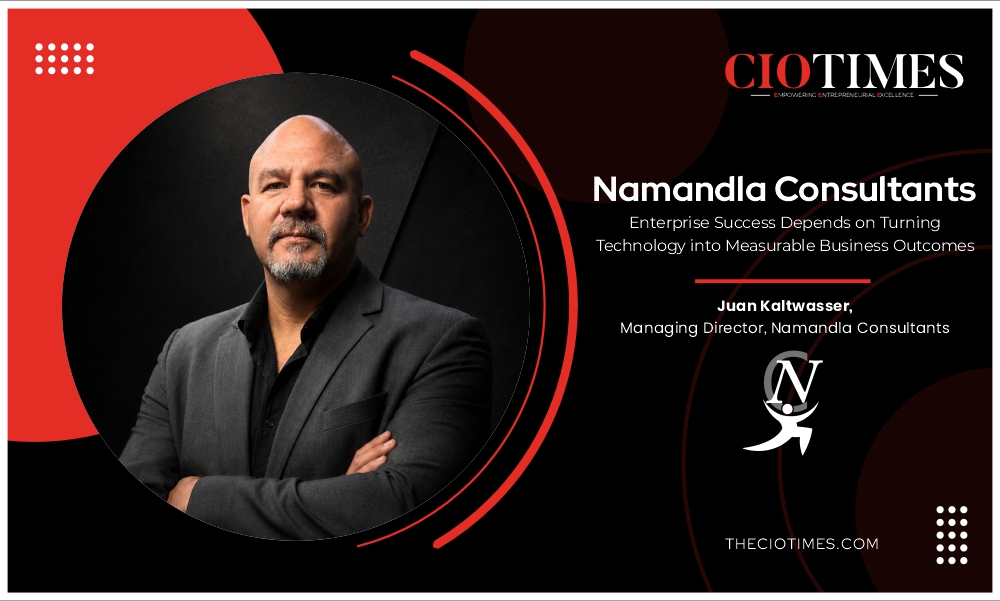
At the centre of this philosophy is Juan Kaltwasser, Managing Director, Namandla Consultants, whose experience across enterprise performance management has shaped the company’s practical, business-first approach to technology transformation. Rather than chasing every emerging trend, the firm has built its reputation by helping organisations extract greater value from the systems they already own.
Years of working with complex Oracle Hyperion environments taught him that successful transformation rarely begins with replacing technology. More often, it starts with understanding the business problem, challenging assumptions, and improving what already exists before recommending change. That philosophy continues to shape the way Namandla Consultants approaches every client engagement.
As enterprises rethink their transformation journeys, consulting firms are expected to bridge the gap between innovation and business outcomes. Those who combine technical expertise with strategic insight continue to play an increasingly important role in shaping resilient and future-ready organizations.
Strategic Value
Juan believes one of the biggest misconceptions in enterprise transformation is the assumption that newer technology is always better. This mindset continues to drive unnecessary enterprise spending. The industry often regards legacy systems as liabilities and modern platforms as automatic upgrades. According to the team, the reality is more nuanced. Across complex Oracle Hyperion environments, they have found that the real gaps lie in optimization, governance, ownership, and specialist expertise.
The team also challenges the belief that migration equals transformation. Migration simply relocates technology. Transformation creates measurable business value. Before approving a transformation programme, the Namandla Consultants team encourages leaders to ask one critical question: What can the new platform deliver that the current environment cannot? If the answer is unclear, the investment may be driven more by industry narrative than strategic capability. In their view, competitive advantage comes from extracting greater value from existing investments.
Beyond the AI Hype
The organization believes many organizations approach AI from the wrong starting point. Instead of focusing on business challenges, they begin with the technology itself. This often results in strategy being driven by urgency rather than measurable outcomes.
To evaluate AI investments, the team recommends asking three questions:
- Can the value be measured?
- Can adoption scale?
- Can outcomes be governed?
If the answer to any is unclear, the investment deserves further scrutiny. The team notes that the greatest AI opportunities are often the most practical. Automating routine financial tasks, improving anomaly detection, or enabling legacy Hyperion systems to deliver insights through natural language can generate significant business value.
Rather than replacing people, the team believes AI should free skilled professionals to focus on higher-value work. For business leaders, the real opportunity lies in identifying where valuable human expertise is still being spent on tasks that technology can already perform.
Hidden Barriers
The same leadership challenges continue to undermine digital transformation across industries. The first is key-person dependency. Many business-critical systems rely on undocumented institutional knowledge, making organizations vulnerable when key individuals leave.
The second is the disconnect between technology delivery and business value. Projects are often measured by implementation milestones rather than the outcomes they create. The team also argues that change management is frequently reduced to communication, when real transformation depends on behavioral change, adoption, and accountability.
It identifies leadership impatience as an overlooked challenge. Many organizations abandon transformation initiatives before meaningful value can emerge. In the team’s view, digital transformation is rarely a technology problem. More often, it is a leadership one.
Strategic Alignment
Most executive teams are not constrained by technology, but by misaligned priorities. Innovation, cost, governance, and resilience are often looked upon as competing objectives. But these elements contribute to long-term business value in reality.
Technology decisions frequently reflect individual priorities rather than collective business goals. The key is to first define what success should look like three years from now. Once that vision is aligned, decisions become driven by value instead of competing viewpoints.
In practice, Juan also helps organizations strengthen existing EPM environments through targeted AI and analytics while avoiding unnecessary platform replacements. The team believes organizations that consistently make sound technology decisions are those that question assumptions, challenge vendor narratives, and rely on evidence rather than enthusiasm.
Capability Building
The team believes the difference between lasting transformation and isolated projects lies in a culture of continuous learning. Successful organizations treat learning as an ongoing capability. Also, project-led organizations often lose momentum after implementation, causing business value to diminish over time.
In contrast, organizations that sustain transformation treat technology as a long-term asset, supported by continuous optimization, clear ownership, and internal expertise. This philosophy is reflected in Namandla Academy, as a voluntary component from the beginning itself. The team is principled about the philosophy that the people behind the technology unlock the organization’s full potential.
The Data-oriented Advantage
Organizations that create competitive value from data combine strong governance with the confidence to act on insights. Reliable decisions begin with reliable data, supported by clear ownership, consistent definitions, and disciplined data management. However, governance doesn’t do the deed fully. Competitive advantage comes from leaders who are willing to challenge assumptions and make decisions based on evidence, even when the findings are uncomfortable.
By contrast, organisations that merely accumulate data often struggle with fragmented information, inconsistent standards, and reporting that ends with distribution rather than action. The team believes the real challenge is rarely technological. More often, it is the discipline to turn trusted data into decisive business action that separates industry leaders from the rest.
Human Accountability
The team views AI as a tool for enhancing financial planning. It has never been viewed as a replacement for humans. Routine processes such as data preparation, reconciliations, and reporting can be automated, enabling finance professionals to focus on strategic analysis and business priorities.
AI is most valuable when it strengthens human judgment by uncovering trends, highlighting anomalies, and providing deeper context for decision-making. While technology can accelerate analysis, interpreting results and setting direction remain distinctly human responsibilities.
According to Juan, governance begins with well-defined goals where accountability must always rest. Business forecasts and investment decisions carry long-term consequences that require executive ownership. In the team’s lens, organisations should design AI around human accountability, ensuring technology supports decisions without replacing responsibility.
Future Cyber Strategy
Cybersecurity is evolving from an IT function into a core business resilience priority. As cyber threats become more sophisticated, responsibility is increasingly shifting from technology teams to executive leadership and boards.
The team says evolving regulations such as POPIA, together with the growing frequency of ransomware attacks and expanding digital infrastructure, have fundamentally changed how organizations should approach cyber risk. The business impact now extends far beyond technology, affecting operations, reputation, compliance, and stakeholder confidence.
Through its managed IT services, the Namandla Consultants Team continues to see many organizations adopt a reactive approach, strengthening security only after a major incident. Anticipating the future, the team expects cyber risk to be managed with the same discipline as financial and operational risk. Organizations that embed cybersecurity into enterprise strategy will be better positioned to build long-term resilience.
Advisory Evolution
The Namandla Consultants Team sees the future of consulting as a blend of human expertise and AI-enabled capability. Rather than replacing consultants, AI is redefining how knowledge is applied. It allows lean teams to deliver greater strategic value with speed and precision.
Clients no longer seek access to information alone. They value informed judgment, specialised expertise, and the ability to solve complex business challenges with confidence. As technology becomes increasingly accessible, these qualities will become even more important. It believes the next generation of consulting firms will be distinguished by the depth of their expertise rather than the size of their workforce. In an AI-driven world, sustainable competitive advantage will come from better decisions.
Learning Advantage
Organizations will gain their greatest competitive advantage by learning and adapting faster than their peers. The real capability gap lies in foundational skills such as data literacy, systems thinking, and the ability to connect business strategy with technology.
Many organizations, Juan believes, already possess powerful enterprise systems but lack the expertise to maximize their value. Closing that gap requires continuous capability development. This philosophy underpins Namandla Academy.
It equips finance and technology professionals with practical, CPDQS-accredited training while supporting broader skills development initiatives. The team believes the organizations preparing for the future are building internal capability today.
Establishing Business Value
The true meaning of a technology investment is better business decisions. Delivering a project on time and within budget demonstrates execution, but it does not guarantee lasting value. Meaningful outcomes are reflected in day-to-day operations. Faster financial close cycles, greater confidence in data quality, stronger forecasting, and informed boardroom discussions all indicate that technology is creating measurable business impact.
The team also views internal ownership as a critical success factor. If organizations remain dependent on external support to maintain or enhance their systems, long-term value has yet to be realized.
Lasting transformation begins when organizations develop the capability to continuously improve existing platforms. The greatest return on technology investment is achieved when the focus shifts from simply operating systems to unlocking greater value from them.
Leadership Priorities
Juan’s Namandla Consultants identifies three qualities that will define effective leadership in the years ahead: intellectual honesty, adaptive conviction, and the discipline to make decisions that rarely attract attention.
In his view, intellectual honesty allows leaders to confront reality without defending outdated strategies or preferred narratives. Adaptive conviction is equally important. It enables executives to stay committed to a clear direction while remaining willing to adjust when evidence points elsewhere.
The team also mentions that decisions creating the greatest long-term value are often the least glamorous. Maintaining critical systems, strengthening internal capability, or declining unnecessary technology investments may never command headlines, yet these choices consistently strengthen enterprise resilience. Ultimately, the team believes organizations are best led by executives who protect enduring value rather than pursue every emerging trend.
Future Shifts
Juan identifies four shifts that will redefine performance management, data strategy, and digital transformation over the coming years. The first is the transition from AI adoption at scale. As organizations move beyond pilot programmes, investments will increasingly be measured by tangible business outcomes rather than technological novelty. Early adopters with proven use cases will hold a lasting competitive advantage.
The second shift is the growing emphasis on data governance. With regulatory expectations rising and executive accountability becoming more defined, organisations will need to treat data quality as a strategic business asset rather than a compliance obligation.
It also expects organisations to maximise existing EPM investments instead of defaulting to large-scale platform replacements. Strengthening proven systems with AI and analytics, they argue, will often deliver greater long-term value than wholesale migration.
Finally, workforce capability is becoming a boardroom priority. As digital transformation accelerates, organisations that continuously develop internal expertise will outperform those relying solely on new technology. Competitive advantage will no longer come from access to technology alone, but from the ability to translate technology into capability, capability into better decisions, and decisions into sustained business outcomes.
Also Read :- CIO Times Magazine for More information