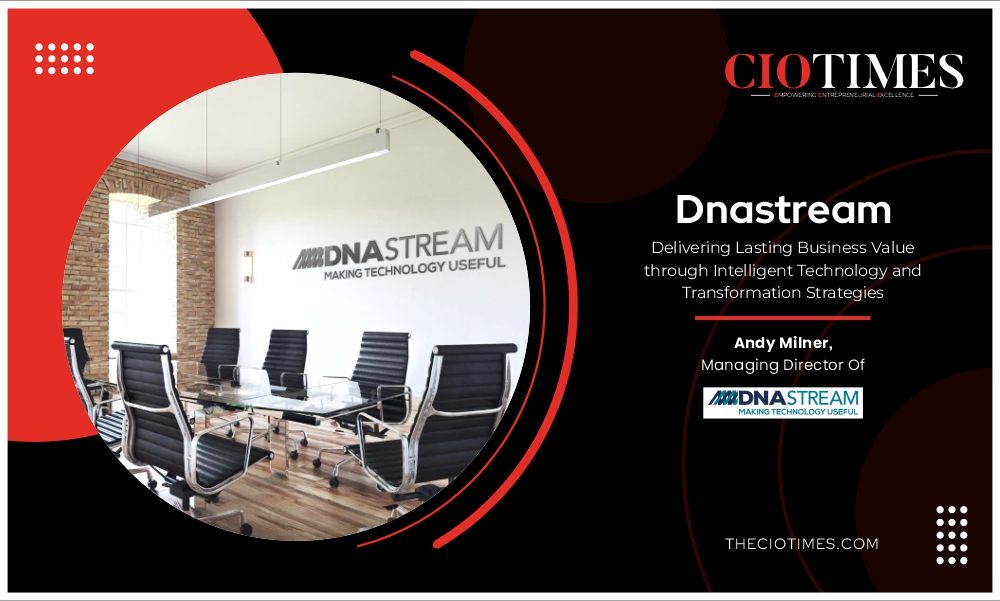
Andy Milner, Managing Director
1. DNASTREAM has consistently positioned itself as an independent and unbiased consultancy. In a market often influenced by vendor ecosystems and technology hype, how does maintaining that independence shape the quality of strategic guidance you provide to clients?
We’re an IFS specialist partner and we make no secret of that.
The independence that matters most to customers, and where they need it most, is in the wider ecosystem around IFS. Integrations, add-ons, third-party tooling – the choices that determine what the platform looks like in production. After nearly twenty years of building, integrating and supporting IFS deployments across defence, manufacturing and service industries, we’ve seen what works and what doesn’t in real environments. That distinction sounds small, but customers feel it quickly in the quality of the advice.
There’s a second strand to this that often goes unsaid. The majority of our consultants came into DNASTREAM from industry – manufacturing, defence, asset management, field service – not from a graduate scheme into vendor academy training. They learned the IFS platform as a way of solving problems they already understood from the inside. When we sit down with a customer’s operational team, the conversation tends to start in their language, not ours. That changes the texture of the advice. We’re not translating between the system and the business; we’ve usually been on the business side of that translation ourselves.
On the hype point: every few years a new technology arrives wrapped in the language of inevitability. The discipline of being a small, focused firm is that we can’t afford to be wrong – so we tend to apply harder tests than the headliners do, and we steer clients accordingly.
2. Since its founding in 2006, DNASTREAM has worked across multiple waves of enterprise transformation. How has the definition of “business value” evolved in the context of technology-led change over the years?
When we started in 2006, value almost always meant cost – ERP business cases built on headcount reduction, working-capital improvement and consolidation of disparate systems. Through the 2010s, value shifted toward process: doing things faster and more consistently across geographies, integrating the supply chain end-to-end and giving leaders one version of the truth. The conversation moved from “what does this save” to “what does this enable.”
In the last few years, it has shifted again – toward agility and applied intelligence. How quickly an organisation can respond when a market changes; how well its data feeds the decisions it actually needs to make; how much of the routine work can be done by software so people can focus on the parts that need judgement. The most useful conversations today are less about the system itself and more about what the business will be able to do that it can’t do today.
The biggest change though, is speed and certainty of value. The customers driving most of the change today (leadership and investor-backed teams) are working to strict cycles, often three to five years between funding rounds. They want results in months, not years, and assurance that the bedding-in period won’t introduce unplanned drag on performance ahead of the next funding round. The window in which transformation can lift the performance ceiling has narrowed, and outcomes need more certainty. In practice, that puts a premium on visible deliverables in the first few months – improvements stakeholders can see and believe in – and on the discipline of the post-go-live phase, where most programmes either consolidate the gains or quietly give them back. Defining business value today means designing for both: the early proof point that keeps believers on board, and the steady delivery that protects the next round of investment.
3. Many organisations invest heavily in digital transformation but still struggle to achieve meaningful adoption and measurable outcomes. From your perspective, where do transformation programs most commonly lose momentum?
The drop-off is almost always in the six months after go-live. The programme ends, the system integrator demobilises, the executive sponsor moves to the next priority, and the new ways of working are left in the hands of the operational team without the support structure they had during delivery.
We see three patterns repeatedly. The first is that change management gets cut when budgets tighten, and it’s almost always the wrong cut, because it’s the cheapest line item with the largest downstream consequence. The second is that leadership treats the go-live phase as the destination rather than the start. The hardest work – embedding the new processes, retiring the workarounds, holding people to the standard the new system requires – happens after the launch event, and it needs continued visibility from the top. The third is that no-one is measuring whether the original benefits case is being realised. Without that, the programme quietly becomes “the system” rather than “the change.”
A separate pattern, increasingly visible, is when investor dynamics override programme logic. We’ve seen well-conceived programmes scaled back not because they were failing, but because leadership feared any slip from plan would put a clean set of numbers at risk ahead of the next funding round. And we’ve seen the converse: investors losing patience with their portfolio company’s ability to absorb change, and pulling support before the value could land. The gap that matters isn’t in the programme; it’s between the cycle the business is on and the cycle the investors are on.
That’s why we now raise it explicitly in scoping. Where investor dynamics could shape what we’re being asked to deliver (and they almost always can) we push the leadership team to align with their investors on cycle and tolerance before the work starts, not after stress arrives. The customers who engage openly land better outcomes; the ones who avoid it tend to confirm the pattern later. Flagging it early is part of what an experienced partner is for.
Our advice is to budget and resource the first twelve months post-go-live as carefully as the delivery phase itself. That’s where the value either lands or doesn’t. For some customers, and especially those without large internal IT functions, the most pragmatic answer is a managed service arrangement that keeps the platform stable, supported and continuously improved after the implementation partner has demobilised. It’s not the right model for every organisation, but for those running lean, it removes the risk of the value quietly eroding once the delivery team has left.
4. DNASTREAM places strong emphasis on pragmatic execution. How do you help enterprises balance ambitious innovation goals with operational realities, legacy environments, and organisational readiness?
The honest answer is that we spend a lot of time talking customers out of doing too much at once. Ambition is the easy part of a transformation; the hard part is sequencing it so the business can absorb the change without losing operational stability.
A DNASTREAM few principles guide how we approach this. We separate “must” from “should” from “could” in the first conversation, and we’re firm about the difference. We design programmes so the core platform lands stably before innovation layers (AI, advanced analytics, automation) are added on top. And we bring operational and legacy stakeholders into the room early, because they know exactly what will break under load. The customers who succeed pick two or three innovation bets per programme and execute them properly, rather than the seven or eight talked about at kick-off. The discipline of doing fewer things, better, is usually what separates a successful transformation from one that gets quietly de-scoped halfway through.
5. As AI, automation and data intelligence become central to enterprise strategy, how do you help clients distinguish between technologies that create genuine business impact and those that risk adding unnecessary complexity?
We apply what I’d call a problem-shape test. Before recommending an AI or automation investment, we ask whether the task actually has a shape that the technology can handle well: is it repeatable, are the inputs reasonably structured and is the cost of an occasional wrong answer acceptable to the business? If those three aren’t comfortably true, the technology is decoration rather than value.
We apply that lens to ourselves and to our clients. Internally, we’ve started training consultants on the AI tools we expect to use most, and we’re aligning closely with IFS’ own AI direction; particularly Nexus Black, where the platform’s thinking is taking shape. We apply AI where it pays back: estimation, configuration drafts, document review, the long tail of work where time saved compounds. We’re more cautious where the failure mode is high-impact or irreversible. With clients, we push back on AI investments that look impressive in a board pack but don’t connect to a measurable outcome, and we challenge the assumption that more data or more dashboards automatically mean better decisions. Often the better answer is fewer, clearer signals in the hands of people accountable for acting on them.
6. Technology transformation today is no longer purely an IT initiative. How have you seen the relationship between business leadership and technology leadership evolve in driving enterprise-wide change?
The most striking change is that technology leadership is now a peer to operational and financial leadership, rather than a function reporting up to them. Ten years ago, a CIO would often be presenting to the executive committee; today they’re sitting on it, shaping strategy as it forms. That shift has changed the questions we get asked. We’re rarely brought in now to answer “what should we buy?”, we’re brought in to answer “what should we be able to do?” and “how do we get there in a way the business can absorb?”
The healthiest organisations we work with treat business and technology leadership as a single, integrated conversation. The DNASTREAM CFO understands the operational consequences of a platform decision. The COO understands the technology choices that constrain or enable their plans. And the CIO is fluent enough in the commercial language of the business to advocate for investments in terms that their peers can engage with.
A third shift, particularly pronounced in defence and regulated industries, is that technology leadership is now expected to own the sovereignty question. It’s not just as a compliance matter, but a strategic one. Where does the data live, who can access it, and what does the supply chain behind the software actually look like? We’ve seen this move from a procurement checkbox to a board-level conversation, and the CIOs handling it well are those who’ve built an answer before they’re asked. For us, that shaped a decision several years ago to build sovereign, UK-hosted delivery capability, ensuring our consultants can deliver sensitive programmes and that they hold the clearances the work requires. It’s now one of the more frequent reasons customers approach us.
7. Across large-scale transformation programs, stakeholder alignment is often more difficult than the technology implementation itself. What approaches have proven most effective in building organisational trust and driving long-term adoption?
Aligning the people is the work – the technology is the easier half. A few things we’ve found make the difference. We invest disproportionately in the first few weeks of a programme – not in design, but in agreeing what success actually looks like, in language the operational team can repeat back. If the criteria aren’t shared at the start, no amount of design rigour will compensate later. And we make sure the operational users, not just the sponsors, are in the room for the decisions that affect them.
We’re honest about trade-offs. When scope is cut, we explain why, in business terms rather than technical ones. When something is going to be hard, we say so early. And we make sure early operational wins are visible, because people believe what they see working far more than what they’re promised. A genuine improvement to a daily task does more for adoption than any communications campaign.
8. In your experience, what separates organisations that successfully scale transformation initiatives from those that remain stuck in fragmented or siloed modernisation efforts?
The DNASTREAM difference is almost always governance and capability, not technology choice. Organisations that scale treat transformation as a continuous programme, not a sequence of disconnected projects. They have a clear platform vision that individual initiatives align to, even if delivered by different teams. They invest in internal capability – people who understand the platform deeply enough to make good local decisions – rather than relying entirely on external consultants. And they have a governance frame that lets things land: clear ownership, decision rights that are actually exercised, and the willingness to retire workarounds rather than letting them accumulate.
The most powerful thing a leadership team can do early is set the rule that new investments must extend the core platform rather than replace or work around it. That single discipline, applied consistently over a few years, separates the scalers from the rest.
9. Many enterprises today are under pressure to move faster while also remaining resilient and adaptable. How should organisations rethink transformation strategies to balance speed, scalability, and long-term sustainability?
The DNASTREAM temptation under pressure is to optimise for speed and accept the consequences later, but this is almost always a false economy. What we’ve seen work is a more federated model: a common platform, stable and well-governed, supporting distributed delivery across business units and geographies. That gives speed where it matters, while preserving the scalability and resilience that come from shared foundations. Cadence matters too – shorter, more frequent release cycles are easier to absorb, easier to learn from, and easier to recover when something doesn’t land. The cost of getting it wrong stays small, which is what makes speed sustainable rather than reckless.
10. DNASTREAM highlights the importance of people in delivering successful outcomes. How do you ensure that transformation programs remain human-centred rather than becoming overly process- or technology-driven?
DNASTREAM start from the view that process and technology are the scaffolding; the project is the people. That’s true of our own team and it’s true of the customers we work with.
With customers, that principle shows up in concrete ways. We send senior consultants to first conversations, not junior people with a presentation deck. We make sure the operational users on the customer side have a real voice in the design. And we measure success partly by how the customer’s own team feels about the platform a year after go-live, because if they don’t trust it, no metric we can publish will matter.
11. Looking at the current enterprise landscape, what are some of the biggest blind spots organisations still have when approaching digital transformation and IT-enabled change?
Three stand out at the moment. The first is underestimating operational change. Boards routinely approve the technology budget and forget to fund the work of retiring the old way of doing things. The system goes in; the workarounds quietly persist; and a few years later the organisation is paying for both.
The second is treating AI as the next wave of robotic process automation. AI behaves differently – it’s probabilistic, not deterministic, and it needs different governance, different testing and a different conversation about acceptable failure modes. Organisations that bolt it onto an RPA-style operating model end up either disappointed or, worse, exposed when something goes wrong in a way no one had anticipated.
The third – and where the more interesting AI conversation now sits – is what happens after the application is built. Rapid development cycles let teams go from idea to working capability in weeks, and when those capabilities solve real business problems the value is genuine. The blind spot is the question often skipped: will this integrate with the systems that already hold the data, and can it be supported, monitored and upgraded like the rest of the customer’s estate? A brilliant standalone tool that becomes a maintenance problem in eighteen months isn’t a win – it’s a deferred cost. Building AI capability is increasingly the easy part; making it part of an integrated, supportable framework is where the engineering judgement now sits, and where we spend much of our time with customers.
12. DNASTREAM As organisations continue to modernise core systems and operating models, how important is it to establish measurable value realisation frameworks from the outset of transformation programs?
It matters more than most other single decisions in the programme. If you don’t define what value looks like before you start, you’ll have no honest way of knowing whether the work was worth doing, and no way to defend the investment when budgets tighten.
The framework doesn’t need to be elaborate; it needs to be in the language of the business, agreed by the people accountable for the outcomes, and reviewed honestly. A few things we’d push for in any meaningful framework. A small, deliberate set of metrics (typically three to five) that genuinely track what matters. Clear baselines captured before the programme starts, because retrofitting them is almost impossible. Quarterly reviews that look at whether reality is matching the case, with the discipline to adjust the programme if it isn’t. And an honest acknowledgement when something hasn’t delivered – because the credibility of the framework depends on it being used to learn, not to defend.
The conversation becomes more interesting when value has to be measured across multiple businesses. A live example is an onboarding diagnostic we’re designing with an acquisitive customer – a structured way of capturing how each newly acquired business actually operates before transformation begins. What runs on the core system and what runs off it. Where process is duplicated, cycle times and payments are slow, complexity is hard to handle, and coordination across teams breaks down. Because the same signals run across every acquisition, improvements become directly comparable over time.
That kind of framework – concrete, in the language of the business and comparable across time – is what value realisation looks like when it’s working. The organisations we see succeed treat it as an active discipline through the life of the programme. The ones we see struggle treat it as something that happens at the end, if at all.
13. Looking ahead, what do you believe will define the next generation of enterprise transformation, and how should organisations prepare themselves to remain competitive in an increasingly AI-driven business environment?
Three forces will shape the next decade. The first is that the platforms themselves are becoming AI-shaped. IFS, our own primary platform, has been explicit about reshaping around AI, and the wider ERP market is moving in the same direction. The question for customers is no longer whether to adopt AI; it’s how to choose partners who can move with the platforms as they evolve, rather than waiting for the dust to settle.
The second is that sovereignty is moving from exception to default. UK customers – particularly in defence, regulated industries, and increasingly across the public sector – are asking harder questions about where their data lives, who can access it, and what the supply chain behind their software actually looks like. The companies that have prepared for that conversation will find it an advantage; the ones that haven’t will find it a constraint.
The third is that capability will be grown, not bought. The talent market for senior AI engineers is already tight and will get tighter. The organisations that succeed will be those that invest seriously in apprenticeships, graduate programmes, and upskilling experienced people – building the durable capability that no external consultancy can fully substitute for.
DNASTREAM own preparation reflects all three. We’ve built sovereign hosting because our customers needed it before the market caught up. We’ve started investing in AI capability and aligning closely with IFS’ direction, because the partners who move with the platform will shape the conversation rather than respond to it. And we’ve taken on a new generation of apprentices alongside our experienced consultants, because the next decade’s capability has to be raised, not recruited.
Also Read :- CIO Times Magazine For More Information