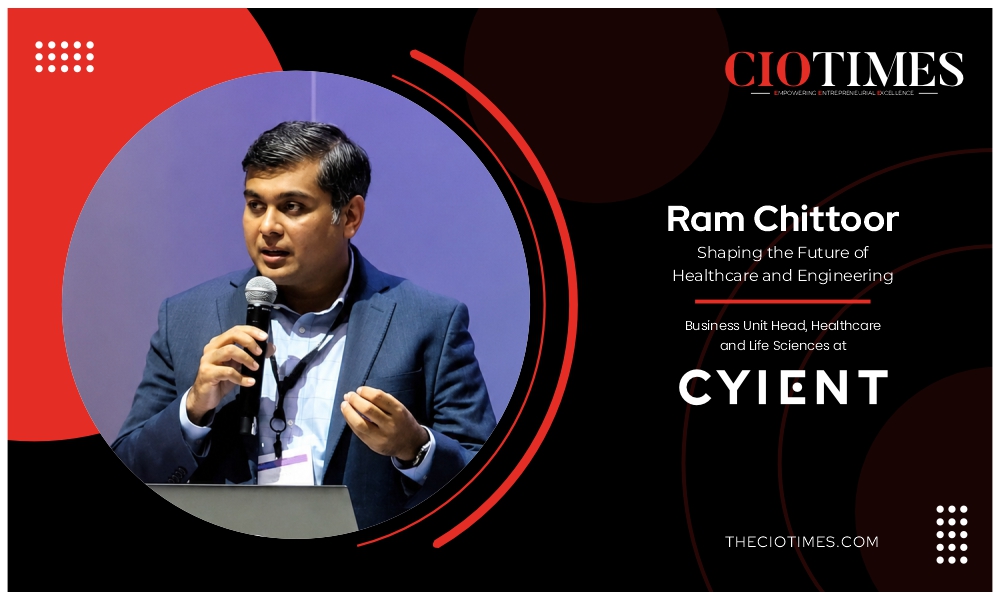
The healthcare and life sciences industry is consistently shifting for the better. It is driven by leaders who are combining innovation with a deeper understanding of patient and business needs. Among these forward-thinking professionals is Ram Chittoor, Business Unit Head, Healthcare and Life Sciences at Cyient. With a strong focus on digital transformation, operational excellence, and technology-led healthcare solutions, he continues to contribute toward building smarter and more connected healthcare ecosystems.
This edition celebrates professionals like him who are helping shape the future of healthcare through strategic leadership and innovation. As the industry embraces AI, data-driven healthcare, and advanced life sciences solutions, leaders with a clear vision and human-centered approach are creating meaningful impact across global healthcare systems and improving outcomes for communities worldwide.
Strategic Evolution
His cross-industry trajectory across engineering services, healthcare, aerospace, and digital transformation has fundamentally shaped the way he navigates complexity and approaches decision-making today. He began his career as a mechanical engineer in the aerospace and automotive sectors, where precision, reliability, and engineering discipline were non-negotiable, especially in environments where technology directly impacts human lives at scale. Those early experiences instilled in him a deep appreciation for rigorous problem-solving and long-term thinking.
As he moved into the MedTech and Life Sciences space, his perspective evolved further. While the technologies and challenges differed, the underlying responsibility remained the same: every decision ultimately affects a patient. This realization strengthened his belief that innovation must always be guided by purpose and accountability.
These experiences have also shaped Ram Chittoor’s systems-thinking mindset. He sees it as part of a much larger ecosystem that connects data, clinicians, and patients across the continuum of care. His exposure to multiple industries has allowed him to bring proven ideas from one domain to another, such as applying safety-critical engineering principles and predictive maintenance approaches from aerospace to the increasingly data-driven world of modern MedTech. Today, his decision-making is centered on finding the right balance between bold innovation and the disciplined execution required in highly regulated industries.
Empathetic Intelligence
In his current role, he describes functioning in an AI-centric world. Being in such an environment where intelligence is liberalized, understanding people and their needs becomes the key differentiator.
He adds, “Empathy comes at the intersection of a deep understanding of patients, caregivers, doctors, and technology limitations.”
In healthcare and life sciences, this shift is visibly changing the R&D-to-patient pipeline in three foundational ways:
1. From testing to prediction
Ram Chittoor observes that organizations are moving beyond reactive testing toward simulation-driven design. With digital twins, teams can anticipate mechanical failures and software issues before physical prototypes are built, significantly reducing the traditional trial-and-error phase of medical device development.
2. Smarter compliance management
He notes that AI is helping automate complex tasks such as Design History File (DHF) remediation and global compliance documentation. This enables engineers to spend far more time driving innovation and solving problems instead of managing paperwork.
3. Personalized clinical outcomes
According to him, AI is making personalized healthcare increasingly scalable. From surgical robotics that adapt to individual techniques to diagnostic systems capable of analyzing imaging data with remarkable precision, organizations are moving beyond designing for the average patient and creating solutions tailored to individual clinical needs.
Focusing on Prolonged Concoction
He has been the cornerstone for clients’ long-term outsourcing strategies. From his lens, it is a transactional race to the finish line to look for the lowest cost per hour one can get. A collaboration-focused model, which is a mindset voiced by Cyient, is a value-based relationship focused on longer-term business outcomes.
The majority of organizations struggle with the trust deficit. Traditional models focus on SLAs (Service Level Agreements), which often incentivize hitting numbers rather than solving problems. It is the classic operation successful, but the patient died scenario.
Partnerships focus on XLAs (Experience Level Agreements) and shared business outcomes.
Ram Chittoor states, “In a partnership, the service provider isn’t just a pair of hands; they are a co-innovator who understands the clinical intent of the device as well as the client does; they understand the end customer’s unstated needs and are an extended team in its truest sense.”
Organizations find it tedious to make this shift as it demands a change in procurement culture that moves from buying capacity to buying outcomes and shared risk. He witnesses the customers moving in this direction rapidly as they try to embrace change in an AI-first world.
Rethinking Lifecycle Management
When asked about the biggest gap between ambition and execution in the healthcare and life sciences sector, he highlights what he sees as a growing “Innovation Paradox.” While MedTech companies are setting bold goals around AI-powered and software-centric medical technologies, many continue to struggle with the realities of managing large, aging product portfolios and longstanding technical complexities.
Ram Chittoor notes that a significant portion of R&D spending, often exceeding 60%, is consumed by sustaining existing products and keeping pace with constantly evolving regulatory requirements across global markets. This leaves organizations with fewer resources to invest in the breakthrough innovations they envision. In his view, the challenge is not a lack of ambition but an execution model that remains fragmented across multiple functions.
He shares, “True execution excellence comes from automating the “run” (legacy maintenance) so you can fund the “build” (innovation).”
To overcome this, he believes organizations must take a fresh approach to Lifecycle Management (LCM). Rather than allowing valuable engineering capacity to be tied up in maintaining legacy systems, companies should focus on streamlining and automating these activities. Doing so creates the space needed to accelerate future-focused innovation. At Cyient, this approach is reflected in the company’s deep engagement across R&D, Quality, Regulatory, Supply Chain, Manufacturing, and related functions, helping customers optimize LCM efforts and redirect their focus toward innovation at scale.
1. Digithttps://www.linkedin.com/in/cvramachandran/al Value
Reflecting on what separates organizations that successfully convert digital strategy into measurable outcomes from those caught in continuous transformation with little impact, Ram points to a relentless focus on business value. In his view, the most successful organizations always ask, “What difference does this actually make?” If a digital thread is introduced across a manufacturing plant, does it accelerate time-to-market? Does it improve quality or drive greater efficiency?
He adds, “At Cyient, we focus on Intelligent Engineering that links technical KPIs directly to business outcomes like EBIT improvement or market share growth.”
He believes organizations that fail to see meaningful results often fall into the trap of “pilot-itis”, launching numerous proofs of concept that generate excitement but never scale because they lack a clear connection to business goals from the outset.
2. Cultural Change
Despite digital transformation remaining a boardroom priority for years, Ram believes several persistent misconceptions continue to derail meaningful progress and limit long-term impact:
A. Technology Alone Drives Transformation
In Ram Chittoor view’s, many organizations still assume that adopting the latest AI tool or digital platform will automatically solve their challenges. In reality, successful transformation is driven far more by people, processes, and organizational mindset than by technology itself. While this is widely acknowledged, breaking away from established ways of working, especially in highly regulated industries, remains a significant challenge.
B. More Data Means Better Decisions
Another common misconception, according to Ram Chittoor , is the belief that collecting more data automatically leads to better insights. Organizations often focus on gathering vast amounts of device, surgeon, and patient data, but without the expertise to interpret it effectively, the value remains limited. In healthcare and life sciences, he emphasizes that data without clinical context is simply information without meaning.
C. Transformation Has a Finish Line
Ram Chittoor also believes many organizations treat digital transformation as a one-time initiative with a clear start and end point. In practice, he sees it as an ongoing journey of adaptation and reinvention, particularly in the age of AI. Organizations that fail to build the agility needed to evolve continuously risk finding that their transformation efforts are outdated before they are fully realized.
3. The Orchestra Conductor Mindset
Ram Chittoor diverse roles have compelled him to be at the front lines of business development and engineering. He mentions that being at such a crossroad demands an orchestral mindset. It helps diverse teams operate in symphony. Business teams define the goal, while engineering teams determine the path, he believes.
He adds, “When we go to our customers, we don’t sell a capability; we sell a validated roadmap. This involves bringing technical architects and delivery leads into the room during the earliest commercial discussions.”
When one aligns the ‘proof of value’ with the ‘scope of work’ at the start, it reduces the friction that occurs half-yearly in a large-scale program. He shoulders the role of value proposition sold to the client, which is technically achievable and operationally sustainable.
4. Strategic Enablement
Reflecting on how engineering services are evolving as a driver of innovation, he believes their role today extends far beyond execution support. He sees them as strategic enablers that help MedTech organizations bring ideas to market faster and more efficiently. By combining global delivery capabilities, proven platforms, and outcome-focused execution, companies like Cyient help OEMs accelerate the journey from product development to patient impact.
He shares, “We are reducing time-to-market by commoditizing the complex-but-standard elements of engineering, allowing our clients to focus on their core clinical innovation.”
In his view, the ability to speed up innovation while improving product outcomes will be a defining competitive advantage in the years ahead.
5. Delivering Value
He has been exposed to diverse sectors like aerospace, healthcare, and industrial sectors. So, when asked about innovation frameworks being transferable, he mentions that these frameworks like Design Thinking or Agile are highly transferable. But they can also strip down when the domain is ignored.
He shares an example, “You can use an Agile methodology to develop a health tracking app, but you cannot use pure Agile to build a Class III implantable medical device where the hardware and regulatory requirements are fixed and sequential.”
The framework must be hybrid, combining the speed of digital software cycles with the discipline and safety of hardware engineering. Where frameworks break down is when one follows the ritual (stand-ups, sprints) without understanding the spirit (value delivery).
6. Leadership Principles
His leadership has encompassed diverse, globally distributed teams across multiple industries. His curated leadership principles have helped him build alignment, accountability, and performance at scale. He believes he is still in the learning phase of his leadership journey. He fancies grasping from newer challenges each day. Since Ram’s expertise has given him some insights, he shared with us 3 core principles that he has relied on to navigate globally distributed multi-functional teams. Those are as follows:
A. Purpose-Driven Transparency
He believes that people at every level, from a new engineer to a senior executive, should understand the purpose behind their work. If teams cannot connect what they do to patient outcomes, they risk losing sight of the larger impact. He also believes transparency around organizational decisions is critical and that information should be shared to create trust, not influence.
B. Ownership Through Empowerment
A key part of his leadership philosophy is giving teams the freedom to solve problems while taking responsibility for the results. He believes this creates a high-performance environment where people are motivated by the value they create rather than simply the tasks they complete.
c.Excellence Across Cultures
Drawing on his global experience, Ram emphasizes the importance of respecting cultural differences while maintaining a shared standard of excellence. While customer focus and quality remain universal priorities, he recognizes that inspiring and motivating teams often requires different approaches across regions and cultures.
7. The Human Agency
As AI and automation continue to transform the engineering sphere, he believes organizations must prepare for a fundamental shift in how talent is developed and deployed. He sees engineers increasingly moving beyond execution-focused roles and stepping into positions that emphasize oversight, decision-making, and system-level thinking. Rather than carrying out every task themselves, they will guide AI-powered tools while concentrating on architecture, security, and responsible innovation.
He adds, “Program / Project managers also are seeing a shift in their job definition from tracking tasks and teams to managing outcomes and value.”
The future PM will need a blend of strategic perspective and analytical thinking, using data-driven insights to steer decisions, align teams, and create measurable value.
8. Market Focus
Looking back at his early years in solution development, commercialization, and go-to-market strategy, he says those experiences fundamentally shaped the way he evaluates new opportunities today. They taught him to view every opportunity through the eyes of the end user. Whether he is considering a potential customer relationship, partnership, or new service offering at Cyient, his first question is rarely whether it can be done. Instead, he focuses on whether it solves a real customer problem, can scale across the healthcare and life sciences industry, and stand up to the expectations of global regulators.
He adds, “When I evaluate a potential customer relationship, partnership, or a new service line at Cyient, the first question is not whether we can do it. I ask if it solves a significant problem for my customer, is it scalable across HLS, can it survive audit scrutiny by a global regulator, etc.”
One lesson that has stayed with Ram over the years is the importance of staying grounded in market needs. He believes it is easy to overinvest or over-engineer solutions based on a single commercial success, but lasting value comes from building what customers truly need, not simply what organizations are capable of creating.
9. Future Horizons
When considering the structural shifts that could reshape engineering services and the healthcare ecosystem over the next few years, Ram sees two major developments on the horizon:
a. Healthcare Closer to the Patient
Ram Chittoor believes the future of care will increasingly extend beyond the walls of hospitals and into people’s everyday lives. This shift will require connected devices and solutions that are not only clinically reliable but also intuitive and accessible for patients. In his view, the convergence of AI, robotics, connectivity, and personalized medicine is paving the way for care that is available on demand, wherever and whenever it is needed.
b. A New Era of Autonomous Engineering
Ram Chittoor also expects engineering to become far more autonomous. He envisions a future where AI manages much of the build, testing, and validation process, creating self-improving engineering cycles. As this evolution unfolds, engineering services organizations will increasingly be measured by the business outcomes they deliver, combining AI-driven capabilities with deep domain expertise to manage entire operational workflows.
To stay ahead of these changes, Ram believes organizations should focus on three key priorities:
- Create Connected Digital Ecosystems: Enable seamless data flow from R&D and manufacturing through to real-world product performance.
- Embrace Agentic AI: Move beyond productivity gains and adopt intelligent agents that can take on regulatory and documentation-intensive tasks.
- Engineer for Resilience: Build modular, adaptable products that can respond effectively to supply chain disruptions and localized manufacturing requirements.
Also Read :- Cio Times Magazine for More Information