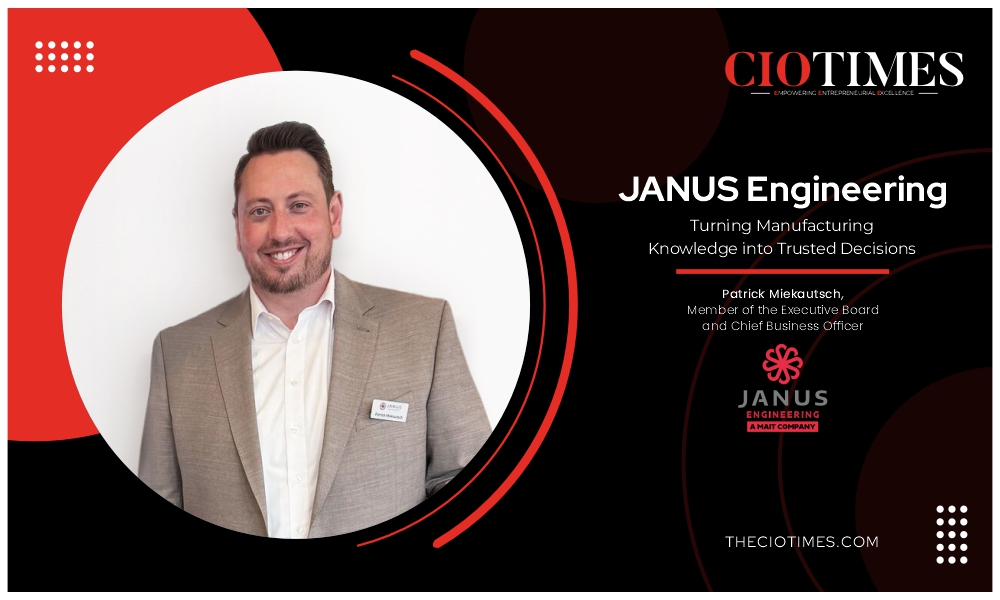
Sustained innovation demands partnerships that combine technical expertise with a shared commitment to customer success. Patrick Miekautsch, Member of the Executive Board and Chief Business Officer, JANUS Engineering AG, exemplifies this philosophy through a leadership approach centered on collaboration, precision, and long-term value creation. Under his strategic direction, the organisation continues to strengthen its position as a trusted technology advisor, helping manufacturers accelerate digital transformation through advanced engineering solutions. By aligning deep domain expertise with customer-centric execution, the organisation fosters enduring relationships. It delivers measurable business outcomes and empowers enterprises to navigate the evolving landscape of smart manufacturing with confidence.
Leadership Excellence
Patrick Miekautsch has cultivated a distinguished career defined by strategic foresight and an unwavering commitment to advancing industrial innovation. His professional journey reflects the skill to bridge engineering excellence with business transformation. It enables organisations to navigate increasingly complex manufacturing landscapes with confidence.
Throughout his career, he has championed collaborative growth, technology-driven progress, and customer-centric innovation as catalysts for long-term value creation. At JANUS Engineering AG, Patrick continues to shape strategic direction by aligning advanced engineering capabilities with evolving industry priorities, reinforcing the organisation’s position as a trusted enabler of digital manufacturing excellence.
Manufacturing Innovation
JANUS Engineering stands at the forefront of industrial digital transformation. It delivers advanced engineering solutions that redefine how manufacturers design, develop, and optimise products throughout the entire lifecycle. By integrating deep domain expertise with cutting-edge technologies across CAD, CAM, PLM, and digital manufacturing.
The company enables enterprises to enhance innovation, operational agility, and engineering precision. Its consultative approach extends beyond technology implementation, empowering organisations to build intelligent, future-ready manufacturing ecosystems that accelerate competitiveness. It fosters sustainable growth and creates enduring value in an increasingly dynamic industrial landscape.
Deliberate Manufacturing Excellence
Manufacturers that successfully reinvent themselves consistently do three things well. Patrick lists them below:
- They simplify before they automate. They also eliminate unnecessary exceptions while defining a preferred way of working.
- They establish clear end-to-end accountability. Engineering, production, quality, and IT all contribute, but one leader remains responsible for the overall outcome.
- They continue leading after going live.
The final point is often underestimated. Transformation creates uncertainty and temporarily increases workload. Leaders must safeguard priorities, communicate the purpose, and make decisions when local interests conflict. They must also recognise that not every legacy preference can remain unchanged. The strongest manufacturers establish a baseline before transformation begins.
Patrick Miekautsch adds, “My practical rule is that no process should be digitised before the organisation has asked whether it should continue to exist in its current form.”
These leaders measure lead time, rework, machine utilisation, quality, delivery performance, and engineering effort, then continue tracking those metrics after implementation. This ensures technology initiatives become business improvement programmes.
Patrick Miekautsch believes that no process should be digitised before the organisation has questioned whether it should continue in its current form. Reinvention begins when companies are willing to eliminate work that no longer creates value. Merely digitising places a new interface around an old problem.
Strategic Transformation
The industry continues to mistake digitalisation for transformation, says Patrick. While connected machines, modern platforms and dashboards contribute to generating value, they do not transform a business. Ideal transformation lies in redesigning how decisions are made, validated and scaled. He observes that many manufacturers still optimise individual departments.
Patrick Miekautsch adds, “What I have learned from customer projects is that intelligence does not begin with more data. It begins with context.”
Engineering, production, quality, and management each advance independently, yet fragmented processes continue to erode efficiency and institutional knowledge. Drawing on customer engagements, he asserts that intelligence begins with context, not only data. Machine signals deliver value only when linked to product definitions, NC programs, tooling, quality outcomes and commercial objectives, enabling faster and better-informed decisions.
At JANUS Engineering, the focus starts with business outcomes rather than software. The priority is identifying where value is lost, which decisions slow performance and which processes can be standardised. Technology is then applied to support those objectives. He notes that the same philosophy underpins iM by JANUS, where the objective is not automation alone but an intelligent manufacturing environment that unifies engineering expertise, software and production. The benchmark is clear: if technology changes but decision quality, process stability and customer outcomes remain unchanged, the organisation has digitised, not transformed.
Building Decision Intelligence
The upcoming competitive advantage will come from the interfaces between product development, manufacturing planning, production and business management, Patrick hints. A technically superior design can still be costly to manufacture. Similarly, a highly automated CAM strategy can fall short if tool data, machine capabilities, or quality feedback remain disconnected. Even a robust PLM platform delivers limited value unless information reaches production in a practical and usable form. Since joining JANUS Engineering in 2014, he has witnessed customer priorities evolve significantly. Conversations that once revolved around software functionality and licensing now focus on resilience, process stability, skills, speed, and measurable business outcomes. That shift has also shaped his own journey from commercial leadership to enterprise-wide responsibility.
Drawing on his role on the Executive Board and his leadership responsibilities, Patrick brings a broad perspective on customer expectations. These pertain to operational manufacturing requirements and the challenge of translating engineering expertise into scalable software.
This convergence is where the industry’s next competitive advantage will emerge.
Patrick Miekautsch states, “Companies must turn the judgment of their best engineers into validated decisions that can be reused across products, machines and sites.”
Organisations must transform the judgment of their best engineers into validated decisions that can be reused across products, machines and sites, ensuring that knowledge is no longer confined to individuals, spreadsheets or local practices.
He adds that JANUS combines deep manufacturing and NX expertise with software development and implementation capabilities. Through MAIT, these strengths are now connected more closely with PLM, ERP and IT to create a more integrated operating model rather than simply a larger technology landscape. The next generation of industry leaders will be defined not by the technology they own, but by how consistently they convert experience into trusted decisions.
Engineering Scalability
The engineering value chain has adopted AI. The sector will shape as a collaborative and orchestrated one. Engineers will increasingly define objectives, constraints and acceptance criteria, while AI systems generate alternatives, evaluate manufacturability, identify risks and propose optimised paths. Product development will become more concurrent. Design, simulation, costing, manufacturing planning and quality will be connected much earlier, so that decisions which are often made sequentially today can be evaluated together.
For a design engineer, this means receiving manufacturing feedback before a geometry is finalised. For a CAM programmer, it means faster access to proven strategies, tool data and process knowledge. For management, it means a better understanding of the consequences of a decision across cost, capacity, quality and delivery.
AI will also change how organisations use experience. Today, valuable knowledge is often scattered across previous projects, machine data, quality reports and the judgment of individual specialists. AI can connect these sources and make patterns visible at a speed no individual can match.
Patrick Miekautsch adds, “I see AI as the second seat in engineering: fast, data-rich and tireless, but never unaccountable.”
But there’s also a suggestion by Patrick. He mentions that AI can scale lesser quality data, presume hidden assumptions and weak governance. Inconsistent information will only accelerate uncertainty instead of a surge in intelligence.
Patrick Miekautsch adds, “Leaders must define where AI may act autonomously, where human validation is mandatory and who remains accountable for the result. They must govern data quality, model performance, cybersecurity, intellectual property and ethical boundaries.”
With solutions at hand like AIDO, the team is working on how AI can nearly support established engineering workflows. The important point is that AI must fit the process and the responsibility model. It should not become an isolated feature.
Highlighting the Value Stream
Leadership begins by making strategic trade-offs explicit. From Patrick’s outlook, organisations cannot simultaneously maximise speed, resilience, sustainability, and cost efficiency without compromise. He identifies the primary tension as the balance between short-term efficiency and long-term resilience.
The lowest-cost supply chain or highest machine utilisation may appear optimal until disruption occurs. He mentions that the true cost of resilience should be measured against the consequences of downtime, missed deliveries, and diminished customer trust.
He also shifts attention to the trade-off between speed and governance. While businesses pursue faster innovation, fragmented tools, inconsistent data, and disconnected processes create technical debt. Sustainable progress is built on standards, modular architectures, and repeatable processes, not on bypassing them.
Patrick Miekautsch adds, “Leaders should optimise for total value under risk, not for the lowest visible cost.”
Furthermore, he says that sustainability must be embedded in operational performance. Energy consumption, material use, scrap, tool life, and rework are environmental topics, but they are also cost drivers. He recommends giving priority to the value stream. Select a concrete product family or process, define the commercial and operational targets, establish a baseline, and prove the impact. Then scale what works.
Durable Transformation
Many evolution programmes are technically delivered but never operationally embedded. The most overlooked success factor is designing business value into transformation from the outset. It cannot be retrofitted after deployment. Successful transformation requires measurable baselines, clear outcomes, and single-point accountability. Master data and process ownership remain underestimated. Organisations often go for software capabilities while overlooking data integrity, governance, interfaces, and standards. These gaps prevent automation from scaling.
Patrick Miekautsch considers organisational adoption equally critical. Employees rarely resist technology itself. They resist solutions that ignore operational realities, add complexity, or are introduced without meaningful engagement.
Lasting adoption begins with involving users early and treating change management as a strategic priority. He also emphasises that implementation is only the beginning. Sustainable transformation requires strong governance, continuous performance monitoring and knowledge that remains within the organisation, not with individual consultants or specialists.
Patrick Miekautsch adds, “Employees do not reject technology simply because it is new. They reject solutions that do not reflect their work, add unnecessary effort or arrive without sufficient training.”
At JANUS, he says, the priority is building customer capability, enabling organisations to confidently operate, optimise and continuously evolve their digital environment. Transformation succeeds only when strategy, process, technology and leadership remain fully aligned around a shared business objective.
Nurturing Digital Continuity
He believes the future of digital continuity is defined by preserving context across the entire product and manufacturing lifecycle. Patrick mentions that every product definition should remain fully traceable. These include design and manufacturing planning to NC programming, production, inspection, and service. This demands disciplined governance, clear data ownership, robust change management, and interoperable architectures that preserve integrity across the value chain.
The next frontier, from his lens, is creating a closed learning ecosystem. Operational intelligence should continuously refine engineering decisions, enabling production insights to improve machining strategies, tooling and product design. Digital continuity becomes truly transformative when every outcome strengthens the next decision.
AI will significantly accelerate this evolution by interpreting relationships across engineering and operational data. It also identifies inconsistencies and supports faster, better-informed decisions. However, he remains firm when he says that AI delivers value only when built on trusted, well-governed data. Data without context is not a competitive advantage. At JANUS, the focus has always been on connecting virtual engineering with physical production through a governed architecture that delivers the right information to the right stakeholder, at the right time.
The business value is compelling: faster problem resolution, systematic reuse of engineering knowledge and greater confidence in every change. He believes digital continuity will become a defining pillar of industrial competitiveness because it enables organisations to learn, adapt and improve with every product, every process and every production cycle.
Future Expertise
Deep intelligence is preserved by continuously sharing, applying, and strengthening it through innovation. At JANUS, manufacturing specialists, consultants, and software developers work as a collaborative team. It ensures knowledge is transferred through mentoring, peer reviews, project retrospectives, and customer engagement. Emerging talent benefits from decades of engineering expertise, while experienced professionals continually evolve through advances in software, AI, and modern engineering practices.
He distinguishes between enduring engineering principles and evolving technologies. The fundamentals of machining, process stability, and quality remain constant. Technology should reinforce that expertise, not replace it.
A high-performance learning culture requires both accountability and psychological safety. Teams must be encouraged to challenge assumptions, learn openly and continuously elevate their capabilities.
He adds, “Our task is to create enough space for learning without lowering our standards. That balance preserves the technical depth, customer proximity and practical mindset that define JANUS.”
Shared Principles
While industries differ in regulation, materials and quality requirements, the strategic challenges facing manufacturers are strikingly similar. Product complexity is increasing. Delivery cycles are shrinking. Skilled labour remains scarce. Data is fragmented, while traceability expectations continue to rise.
He believes competitive advantage comes from transferring proven principles, not replicating solutions. Closed-loop quality, structured resource management, modular automation and standardised engineering processes create value across industries. Their application must reflect each organisation’s operating model, regulatory environment and risk profile.
He shares, “Our cross-industry experience helps us recognise patterns early and reduce risk. We can identify which elements have already been proven elsewhere and which parts must remain specific.”
JANUS’ cross-industry perspective enables the organisation to identify proven patterns early. This accelerates adoption, reduces execution risk, and helps distinguish where industry-specific approaches remain essential. His philosophy is simple. Standardise where it improves speed, quality, and scalability. Differentiate where it creates sustainable competitive advantage.
Partners Creating Value
Manufacturers seek strategic partners who understand manufacturing, challenge assumptions, and deliver measurable business outcomes. Since joining JANUS in 2014, he has seen customer priorities evolve from software functionality to competitiveness, resilience, operational excellence, and long-term value creation. His own progression to the Executive Board has reinforced a broader focus on business strategy, organisational readiness, and sustainable growth. Effective partnerships begin long before implementation.
JANUS works with customers to define business objectives, assess operational maturity, and establish practical transformation roadmaps. Throughout execution, every technical decision is aligned with operational and commercial outcomes.
He also believes a trusted advisor must be prepared to challenge investments that lack clear business value. Trust, he argues, is built through objectivity, transparency and the discipline to avoid unnecessary complexity. Patrick notes that JANUS combines deep manufacturing expertise with consulting, software development, implementation and support.
Through MAIT, these capabilities now extend across PLM, ERP and IT, enabling the company to support enterprise-wide transformation rather than isolated technology projects. Strategic partnerships are measured by outcomes. Contracts may initiate the relationship, but sustained operational performance ultimately defines its success.
The Judgment Imperative
Human expertise will remain indispensable wherever complexity, uncertainty, and business consequences extend beyond what data alone can define. He mentions that while AI can optimise a defined objective, only people can determine whether it is the right one. A system may recommend the fastest process, but experienced engineers understand when operational realities, material variation, machine capability, or workforce expertise demand a different decision.
Manufacturing continues to rely on deep tacit knowledge. Skilled professionals recognise patterns in tool wear, vibration, surface quality and process stability that are not always captured digitally. While this expertise should be embedded into future systems, it cannot simply be assumed or replicated.
Patrick Miekautsch also talks about human judgement becoming critical. It becomes so when quality, cost, delivery, safety, and sustainability compete for priority. Such decisions require technical expertise, commercial perspective, and accountability.
The role of engineering leaders will continue to evolve. Their focus will shift from repetitive execution to framing complex problems, validating outcomes, and managing exceptions. He believes human value will not diminish. It will become increasingly concentrated where judgment, trust, and accountability create lasting competitive advantage.
Defining a Legacy
JANUS’s legacy should be measured by the lasting capabilities it helps customers build. He believes the company’s purpose is to transform complex technology into measurable business value. By enabling better decisions, more resilient operations, responsible resource utilisation, and sustained competitiveness, the organisation can help shape the future of manufacturing.
Patrick Miekautsch notices a responsibility to preserve and scale engineering excellence. Europe’s industrial strength will depend on combining deep technical expertise with the intelligent use of software, data, and AI. It was done while simultaneously embedding knowledge across organisations rather than within individuals. As part of MAIT, JANUS can extend its manufacturing expertise across a broader European ecosystem without compromising the technical depth, integrity and customer focus that define the business is what he presumes.
Patrick Miekautsch hopes JANUS leaves organisations with stronger capabilities, fewer disconnected systems and manufacturing environments that continuously learn, adapt and improve. For him, that would be a legacy defined by intelligent innovation, operational resilience and enduring business value.
Conclusively, Patrick Miekautsch states, “Personally, I would be proud if JANUS left customers with fewer isolated solutions, less dependence on individual heroes and a manufacturing system that learns from every process and every decision.”
Also Read :- CIO Times Magazine For More information