Every startup founder hits this fork in the road early: register as an LLP to keep compliance light, or go Private Limited to keep the door open for investors? It looks like a simple cost decision at first , Limited Liability Partnership Registrations are cheaper to run, Private Limited Company Registration costs more to maintain. But for a startup, that framing misses the bigger picture.
The structure you choose determines whether you can issue ESOPs to your first ten hires, whether a venture capital fund will even consider writing you a term sheet, and whether you’re eligible for the Section 80-IAC tax holiday under the Startup India programme. Founders who register as an LLP to save on compliance costs sometimes find themselves converting to a Private Limited Company eighteen months later, right in the middle of a funding round , a process that costs time and money exactly when speed matters most.
This guide is written specifically for startup founders, not general small businesses. If you’re building something you plan to scale, raise funding for, or eventually exit, the calculus is different from a family business or a solo consultancy. We’ll walk through funding readiness, ESOPs, DPIIT recognition, taxation, and the compliance trade-offs that actually matter at the startup stage.
Why This Decision Is Different for Startups
A retail shop or a professional consultancy can pick LLP registration or Private Limited largely based on compliance appetite. A startup can’t, because two forces are unique to the startup journey:
- External capital. Startups often need equity funding from angel investors, venture capital funds, or accelerators within the first few years. Not every structure can accept that capital cleanly.
- Talent incentives. Early hires at a startup are frequently compensated with equity upside instead of higher cash salaries, which requires a specific legal instrument.
Both of these , equity fundraising and ESOPs , are structurally tied to being a company, not an LLP. That single fact drives most of the analysis in this guide.
Did You Know? As of 2026, India has over 2,07,000 DPIIT-recognised startups and 110+ unicorns, and the vast majority are registered as Private Limited Companies specifically because of fundraising and ESOP requirements.
Can an LLP Raise Venture Capital?
Can an LLP raise funding from venture capital or angel investors? Technically YES, but in practice, it is rare. LLPs can accept capital contributions from partners, including institutional partners, but VCs and angel investors overwhelmingly prefer the Private Limited structure because it offers a clean cap table, well-defined share classes (equity, preference shares, convertible instruments), and standardised exit mechanisms that Indian company law and market practice are built around.
An LLP Agreement can technically be structured to mimic some of these features, but investors would need bespoke legal documentation for every round, adding cost, delay, and negotiation friction that most funds simply won’t accept. If fundraising is even a possibility in your roadmap, Private Limited is the structurally simpler path.
Can an LLP Issue ESOPs?
Can an LLP issue Employee Stock Options (ESOPs) to its employees? NO. Under Indian law, only companies registered under the Companies Act, 2013 can issue ESOPs, governed by Section 62(1)(b) of the Act read with Rule 12 of the Companies (Share Capital and Debentures) Rules, 2014. An LLP has no share capital in the company-law sense, so it cannot legally grant stock options.
LLPs can offer alternatives like profit-sharing arrangements or admitting a key employee as a partner, but these lack the flexibility, vesting structures, and tax treatment that startups typically want when building an ESOP pool for early employees. For DPIIT-recognised startups, promoters and founders themselves can also receive ESOPs for up to 10 years from incorporation, subject to shareholder approval , another benefit only available to companies, not LLPs.
DPIIT Recognition and Section 80-IAC: What Startups Need to Know
Which entities can apply for DPIIT startup recognition? A business can apply for DPIIT recognition if it is registered as a Private Limited Company, an LLP, or a Registered Partnership Firm, and has not completed more than 10 years since incorporation (20 years for Deep Tech startups), with turnover below the notified threshold. Sole proprietorships are not eligible.
Which entities are eligible for the Section 80-IAC tax holiday? Only a Private Limited Company or LLP , not a registered partnership firm , can claim the Section 80-IAC benefit: a 100% deduction on profits for any three consecutive financial years chosen out of the first ten years from incorporation, subject to DPIIT recognition and separate approval from the Inter-Ministerial Board (IMB).
Startup Structure Eligibility Snapshot
| Benefit | Private Limited | LLP | Partnership Firm |
| DPIIT Recognition | Eligible | Eligible | Eligible |
| Section 80-IAC Tax Holiday | Eligible | Eligible | Not eligible |
| Angel Tax Exemption | Eligible | Eligible | Not typically applicable |
| ESOPs to Employees | Can issue | Cannot issue | Cannot issue |
| VC/PE Equity Funding | Standard route | Rare, non-standard | Not suitable |
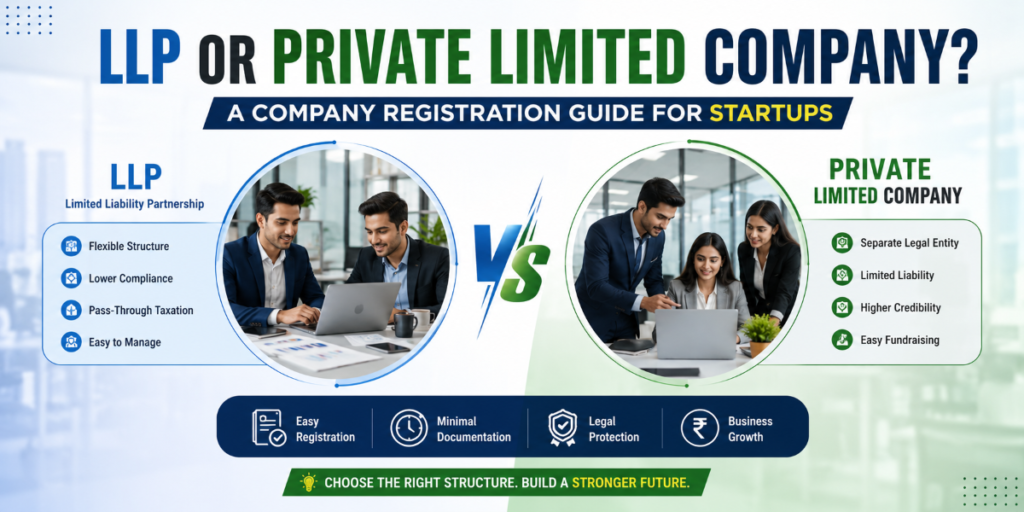
LLP vs Private Limited: Full Comparison for Startups
| Feature | LLP | Private Limited Company |
| Governing Law | LLP Act, 2008 | Companies Act, 2013 |
| Minimum Founders | 2 designated partners | 2 shareholders, 2 directors |
| Ownership Instrument | Capital contribution, profit share | Equity shares, preference shares, CCPS |
| ESOP Eligibility | Not permitted | Permitted under Section 62(1)(b) |
| VC/PE Fundraising | Uncommon, non-standard | Standard, investor-preferred |
| DPIIT Recognition | Eligible | Eligible |
| Section 80-IAC Tax Holiday | Eligible | Eligible |
| Statutory Audit | Only above ₹40 lakh turnover/₹25 lakh contribution | Mandatory every year |
| Board/Governance | LLP Agreement, no board meetings required | Board of Directors, minimum board meetings mandated |
| Conversion Path | Can convert to Private Limited later | Rarely converts down to LLP once funded |
| Investor Perception | Seen as a professional-services or bootstrapped structure | Seen as the standard startup/scale-up structure |
| Best Fit | Bootstrapped, service-based, or pre-funding-stage startups | Startups planning to raise external equity or grant ESOPs |
Registration Process for Startups
LLP registration steps:
- Step 1: Obtain Class 3 DSC and DPIN for all designated partners
- Step 2: Reserve the LLP name via the RUN-LLP service
- Step 3: File FiLLiP with identity, address, and registered office documents
- Step 4: File the LLP Agreement in Form 3 within 30 days of incorporation
- Step 5: Receive the Certificate of Incorporation, PAN, and TAN
Private Limited Company registration steps:
- Step 1: Obtain Class 3 DSC for all directors
- Step 2: Reserve the company name via SPICe+ Part A
- Step 3: File SPICe+ Part B with MoA, AoA, and subscriber details
- Step 4: Pay stamp duty and MCA fees based on authorised capital
- Step 5: Receive the Certificate of Incorporation, PAN, and TAN
- Step 6: File Form INC-20A (commencement of business) within 180 days
After incorporation, for either structure: Apply for DPIIT recognition via the Startup India / NSWS portal (free, typically processed in 2–10 working days), then separately apply for Section 80-IAC certification through the Inter-Ministerial Board if you want the tax holiday.
Documents Required
- PAN and Aadhaar of all founders/partners/directors
- Passport-size photographs and address proof
- Registered office proof (rental agreement/NOC + utility bill)
- Class 3 Digital Signature Certificate for all founders
- Private Limited: Draft MoA and AoA
- LLP: LLP Agreement (Form 3)
- For DPIIT recognition: Certificate of Incorporation, a brief write-up on innovation/scalability, and (for 80-IAC) audited financials and board resolution
Cost and Compliance Comparison
| Cost/Compliance Item | LLP | Private Limited |
| Registration cost (approx.) | ₹5,000–₹20,000 | ₹7,000–₹25,000 |
| Annual filings | Form 8, Form 11 | AOC-4, MGT-7/7A |
| Mandatory audit | Only above ₹40 lakh turnover/₹25 lakh contribution | Every year, regardless of turnover |
| Board/general meetings | Not mandatory | Minimum 4 board meetings/year (2 for small companies) |
| Annual compliance cost (approx.) | ₹5,000–₹15,000 | ₹15,000–₹40,000+ |
Compliance Checklist for DPIIT-Recognised Startups:
- File annual returns (Form 8/11 for LLP; AOC-4/MGT-7 for company) on time
- Renew DPIIT recognition eligibility annually (turnover and age criteria)
- Maintain a separate ESOP register (Private Limited only) if options are granted
- File income tax returns even during the 80-IAC exemption years, since the exemption isn’t automatic
- Track the 10-year DPIIT eligibility window from the incorporation date, not the trading start date
Pros and Cons for Startup Founders
LLP
- Lower compliance cost while the startup is pre-revenue or bootstrapped
- Full flexibility to define profit-sharing among founders via the LLP Agreement
- Cannot issue ESOPs, a major limitation for hiring senior talent with equity
- Investors generally won’t fund an LLP through standard equity instruments
Private Limited Company
- Standard structure for VC/PE fundraising, SAFE notes, and convertible instruments
- Can issue ESOPs to employees and, if DPIIT-recognised, to founders for up to 10 years
- Mandatory annual audit and more frequent board compliance, regardless of size
- Slightly higher registration and annual compliance cost than LLP
Common Mistakes Startup Founders Make
1. Registering as an LLP to save costs, without accounting for future ESOP needs ,
a founder later has to convert to Private Limited just to reward early employees with equity, delaying hiring plans.
2. Assuming DPIIT recognition alone gives tax exemption
Section 80-IAC requires a separate Inter-Ministerial Board approval; DPIIT recognition is only the first step.
3. Missing the incorporation-date clock for the 10-year DPIIT window
the eligibility period runs from the Certificate of Incorporation date, not from when the business actually started operating.
4. Approaching investors as an LLP expecting standard equity terms
most term sheets assume a Private Limited structure with defined share classes; an LLP structure typically triggers a conversion requirement before the round closes.
5. Forgetting that a partnership firm, even if DPIIT-recognised, cannot claim Section 80-IAC
only Private Limited Companies and LLPs qualify for the tax holiday.
Case Study: A three-founder edtech startup registered as an LLP in 2023 to minimise early compliance costs. By 2025, when a seed-stage VC fund offered a term sheet, the fund’s legal team required conversion to a Private Limited Company before the round could close , since the fund’s standard SAFE-equivalent instrument and post-money cap table only work with share capital. The conversion, ESOP pool creation, and DPIIT re-verification added roughly six weeks to the fundraising timeline, on top of the professional fees for the conversion itself.
Which Structure Should Startup Founders Choose?
- Choose LLP if you’re building a services business, staying bootstrapped for the foreseeable future, don’t plan to offer ESOPs, and want the lowest possible compliance overhead while you validate the business model.
- Choose Private Limited if you plan to raise angel or VC funding at any point, want to offer ESOPs to attract talent, or intend to apply for accelerator programmes that typically require a company structure.
If there’s genuine uncertainty about whether you’ll raise funding, most startup-focused CAs and company secretaries recommend registering as Private Limited from the start. The extra compliance cost in the early months is usually far smaller than the cost, delay, and investor friction of converting mid-fundraise.
Why Choose Vakilsearch?
Vakilsearch combines legal, tax, and company secretarial expertise to help startup founders make this decision with real numbers, not guesswork:
- Structure advisory tailored to your funding and hiring roadmap, not a one-size-fits-all recommendation
- End-to-end registration , LLP or Private Limited , with DPIIT recognition support included
- Section 80-IAC application assistance through the Inter-Ministerial Board process
- ESOP scheme drafting and compliance for Private Limited startups
- Transparent pricing and dedicated support from incorporation through your first funding round
Key Takeaways
- LLPs cannot issue ESOPs; only Private Limited Companies can, under Section 62(1)(b) of the Companies Act, 2013.
- VC and angel investors overwhelmingly prefer funding Private Limited Companies over LLPs, due to standardised share instruments.
- Both LLP and Private Limited Company are eligible for DPIIT recognition and the Section 80-IAC tax holiday; registered partnership firms are not eligible for 80-IAC.
- LLPs are audit-exempt below ₹40 lakh turnover/₹25 lakh contribution, while Private Limited Companies require a mandatory annual audit regardless of size.
- The Finance Act 2024 abolished angel tax and extended the Section 80-IAC window, easing early-stage fundraising for both eligible structures.
- Founders uncertain about future fundraising should generally default to Private Limited to avoid a costly mid-fundraise conversion.
Conclusion
For a general small business, LLP versus Private Limited is largely a cost-versus-flexibility trade-off. For a startup, it’s a fundraising and talent-strategy decision disguised as a registration form. LLPs offer real advantages , lower compliance cost, audit exemption below thresholds, and flexible profit-sharing , but they structurally cannot issue ESOPs and are rarely accepted by institutional investors for equity funding. Private Limited Companies carry a heavier compliance load but remain the default structure for any startup with fundraising or equity-compensation ambitions.
Both structures can access DPIIT recognition and the Section 80-IAC tax holiday, so the tax angle alone shouldn’t tip the decision. What should tip it is an honest assessment of your next 24 months: are you raising money, hiring with equity, or staying lean and bootstrapped? Answer that question first, and the LLP-versus-Private-Limited choice becomes far more obvious.
Also Read :- Benefits of Registering a Private Limited Company in India