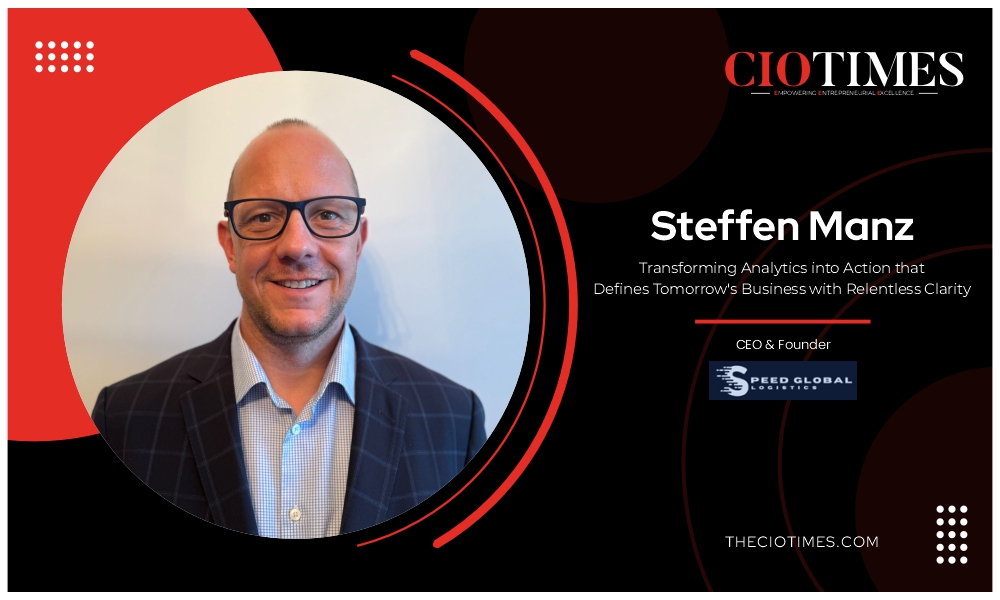
A CEO can reshape how an organization responds to a fast-changing business world. The role calls for a strong sense of direction and an ability to recognize shifts before they become defining trends. Rather than following established patterns, the leadership creates scope for fresh ideas and purposeful change. Decisions are guided by a broader view of where markets are heading, and what customers will expect next. Steffen Manz, CEO / Founder Speed Global Logistics, adapts this same approach that builds momentum across the organization while keeping execution focused. His leadership has strengthened the company’s ability to remain relevant, competitive, and prepared for the future.
Executive Foresight
Steffen Manz extensive leadership experience across the international logistics landscape makes him stand out from the crowd. With a career across countries like Germany, the Netherlands, and Malaysia, he brings a nuanced understanding of global trade and evolving supply chain demands.
His leadership is defined by strategic foresight, operational agility, and a commitment to advancing modern freight solutions. Through his vision, he continues to strengthen the company’s global capabilities while shaping a more responsive and technology-driven approach to international logistics.
Connected Commerce
Speed Global Logistics delivers integrated freight and supply chain solutions designed to support businesses operating across international markets. The company manages air and ocean transportation, customs processes, warehousing, and distribution through a coordinated service model.
The technology-enabled approach provides greater shipment visibility while allowing clients to navigate complex logistics requirements with confidence. Backed by global reach and industry knowledge, Speed Global Logistics develops tailored solutions that improve operational efficiency, strengthen supply chain performance, and support the evolving demands of international commerce.
Strategic Continuity
Over three decades, Steffen Manz has witnessed supply chains shift from cost-focused operations to strategic assets. In his foundational years, logistics was largely about moving freight efficiently, with little recognition of its role in driving growth. Globalization marked the first turning point. It expanded manufacturing across continents and demanded complex international markets. Digitalization followed, bringing real-time visibility into shipments and performance. More recently, the COVID-10 pandemic, geopolitical instability, and shifting trade policies underscored resilience as equally vital as efficiency.
These occurrences shaped his leadership philosophy: supply chains must secure business continuity by anticipating disruption rather than reacting to it.
He adds, “Great supply chain leaders prepare for uncertainty before disruption occurs.”
In each role, he has urged teams to look beyond transportation, aligning logistics with customer objectives and safeguarding revenue, satisfaction, and reputation. Today, he views supply chain leadership as a balance of operational excellence. He considers it an evolutionary process that has redefined both the industry and his own approach to leadership.
Lasting Strategic Advantage
Today’s supply chains, Steffen Manz believes, must transcend efficiency to embody resilience, agility, and strategic differentiation. Historically, excellence was defined by cost minimization and punctuality. But such measures are no longer adequate in a volatile global economy. Resilience now stands as the cornerstone of modern supply chain leadership.
Enterprises must demonstrate the capacity to absorb shocks and respond with speed and precision. These shocks can be in terms of geopolitical upheavals, regulatory shifts, labor shortages, or economic turbulence. Agility is equally indispensable, requiring diversified sourcing, flexible supplier ecosystems, multiple transport modalities, and contingency frameworks that preserve service integrity under pressure.
Visibility has become a decisive enabler. End-to-end transparency, predictive analytics, and real-time data empower leaders to act with foresight and confidence. Yet technology alone is insufficient. It demands collaborative ecosystems built with customers, carriers, customs authorities, suppliers, and logistics providers.
He states, “The organizations that will lead the next decade are those that integrate logistics directly into corporate strategy rather than treating it as a downstream operational function.”
He envisions the supply chain as engines of competitive advantage rather than cost centers. Organizations that deliver faster, recover sooner, and operate with greater reliability secure loyalty and market distinction.
Global Integrity
Steffen’s career allowed him to be in geographical locations like Europe, Asia, and North America. These have afforded him a rare vantage point. He gained insights about the nuances of global commerce, revealing both striking differences and enduring similarities in business cultures. He underscores that certain leadership principles remain universally relevant.
Integrity builds trust in every market. It also includes honesty, transparency, and accountability, which are valued across geographies.
He states, “Listening is another universal leadership skill. Effective leaders spend more time understanding than speaking.”
Respect for people, consistency in two-way communication, and delivering on commitments are constants. He also mentions the importance of adaptation. Communication styles and decision-making processes vary widely: some cultures emphasize consensus, while others prize speed and individual accountability.
Relationship-building also differs significantly. In several Asian markets, trust is cultivated through long-term personal connections before commercial negotiations, whereas other regions move more swiftly to transactional decisions. International leadership requires humility. Being aware of this, Steffen Manz highlights the thought that success in one market does not guarantee success in another. Adaptability, cultural awareness, and curiosity are essential qualities for leaders who aspire to operate effectively on a global stage.
Consultative Leadership Advantage
Steffen’s philosophy of addressing customer challenges rather than simply selling logistics services forms the defining ethos of Speed Global Logistics. He recognizes that customers are striving to reduce inventory costs, enter into new markets, improve cash flow, mitigate risk, and elevate customer service. Logistics is a strategic enabler of these broader ambitions.
This orientation reforms the dialogue. Instead of asking what freight customers have today, it begins by discerning where they intend their business to be tomorrow. Consultative partnerships generate enduring value because they are anchored in shared objectives rather than transactional pricing. When logistics providers possess deep knowledge of their customers’ industries, supply chain strategies, production cycles, and commercial priorities, they unlock opportunities that extend far beyond the movement of goods.
He shares, “Over the years, many of my customers have remained loyal despite changes in companies, industries, and economic conditions. That loyalty was never built through pricing. It was earned through consistency, transparency, responsiveness, and delivering solutions when circumstances became difficult.”
He has imbibed a singular mandate: the firm must not be perceived as a vendor, but as a trusted extension of its customers’ organizations. True value is realized when customers engage the company in strategic planning discussions rather than limiting its role to transportation requests. An approach that elevates logistics into a genuine source of competitive advantage.
Competent Leadership
Steffen highlights that organizations that endure disruption tend to rely on reactive crisis management. Those that emerge stronger invest in preparation well before volatility strikes. He stresses diversification as a core capability. Companies must avoid dependence on a single supplier, transport corridor, or manufacturing region. Flexibility across the supply chain builds resilience. Scenario planning is equally instrumental.
He adds, “Leaders should continuously evaluate potential risks and prepare alternative sourcing, transportation, and inventory strategies before disruptions occur. Investment in talent represents another critical capability.”
Talent investment is another aspect. Technology provides data, but experienced professionals turn information into sound judgment. Organizations with skilled teams consistently outperform those that rely on automated systems. Also, firms that build collaborative ecosystems maintain trusted partnerships. These enable customers, suppliers, freight forwarders, customs authorities, and carriers to gain faster access to intelligence, greater adaptability, and stronger recovery capacity.
Disruption is no longer an anomaly. It is a permanent condition of global commerce. The enterprises that will lead are those prepared for continuous change, consistently outperforming competitors who wait for stability to return.
Strategic Synergy
Technology has profoundly redefined the logistics realm. Steffen Manz prefers to maintain that supply chains remain anchored in human judgment. Artificial intelligence, predictive analytics, automation, digital documentation, and real-time visibility have elevated efficiency, enabling professionals to redirect focus toward higher-value priorities.
He emphasizes that technology excels at processing vast data sets, discerning patterns, forecasting disruptions, optimizing routes, and automating routine tasks. Such capabilities create measurable strategic advantage. Yet logistics is ultimately a people-driven enterprise. Disruptions seldom follow predictable models; political developments, regulatory shifts, customer priorities, negotiations, and crisis management demand seasoned judgment, experience, and emotional intelligence.
Relationships remain irreplaceable for Steffen. In times of disruption, businesses depend on trusted partners who communicate openly, collaborate effectively, and prioritize enduring commitments over short-term transactions. He looks at technology as it should serve to amplify human capability rather than deplete it. The organizations that integrate advanced digital platforms with experienced professionals will deliver superior outcomes. The future will not belong to companies with the most technology, but to those that deploy it with discernment while sustaining exceptional human relationships.
Enduring Trust
Customer loyalty is the most definitive measure of leadership. Trust is not created through a single successful shipment but through thousands of consistent actions over time. He identifies honesty as the first principle. Customers value transparency, particularly when challenges arise. Each supply chain encounters problems, but the distinction lies in how swiftly they are communicated and how effectively they are resolved.
Reliability is the second principle. Organizations that consistently deliver on commitments, especially in difficult circumstances, earn sustained appreciation.
A third principle is genuine engagement with the customer’s business. He highlights the importance of understanding markets, products, growth plans, and strategic objectives. It exhibits commitment beyond transportation services.
He adds, “Many of my longest-standing customer relationships have continued for decades because they are built on mutual respect, consistent delivery, and shared success.”
Accessibility is equally vital. Leadership must remain directly available to customers, ensuring that critical relationships are supported by open communication rather than obstructed by hierarchy. His longest-standing customer relationships have endured for decades because they rest on mutual respect, consistent delivery, and shared success. These principles, he insists, remain constant regardless of market conditions.
Visionary Foundations
The founding of Speed Global Logistics is the natural culmination of decades. Steffen Manz has triumphantly driven commercial growth across Europe, Asia, and North America. Despite the industry’s scale and sophistication, he observed that many customers remained underserved. Too often, providers emphasized transactions over strategic partnerships, leaving a clear gap for a fundamentally different model.
He envisioned an enterprise built on customer-centric consulting rather than traditional freight forwarding. The mandate was precise: unite global expertise with personalized service, commercial insight, and enduring partnership. He insisted that every client should have direct access to seasoned professionals capable of decisive action.
He says, “Speed Global Logistics was established to provide agility without sacrificing global capability. We wanted customers to experience the responsiveness of a boutique organization supported by the international reach and expertise typically associated with much larger companies.”
He set out to build an organization where relationships carry weight, accountability is personal, and customer success defines the measure of the company’s own success.
Value Redefined
Steffen Manz contends that one long‑held assumption in global logistics must be fundamentally challenged. The belief that lowest cost always represents the best decision. For decades, organizations optimized supply chains primarily around cost reduction. While financially appealing in stable environments, this approach often compromised resilience, flexibility, and long‑term sustainability.
He adds, “Supply chains should be measured not only by transportation costs but by their contribution to enterprise performance.”
He stresses that recent global events have revealed the flaw in this thinking: the cheapest solution frequently becomes the most expensive when disruption occurs. Leaders need to instead evaluate total business value. That encompasses service reliability, responsiveness, customer experience, inventory efficiency, business continuity, risk mitigation, and strategic flexibility. Supply chains must be measured by their contribution to enterprise performance. Organizations willing to invest in resilience consistently outperform those focused solely on minimizing immediate expenses.
Scrutinized Future Evolution
The relationship between logistics providers and enterprise leadership evolves into a distinctly strategic partnership. Historically, providers were engaged only after commercial decisions had been finalized. Increasingly, organizations recognize that supply chain capabilities shape product launches, market expansion, manufacturing strategies, inventory optimization, sustainability objectives, and overall financial performance.
Steffen Manz envisions logistics partners entering the dialogue much earlier. It contributes directly to strategic planning.
He adds, “Executive leadership teams will seek partners capable of providing market intelligence, geopolitical analysis, regulatory expertise, risk assessments, and supply chain optimization recommendations.”
In this model, the freight forwarder of the future transcends the role of operational service provider to become a trusted strategic advisor.
This evolution demands investment in advanced consulting capabilities. Understanding customers’ industries will become as critical as mastering shipping routes. Organizations embracing this expanded role will generate far greater long‑term value, positioning themselves as indispensable partners in enterprise success.
Lasting Legacy
Legacy is an extension far beyond financial success for Steffen Manz . For customers, he envisions Speed Global Logistics being remembered as a trusted partner that consistently enabled growth, solved complex challenges, and instilled confidence during periods of uncertainty. For the industry, he aspires to demonstrate that exceptional relationships, integrity, and strategic thinking remain the strongest competitive advantages. Technology will continue to advance, but he insists that trust will always define lasting success.
For future leaders, Steffen Manz emphasizes that true leadership is about serving others. Titles may confer authority, but character creates influence. He believes the next generation of logistics professionals will inherit an industry undergoing extraordinary transformation. It will be marked by greater complexity but also unprecedented opportunities to shape global commerce through innovation, sustainability, and collaboration.
He adds, “If Speed Global Logistics contributes to developing ethical, customer-focused leaders who value integrity as highly as performance, then our greatest achievement will extend far beyond our own organization.”
At the end of his career, he will not measure success solely by revenue, market share, or growth, but by the relationships built, the businesses supported, the people developed, and the positive impact left on the industry. If customers, colleagues, and future leaders remember Speed Global Logistics as a company that consistently placed people, partnerships, and long‑term value ahead of short‑term gain, he will regard that as the most meaningful legacy created.
Also Read :- CIO Times Magazine For More information