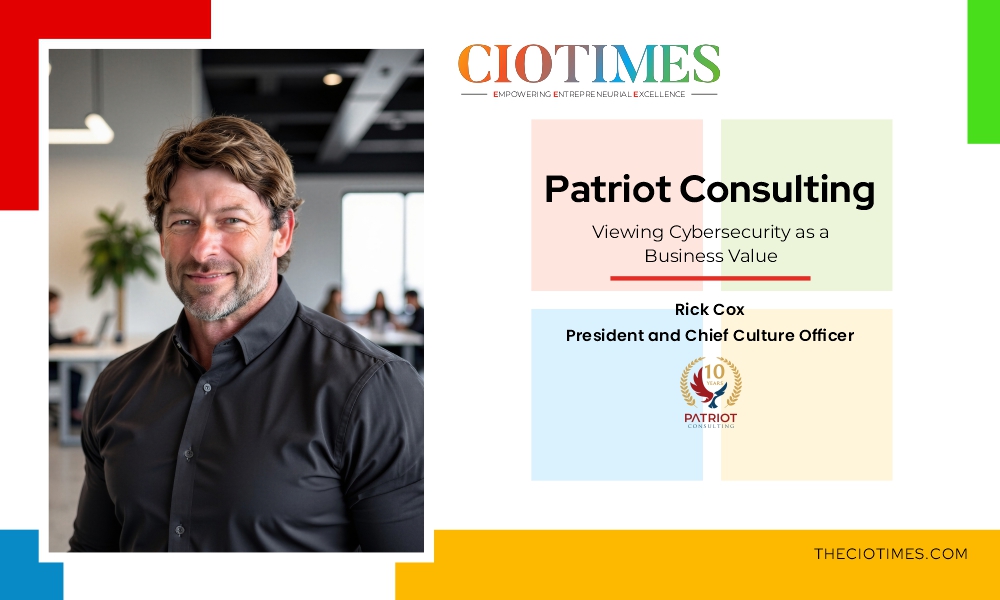
Business organizations view cybersecurity as a business leadership responsibility. It is no longer perceived as merely a technological function. As the President and Chief Culture Officer at Patriot Consulting, Rick Cox understands the consequences of security failures for people: employees may be unable to work, customers may raise questions, and leaders may have to make difficult decisions quickly. Trust, once damaged, can be difficult to restore.
This perspective is shaped by his role which focuses on people, clients, and the conditions that allow an Patriot Consulting organization to operate well. His team’s conversation is centered around business. They ask practical questions like:
- What matters most to the business?
- Which operations cannot stop?
- What information must not be lost or exposed?
- And what would have the biggest impact on the people they serve?
After clearing these priorities, technical teams can build security measures around them. Technology remains essential, but it cannot carry the responsibility alone. People, processes and clear ownership are significant. In this way, security ultimately protects an organization’s ability to take care of its employees and customers while continuing to operate and earn trust.
Choosing Specialization over Breadth
Rick has chosen specialization over breadth to excel in a cybersecurity field. His main focus is to be exceptional at helping clients get maximum value from the Microsoft investment they have made. This focus has enabled him to invest more in his employees, build deeper expertise, remain aligned to Microsoft, and apply insights gained from one client engagement to support another.
Patriot Consulting is a Microsoft-only partner, and it has shaped the team’s approach towards licensing and cloud management, beyond security. For clients that already trust the team with their Microsoft security, the company aims to become a trusted partner across their broader Microsoft licensing and cloud environment. The CSP program supports this broader relationship through simplified licensing.
Emphasizing his specialization approach, Rick says, “CSP allows us to make sure the Microsoft technology we’re deploying is matched with the right licensing for the client’s actual needs. It’s about helping clients get the greatest value from their Microsoft investment.”
This approach has moved Patriot Consulting to new areas without compromising their original identity. As AI becomes increasingly embedded in how companies operate, the team believes that security and governance must evolve alongside it. This thinking is reflected in AIShield365, the organization’s managed service focused on AI governance.
His role in this evolution is less about personally mastering every technical detail and more about creating an organization capable of mastering them. He acknowledges that he does not need to understand every setting within platforms such as Sentinel, Defender, Entra, and Purview or every technical aspect of AI governance. He is focused on people development aspects.
Hiring capable professionals, investing in their development, building strong leaders, and fostering a culture of knowledge sharing are essential to sustaining the depth that has become part of Patriot’s identity. This focus has contributed to the success of Patriot. He believes it will be significant in their goal of becoming a leader in responsible AI governance.
Choosing Security and Using it Well
A significant investment in security technology does not necessarily offer the expected level of protection. According to Rick, the disconnect lies between purchasing security solutions and using them effectively. Without clear operational accountability, organizations may struggle to realize the full advantage of security investments.
This requires clear answers to important questions: Who is responsible for the technology after deployment? Who monitors it? Who responds when a security incident occurs? And who ensures the systems continue to function as intended over time? Having someone available to respond outside normal working hours is equally important.
This emphasis on ongoing accountability is one reason Patriot’s managed services have become an increasingly important part of its business. Rather than simply deploying a security solution and leaving the client to manage it, the company helps ensure that the technology continues to meet the client’s security needs.
Turning Technical Acumen into Institutional Capability
For Rick, translating technical expertise into institutional capability begins with people and culture. While an experienced engineer may be able to resolve complex problems, an organization’s strength lies in its ability to turn individual expertise into shared knowledge that benefits the wider team. Rather than allowing employees to treat knowledge as personal job security, he encourages them to document their learning and share their expertise with colleagues.
An engineer’s insights, for instance, could help ten other engineers become better; it can result in improving the organization’s collective capabilities. In this way, this culture of knowledge-sharing benefits Patriot Consulting while also improving the experience it delivers to clients. As Rick explains, “The goal should never be for a client to depend on one individual person. We want to build something that lasts.”
Building Security Maturity with Continuous Efforts
From his perspective, successful security implementation and lasting security maturity are not the same thing. A project may have a beginning and end, but security requires continuous attention. As technology, threats, business priorities, and people continue to evolve, organizations must keep reviewing their security practices, testing their approach, making improvements, and ensuring clear ownership. This realization has shaped Patriot Consulting move beyond project-based work. Through their projects like, SecureShield365 and MXDR365, the company supports clients after deployment. This helps them maintain and improve their security environments over time. In case of AI governance also, he is aware about the fact that deploying AI is one thing, while governing its use responsibly over time is another. He knows that it requires continuous effort. Much like company culture, security maturity cannot be established through a single initiative; it needs continuous action.s
Rethinking Secure Environment
From Rick’s leadership perspective, the traditional boundaries around a company no longer mean what they once did. People work across different environments, data is everywhere, applications are in the cloud, and employees are using AI in ways that did not exist a few years ago. This changing environment requires leaders to ask different questions about who has access to their information, whether they should have that access, and whether the organization can see and manage what is happening with its data. AI adds another layer to this challenge, as AI tools and agents increasingly interact with information alongside people. While the technology behind these questions can become complicated, he believes the leadership responsibility is straightforward: “Know where your important information is, know who or what can get to it, and make sure someone is responsible for protecting it.”
Cybersecurity as an Enabler of Innovation
Rick believes effective security can help organizations move faster rather than slow business innovation. The problem arises when security enters the process only at the end, after an idea is ready to launch and security concerns can suddenly become a roadblock. The solution is to bring security into the conversation from the beginning.
He applies this principle in his AI also. Although he recognizes that the opportunity in AI is incredible, moving fast without putting the right guardrails around it can create real risk. This makes AI governance a crucial part of strategy at Patriot. Through AIShield365, it aims to help its clients to put governance around AI that enables them to innovate responsibly rather than approach it with fear. In this way, they are helping organizations to build confidence to use AI, rather than hold back from its potential. Emphasizing the role of security in innovation, Rick says, “The organizations that already have strong identity, security, and data governance in place can move faster because their leaders have more confidence. I don’t think security should be the brake pedal. Done well, it gives you the confidence to press the accelerator.”
Continuous Security Leadership
The cybersecurity sector is shifting towards an arena shaped by AI-assisted attacks, identity compromise, regulatory scrutiny, etc. There are certain preconceived notions about enterprise security that are becoming obsolete. From his lens, one of the biggest mistakes leaders make today is assuming what worked in the past will be sufficient tomorrow. In his view, the pace of change is accelerating across every aspect of the business. While AI is helping organizations to move faster and operate more efficiently, it is also equipping bad actors with new capabilities. Information moves faster, attacks move faster, and decision-making cycles continue to compress.
As a result, security can no longer be treated as an annual review exercise. The cost of the exercise is simply too high. Leaders must view security as a continuous business priority, much like any other critical function of the enterprise. Security strategies need to evolve in real time to keep pace with emerging threats, shifting technologies, and changing business requirements.
He also warns against treating AI and cybersecurity as separate discussions. His expertise till now suggests whenever AI interacts with organizational data, systems, or employees, security and governance considerations should be integrated from the outset rather than addressed later.
This outlook is paving the way for significant investment at Patriot. AI governance will become one of the most important leadership challenges organizations face in the years ahead. Through Patriot Consulting and AIShield365, the company is focused on helping clients navigate this evolving landscape responsibly while establishing the governance frameworks needed to support secure AI adoption.
Rick states, “We are making a significant investment at Patriot. We believe AI governance is going to become one of the most important leadership issues organizations face, and we want Patriot Consulting and AIShield365 to be out in front helping clients navigate it responsibly.”
The organizations best positioned for the future will be those that embed security, governance, and risk management into every strategic conversation from the beginning.
Intent-specific Partnerships
The cybersecurity market becomes increasingly crowded and commoditized. Helpfulness is the key that will remain strategically relevant to enterprises and for the organization’s future. The concept is more than a value statement. It serves as a guiding principle that shapes how the organization approaches clients, challenges, and outcomes. He puts forth a question for his team: how many clients can they help each day, and how effectively can they support them?
He stresses on the importance of operating a healthy and growing business; he does not believe revenue should be the primary motivation driving employees. In his view, financial performance enables investment in people, service development, and organizational growth, but prolonged triumph is built on delivering value to clients. Business results follow naturally when organizations consistently help clients, perform at a high standard, and earn trust through their actions.
Rick doesn’t view helpfulness as an abstract concept. It is measured through accountability and execution. He points to practical questions such as whether teams responded promptly, followed through on commitments, took ownership of problems, delivered on promises, and ultimately left clients in a better position because of Patriot’s involvement. Such factors he mentions remain critical differentiators in an increasingly crowded cybersecurity market.
He adds, “Technology can be purchased. Licenses can be purchased. What is much harder to duplicate is a group of people who genuinely care about the outcome and are willing to stay with a client until the job is done.”
As artificial intelligence continues to reshape the cybersecurity landscape, this philosophy will become even more valuable. Organizations will increasingly seek trusted partners capable of helping them adopt AI technologies while maintaining control over data, strengthening security, and preserving employee trust. AI governance is a logical extension of Patriot’s existing mission and capabilities. In his opinion, the growing need for responsible AI adoption aligns closely with the company’s customer-first approach.
He also envisions AIShield365 as a key component of the organization’s future strategy. By combining cybersecurity expertise with AI governance capabilities, he believes the platform positions the company to help clients navigate emerging risks while enabling innovation in a secure and responsible manner.
Resilient Leadership
Resilience is fundamentally defined by what an organization does before something goes wrong. Virtually, every organization focuses on security after a significant incident occurs. The true measure of resilience, however, is whether leaders prioritized preparation before disruption emerged. He poses some critical questions that organizations need to address in advance.
- Do they have the right technology in place?
- Do employees understand their responsibilities?
- Has the team practiced its response procedures?
- Who makes key decisions during a crisis?
- How is communication managed?
- Who owns specific responsibilities?
These issues cannot be left untapped until an incident unfolds. Effective preparation requires clear answers long before a crisis occurs. As an astute leader, Rick believes that challenging situations do not create culture as much as they reveal it. The same principle applies to cybersecurity and operational resilience. When a disruption takes place, organizations quickly discover whether their preparation was sufficient. Processes, leadership, communication structures, and decision-making frameworks are tested in real time, exposing both strengths and weaknesses.
He shares, “One thing I believe very strongly in as a leader is that difficult situations usually don’t create your culture. They reveal it. Security works the same way. When something bad happens, you find out very quickly whether the organization was prepared.”
The objective for Rick is not to build a business that never experiences a bad day. It is to build a business that can withstand a bad day without losing the confidence and trust of the people who rely on it. In an environment where digital infrastructure underpins every aspect of operations, that capability has become a defining characteristic of long-term organizational strength.
Trust-Driven Growth
Trust will become one of the most valuable assets an organization can possess. In Rick’s view, customers, employees, partners, and boards increasingly expect transparency around data, technology, and risk. As AI adoption accelerates, organizations that can address these concerns with confidence will gain a meaningful advantage. However, he does not believe trust can be built through marketing alone. It is earned through consistent decisions, strong governance, and reliable execution over time.
For him, people remain the defining factor. While companies can invest in advanced technologies, they cannot simply purchase accountability, commitment, or genuine care for customer outcomes. Those qualities must be built into the culture. This principle shapes Patriot’s approach. Organizations must invest in technology and people together, particularly as AI becomes more deeply embedded in business operations.
He adds, “The winners won’t just be the companies that adopt AI the fastest. They will be the ones that can adopt it responsibly, govern it well and still maintain the trust of their employees and customers.”
That belief is driving Patriot Consulting focus on AI governance and its investment in AIShield365. He sees responsible AI adoption as a strategic priority that requires the same discipline applied to security and risk management. Leading organizations will build cultures defined by integrity, service, urgency, and operational excellence. In those environments, security and responsible AI become more than business expenses. They become strategic differentiators that strengthen trust, support resilience, and create long-term competitive advantage.
Also Read :- CIO Times Magazine For More Information