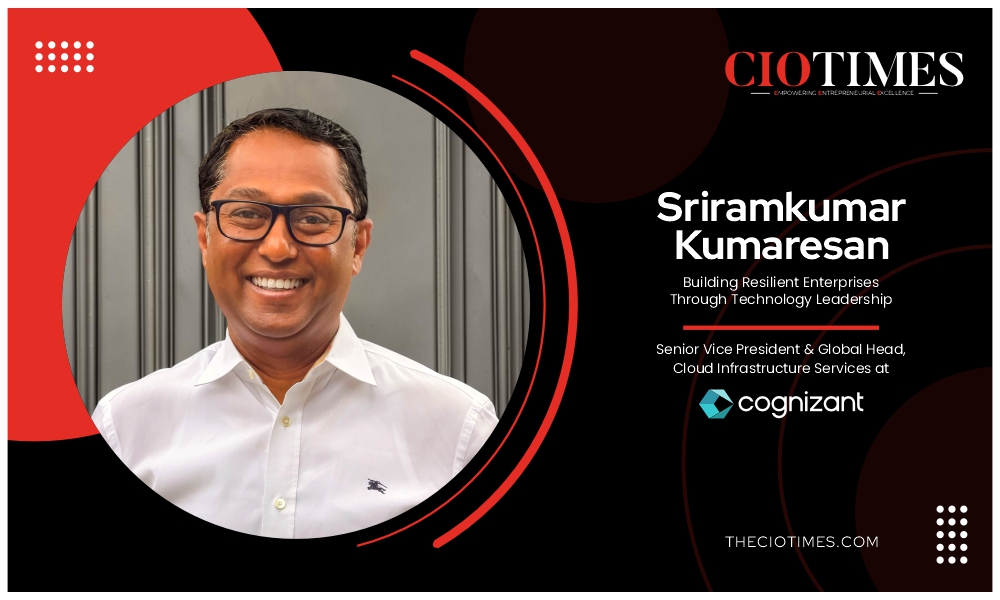
Modern technology leadership has increasingly focused on deliberate decisions that strengthen business resilience. It is no longer defined by adopting the latest tools. This leadership helps organizations prepare for what comes next. Industry leaders like Sriramkumar Kumaresan, Senior Vice President & Global Head, Cloud Infrastructure Services at Cognizant, are committed to building technology ecosystems that scale with changing demands while maintaining operational control. Such leaders perceive success as a strong foundation before pursuing transformation. Clear governance helps teams move faster with confidence. It embeds security in every strategic decision rather than treating it as a separate function.
Technology Brings in Value
Sriramkumar Kumaresan believes the relationship between technology and business has become far more direct in recent years. This is due to enterprises increasingly using technology as a differentiator to innovate and accelerate growth. Earlier in his career, he viewed technology primarily as an enabler. He assumed that if technology was built well, positive business outcomes would naturally follow. Over time, recognized that this perspective was incomplete. Technology alone does not create value. It emerges when technology becomes embedded in the way a business operates.
Many technology leaders continue to overlook the foundation beneath emerging technologies. Algorithms do not fail in isolation. They often fail because of fragmented data environments, siloed computing resources, or inadequate governance. He believes infrastructure has evolved beyond being a supporting layer and is becoming an intelligent control plane for enterprise intelligence.
He highlights culture as a crucial factor in successful technology transformation. In his view, transformation is fundamentally a people-driven effort. Organizations are more likely to sustain new technologies when they invest in employee capabilities and create an environment where teams feel comfortable experimenting with new operating models.
Enterprises conventionally adopted technology around three strategic pivots: redefining products, reimagining experiences, and redesigning operational effectiveness. With technology and business now converging more closely, organizations are increasingly using technology to pursue all three simultaneously.
He states, “Over the years I have learnt that technology creates possibility. However, business context, culture and disciplined execution turn possibility into value.”
Transforming Business Through Technology
The gap between technological transformation and meaningful business transformation is not only a technology issue. Sriramkumar’s expertise has exposed him to several transformation programs, and they have begun as technology migrations. These are with business outcomes considered only after the technology roadmap has been defined. He sees this sequencing as a major constraint on impact.
He asserts, “Successful transformation starts from the business operating model, not the technology stack. It asks what the enterprise should look like when the work gets done differently.”
Technology should then be positioned as the mechanism that enables this change. From this perspective, modernization becomes a business imperative rather than a standalone technology initiative.
He also identifies operational fragmentation as a significant barrier. In many organizations, Run and Transform functions operate as separate teams with distinct priorities and budgets. This structure can reinforce the very solis that transformation efforts are intended to eliminate. Bringing Run and Transform together under a unified team allows the operating model to evolve alongside the technology.
Measuring transformation through business outcomes such as time-to-market, mean time to resolution, availability, and operating expenses. Across his client engagements, he has seen disciplined transformation deliver two to three times faster time-to-market, a 25% to 30% reduction in mean time to resolution, and a 15% to 20% reduction in operational expenses. Transformation is fundamentally an operating-model redesign, with technology serving as the medium for change.
Differentiation Beyond Technology Architecture
Differentiation in technology has shifted from the technology layer to the integration layer. With hyperscalers, security providers, and platforms offering increasingly capable products, selecting the right technology is no longer enough. The real advantage lies in combining these capabilities to deliver measurable business outcomes.
At Cognizant, he views differentiation through three lenses. These are:
1. The partner Ecosystem
In this, the focus is on moving clients from what a product can solve to how it can improve business performance.
2. Commercial flexibility
Models such as outcome-based pricing, gainshare, vendor-exit pricing, fabric-level FinOps, and pay-as-you-go Business Resilience-as-a-Service can be tailored to specific client needs and outcomes.
3. End-to-end expertise
By connecting Run and Transform capabilities with specialized teams, organizations can develop industry-specific solutions at scale. He points to more than 150 plug-and-play cloud solutions, including TriZetto in healthcare and Store360 in retail.
He states, “Differentiation cannot be engineered through architecture alone. It comes from combining ecosystem, commercial model, and industry context so a client sees measurable business change.”
Engineering Operating Models
Solution design changes significantly when the objective shifts from solving a technical problem to redesigning an enterprise’s operating model. Technical problem-solving is convergent, with defined constraints and selected architectures. Operating model transformation is more divergent, requiring leaders to consider multiple possible futures.
He frames this approach around three stages: redefine, reimagine, and redesign. Using Uber as an example, he explains that the company redefined its market through cab booking, reimagined its business through Uber Eats, and redesigned operations by integrating multiple backend environments. Enterprise transformation often requires all three at different points in the journey.
Sriramkumar Kumaresan also notices a shift from human-plus-bot workflows to human-plus-agent collaboration. As AI capabilities, governance, and trust evolve, the boundaries between human and agent responsibilities will continue to change. Solution architecture must accommodate this evolution rather than lock organizations into a fixed model.
The growing importance of Business Process Level Agreements alongside traditional Service Level Agreements is also an aspect covered in the discussion. Measuring outcomes at the process level ensures that architecture supports the operating model rather than dictating it.
The Cloud’s Intelligent Evolution
Enterprises are entering a fundamentally different phase of cloud adoption. While migration, cost optimization, and elasticity defined earlier stages, he considers them table stakes today. The current phase is centered on intelligence. Sriramkumar Kumaresan describes the evolution through three eras. Traditional infrastructure created a fabric of servers, storage, and middleware, with tools extracting intelligence from it. Cloud expanded this fabric through greater density, diversity, and distribution across private, public, and hybrid environments. Yet the role of the tool layer largely remained unchanged.
The AI era is changing the purpose of infrastructure. Rather than simply extracting intelligence, infrastructure must now harmonize intelligence across a heterogeneous technology fabric.
He adds, “Every service now bifurcates into two components. Services delivered For AI, which prepare the enterprise fabric for AI workloads. And services delivered By AI, which operate the infrastructure itself through AI.”
He believes next-generation cloud architecture must go beyond scale and efficiency. It should prioritize trust and portability while embedding governance by design. Composability is equally important, enabling agents, models, and data services to work together without requiring organizations to rebuild the underlying stack.
Building Shared Accountability
Technology is rarely the blocker to making outcome-based and XaaS models work. Cloud consumption models, unified observability, and fabric-level FinOps have matured enough to support genuine outcome-based delivery. The larger gap lies elsewhere.
The first friction point is the commercial layer. Conventional procurement is built around inputs rather than outcomes, with statements of work, cost baselines, and volume assumptions reflecting an older model. Moving toward gainshare, risk-reward structures, or Business Resilience-as-a-Service requires both parties to operate outside familiar frameworks. Sriramkumar Kumaresan believes this requires senior-level sponsorship rather than incremental process changes.
The second challenge is cultural. Outcome-based models require shared accountability. If either side continues to view the other as a vendor, the model is unlikely to succeed. Providers must be willing to share risk, while clients need to be comfortable exposing the operational metrics that matter. Building that level of openness takes time.
The last layer he shares is the measurement discipline. Business Process Level Agreements represent the natural evolution of Service Level Agreements by connecting provider performance to the business processes supported by technology, rather than focusing only on system updates. Embedding this approach requires alignment across both organizations.
The ecosystem needs greater trust, transparency, and shared accountability. Commercial models are evolving, and contracts will follow as organizations become more comfortable sharing risk and measuring success through business outcomes.
Identifying Structural Change
Sriramkumar Kumaresan uses three questions to assess whether an emerging technology represents a structural shift or simply a temporary cycle of enthusiasm.
The first is economics. He asks whether the technology fundamentally changes the unit economics of a business or simply optimizes existing ones. Cloud, for example, he says, changed the marginal cost of compute and the speed of provisioning. Industrial IoT has done so in specific contexts where sensor economics transformed asset maintenance. Consumer AR did not meet this test over the last decade, despite advances in the underlying technology.
The second question is what humans stop doing. According to Sriramkumar, every genuine structural shift changes the boundary between human and machine responsibilities. Cloud changed the role of infrastructure teams, while AI is now shifting that boundary within knowledge work. When that change becomes durable, the technology demonstrates deeper enterprise relevance.
The third question is whether the technology requires a new operating model. Technologies that force organizations to rethink how work is performed are more likely to represent structural change.
He adds, “Technologies that fit inside the existing operating model often turn out to be cyclical.”
Many leaders make the mistake of evaluating technological capability alone and extrapolating its potential. In his view, enterprise value emerges when economic impact, changing human-machine boundaries, and operating-model transformation appear together. This framework helps distinguish a long-term investment thesis from a technology trend that may simply be a fashionable adjacency.
The Intelligent Control Plane
The term IT infrastructure for Sriramkumar Kumaresan is stretching to the point where it needs a new frame. As workloads span public and private clouds, Neo-cloud platforms, edge notes, SaaS platforms, and data infrastructure, the traditional definition no longer reflects the broader enterprise technology landscape.
He sees the more useful concept as an intelligent control plane: a composable layer that harmonizes intelligence across a heterogeneous fabric and converts it into business outcomes. Infrastructure is no longer defined by where compute resides, but by how services are delivered.
Sriramkumar adds, “CIOs often cite that infrastructure strategy as the barrier to AI progress in their domain. That view tells us the traditional concept is not delivering.”
Some favor private environments, while others prefer public cloud. Manufacturing workloads may begin at the edge and scale into public cloud, while organizations may move workloads back to private environments as GPU requirements grow. There is no single right architecture.
In his view, the new foundation should be a cross-reference architecture spanning public, private-shared, private-dedicated, and Neo-cloud environments, including hybrid combinations. The value lies not in choosing one topology, but in orchestrating across them while maintaining security, governance, and business continuity.
Resilience-Driven Cybersecurity
Cybersecurity must evolve from being viewed as a mere control function. It needs to be perceived as an architectural principle embedded across every layer of an enterprise’s technology environment. As cloud, artificial intelligence, automation, APIs, edge computing, and increasingly autonomous systems continue to remold the attack surface, organizations need to fundamentally rethink how security is designed and implemented.
Sriramkumar Kumaresan believes security should no longer be treated as a control function added to the side of an organization’s technology architecture. Instead, it must be woven into every operating layer. He views Zero Trust as a mindset rather than a product. He envisions the product with continuous verification of identities, devices, applications, and data flows serving as a core operating principle for AI-era architectures.
He brings to notice a critical distinction between data recovery and true business resilience. It is one that he believes many boards are only beginning to fully recognize. Recovering data is essential, but it does not by itself restore business operations. True business resilience is measured by an organization’s ability to keep supply chains moving.
The September 2025 cyber incident involving Jaguar Land Rover demonstrated this distinction clearly. JLR reported approximately £196 million in direct exceptional costs, while the UK Cyber Monitoring Centre estimated the broader economic impact on the UK at £1.9 billion. More than 5,000 organizations across the supply chain were reportedly affected. It made the incident the most economically damaging cyber event in UK history.
That is why the organization partnered with Rubrik to deliver Business Resilience-as-a-Service through a subscription-based, pay-as-you-go model aligned with critical business outcomes. As cyber insurance premiums continue to rise, enterprises also need a resilient architecture that enables them to withstand and recover from cyber incidents.
Building Differentiated Technology Organizations
Sriramkumar Kumaresan has been exposed to three things which, in his experience, separate technically excellent technology organizations from those that can consistently anticipate market shifts. He highlights them as follows:
1. Proximity to the client’s business
Technical excellence is necessary but insufficient. Organizations that consistently anticipate shifts spend time understanding client business models at a level most vendors do not attempt. That proximity generates early signals. It also lets them position technology in terms clients recognize, which is often the difference between influencing strategy and executing it.
2. Four levels of wise-ness
World-wise means knowing how the industry-standard technology works. Industry-wise means knowing how a specific industry applies it, for example, HIPAA-compliant claims automation. Enterprise-wise means knowing how a specific company applies it. And task-wise means knowing the atomic decision of whether a task belongs to a human or an agent.
3. Leadership culture
Transparency, empathy, and accountability are the operating values that let teams take risks with new operating models. Without those, even excellent teams retreat to safe execution. In a period of significant market movement, that retreat is what causes companies to fall behind.
He adds, “Anticipation is not a talent. It is a system built from proximity, discipline, and cultural courage.”
Navigating Technology Inflection Points
Some shifts that felt transformative to Sriramkumar Kumaresan were the beginning of much larger structural changes. Mobile computing was one. It was initially framed as a device shift. It turned out to be an operating-model shift. Cloud was similar. The migration story was interesting. The composability story that came later was the real change.
Others were overestimated in the short term. Early consumer AR and VR were among them. Enterprise blockchain was another. Both had promising technology. Neither passed all three of the tests he mentioned earlier. Neither changed unit economics, redrew the human-machine boundary at scale, or required a new operating model at the enterprise level. Some may return in different form. That is not the same as being transformational at the moment they were declared so.
The pattern is this for him. The gap between technical possibility and enterprise-grade operationalization is usually much wider than early demonstrations suggest. Enterprise-grade means secure, governed, integrated, scaled, and economically defensible. Technologies that clear that bar usually take longer to mature than the hype cycle predicts. They also end up bigger than expected once they do.
He adds, “The discipline is patience with the hype and rigor with the fundamentals. The next inflection point is rarely where the noise is loudest.”
Adaptive Advantage
As we look forward the next phase of enterprise technology, there are some fundamental questions CIOs and technology leaders should be asking and exploring today. Many are currently focused on whether they are AI-ready. That is a reasonable question. It is also the wrong one to prioritize now.
The question worth asking is different. Where does the human-agent inflection point sit for each of a company’s business processes, and how should an operating model be designed to let that line keep moving? Because it will keep moving. As capability, governance, and trust mature, more processes will shift to agents. Some of it will move back to humans as organizations learn where judgment matters. Architectures that lock a single equilibrium will be rebuilt within three years.
A second question, closely related, is on cyber resilience. Not whether a company can recover its data, but whether its business can continue to operate while its technology estate is being restored. That reframing changes what boards invest in. It changes the resilience architecture from a data problem into a business-continuity problem.
The organizations that answer these two questions well will build durable competitive advantage. They will move from AI experimentation to AI industrialization. They will build cyber resilience as a business capability rather than an IT function.
He adds, “More than any single technology bet is what will separate the leaders from the followers in the years ahead.”
Also Read :- CIO Times Magazine for More Information