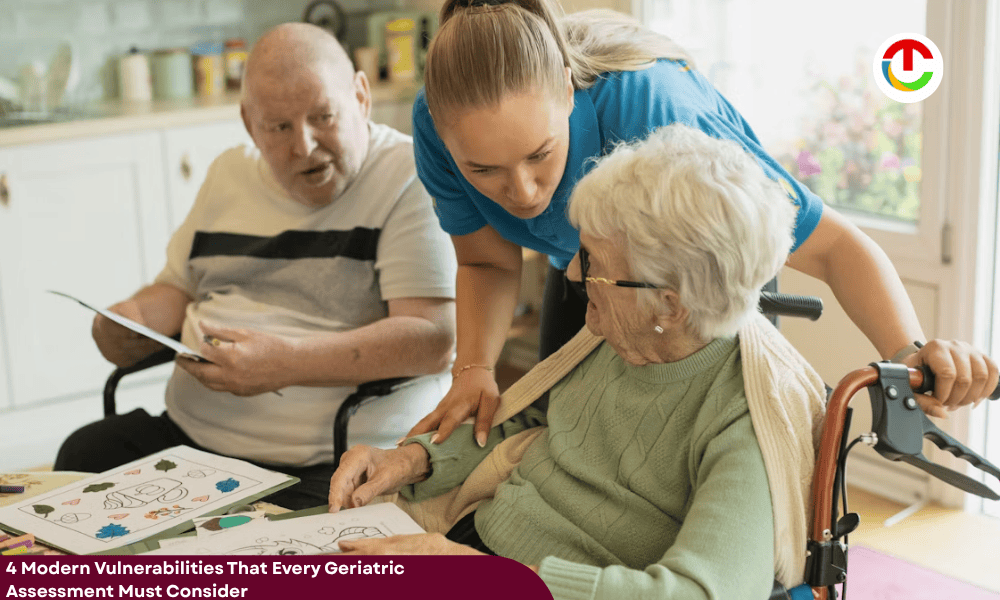
Someone may consider a person a decade or two older than them as aged, whereas another may think the process only starts at 65 years (or some other number). The point is not whether 75 is the new 65, but when observed closely, aging is a lifelong process. Every individual is older than the person they were a year ago, or even a day back. What matters is living healthy and independent lives, even after 65.
Comprehensive geriatric assessments have traditionally helped clinicians in understanding the multidimensional needs of older adults. To that end, advancements have been made. Dr. George Kuchel, the Director of the UConn Center on Aging, said, “I am amazed by how far we have come just during my own career.”
With advancements like patient portals, telemedicine, digital health tools, and more, certain vulnerabilities also creep in. This article will discuss why considering them during a geriatric health assessment is important. Let’s get to know four of the most critical ones.
4 Modern Vulnerabilities Geriatric Assessment Must Consider
1. Technology-Driven Social Isolation
Technology has totally transformed the way people socialize these days. Statista shared that even in 2025, Facebook was the market leader, with over three billion monthly active users. Also, the United States and China had the most high-profile social platforms.
Even older adults have been able to stay connected with family, friends, caregivers, and healthcare providers regardless of the distance. Video calls, instant messaging, and online communities have improved opportunities for social engagement.
Still, digital connectivity cannot be equated with meaningful social connections, right? Recent studies have shown that the issue is not about digital access, but whether seniors can participate meaningfully in the online world.
In a 2025 study, aging data from China, the US, and England were analyzed. It was found that digital exclusion was associated with high odds of loneliness. This was the result across all three cohorts after accounting for demographic, socioeconomic, and health-related factors.
It means healthy digital engagement is also an important component of healthy aging and social well-being. Technology-driven social isolation may have the following important clinical implications:
- Poorer medication adherence and self-management of chronic conditions
- Lower engagement with preventive care
- Reduced physical activity and participation in community programs
- Higher risk of depression, anxiety, and cognitive decline
- Greater dependence on emergency services due to the absence of timely practice or emotional support
So, a modern geriatric assessment cannot stay confined to asking whether the patient has a family nearby. It should explore how patients stay socially connected through questions revolving around ease of tech use, frequency of online engagement, and emergency contacts. This may provide a more complete picture of functional independence.
2. Digital Financial Vulnerability
Being able to manage one’s personal finances has been considered a mark of functional independence. Earlier, this responsibility may have been as simple as paying bills and balancing the books, but not today. Older adults must now rely on online banking, digital payment platforms, e-commerce, and electronic communication to manage daily life.
Traditional geriatric assessments were not designed to account for the cognitive and technological demands these tools create. As per the US Federal Trade Commission (FTC), senior consumers reported $159 million in losses to tech support scams in 2024 alone.
Even in general, it has been found that seniors are much more likely to lose money to tech support or government impersonation scams compared to younger demographics. Although cognitive impairment is a major factor contributing to this, even those with subtle executive dysfunction, limited digital literacy, or social isolation are vulnerable to financial threats.
This is where common digital scams targeting seniors become a clinical concern, not just a cybersecurity issue. Modern scams are extremely sophisticated, extending far beyond suspicious emails. Many convincingly imitate trusted organizations such as banks, healthcare providers, government agencies, and delivery services. Common examples include:
- Phishing emails and text messages requesting passwords or banking credentials
- Tech support scams that persuade victims to grant remote access to their devices
- Government or healthcare impersonation scams demanding immediate payment or personal information
- Investment scams promising unusually high returns
- Romance and grandparent scams that exploit emotional trust before requesting money
While such incidents can be lapses in judgment, they also reflect reduced processing speed, declining health literacy, and inadequate social support. During geriatric assessments, even brief conversations about how patients manage online financial tasks or unexpected digital communications can go a long way. Healthcare providers may gain valuable insights into decision-making capacity, executive function, and functional independence.
3. Digital Health Literacy
Again, this is digital but encompasses a whole different set of demands. Healthcare has largely moved online, from scheduling appointments to managing prescriptions. It won’t be incorrect to state that many routine healthcare interactions now require a certain level of digital competence that cannot be taken for granted.
The US Office of Disease Prevention and Health Promotion (ODPHP) considers health literacy to be one of the digital determinants of health. The agency also notes that as many as nine in 10 adults have limited health literacy skills, with seniors being the disproportionately affected population.
Now, this isn’t just about knowing how to use a smartphone or a computer. Digital health literacy is mainly about an individual’s ability to find and evaluate information and services to make informed healthcare decisions. Challenges in this area can have the following clinical consequences:
- Delayed or missed appointments because patients cannot navigate online booking systems
- Poor adherence to medication due to difficulty accessing electronic prescriptions or pharmacy apps
- Missed test results or follow-up instructions shared through patient portals
- Reduced participation in telehealth, particularly among individuals with hearing, vision, and cognitive impairments
- Greater reliance on family members or caregivers for tasks that patients previously managed by themselves
Healthcare professionals do not need a formal screening tool to assess digital health literacy. Simple questions will work, such as asking whether a patient is comfortable using the patient portal or if they have ever avoided a telehealth appointment because the technology was difficult to use.
Instead of technological expertise, such questions help recognize practical barriers that influence communication, medication adherence, and continuity of care. Once recognized, it also creates opportunities to tailor patient education, recommend trusted online resources, and provide alternative methods of communication.
Also Read : –Privacy watchdog faults operator and Health NZ over Manage My Health breach
4. AI and Online Health Misinformation
The internet has emerged as one of the first places people turn to for matters of health. Even older adults are using it to research health concerns. Many are even familiar with social media and AI-powered tools to seek explanations, compare treatments, and understand their symptoms.
Now, although these technologies give users power to stay informed, they also make it easier for misinformation to spread. According to the University of Michigan National Poll on Healthy Aging, 20% of adults aged 50 years and older reported having little to no confidence in their ability to identify health misinformation.
The poll also discovered that 74% would have very little or no trust in health information if they knew it had been generated by AI. Both of these raise concerns about information accuracy. Older adults are not uninterested in learning about their health.
However, they don’t know what to trust, and factors like visual impairment or cognitive changes can impact the way information is interpreted. So, how exactly do AI-generated and online health misinformation influence patient care? Listed below are the main ways:
- Delayed medical consultation because symptoms are attributed to misleading online advice
- Discontinuation of prescribed medication after reading alarming or inaccurate claims
- Purchase of unregulated supplements or alternative therapies promoted with little to no scientific evidence
- Reliance on AI-generated symptom assessments without seeking professional evaluation
- Complicated decision-making because the patient arrived with inaccurate information
Since these consequences mean that the patient is struggling to understand the credibility of information, geriatric assessments should consider them. Again, brief questions may help regarding how patients obtain and interpret health information outside the clinic.
Questions centered on where patients search for information or how they decide whether something they read online is credible are good places to start. Such questions are not meant to discourage patients from using digital resources. The only aim is to help clinicians identify misconceptions before they influence care.
FAQs
1. Which risks are often overlooked in modern geriatric assessments?
Traditional geriatric assessments mainly focus on physical health, cognition, medication, and functional ability. However, today’s older adults also face challenges that arise from a largely digital world. These include digital financial vulnerability, technology-driven social isolation, and exposure to AI-generated or online health misinformation, which may be overlooked.
2. How can healthcare professionals assess digital vulnerabilities without stretching geriatric assessment?
Assessing digital vulnerabilities does not necessarily require new screening tools. Clinicians can incorporate a few targeted questions into their routine consultations. For example, asking how patients access their health information or manage online financial tasks can reveal challenges that otherwise go unnoticed.
3. Why are digital skills becoming an important part of healthy aging?
As healthcare, banking, communication, and daily services continue to move online, digital skills influence an older adult’s ability to live safely and independently. Someone who struggles to navigate patient portals or recognize online scams may face risks that traditional assessments cannot detect.
Recent Data and Stats Worth Noting
| US Federal Trade Commission report | Senior consumers reported $159 million in losses in tech support scams in 2024 alone |
| US Office of Disease Prevention and Health Promotion (ODPHP) | Health literacy is one of the top digital determinants of health. Nine out of 10 adults have limited health literacy skills, with older adults being the most disproportionately affected population. |
| 2025 Statista data on social media consumption | Facebook emerged as the market leader with over 300 billion monthly active users The US and China had the most high-profile social platforms |
| 2025 study on aging data from China, the US, and England | It was found that digital exclusion was associated with high odds of loneliness |
| University of Michigan National Poll on Healthy Aging data | 20% of adults aged 50 years and older reported having little to no confidence in their ability to identify health misinformation 74% would have very little or no trust in health information if they knew it was generated by AI |
| 2024 WHO and London School of Economics study findings | 127 new determinants of health on the digital front were identified, including algorithmic transparency and internet access |
It’s good that healthcare has made such strides that biological aging is not the only thing that geriatric assessments consider. A 2024 WHO and London School of Economics review identified 127 determinants of health on the digital front. These included the above-mentioned factors, along with algorithmic transparency and internet access.
Geriatricians and other healthcare professionals have an important window of opportunity here. Identifying vulnerabilities early on can help avoid medication errors, financial exploitation, and loss of independence. So, is your care fully prepared for the realities of today and tomorrow?
Also Read :- How to Prepare for Elder Care Responsibilities?