Visibility used to be the finish line. Get seen enough times, in enough places, and credibility was assumed to follow. That assumption no longer holds. Attention itself has become a commodity: it can be bought in the form of placements, purchased awards, paid followers, and an endless supply of content that makes someone look accomplished at first glance. None of it proves that an independent party actually decided the work was worth recognizing.
For most companies, that shift is an inconvenience. For the clients of Global Talent PR, it can be the difference between an approved case and a denied one. The firm works almost exclusively with professionals pursuing immigration classifications that require evidence of extraordinary ability, and in that world, media coverage counts as evidence, not marketing.
Federal regulations describe the published-material criterion as coverage about the individual appearing in professional or major trade publications or other major media. Promotional content does not fit that description, and that distinction, more than any general theory of public relations, shapes how the firm defines its work.
Rather than chase impressions, volume, or the number of logos a client can display on a website, the firm says it would rather secure one meaningful placement that explains why someone’s work matters than ten that nobody believes were earned. Success, in this framing, is measured by whether coverage strengthens credibility, changes how a person or company is perceived, and still holds value once the initial attention fades.
When asked what truly differentiates one communications firm from another in an increasingly AI-driven media landscape, Global Talent PR points not simply to the message or the messenger, but to the credibility behind both.
The Origin of a Deliberate Gap
The firm’s founders had already spent years in traditional earned media before they entered the immigration space, and what they found there unsettled them. The firm describes spotting a specific gap on arrival: “nearly every PR agency serving EB-1A and O-1 visa applicants appeared to rely heavily on pay-to-play publications.”
Clients were told these purchased articles would strengthen their petitions. Many, according to the firm, had no idea the coverage had been bought through an agency at all. Fewer still understood that, as the team puts it, “paid, promotional content does not carry the same evidentiary value as independent editorial coverage.”
That is not a small problem in the firm’s telling. When an article exists only because someone paid for it, doubts creep in about whether the recognition behind it is genuinely independent.
Having spent years working in traditional public relations, the co-founders built Global Talent PR around an earned media standard. The firm pitches journalists and editors and leaves the decision to them. There is no promising a specific placement or predicting what an editor will choose to run, and the firm treats that lack of control as the very thing that gives a resulting story its weight.
The paid alternative is undeniably easier: faster to execute, more predictable, and simpler to scale. Global Talent PR built its business against that convenience anyway, wagering that professionals who have genuinely earned recognition deserve coverage that can hold up under scrutiny rather than a shortcut that cannot.
Validation Before Amplification
That standard shapes how the firm treats the material clients bring in the door. A list of titles, projects, and technical responsibilities is not automatically interesting to a journalist, no matter how accomplished the person behind it.
Before the firm tells a client’s story, it says, it has to identify what the work actually proves: whether it solved a problem affecting an entire industry, whether it produced an approach other professionals can learn from, whether its significance can be explained without leaning on a job title or the client’s own description of how important it is.
That discipline cuts both ways. Global Talent PR describes its role as finding the strongest, most defensible part of a client’s expertise and connecting it to something that matters beyond the resume, rather than dressing up everything a client says to sound impressive.
It has also made the firm more willing to tell clients when something is not ready, whether because a proposed topic reads as too promotional, an accomplishment needs more context, or the angle a client wants covered simply is not compelling to the media. As the firm puts it, “Validation has to come before amplification, otherwise PR becomes an exercise in making claims louder rather than making them more credible.”
The firm applies the same scrutiny to what counts as proof of excellence in the first place. Some of its most accomplished clients work deep inside technical or regulated industries where their names are not widely known, even as their work, according to the firm, has gone into systems used by millions of people, closed costly operational gaps, tightened security, shaped internal standards, or built processes other organizations have since adopted.
At the same time, the firm believes it has learned not to treat every award, title, or publication as proof on its own. Did real competition decide that award, with qualified judges behind it? Did an editor choose to run the story without being asked? And what, specifically, did this person build or fix, and what changed as a result?
Genuine excellence, in the firm’s experience, tends to reveal itself through specificity: a person who can explain the problem, what made it difficult, the decisions they made, and the significance of the result, without leaning on adjectives to do the work for them.
Reputation as Accumulated Evidence
Reputation compounds the way capital does, though most organizations do not treat it that way. A launch is easy to measure. A quarterly report can count placements and track traffic. Reputation, by contrast, is often most valuable precisely when nothing dramatic is happening. It shows up instead in a long accumulation of quieter choices: telling the truth when something goes wrong, following through on commitments, treating employees and customers well, and keeping public statements aligned with actual conduct.
The founders have a long history of working with both Fortune 500 companies and startups and see most businesses turning to reputation only after the fact, once they need funding, are pushing into a new market, are preparing an immigration filing, or are already in the middle of a crisis, and suddenly want instant credibility. That is rarely how it works.
A strong story lands more easily when there is already a track record standing behind it, not one assembled after the need arises. The payoff becomes visible in dollar terms once two companies offer similar products, or two executives carry near-identical resumes: people default to whichever one they already trust, and that trust shortens the distance a company has to travel to close the sale.
The same dynamic extends outward, making customers, partners, journalists, investors, and employees all more willing to listen in the first place. That is why the firm treats reputation less as a campaign than as accumulated evidence. “Every credible article, successful engagement, honest decision, and fulfilled promise adds to it. Every inconsistency makes a withdrawal.”
That accounting logic extends to how the firm runs its own business. As the firm puts it, “You decide in advance what you will not compromise when there is pressure to move faster or make more money.”
For Global Talent PR, that means refusing to buy articles and pass them off as earned coverage, declining to promise a specific outlet when that call belongs to an editor, and being upfront with prospective clients about what is realistic rather than telling them what they want to hear. Those commitments make the business less predictable.
Journalists decline strong pitches, outlets shift editorial priorities, and a fast-moving news cycle can bump a story that was never about the client to begin with. But the appetite for credible outside validation, the firm says, never actually goes away just because the news cycle has moved elsewhere.
Asked where responsibility for reputation begins, whether with leadership, culture, communication, or execution, the team answers plainly: with execution. No amount of messaging can permanently close the space between what an organization claims and what it actually delivers. Leadership comes next. What leaders choose to reward, tolerate, and prioritize sets the tone for everything below them, and that shapes culture whether or not anyone intends it to.
From there, communication’s job is to translate that real performance, along with the decisions and values behind it, into something other people can actually understand. Get the sequence backward, the firm warns, and a company writes the message first, then spends its energy trying to bend reality to match it. That can produce a polished brand. It does not produce a trustworthy one.
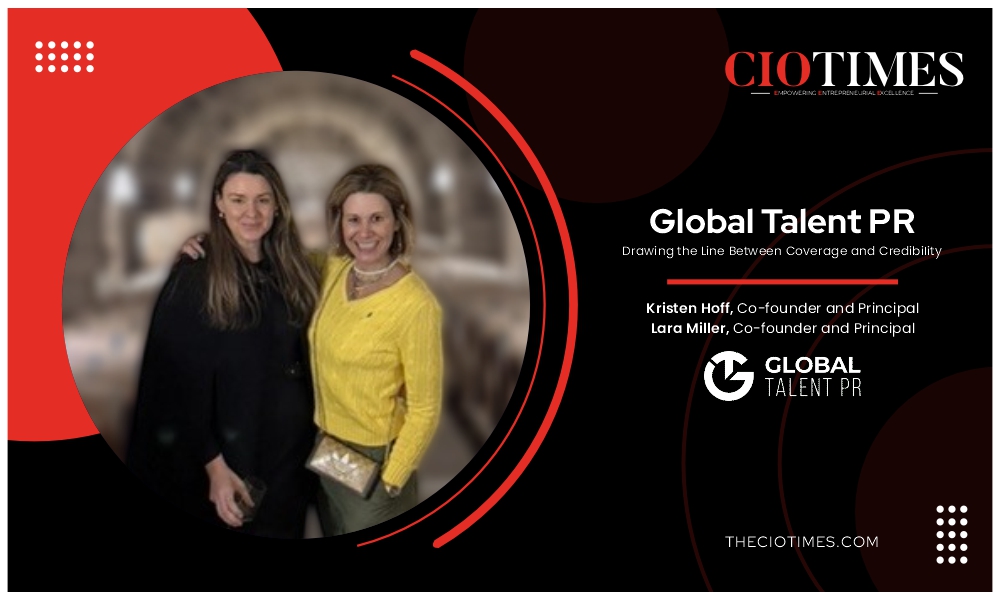
Lara Miller: Trust Over Influence
Those principles are not abstractions handed down from the top. They show up in how the firm’s own co-founders talk about their craft. Lara Miller, Co-founder and Principal at Global Talent PR, has spent more than two decades advising celebrities, founders and executives, long enough to watch one early conviction quietly give way to another. As Miller puts it, “I have become much less convinced that the most polished person in the room is necessarily the best communicator or the strongest leader.”
Earlier on, Miller admits she leaned toward polish: getting every word right, radiating certainty whether or not she felt it. What shifted, over the years, was seeing how quickly people sense when someone is being handled, ducking a hard question, hiding behind jargon, or bluffing expertise they do not actually have.
What she values now is directness: a leader willing to lay out what is actually happening, the reasoning behind a decision, and the honest boundary between what they know and what they do not know yet. That is not license to overshare or improvise.
Judgment about what to disclose still matters. The line she draws is between choosing what to share thoughtfully and trying to steer how people read a situation. “The bottom line is that the leaders who communicate best are the ones whose words consistently match their decisions and actions.”
Miller does not treat influence and trust as automatically aligned, especially in the short term. Pressure, selective information, fear, urgency, or simply telling someone what they want to hear can all move people toward a desired response, but she declines to call that good communication.
Trust often means saying the less convenient thing: that Global Talent PR cannot promise a particular outlet, that an opportunity is not the right fit for a client, or that the story someone wants told simply will not land with a journalist. Overpromising would be simpler, and might even win the client faster, but it would undercut the relationship before it even began.
Miller frames it as a real fork: leaders sometimes have to pick between managing how something lands right now and protecting the trust that has to hold over years. “My view is that trust should win. Influence built without trust is fragile. The minute people realize they were pressured, misled, or only given part of the story, the influence disappears with it.”
Being straightforward, particularly when the news is unwelcome, tends to earn more influence over time than any tactic could, simply because nobody has to wonder whether the credibility behind it is real.
Kristen Hoff: The Discipline of Restraint
Kristen Hoff, Co-founder and Principal, draws the same line from a different angle. Her answer to nearly any dilemma comes back to one fixed point: always tell the truth. Whether the client is the CEO of a public tech company, a candidate running for state senate, or an engineer at Meta, Hoff says the opening question never changes: how does the team tell this person’s story, their background, their work, their company where relevant, in a way that is genuinely authentic while still compelling to the press and the audiences reading it?
That work, in her telling, comes down to translation: taking what a person, often someone with a deeply technical background, has actually done, and rendering it in language an outside audience can follow. “The best narratives are true ones that are told well.”
Hoff is just as exacting about when not to speak. She points to live interviews, where reporters are trained to use silence itself as a tool, going quiet after an answer to see whether a source keeps talking and hands them something they did not ask for. Her guidance holds across broadcast, podcast, and written formats alike: “answer the question, then stop.”
The stakes have only grown, Hoff notes, because a four-minute answer can be chopped down to the single sentence a reporter chooses to run as the quote, and that is where people most often get themselves in trouble.
The other half of restraint, for Hoff, is comfort with not knowing. If a reporter writing about you asks something you cannot answer, she says, it is fine to admit it and offer to follow up later. On a live broadcast, “I don’t feel comfortable answering that” or “I don’t know the right answer” both work. What should never happen, in Hoff’s view, is fabrication. “An honest ‘I don’t know’ will always serve you better than a made-up answer.”
The Gap That Would Remain
Ask the team what would go unsolved if the firm disappeared tomorrow, and the answer arrives without hesitation: a PR firm that actually understands both how earned media works and how immigration officers weigh media evidence in an extraordinary-ability case.
Established agencies tend to know one half of that equation. They understand journalism, editorial standards, and the mechanics of earning coverage, but few grasp how an O-1 or EB-1A adjudicator actually reads a media exhibit.
On the opposite side sit the companies built to sell directly to immigration applicants, many of them run by people with no background in journalism, media strategy, or PR at all. Pitching an independent reporter, shaping a genuinely newsworthy angle, standing up to editorial scrutiny, or building a real relationship with the press are not part of that business model. What they are selling, in the firm’s framing, is access to publishing inventory dressed up as coverage, closer to buying an ad than earning a story.
The consequences of confusing the two run deeper than a wasted marketing budget. An extraordinary-ability petition treats media coverage as proof that people with no stake in the outcome independently judged someone’s work significant.
A stack of articles that exists only because an intermediary wrote a check can imitate that judgment without ever delivering it, and once the commercial arrangement behind a placement comes to light, it can cast doubt not just on that one exhibit but on the credibility of the petition as a whole.
That was the exact gap Global Talent PR’s founders set out to close. They arrived as working PR professionals who already understood how earned coverage gets built: finding the genuinely compelling angle in a client’s work, shaping it into a story that can withstand an editor’s questions, pitching it to journalists directly, absorbing whatever feedback comes back, and accepting that the outlet, not the agency and not the client, makes the final call. None of that reduces cleanly to a price list.
There is no outlet the firm can promise in advance and no outcome it can purchase. What it offers instead is the craft itself, the ability to build a real shot at independent editorial recognition, so that whatever coverage results carries weight beyond a byline with the client’s name in it.
The alternative persists for reasons that have little to do with serving clients well and everything to do with ease. A paid-placement operation can name the outlet up front, quote a flat fee, run pre-written copy, and hit a delivery date, with almost none of the uncertainty and very little of the actual craft that earned media demands. Clients walk away believing they purchased credibility. Frequently, what they purchased was simply a publication date.
None of that keeps the firm out of the news entirely. The firm still steps into a story when a client genuinely has something worth adding, but it treats that as incidental rather than strategic, refusing to mistake a moment of attention for a durable business.
People and organizations, in its view, will always need someone else to explain why their work matters, a need that holds steady no matter which topic happens to be trending this week. Building the firm around accuracy, editorial independence, and long-term reputational value, rather than around whatever is getting attention at the moment, is what the team treats as the actual foundation underneath the work.
Asked directly what its absence from the market would actually mean, the team keeps returning to the same clear-eyed answer, one that treats the firm’s existence as a matter of market function rather than self-promotion.
As the team puts it, “Without Global Talent PR, the unresolved gap would not merely be a lack of immigration-focused media support. It would be the lack of a firm willing and able to distinguish genuine third-party recognition from manufactured visibility.”
It is a standard the firm applies to its own work as much as to the market it critiques. “Extraordinary-ability applicants deserve more than a vendor selling them articles. They deserve experienced public relations professionals who understand editorial integrity, know how to earn credible coverage, and recognize that the consequences of getting it wrong can extend far beyond a disappointing campaign.”
Hoff and Miller are also the co-founders of SkyPR.co, a boutique firm that works with startups, and CasePR.co, a boutique firm that provides strategic public relations and expert witness services for high-stakes litigation, disputes, and reputation-sensitive matters.
Also Read :- CIO Times Magazine For More Information