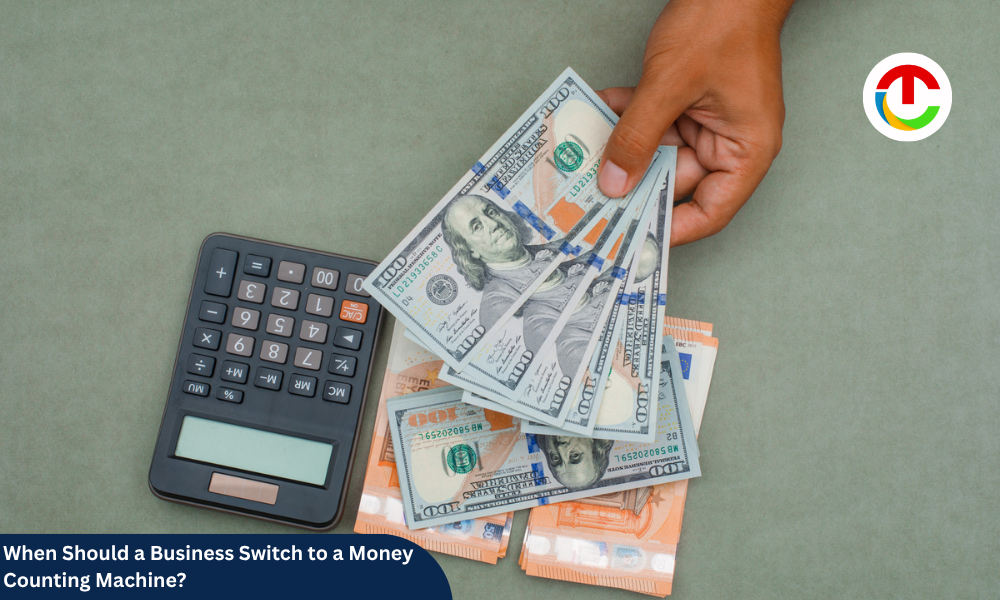
Most businesses do not decide to buy a money counting machine. They reach a point where counting cash by hand quietly costs more than the machine would. Drawers take too long to close, totals stop matching, and a manager spends the end of every shift recounting notes. Knowing when to switch to a money counting machine is about spotting that tipping point before it starts to cut into margins.
What a Money-Counting Machine Actually Does?
A money counting machine feeds a stack of notes past optical sensors and tallies them in seconds. Depending on the model, it does a good deal more than count.
Machines tend to fall into a few groups based on what they can handle:
- Basic bill counters tally the number of notes in a stack. They assume the cash is already sorted by denomination, which suits a till that empties straight from a register.
- Value or mixed counters read each note’s denomination and return a total dollar value, so an unsorted drawer can go in as-is.
- Coin counters and sorters deal with change, either totaling it or separating it by denomination.
- Two-pocket sorters divert suspect or off-sort notes into a second tray without halting the whole batch.
Alongside counting, most current machines check notes for signs of counterfeiting using ultraviolet, magnetic ink and infrared sensors, and flag anything that fails.
The Real Cost of Counting Cash by Hand
Manual counting looks free because no one buys equipment for it. The cost shows up elsewhere.
The first cost is time. What takes several minutes to half an hour by hand finishes in under a minute on a machine, and that time lands at the worst moment: the end of a shift, when staff want to leave and attention is lowest.
The second is accuracy. Human counting drifts with fatigue, interruptions and volume, and a single miscount turns end-of-day reconciliation into a hunt for the difference. When totals do not match the point-of-sale record, someone has to recount, and trust in the figure erodes.
There is also the question of whether this is a problem worth solving at all. It is, because cash has not gone away. The Federal Reserve’s2026 Findings from the Diary of Consumer Payment Choice reports that cash was the third most-used payment instrument for the sixth year running, with four in five consumers using it in the past month. For any business with a register, cash handling is a permanent operational task rather than a shrinking one.
Choosing the Right Machine and Planning for Upkeep
Once a business decides to switch, the next question is which machine fits. The right choice depends on matching capability to the actual workload rather than buying the most feature-heavy model on the shelf.
| Machine type | What it does | Best suited to |
| Basic bill counter | Counts pre-sorted notes by quantity | Small shops emptying a single register |
| Value or mixed counter | Reads denominations and returns a dollar total | Unsorted drawers, cafes, busy retail |
| Coin counter or sorter | Totals or separates change by denomination | Laundromats, vending, convenience stores |
| Two-pocket sorter | Counts and diverts suspect notes without stopping | High-volume or multi-location operations |
Whatever the model, a counter is hardware that needs routine care. Jams, sensor errors and worn feed rollers are common enough that manufacturers publish troubleshooting guides, and reading through the maintenance issues that affect Kolibri bill counters and similar machines before buying gives a realistic picture of cleaning schedules, part replacement and how long a unit lasts under heavy use.
Signs a Business Has Outgrown Counting by Hand
The switch rarely hinges on a single dramatic moment. It shows up as the same friction repeating at cash-up. A handful of signals tend to appear together:
- The daily count regularly runs past 10 to 15 minutes or ties up a manager who should be on the floor.
- Until discrepancies become routine rather than rare, staff must recount the same drawer two or three times before anyone trusts the number.
- Cash volume has grown to the point where notes are counted in stacks, not handfuls, across multiple drawers or locations.
- Change is piling up, and coins are being sorted by hand more than once a week.
- Staff handle cash fast during busy periods and no longer have time to inspect notes for authenticity.
- The business is opening a second location or adding shifts, so the counting burden is about to multiply.
None of these means the current routine has failed. It means the task has become too repetitive and too high-volume to rely on people alone, especially when accuracy matters and staff time is already stretched.
Counterfeit Detection and Cash Accountability
Two risks push cash-heavy businesses towards a machine faster than time savings alone: fake notes and internal loss.
Counterfeit detection built into a counter checks each note as it feeds, which is more reliable than a rushed visual glance mid-rush. It does not replace staff judgement. The U.S. Currency Education Program, run by the Federal Reserve, publishes a cashier’s guide to authenticating genuine notes by their security features, and pairing that training with a machine’s ultraviolet, magnetic and infrared checks covers far more than either does on its own.
The second risk is quieter. When every drawer runs through the same device and produces a logged total, discrepancies become visible and harder to write off, which supports accountability and discourages internal theft. That matters more than it sounds. In its 2023 National Retail Security Survey, the National Retail Federation put total retail shrink at $112.1 billion, with internal and external theft accounting for roughly two-thirds of it and process errors making up much of the rest. Consistent, machine-generated counts reduce both.
Does the ROI Actually Add Up?
The math on a money counter is simpler than most equipment decisions. The main input is staff time. As with evaluating business software, the real question is whether recovered time and fewer errors outweigh the purchase price.
A store where cash-up takes 30 minutes a day, six days a week, spends roughly 150 hours a year on it for a single person, and more once a second staffer is pulled in to verify the total. Against that, an entry-level bill counter costs around $100, and a mixed-denomination model with counterfeit detection runs a few hundred. Even a mid-range unit tends to pay for itself inside the first year on recovered labor alone.
With rising operating costs squeezing margins, those recovered hours are not a rounding error. They are staff times that can go to customers, stock, or simply closing the store faster.
The harder-to-quantify returns sit on top of that: fewer reconciliation disputes, faster closes, and counterfeits caught before they cost anything. For a business already showing several of the signs above, the question is usually not whether a machine pays off but how much it has cost to wait.
Frequently Asked Questions
1. When should a business switch to a money counting machine?
The right time is when counting cash by hand starts costing effort, accuracy, or staff attention every day. Recurring till discrepancies, counts that take more than 10 to 15 minutes, and managers being pulled off the floor to recount are the clearest signals. A single bad count is normal; a repeating pattern is the real trigger.
2. Is a money counting machine worth it for a small business?
For most cash-handling small businesses, yes. Even an entry-level model recovers enough staff time within a year to cover its cost, and it reduces reconciliation errors at the same time. The value scales with how much cash the business handles and how often totals need to match a point-of-sale record.
3. How much does a money-counting machine cost?
A basic bill counter typically starts around $100. Mixed-denomination counters with counterfeit detection run a few hundred dollars, while high-volume two-pocket sorters can reach the low thousands. The right price depends on cash volume and whether the machine needs to read denominations or just count notes.
4. What is the difference between a bill counter and a value counter?
A basic bill counter tallies how many notes are in a stack and assumes they are already sorted by denomination. A value or mixed counter reads each note’s denomination and returns a total dollar amount, so an unsorted drawer can go in directly. Value counters cost more but save the sorting step.
5. Can a money-counting machine detect counterfeit notes?
Most modern machines include counterfeit detection using ultraviolet, magnetic ink and infrared sensors and divert or flag notes that fail. This is more consistent than a rushed manual check during busy periods. It works best alongside basic staff training on genuine currency security features.
6. How much time does a money-counting machine save?
A task that takes several minutes to half an hour by hand usually finishes in under a minute on a machine. Across a full year of daily counts, that adds up to well over 100 hours for a single staff member. The saving is largest at closing time, when speed and accuracy matter most.
7. Does a business need a coin counter as well as a bill counter?
Only if the business handles a significant cash volume. Laundromats, vending operators, cafes and convenience stores that sort coins by hand more than once a week usually benefit from a coin counter or sorter. Businesses whose cash is mostly notes rarely need one.
8. Are money-counting machines accurate?
Yes, and they hold that accuracy across large volumes where human counting drifts. Miscounts on a well-maintained machine are rare and usually trace back to dirty sensors or worn rollers rather than the counting logic. Regular cleaning keeps accuracy consistent.
9. How long does a money counting machine last?
With routine cleaning and occasional part replacement, a quality machine commonly lasts several years of daily use. Lifespan depends heavily on volume and maintenance. Machines needing frequent repairs, or older than roughly 8 to 10 years under heavy use, are usually due for replacement.
10. Do money-counting machines require maintenance?
They do. Regular cleaning of the hopper, feed track and optical sensors prevents the most common problems, and feed rollers wear out over time and need replacing. A simple weekly cleaning routine during heavy use prevents most jams and sensor errors before they start.
Conclusion
The decision to switch is less about the machine and more about the routine around it. When counting by hand starts costing time, accuracy and floor presence every day, a counter stops being a nice-to-have and becomes the cheaper option. For most cash-handling businesses, the signal to move is not one bad count but the steady pattern of small ones. Reading those signs early turns a reactive purchase into a planned upgrade that pays for itself quickly.
Also Read :- How Can Entrepreneurs Prepare for Life After Selling Their Business?