Technological progress is moving at a pace that often outstrips the systems designed to govern it. As new tools reshape industries, they also introduce layers of uncertainty that demand careful interpretation and steady judgment. In this environment, the role of legal insight has grown more nuanced, requiring a balance between innovation, risk, and responsibility.
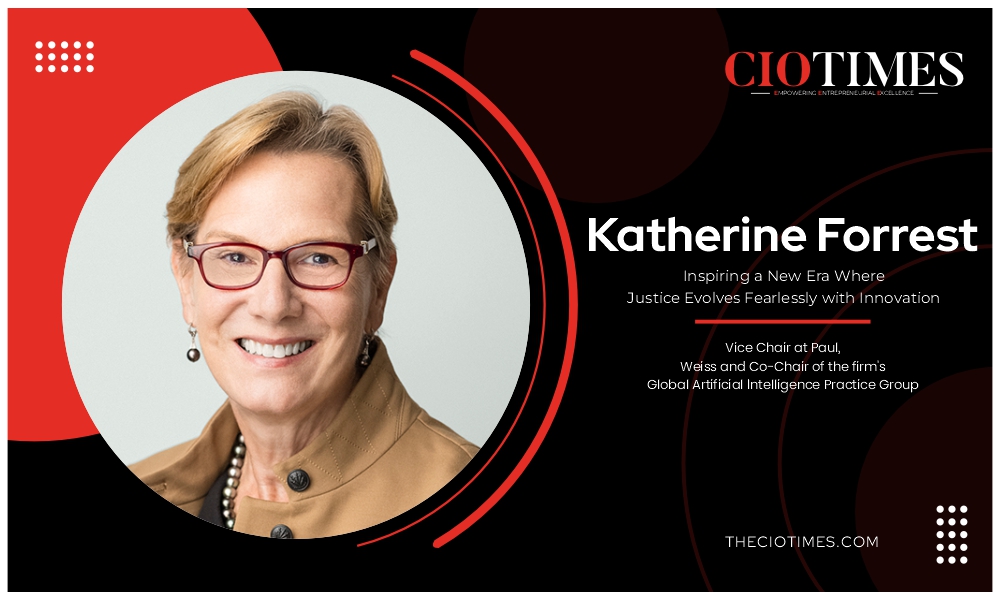
Katherine Forrest stands at the intersection of law and advanced technology. As Vice Chair at Paul, Weiss and Co-Chair of the firm’s Global Artificial Intelligence Practice Group, she plays a central role in advising clients on some of the most pressing issues in artificial intelligence, digital assets, and emerging technologies. Her work focuses on helping organizations understand risk, respond to regulatory shifts, and approach innovation with careful structure.
Her perspective is shaped by a distinguished public service background. Nominated by President Barack Obama and confirmed by the United States Senate, she served as a United States District Judge for the Southern District of New York. During her time on the bench, she presided over thousands of cases and contributed to the Judicial Patent Task Force. This experience informs her approach today, bringing a measured and disciplined view to complex legal challenges.
Before her judicial role, she held a leadership position within the Department of Justice Antitrust Division. That experience continues to influence her work in high-level investigations involving agencies such as the DOJ and FTC, as well as international regulators. Her practice now spans litigation, advisory work, and strategic counsel across areas that demand both technical understanding and legal precision.
Katherine Forrest’s contributions extend beyond her client work. She is the author of books focused on artificial intelligence and hosts an award-winning podcast that explores its broader impact. Her voice reflects a consistent effort to make complex ideas more accessible while maintaining depth and accuracy.
Her recognition across leading industry publications reflects the breadth of her influence. Rankings from Chambers, honors from Benchmark Litigation, and acknowledgment from the Financial Times and The New York Law Journal highlight a career defined by both expertise and consistency. Through each role, her work continues to address the growing need for clarity in an increasingly complex digital world.
Judicial Reflections
Katherine Forrest sheds light on her journey through private practice, the Department of Justice, and the federal bench. These are the most powerful vantage points in the law. She stresses that she has had quite a few key moments in her career. She sees her 2011 nomination to the federal bench as a culmination of years of preparation. Serving as a federal judge, she shares, is one of the highest honours in the profession and also a deeply humbling responsibility. The weight of decision-making at that level is profound, as it can directly determine someone’s liberty.
Legal Northstar
Katherine Forrest reflects on how, in AI, technology is accelerating faster than the law, often leaving clients seeking clear answers in areas where the rules are still forming. She explains that the common law has always been adaptable, evolving through earlier technological shifts like the internet.
She views AI in the same light, with current disputes often centered on copyright, patents, trade secrets, and rights of publicity. The guiding principle remains simple for her: return to these foundational legal principles and build outward from there.
Heavy Responsibility
Katherine Forrest , when asked about how she carries the weight of matters that extend far beyond the courtroom and still manages not to let them follow her home at night, says that there is no real separation when the responsibility is that significant.
She explains that both as a practitioner and as a judge, many decisions stayed with her long after the day ended.
She shares, “As a judge, making a decision as to whether or not an individual would spend additional time in prison was not easy; it is a judgment that one cannot just dispense with when switching off the light in the evening.”
Such decisions were never easy to set aside. It is both natural and appropriate that such responsibility carries emotional weight. In her current work in emerging AI fields like superintelligence, she finds herself thinking just as deeply about what the future may hold.
Still, she believes balance is essential, and she finds it in simple moments outdoors, like on a kayak or hiking. There, she gets a chance to reset and regain perspective.
A Dual Perspective
Katherine Forrest’s experience on both frontiers of enforcement and defense has given her a sharper understanding of complex cases rather than creating internal tension. Having worked in the Antitrust Division as an enforcer and defended numerous antitrust matters in private practice, she has learned to evaluate issues from every angle.
This dual perspective helps her identify where arguments need strengthening, what strategies are likely to succeed, and what should be set aside.
Recrafting Antitrust Technology
As antitrust enters a major cultural moment, Katherine Forrest believes much of the conversation around where competition law is headed is still being shaped by misunderstandings about technology itself. About the growing debate around algorithmic decision-making, she explains that many recent cases have treated the use of algorithms as evidence of conspiracy under Section 1 of the Sherman Act, even though these systems are often performing the same qualitative analytics that were once done manually.
She adds, “There seems to be confusion around the use of technology and whether it constitutes improper information sharing.”
Public information remains as is, whether it is analyzed through machine learning or by someone working with traditional methods.
Strategic Balance
Being a cautious advisor and a fierce litigator, she explains that both roles ultimately serve the same purpose: helping clients achieve the best possible outcome. Sometimes that means advising that the risks of trial are extremely high, but she believes a lawyer’s responsibility is to clearly present the pros, cons, and possible consequences.
She adds, “If I have advised a client on the risk scenarios and they’ve nonetheless chosen to fight through trial, then you bet that’s what we do, and we do it to win.”
Even in cases where she may have recommended a settlement, if the client chooses to fight through trial, Katherine Forrest commits fully to the battle. She develops the strongest strategy, preparing the sharpest cross-examinations, and fighting relentlessly to win.
Perspective Across Benches
Moving back into private practice after a decade of public service gave her a new perspective on how the profession had evolved during her time away.
She noticed that the legal world had become far more business-driven, while even routine negotiations often felt more intense and adversarial than she remembered from earlier in her career. At the same time, viewing the profession from both the judge’s chair and private practice gave her a deeper appreciation for the way lawyers present arguments and conduct themselves.
Katherine Forrest states, “I have found the majority of lawyers attempt to conduct themselves graciously and without unnecessary rancor towards their adversaries.”
Legal Analytics
Through her experience as a professor at NYU School of Law, she realized many law students had never been exposed to the powerful role data can play in shaping stronger and more comprehensive legal arguments.
She explains that, when used effectively, data can often demonstrate patterns and defend long-term practices in ways a single witness simply cannot. While she acknowledges that personal narratives and emotional testimony still hold immense value in the courtroom, she believes there is no substitute for understanding how large data sets can answer complex questions with greater breadth and clarity.
Many of her students, she notes, admitted they had encountered very little quantitative analysis elsewhere in their legal education.
She shares, “The legal world is not so much allergic to data as unfamiliar with its possibilities.”
Given the opportunity, she believes every law school should equip future lawyers with these skills in an era increasingly shaped by large-scale data.
Adapting Through Change
The speed of technological change is immense. Upon keeping up with this speed, Katherine says, the legal system is quick enough. She also acknowledges that the speed of innovation continues to accelerate, and she is confident in the adaptability of the common law system.
Katherine Forrest believes the law has consistently evolved through centuries of technological, political, and social change. From the country’s founding through 2026, it has repeatedly adjusted to new challenges. This history proves the legal system is more resilient than many assume.
Timely Justice Matters
Katherine Forrest has a belief that is rooted in both criminal and civil law: justice delayed is justice denied. Delays in the legal system carry real human consequences.
Katherine Forrest asserts, “For a civil litigant who has a wrong that should be addressed and needs to be addressed, waiting years for a court to consider a claim can result in hardships felt not only by the parties to the dispute but by their families, businesses, and communities.”
Delivering timely justice remains one of the profession’s greatest responsibilities.
Also Read :- CIO Times Magazine For More Information