For two decades, American hospitals have run an expensive experiment in visibility. Electronic health records went in. Command centers got built. Dashboards multiplied across every floor of every health system in the country, and at the end of that investment, administrators could often watch a crisis unfold in real time without having any way to stop it.
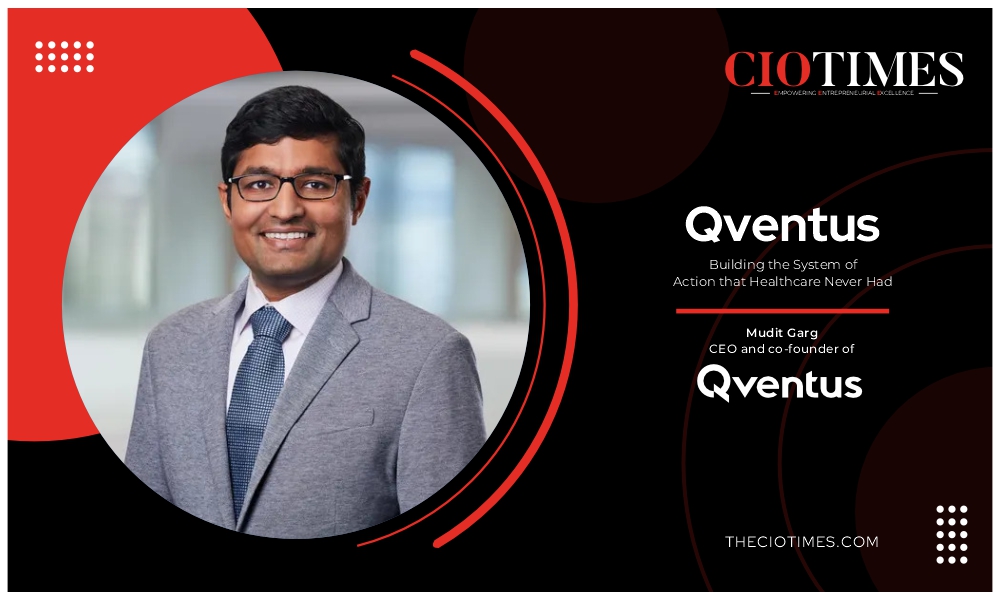
That gap between what a health system can see and what it can do is the problem Mudit Garg set out to solve. As CEO and co-founder of Qventus, . Mudit Garg as CEO And Co Founder of Qventus has spent his career arguing that healthcare’s shortfall was a lack of a system built to act on what the technology already knew.
The Missing Layer
Healthcare organizations, Mudit says, have lacked a system of action built for their systems of record. Health systems spent two decades installing EHRs, standing up command centers, and buying dashboards, and what came out of that spending was better visibility without better outcomes.
As he puts it: “You can see a bed is occupied, see a discharge is delayed, see misutilized OR time, and still have no system that acts on any of it.”
What was missing, in his account, is the layer that takes structured and unstructured data and orchestrates coordinated action across the people and workflows that actually own and move the patient journey. That is the distinction Qventus was built around. The data, Mudit argues, has largely already been there. What had not existed was the ability to automate dozens of interdependent decisions and workflows across care teams, in real time, at the scale of an entire health system.
Where Efficiency Meets the Patient?
Qventus’ mission, as Mudit frames it, is to help health systems secure the margins they need to deliver excellent care to their communities. Automated care operations sits at the center of that mission because it touches patients, staff, and the bottom line simultaneously.
Operations get measured by efficiency, but efficiency was never the whole story for Mudit, who puts it this way: “A surgical case that gets delayed from misutilized OR time isn’t just a scheduling metric. It’s a patient waiting longer for care and a surgeon unable to grow their practice as quickly as they’d like. A discharge that gets stuck isn’t just a length-of-stay number. It’s a bed a sicker patient needs and a nurse absorbing the strain of a system that isn’t keeping pace.”
That conviction shapes how Qventus builds and deploys its technology. It employs clinicians who have lived the exact workflows it is trying to fix, people who have felt the friction firsthand, and that experience changes what gets built. It also shapes deployment. Qventus partners directly with clients rather than shipping something finished and asking them to adapt to it, embedding every solution into the workflows staff are already using.
Mudit has little patience for tools that add a login or a screen to report that a task now takes twenty fewer seconds. If a solution is not embedded in how people already work, he says, it will not get used, regardless of how much time it theoretically saves.
That same logic extends to how Mudit thinks about the tradeoffs hospital leaders are told they must make between cost, capacity, clinician experience, and patient outcomes. Across Qventus’ client base, he has found that automating care operations tends to move all four at once.
Automating discharge coordination shortens length of stay, and in doing so it also returns clinician time, opens capacity for the next patient, and improves the outcome for the patient already in the bed. The health systems that see compounding results, rather than resetting with every new initiative, are the ones treating automated care operations as the layer that addresses all four objectives together, a harder problem to solve than any single initiative, which is why it has been underinvested in for so long.
The Hardest Mile
Mudit thinks about the boundary between automation and human judgment the way autonomous vehicle companies think about the hardest mile of driving. Getting a car around a controlled track, he notes, has been solvable for a decade. “The real breakthrough came from handling the edge cases, the unmapped construction zone, the pedestrian who steps out unexpectedly, where surface-level automation falls apart and genuine understanding becomes non-negotiable.”
Healthcare, in his view, has the same shape of problem. Automating a reminder call is easy. Automating a decision that reconciles labs across vendors, reads clinical notes, and knows when to escalate to a person requires real depth, not a thin layer of AI laid over an old workflow. Health systems that adopt solutions capable of orchestrating entire workflows end to end, rather than automating individual tasks, will see the value compound over time, he says.
There is a human dimension to this as well. Mudit points to how much of healthcare today runs on staff working well below their license. A pre-admission testing nurse sitting on hold with a cardiologist’s office to track down patient records is not why she went to nursing school, he says. Automating that kind of below-license work frees care teams to do the work they were actually trained for, and to spend more time with patients.
What the Industry Underestimates?
Software alone does not create lasting change, and Mudit is candid about how often the industry misjudges what does. Qventus’ own research this year found that nearly nine in ten health system leaders point to tech fatigue, staff exhausted by learning new systems before seeing any tangible value, as a real barrier to AI adoption, he says.
What the industry underestimates, in his assessment, is that a new system asks something of every person whose workflow it touches: a nurse, a case manager, a scheduler, a surgeon. If that ask is not clearly smaller than the burden it removes, adoption stalls regardless of how good the underlying intelligence is.
The same research found that only about six in ten health systems currently involve clinicians in defining what success looks like, and just over half are tracking clinician burnout and satisfaction before and after rollout, according to Mudit. Skip those steps, he says, and a system can hit every accuracy benchmark and still go unused. One CMIO he spoke with, Mudit says, put it plainly: “there’s still real hesitation about fully autonomous processes, and it isn’t a technology problem so much as a change management one.”
That is why every Qventus rollout involves people who understand the actual workflow being automated, designed so the right action is the easiest one for a busy clinician to take. What transforms a hospital, in Mudit’s view, is a system that people trust enough to build new habits around, and that trust has to be earned deliberately, at the level of individual workflows, one care team at a time.
Earning Trust, Escaping the Pilot
Competitive advantage in healthcare AI, Mudit argues, no longer comes from algorithms alone. It comes from trust, and trust in healthcare AI has to be earned through evidence a health system’s own leadership can verify, he says: “Anyone can build a good demo with AI right now. Operationalizing it inside a real hospital’s workflows is ten times harder, and that’s where trust gets won.” Qventus was built around guaranteeing and then delivering outcomes well beyond the pilot. Clients see an average of 11x ROI, according to Mudit, and the company holds every deployment to that bar.
What earns that trust and keeps it, in his telling, is also the people behind the technology. Qventus’ team stays in the trenches with clients day in and day out, tuning solutions to specific problems, which Mudit says is why 100 percent of the company’s clients describe Qventus as part of their long-term plans. That kind of trust compounds, giving clients the confidence to expand enterprise-wide.
One shift reshaped how Mudit thinks about the company he is building. Health system executives began describing Qventus back to him as one of the critical parts of their tech stack: the layer that alleviates administrative burden on staff, drives strategic surgical growth, increases inpatient capacity, cuts preventable surgical cancellations, and catches diagnoses that would otherwise go unnoticed. That, to him, is the job of an enterprise-wide platform that orchestrates entire workflows, not a set of point solutions that send notifications without taking action.
The organizations that actually transform, in Mudit’s experience, hold vendors to a short proof point. Health systems typically reach break-even within two to three months of go-live, he says, and they build on a platform rather than a shelf of point solutions, so each new capability strengthens the ones already in place. The rest, he argues, comes down to leadership and partnership.
When an executive sponsor owns the timeline and clears the organizational barriers to adoption, technology moves out of the pilot phase. Left to a single champion without that backing, it stays there indefinitely. The work does not stop at go-live, either. The health systems that transform, Mudit says, are the ones who treat the vendor relationship as an ongoing partnership rather than a project that ends once the pilot is declared a success.
The Belief That Hasn’t Moved
Beyond the current excitement around generative AI, Mudit sees a structural shift ahead: automated care operations becoming its own category of infrastructure, sitting alongside the EHR, the ERP, and the cloud as a permanent part of every health system’s tech stack rather than something occasionally piloted. That is a bigger change than any single model capability, he says, because it changes how health systems budget, structure AI platform partnerships, and define what working with AI even means.
Most industry attention right now sits on generative AI’s most visible uses: documentation, summarization, conversational tools. Those are valuable, Mudit says, but they remain assistance layered on top of workflows that still require a human to close every loop manually. The real shift, in his view, is orchestration: systems that automate action across scheduling, staffing, discharge planning, and reimbursement, instead of surfacing information for someone else to act on.
That shift matters more, Mudit argues, as resilience displaces efficiency as the defining goal for health systems navigating workforce shortages and unpredictable demand. A strategy built purely around squeezing efficiency out of a fixed process breaks the moment volume spikes or staff call out, because it was never designed to flex.
Operations should be able to absorb variability by reallocating resources and automating and predicting things like discharge dates and open OR time accurately, he says. Facing today’s workforce shortages and demand volatility, health systems should focus on building the operational layer that lets a leaner team spend more time on work suited to their license and deliver better patient care more quickly, he says.
Through all of it, one belief has stayed constant, he says: “Our mission has always been helping health systems secure the margins to deliver excellent care to their community.” It is why, he says, Qventus has never built point solutions that optimize a single step in isolation. A faster piece of a broken process, in his words, is still broken.
Healthcare, Mudit says, has absorbed a lot of technology promises that did not survive contact with a real hospital floor. When asked what he hopes Qventus is remembered for a decade from now, he points past the technology itself, to a shift in category: the moment health systems stopped treating AI as a pilot project and started treating automated care operations as foundational infrastructure, the same way the EHR became foundational a generation earlier.
“I’d want Qventus named among the organizations that made that shift feel inevitable rather than aspirational,” he concludes.
Also Read :- CIO Times Magazine For More Information